
Back in February 2020, Air New Zealand unveiled plans for Skynest, a lie-flat product for Economy Class travellers. This grabbed headlines everywhere, and understandably so. While First and Business Class continue to set new highs for luxury, Economy Class has remained, well, Economy Class.
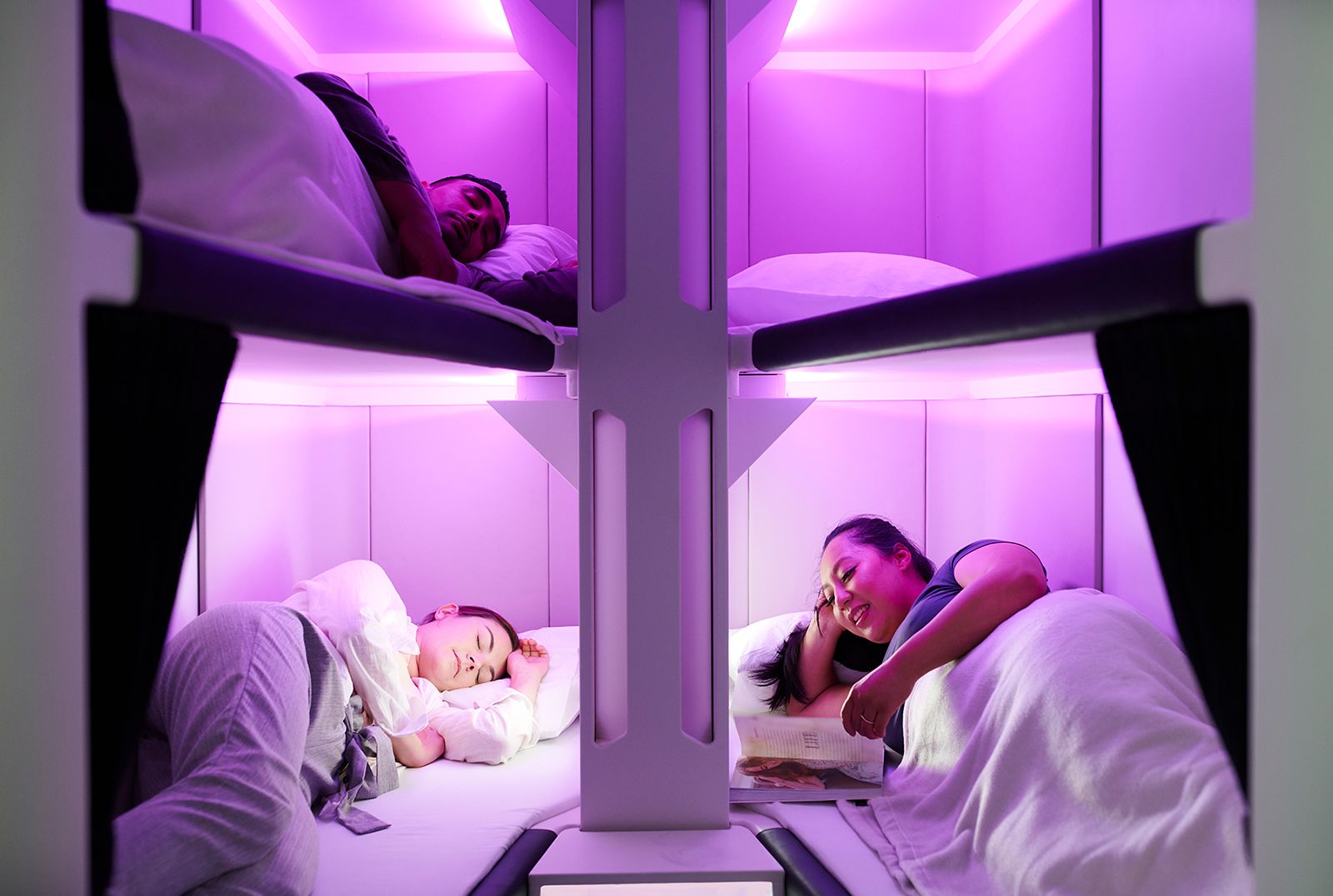
Unfortunately, COVID hit soon after, and plans for Skynest were shelved. The concept resurfaced in May 2023, but promises of a 2024 launch failed to materialise, and many wondered if it was nothing more than vapourware.
Well, Skynest may never go mainstream, but at least it’s making the leap to the real world. Air New Zealand has now locked in a date for Skynest’s debut, with the bunk beds going on sale from 18 May 2026 on the Auckland to New York route, for travel from November 2026 onwards.
Air New Zealand’s Skynest launch plans
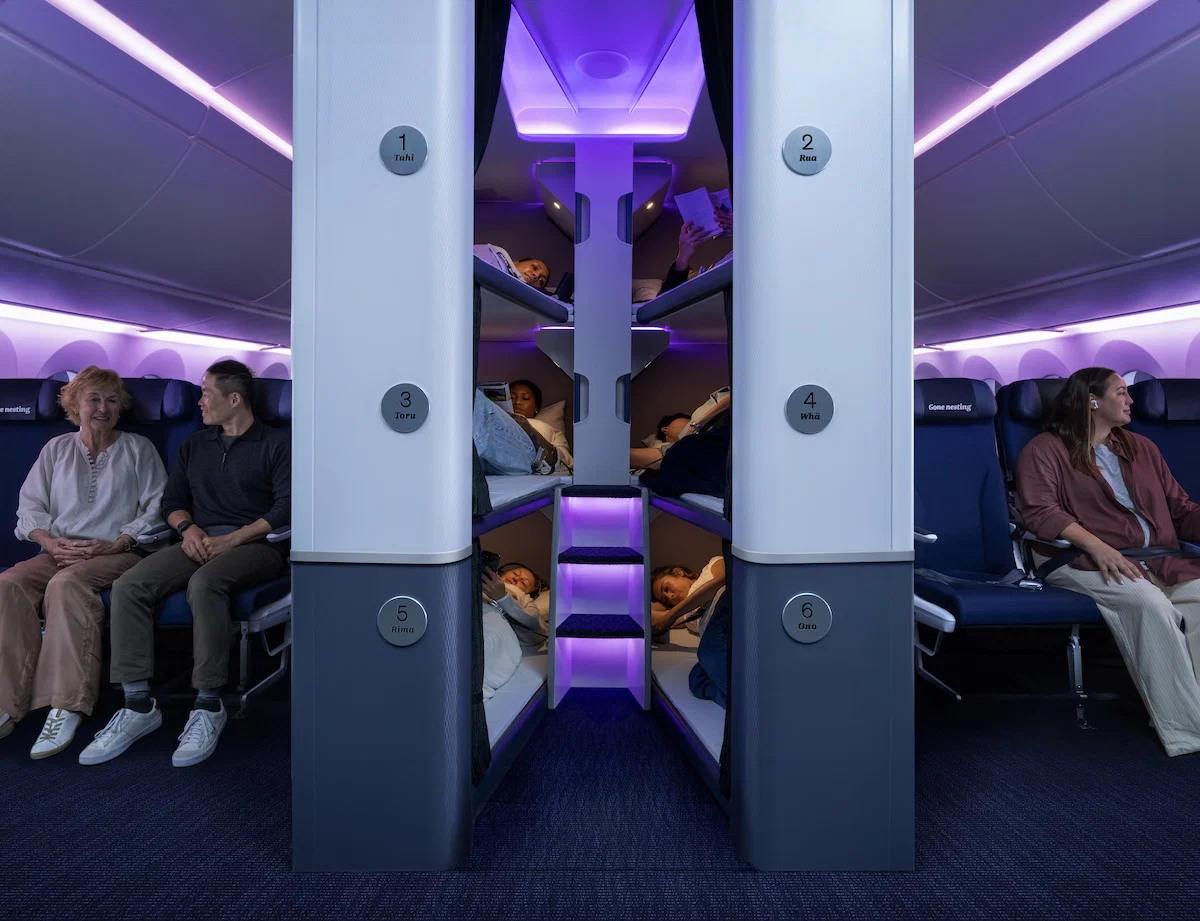
Skynest will initially be available on select ultra long-haul flights on the Boeing 787-9 between New York and Auckland (“select”, because with just a single aircraft fitted with the product, it won’t be possible to offer daily service).
Skynest will sit between Premium Economy and Economy, occupying the space that would otherwise be allocated to six Economy Class seats. Passengers in Premium Economy and Economy will be able to book a single four-hour session, planned outside meal services. While the New York to Auckland route is long enough to accommodate three sessions, Air New Zealand will initially be selling two sessions per flight.
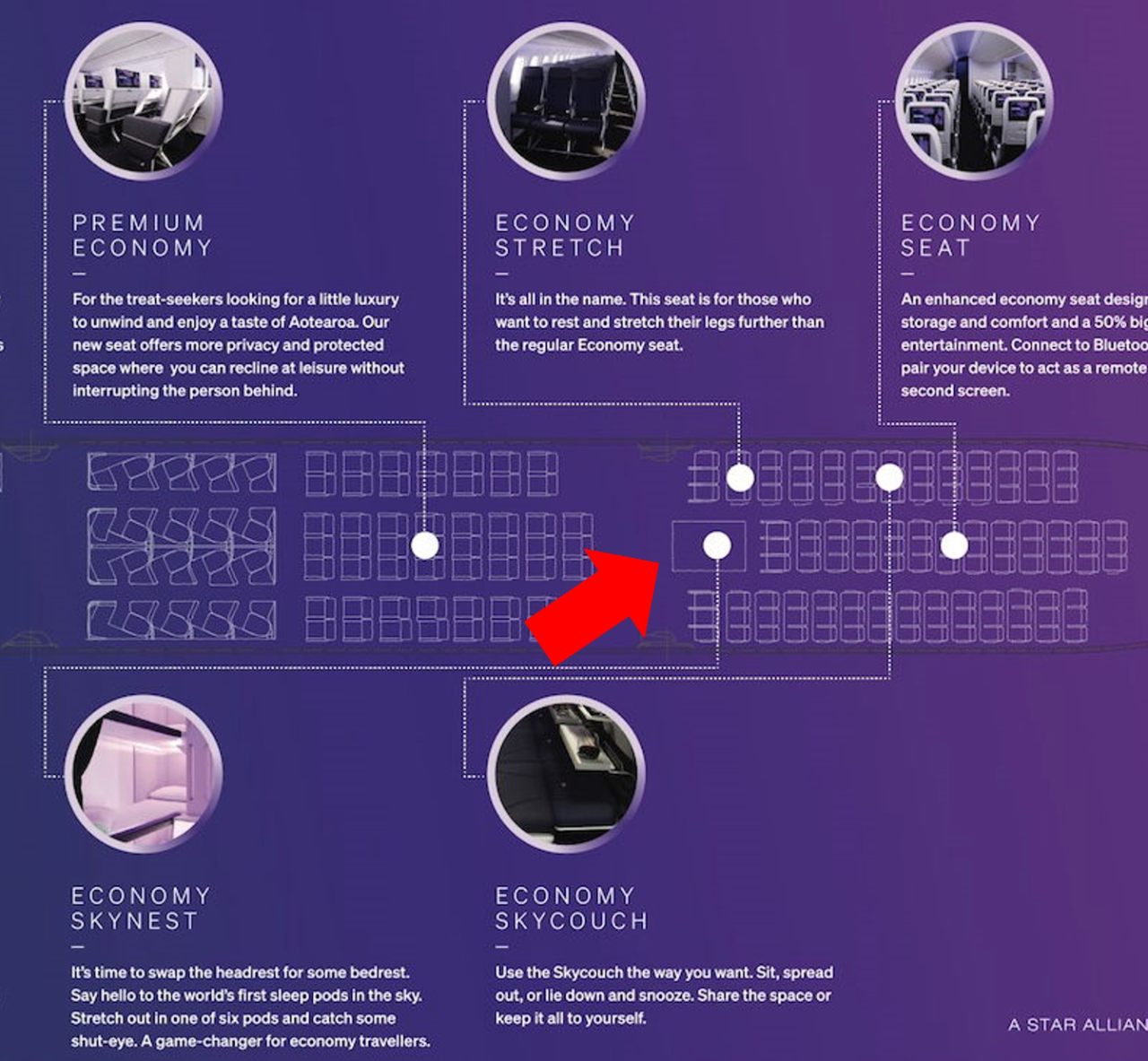
Pods will be cleaned and refreshed in 30-minute intervals between sessions, and before you ask, there’s a limit of one person per bunk, so joining the mile high club is somewhat inadvisable.
Here’s how Air New Zealand describes the process flow.
|
The first Skynest session (Session A) will take place after the first meal service, and run for four hours. The second session (Session B) will begin once cabin crew have changed the bedding in the nests, and run for four hours. After the second session has ended, the second meal service will commence. Skynest sessions are planned outside of meal times, so you’ll be able to eat before or after your session. We’ll let you know when it’s almost time for your session to start so you can get ready. You’ll receive a reminder on your inflight entertainment screen:
If you happen to miss the notifications, our cabin crew will come get you. Nest lights will gently illuminate around 5 minutes before the end of your session. There’s no need to set an alarm, our crew will be around to notify you if you miss the signal. -Air New Zealand |
Other house rules of Skynest include:
- Shoes off, socks on
- No snacks allowed, or any drinks besides water
- All entertainment must be used with headphones (it’s sad this needs to be put down explicitly)
- Turn devices to silent mode
It’s also worth noting that Skynest will only be available to passengers aged 15 and older (those with younger kids might want to consider Skycouch instead; see below).
If you’re travelling with a child aged 12 years and below, that child must be accompanied in the cabin at all times by a passenger 15 years or older. Therefore, a single traveller with a child aged 12 years and below won’t be able to book Skynest for themselves.
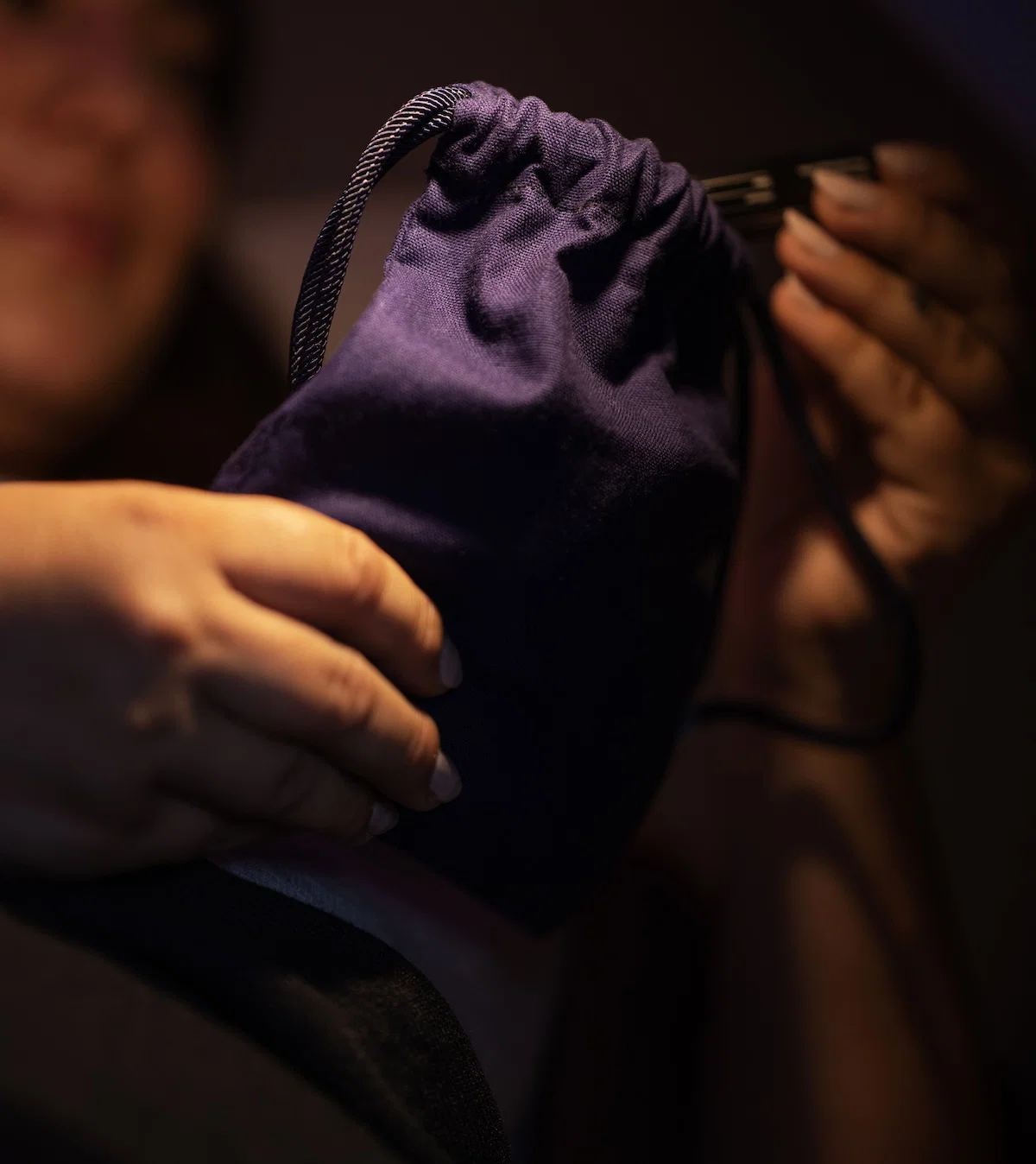
Skynest does not have any inflight entertainment installed (nor should it — who wants the light pollution?) but passengers can BYO devices or books and make use of the USB-C charging outlet and reading light. Passengers will also receive a full-size pillow, sheets, blanket and an amenity kit with Aotea skincare products.
How much will Skynest cost?
Skynest will start from NZ$495 (~S$370) per session, which works out to approximately S$92.50 per hour of sleep.
I think that’s cheap enough for passengers to bite, though remember, it is on top of whatever you’ve paid for your Premium Economy or Economy Class ticket already.
Common sense would tell you that not all four-hour blocks are equal. I imagine the first block would be especially popular, particularly for red-eye departures, and I expect we’ll eventually see differentiated pricing depending on time slot and maybe even bunk location.
What is Skynest?
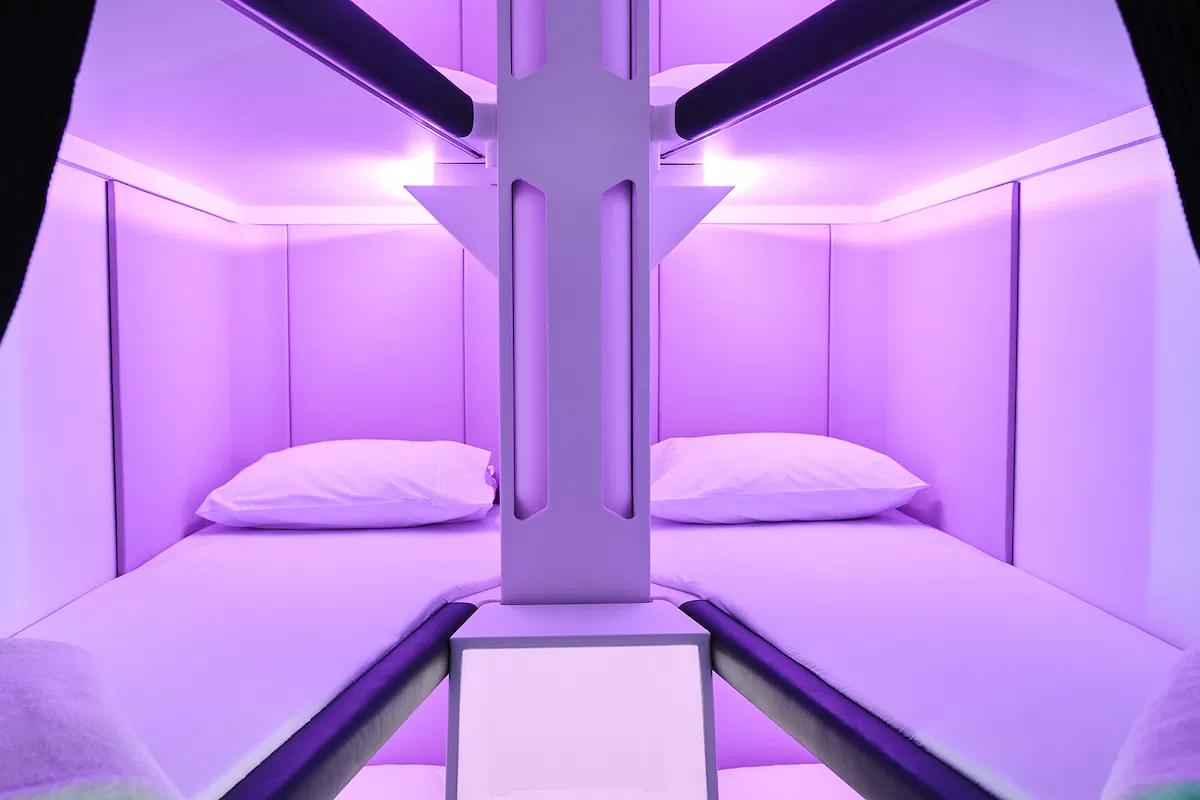
Skynest is a pod of six bunk beds, fitted in a three-level capsule located between the Premium Economy and Economy cabins. Each bed is 2.03m long, and 58 cm wide, with an individual reading light, USB charging outlet, and ventilation nozzle.
In May 2025, on the sidelines of the media preview of Air New Zealand’s first retrofitted B787-9, I had the opportunity to try a Skynest mockup.
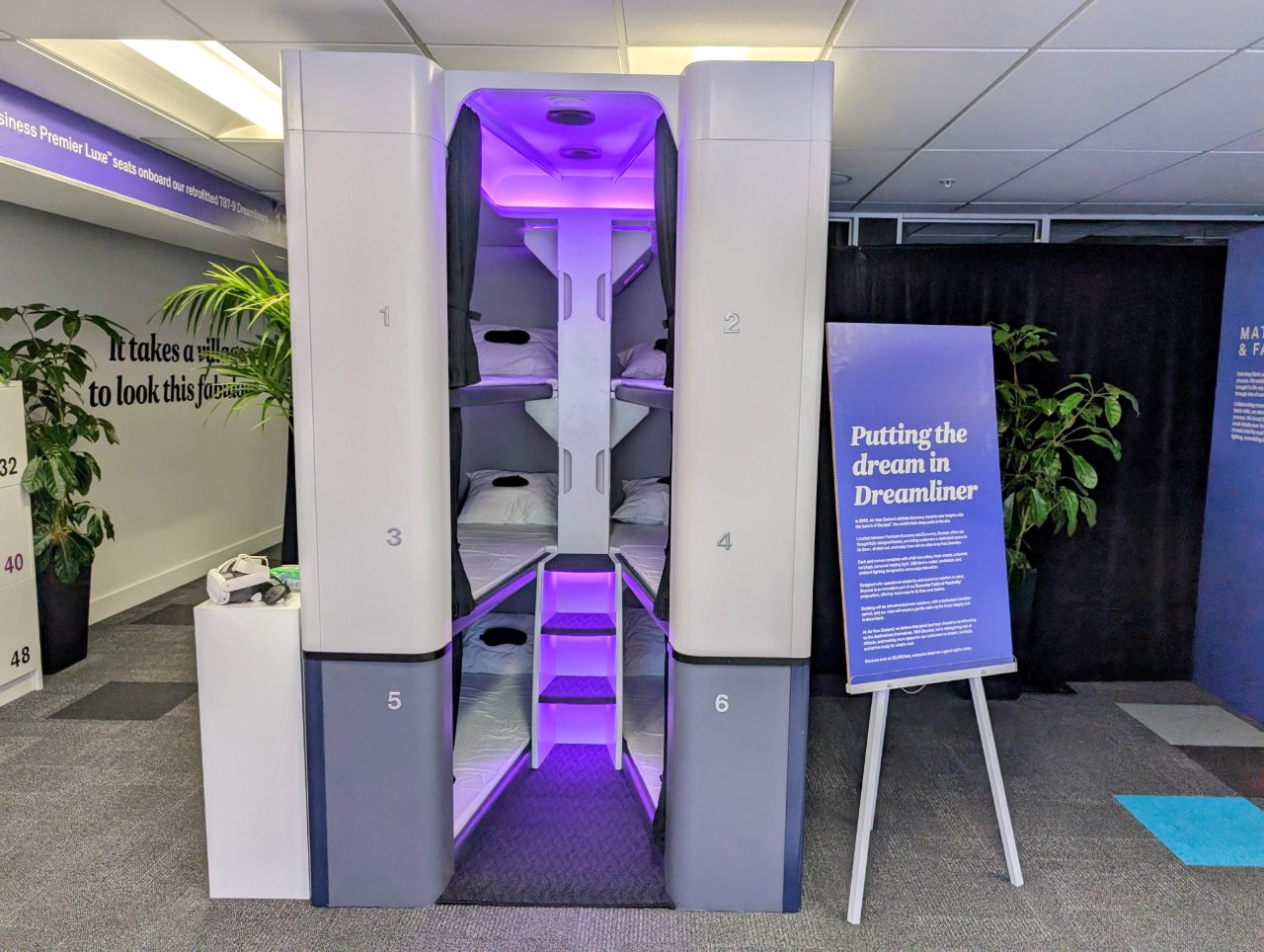
It’s a curious-looking monument to say the least, and very similar to a crew rest area. Bunks are numbered 1-6, with 1 & 2 on top, 3 & 4 in the middle and 5 & 6 at the bottom. Bunks 1 & 2 can only be accessed by climbing a short stepladder, and some upper body strength is necessary to haul yourself into place. Passengers with reduced mobility are likely to find it difficult to manoeuvre into any of the bunks, given the tight confines.
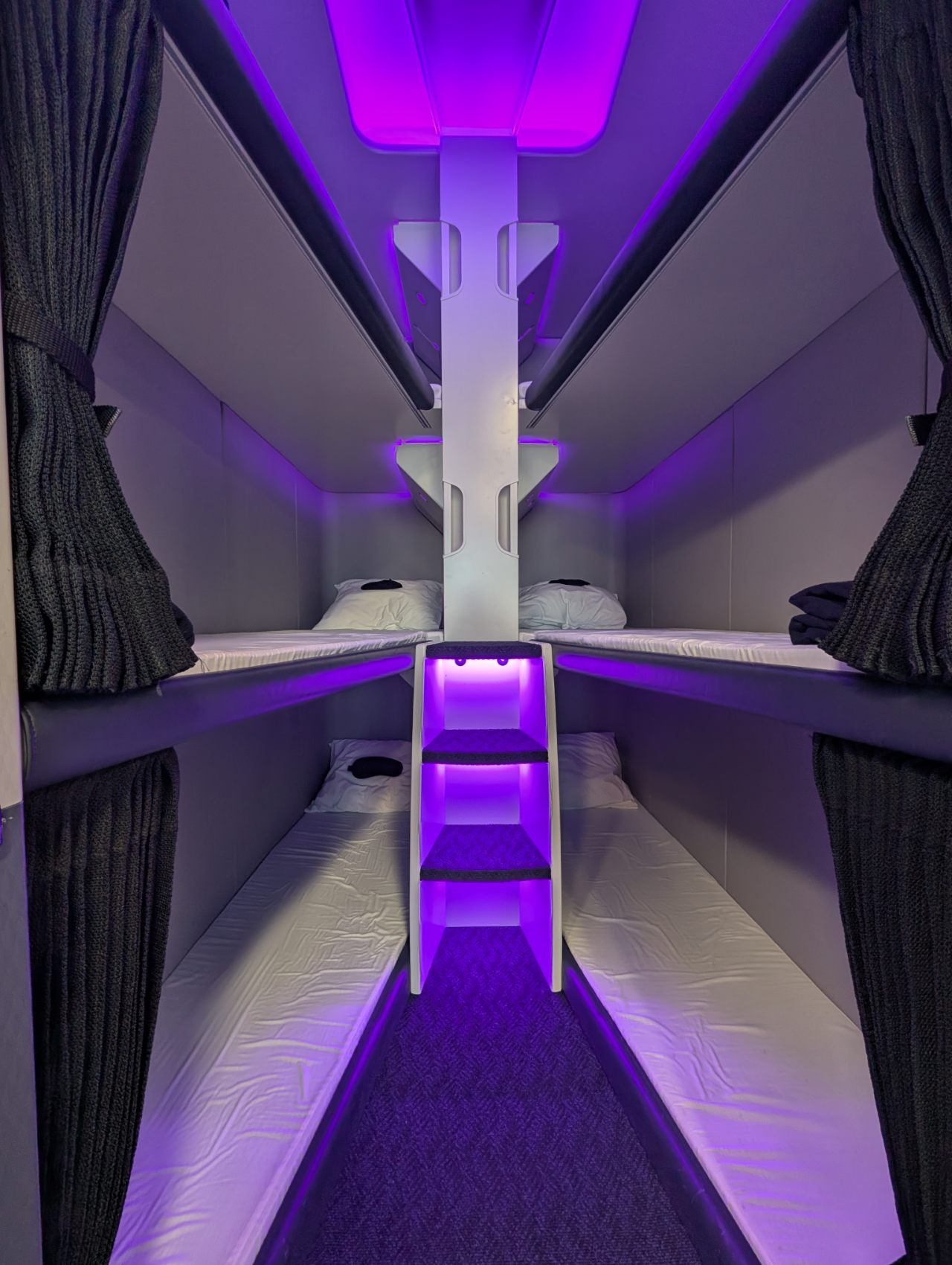
To give some height perspective, here’s me (1.8m) standing and sitting inside.
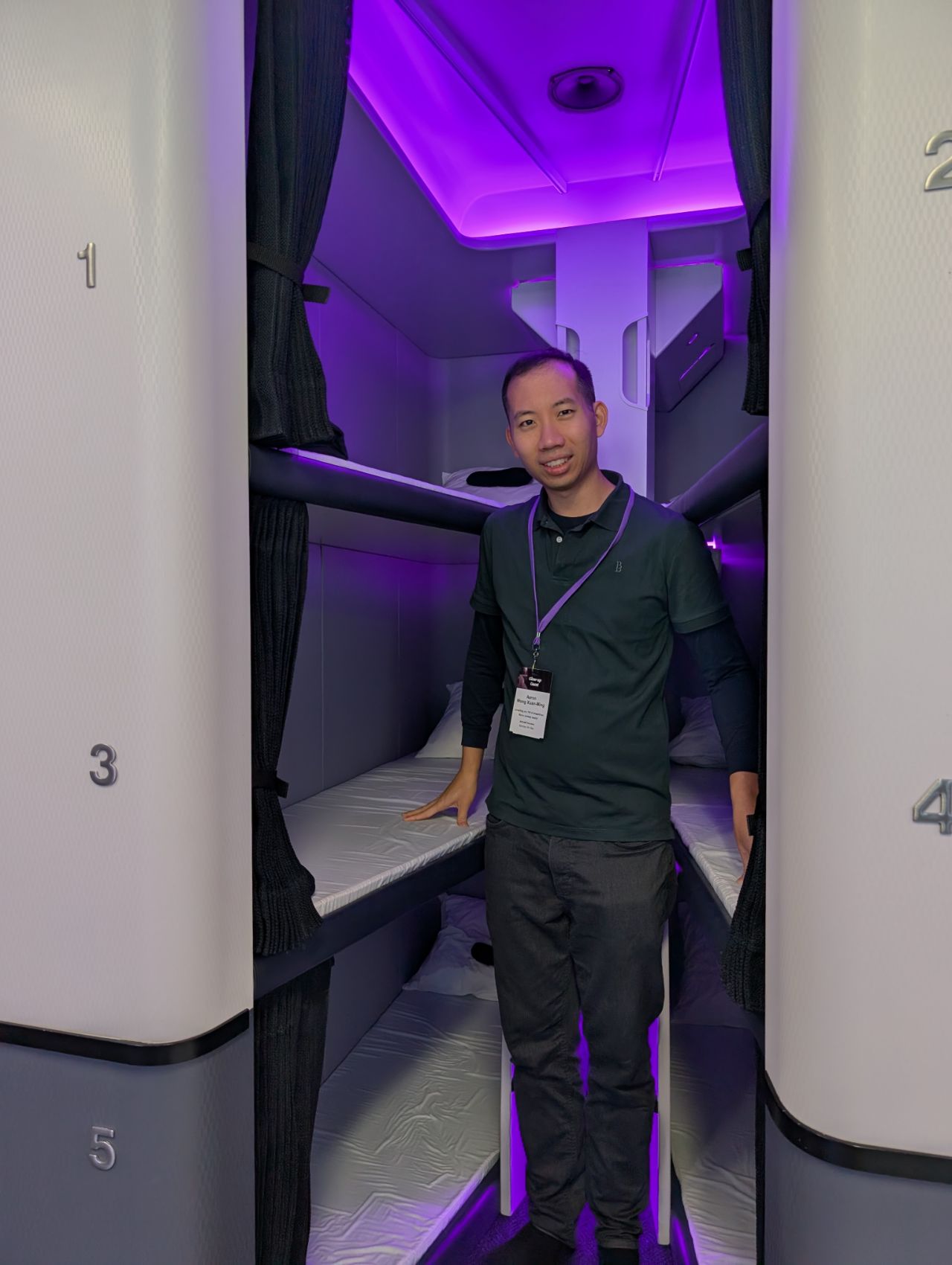
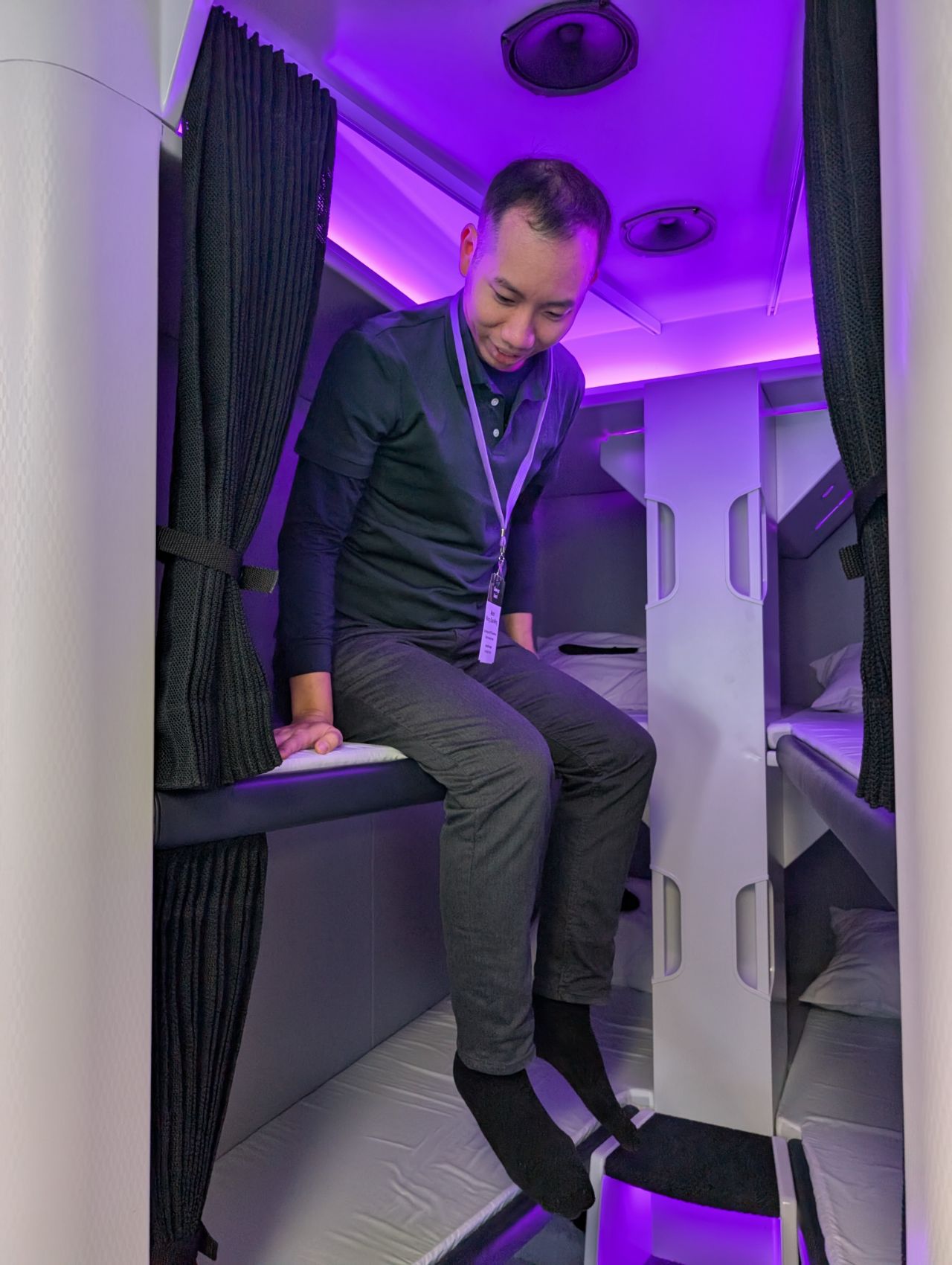
Skynest is obviously not suited for those uncomfortable with small spaces, but Josephine Teo jokes aside, the bed itself was surprisingly comfortable. While the mattress looks thin, the padding was more than adequate, and assuming you’re not podsharing with a chronic snorer, I could see having a very good rest in one of these.
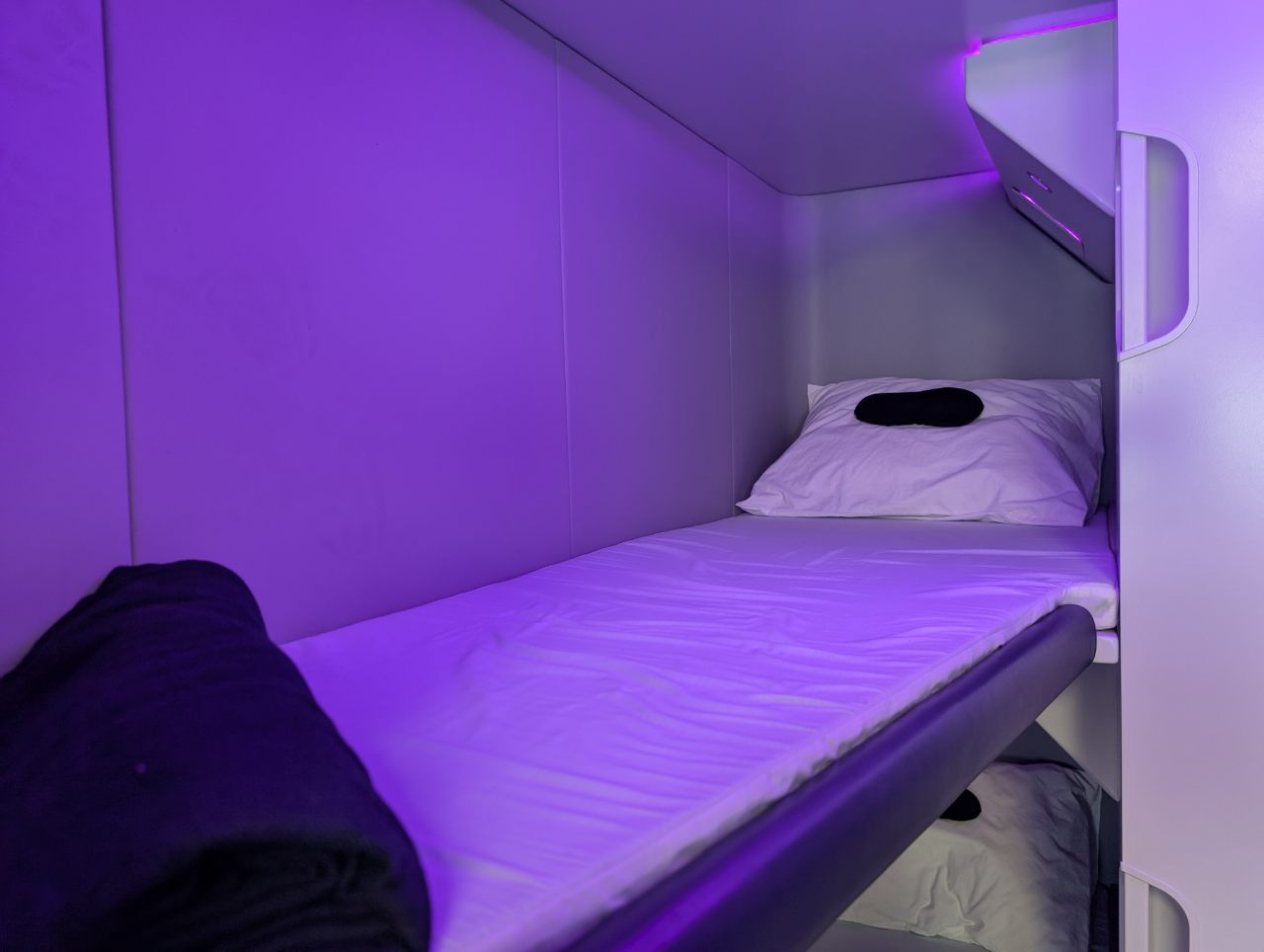
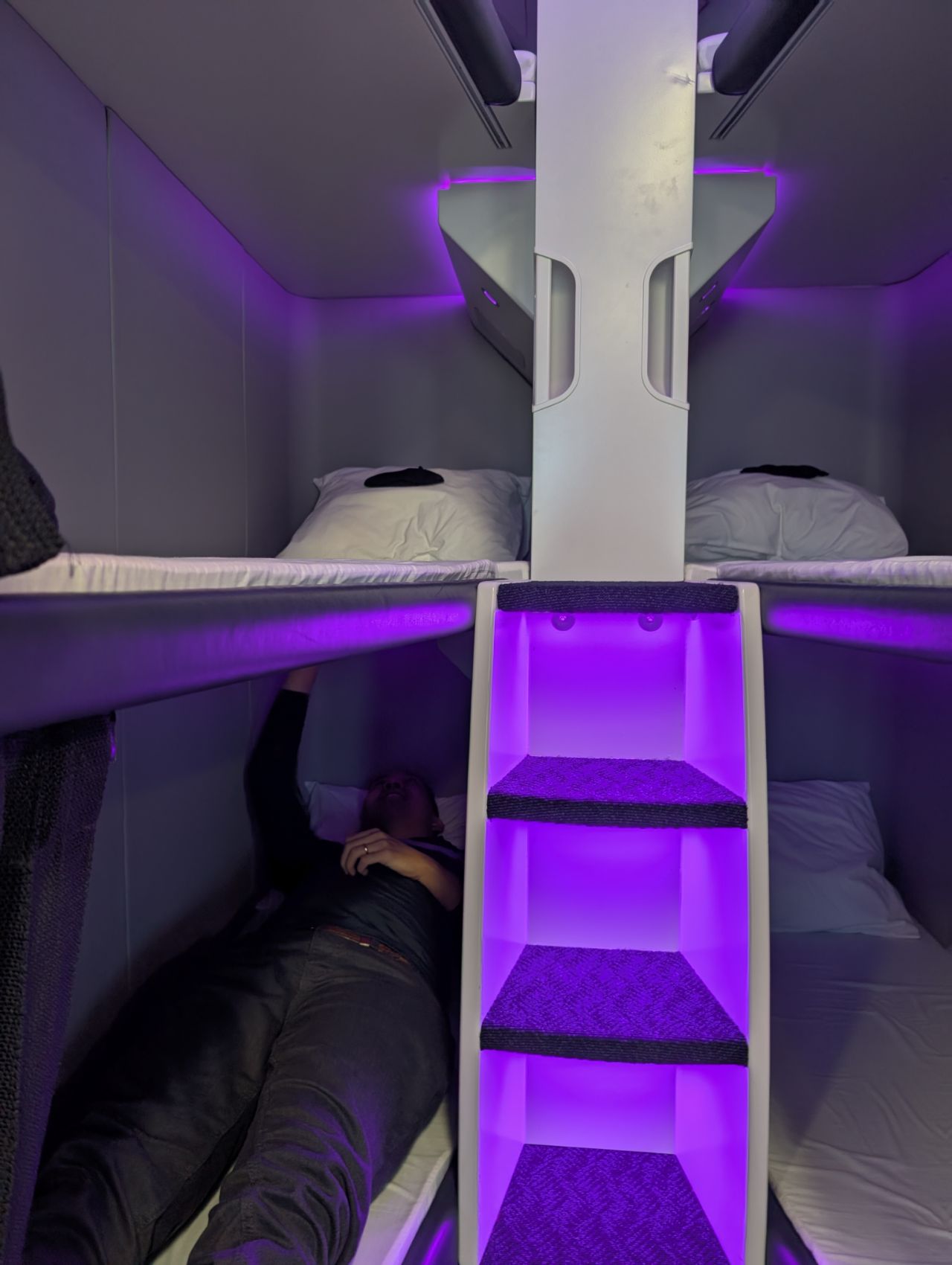
A curtain (not blackout) provides a modicum of privacy, and the mood lighting creates a sleep-inducing atmosphere. The biggest danger here would be waking up in the middle of the night, instinctively sitting up and bumping your head. I wonder if some thin padding on the underside might help, because the kiss of hard plastic is unpleasant to rouse to.
There’s also the human factor to consider, and Air New Zealand will need to consider the possibility of anti-social behaviour, such as passengers using the space to watch movies without headphones, crunching away on noisy snacks, or creeps trying to proposition other travellers (or…themselves). To that end, the airline has done up a guide on Skynest “Nestiquette”, though it could really be summed up in the phrase “don’t be a jerk”.
Skynest is an unprecedented (and commercially untested) product, so Air New Zealand is being understandably cautious with its rollout. Skynest will not be fitted on the Boeing 777s, nor on any of the 14 existing Boeing 787-9 aircraft earmarked for retrofits. Instead, the plan is to install Skynest on two new Boeing 787-9 aircraft that Air New Zealand expects to receive in 2026.
| ✈️ New B787-9 | ||
| V1 (Retrofit) | V2 (Factory-fit) | |
| Business | 26 | 42 |
| Premium Economy | 33 | 52 |
| Economy | 213 | 125 |
| Skynest | No | Yes |
| Total Seats | 272 | 219 |
It’s toe-in-the-water stuff at the moment, and it’s safe to say that Skynest won’t be a common feature on Air New Zealand flights in the near future.
Not the same as Skycouch
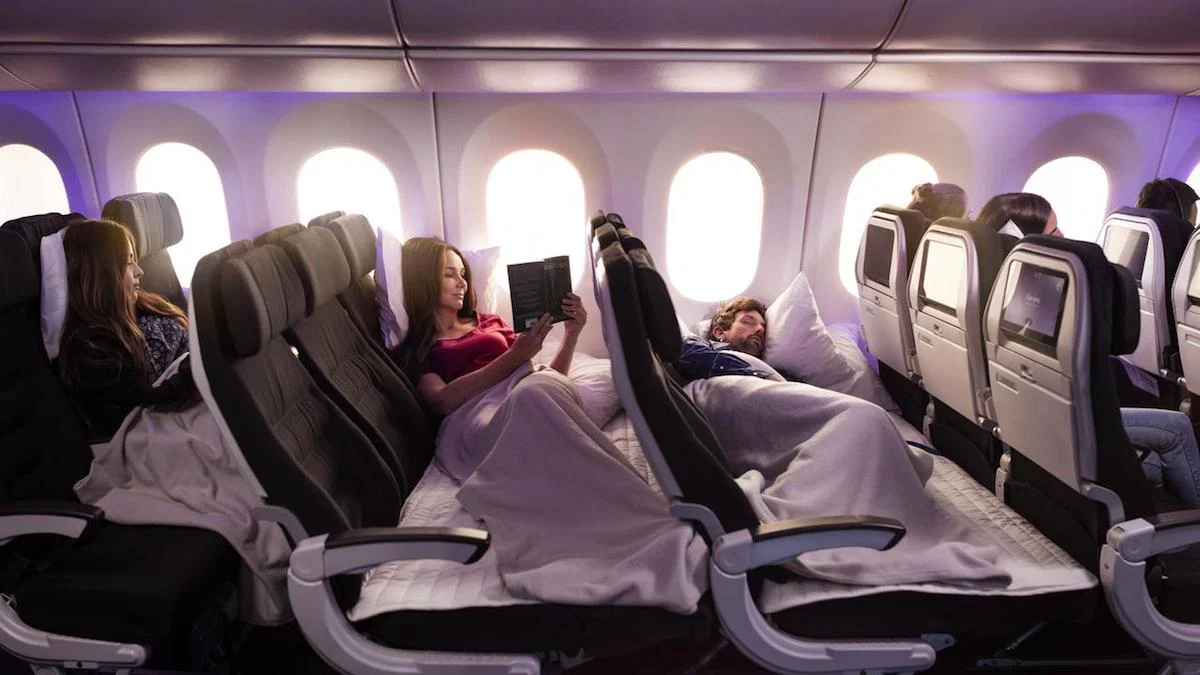
Since Skynest is not available to travellers under the age of 15, those with younger children might want to consider Skycouch instead.
Skycouch is basically a row of Economy Class seats with an extended footrest that can be flipped up 90 degrees to form a full flat surface. Unfortunately, it’s only 124 cm long, so the average adult will not be able to lie down without their feet spilling into the aisle. It’s telling that Air New Zealand is careful to set expectations by saying “Skycouch is a lie-flat couch experience rather than a bed”.
The Skycouch concept was licensed to ANA and China Airlines, with varying degrees of success. ANA only offers it on its tiny fleet of three A380s, and China Airlines has since uninstalled the product.
However, United Airlines is planning to go big on the idea by installing Skycouch (branded as the “Relax Row”) on more than 200 aircraft by 2030. That’s the kind of scale that Air New Zealand could never offer, so it’ll be fascinating to see how that plays out.
Conclusion
Air New Zealand will debut its long-awaited Skynest bunk beds in November this year on the Auckland to New York route, with bookings opening from 18 May 2026.
Given that the concept is commercially untested, the airline is understandably taking a cautious approach. Skynest will initially be installed on just a couple of new Boeing 787-9 aircraft, making this more of a limited trial than a full fleet rollout. It’s also likely the design allows for easy removal, so the pods can be uninstalled and replaced with regular Economy Class seats if they don’t perform as expected.
Call it a marketing gimmick if you want, but you have to at least hand it to Air New Zealand for trying to innovate in Economy, a cabin which airlines have historically neglected.
Will you be trying Skynest?

Interesting…..