
In my younger and more vulnerable years, my go-to song for crying in the shower was Lori McKenna’s “The Time I’ve Wasted”.
I could have walked around the world a couple times
I could have swam across the ocean and back again
Made a wish on every star that Galileo drew
For all the time I’ve wasted on you
That sense of melancholy returned as I wandered through the Premium Economy and Economy Class pavilions at Singapore Airlines’ New Travel Experience unveiling last Friday. Not just because of all the features that SIA passengers could have been enjoying half a decade ago, but because these two seats are emblematic of the issues that SIA — and many other carriers, to be fair — have faced with the Boeing 777-9.
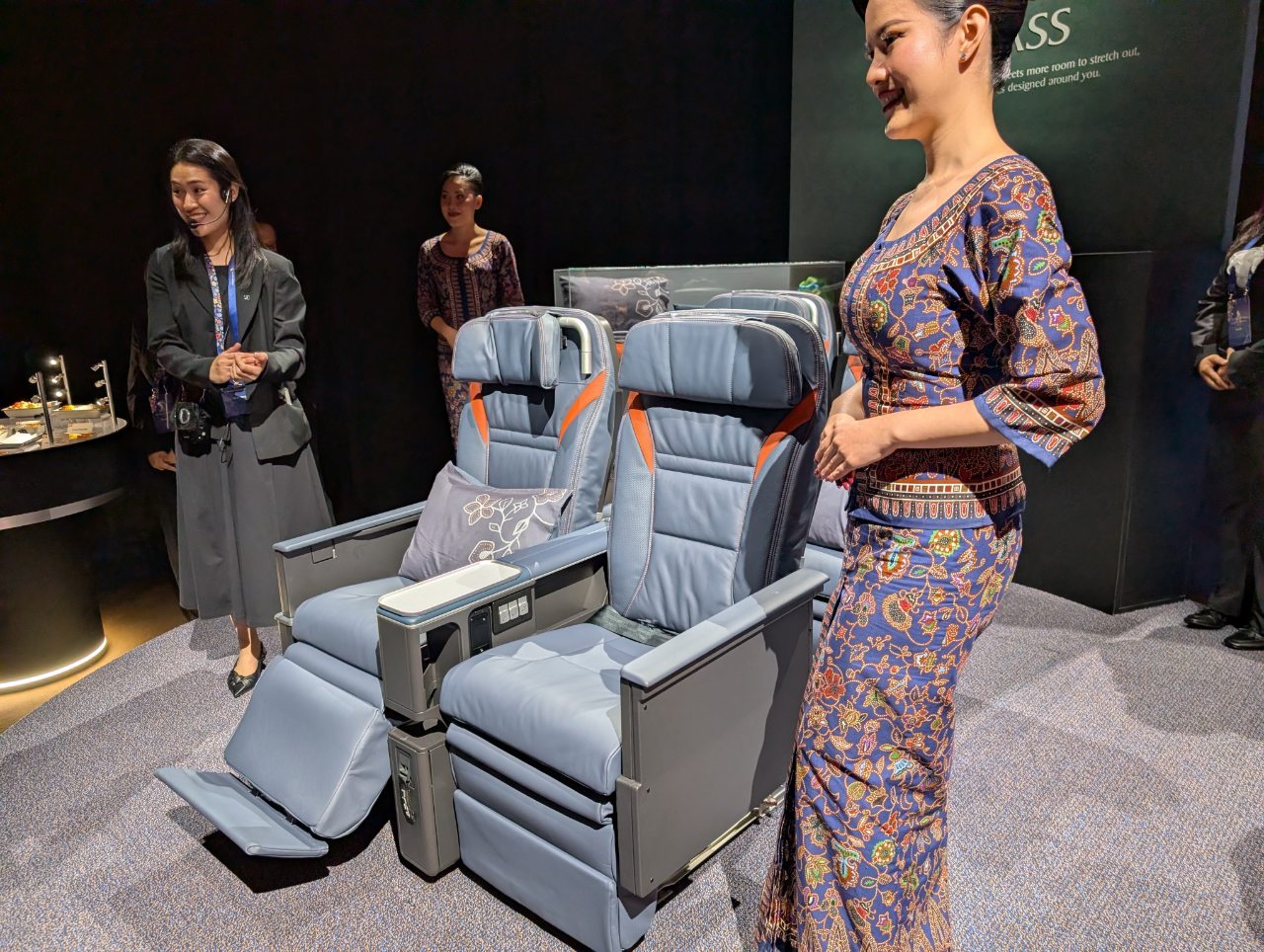
And while the First and Business Class seats hogged the limelight that day, it’s ultimately Premium Economy and Economy that will carry the bulk of the B777-9’s passengers. They’re also the seats I had the most hands-on time with — it’s probably a bit of meta-commentary that you needed an escorted tour to visit First and Business, while anyone could just waltz up to these!
When are the new seats coming?
As the new Premium Economy and Economy Class seats will only be installed on the Boeing 777-9, their debut is directly tied to the arrival of that aircraft.
Enough ink has been spilled on the fiasco that is the B777X development programme, suffice to say the delivery timeline is still anyone’s guess. ETOPS flight testing has yet to begin, but Boeing is hoping to get the aircraft certified early next year, with the first deliveries before the end of 2027. We’ve been disappointed before.
You won’t find these new seats on the 34 retrofitted Airbus A350-900LHs or 7 A350-900ULRs, as SIA’s plan for these aircraft is a limited “refresh” of the Premium Economy and Economy cabins, with upgraded KrisWorld systems and new upholstery. That’s a very disappointing decision, and odds are, if you set foot in Economy or Premium Economy over the next five years, it’s not going to be one of these new seats.
| A350-900LH | A350-900ULR | B777-9 | |
| First Class | N/A | 4 New |
6 New |
| Business Class | 42 New |
70 New |
54 New |
| Premium Economy Class | 24 Refresh |
58 Refresh |
36 New |
| Economy Class | 192 Refresh |
N/A | 204 New |
| Total Aircraft | 34 | 7 | 31 (on order) |
| Debut | H2 2027 | ? | ? |
The tale of two B777-9s
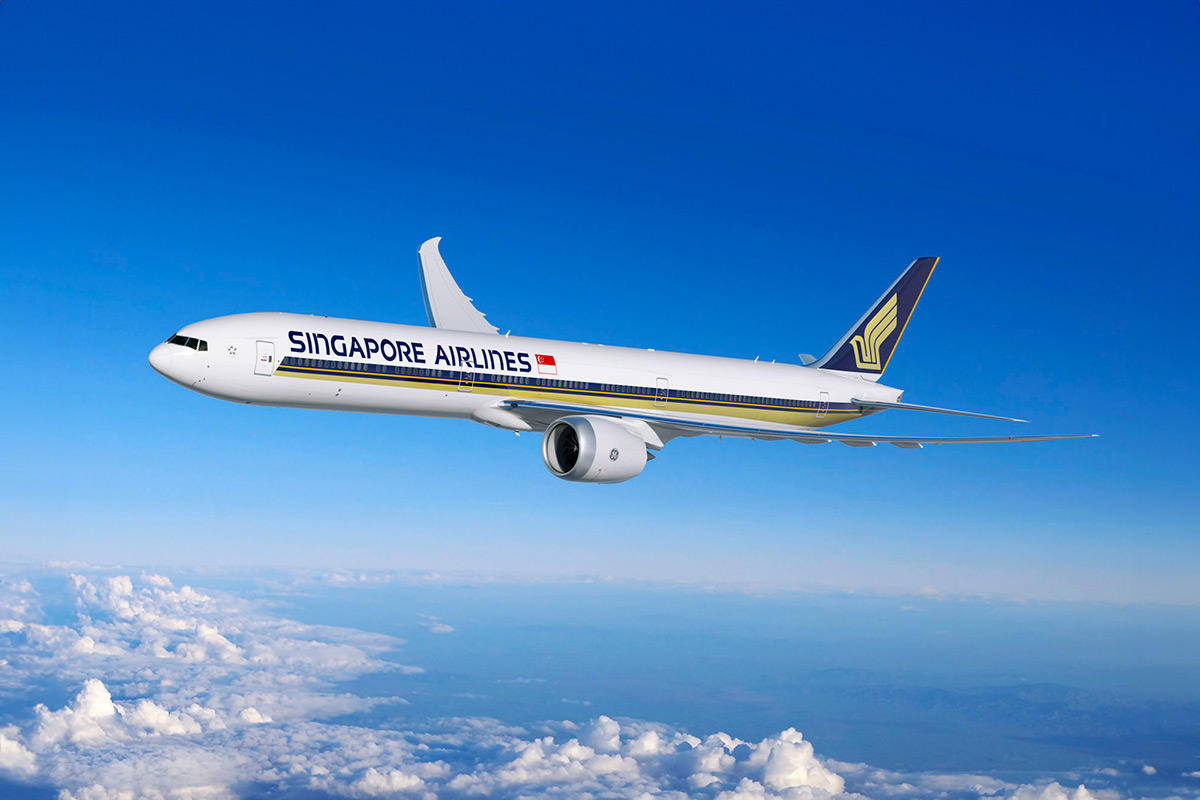
As I said at the start, we cannot have any discussion about the new Premium Economy and Economy Class seats without first understanding the Boeing 777-9 situation.
In short, there are two types of Boeing 777-9s that Singapore Airlines will operate.
| B777-9 v1 |
B777-9 v2 |
|
| No. of Aircraft | 12 | 19 |
| IFE System | NEXT | Astrova |
| Premium Economy | ||
| Screen | Up to 16″ 4K | Up to 16″ 4K |
| OLED | ❌ | ✅ |
| USB-A | ✅ | ❌ |
| USB-C | ✅ | ✅ |
| AC Power | ✅ | ✅ |
| Economy | ||
| Screen | Up to 13″ 4K | Up to 13″ 4K |
| OLED | ❌ | ✅ |
| USB-A | ✅ | ❌ |
| USB-C | ✅ | ✅ |
| AC Power | ✅ | ❌ |
The reason for the differences lies in the inflight entertainment system:
- v1 aircraft use Panasonic NEXT (introduced in 2017)
- v2 aircraft use Panasonic Astrova (introduced in 2022)
It’s not lost on me that the brand-new B777-9s will be using a decade-old IFE system, but this fragmentation simply reflects the protracted development cycle of the B777X programme.
NEXT was introduced in Hamburg in 2017, with the new hardware and software timed to coincide with the B777-9’s entry into service, then expected to be between 2019 and 2020. That didn’t happen, obviously, but SIA had already committed to NEXT on its first 12 airframes.
Then in 2022 came Astrova, which marked a significant upgrade. Panasonic markets it as the first IFE solution to offer 4K OLED and — more importantly to airlines — it’s 30% lighter than earlier systems.
| NEXT | Astrova | |
| OLED support | No | Yes |
| USB-C Power | 45W | 67W* |
| AC Power for Economy | Yes | No |
| *Panasonic says Astrova guarantees 67W per seat and can go up to 100W |
||
NEXT supports a maximum USB-C output of 45W, while Astrova supports upwards of 67W. However, Astrova does not offer the option of in-seat AC power in Economy, and while it can support USB-A, the default peripheral bar doesn’t have it.
If you’re a First or Business Class passenger, there is no meaningful difference in the experience.
For Premium Economy passengers, the difference is minor. The v1 aircraft (NEXT) have a USB-A port, while the v2 aircraft (Astrova) lose the USB-A port but gain an OLED display. Either way, you’ll have USB-C and AC power.
For Economy passengers, the trade-off is bigger. The v1 aircraft (NEXT) have USB-A ports and AC power. The v2 aircraft (Astrova) upgrade you to an OLED display, but at the expense of both. USB-C becomes your only way to charge.
The seats on display at the unveiling event are from the v1 aircraft. That means there may be differences in your experience, depending on which variant you fly on. I’ll flag these as needed.
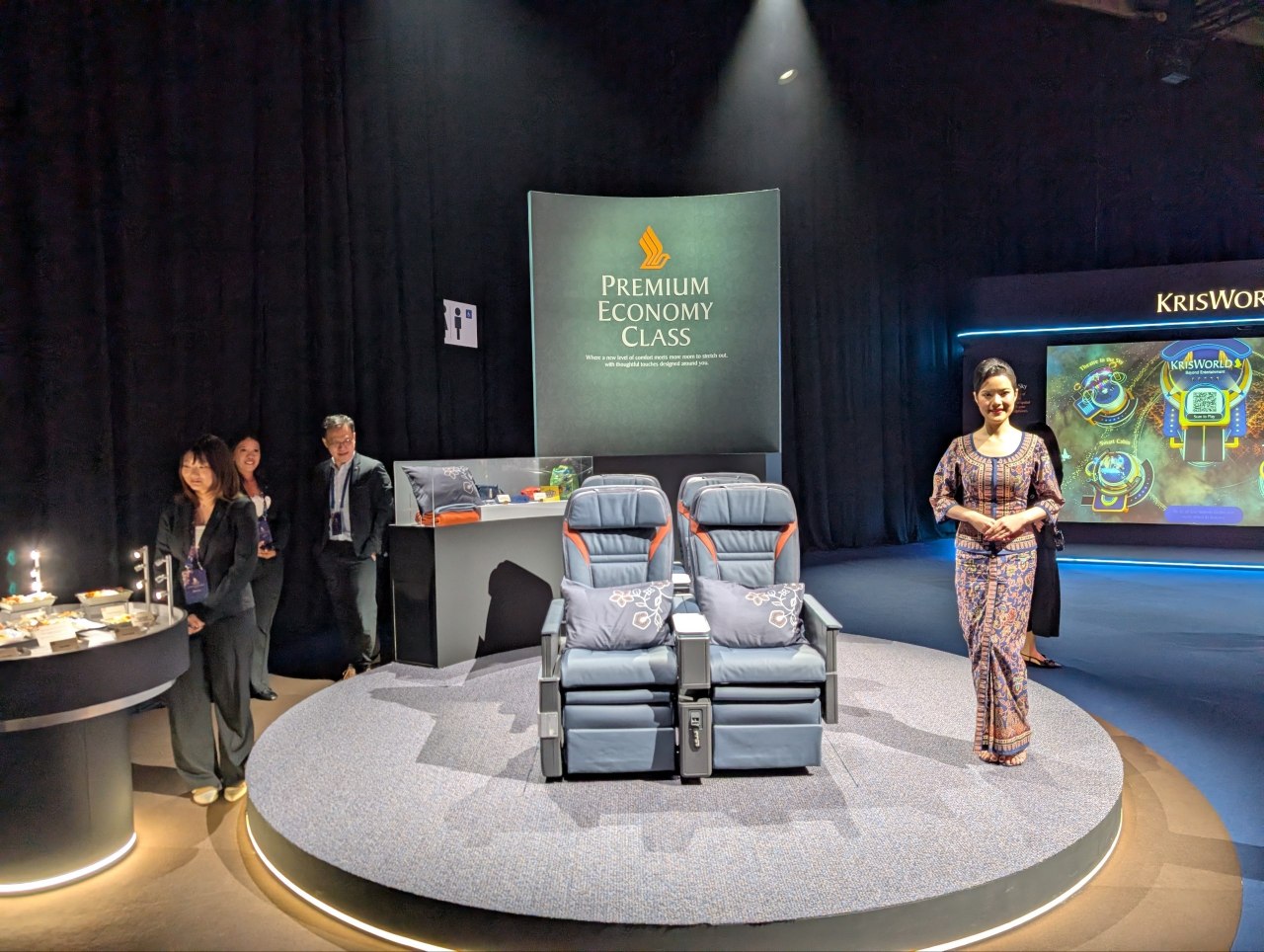
Singapore Airlines’ new Premium Economy
Overview
 |
||
| B777-9 v1 |
B777-9 v2 |
|
| No. of Seats | 36 | |
| Configuration | 2-4-2 | |
| Seat Pitch | 40″ | |
| Seat Width | 19″ | |
| Seat Recline | Up to 9″ | |
| IFE Screen | Up to 16″ 4K | |
| Touchscreen | ✅ | ✅ |
| OLED | ❌ | ✅ |
| Spatial Audio | ✅ | ✅ |
| Bluetooth Audio | ✅ | ✅ |
| AC Power | ✅ | ✅ |
| USB-A | ✅ | ❌ |
| USB-C | ✅ 45W |
✅ 67W |
| Wireless Charging | ❌ | ❌ |
| Other Features |
|
|
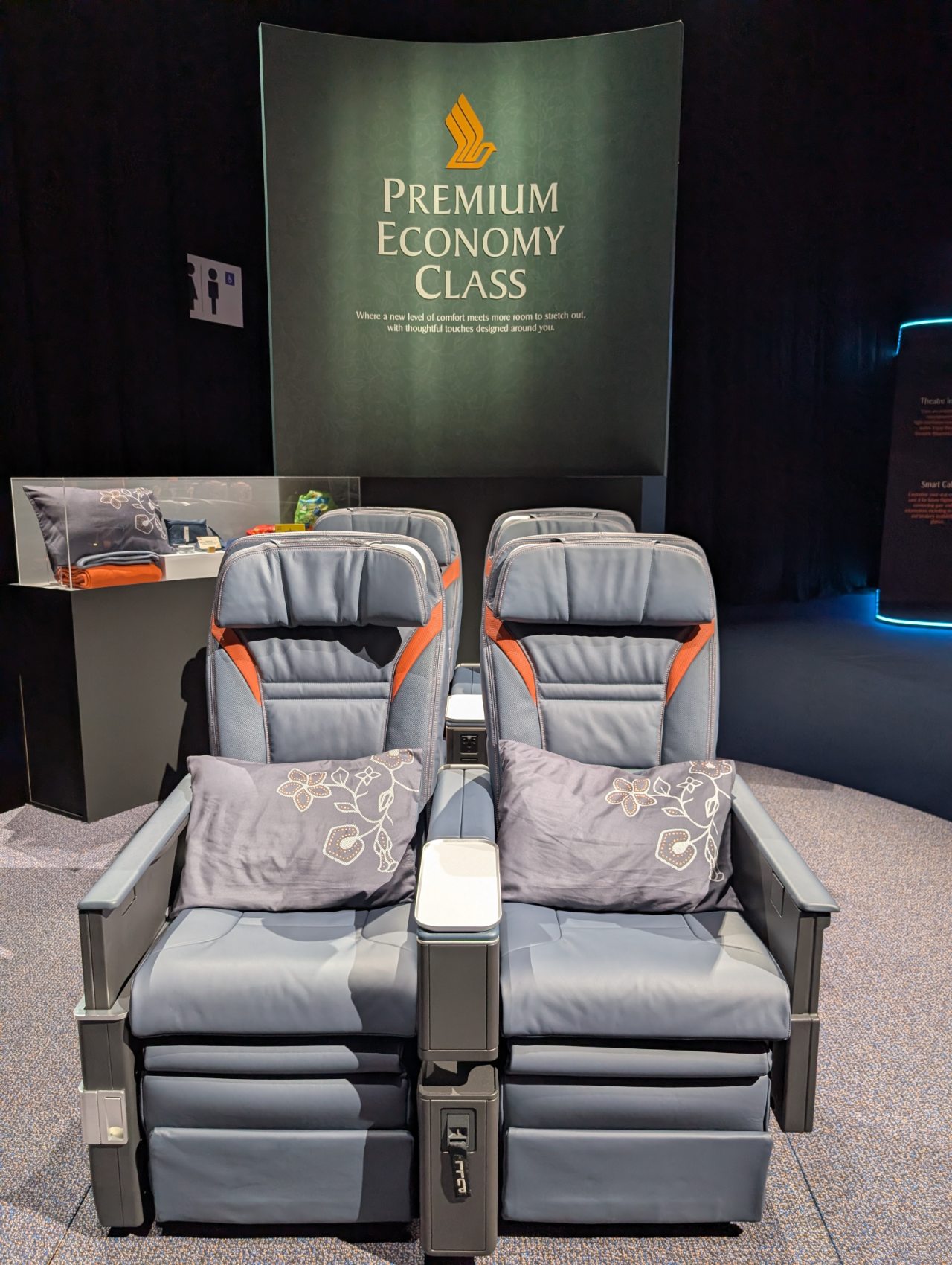
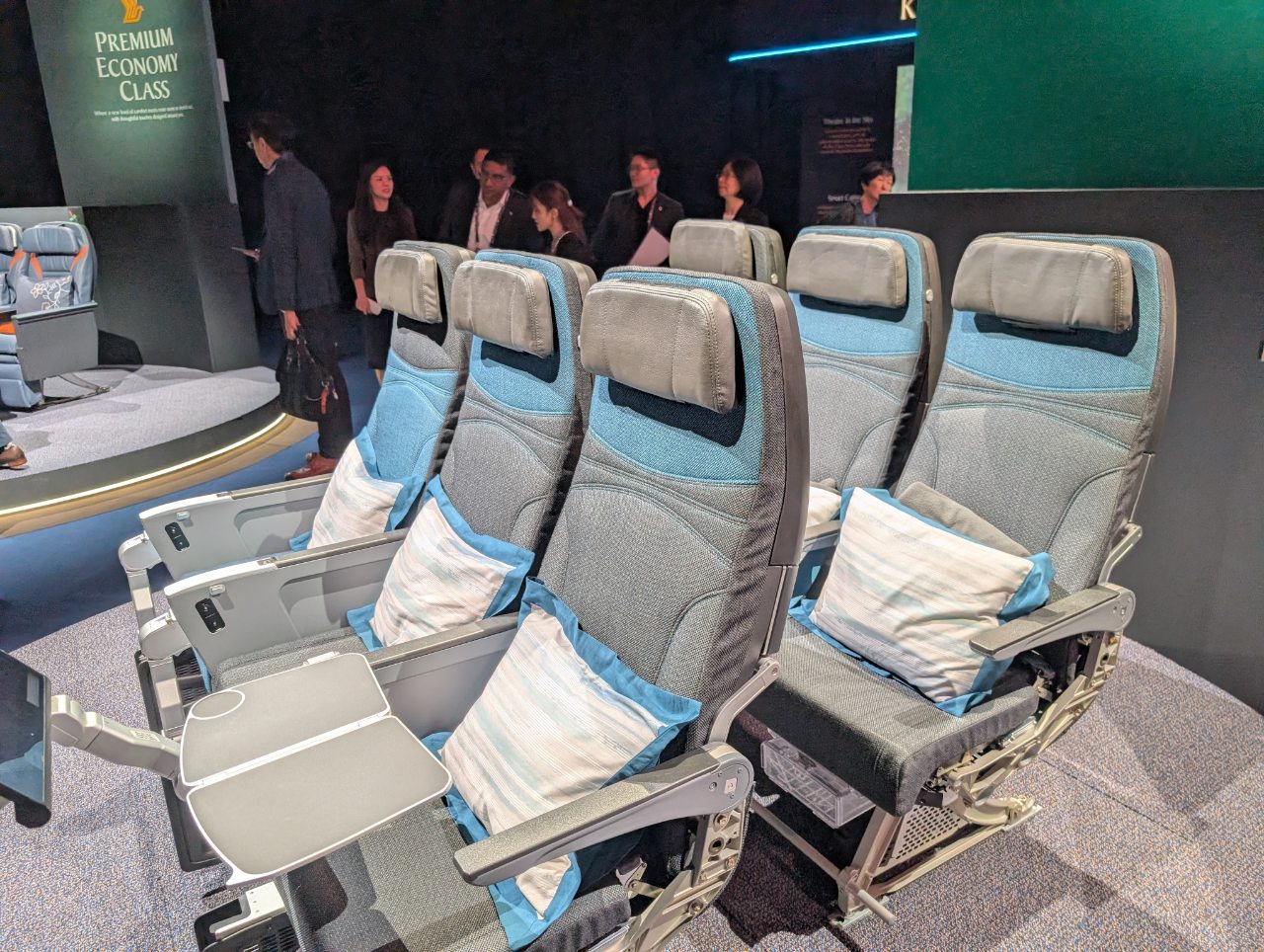
Singapore Airlines’ new Premium Economy Class seat is manufactured by Collins Aerospace, and styled by Factorydesign.
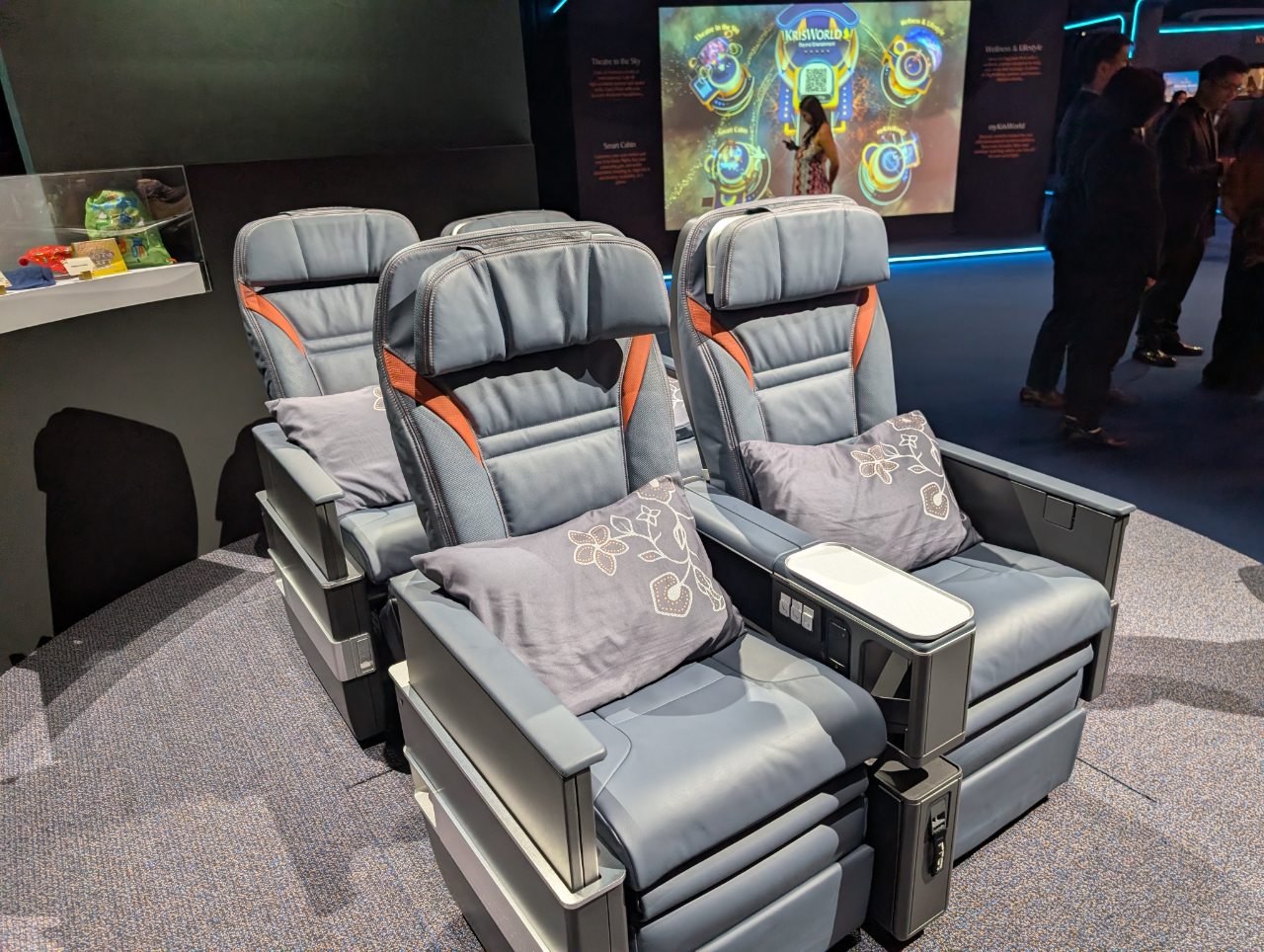
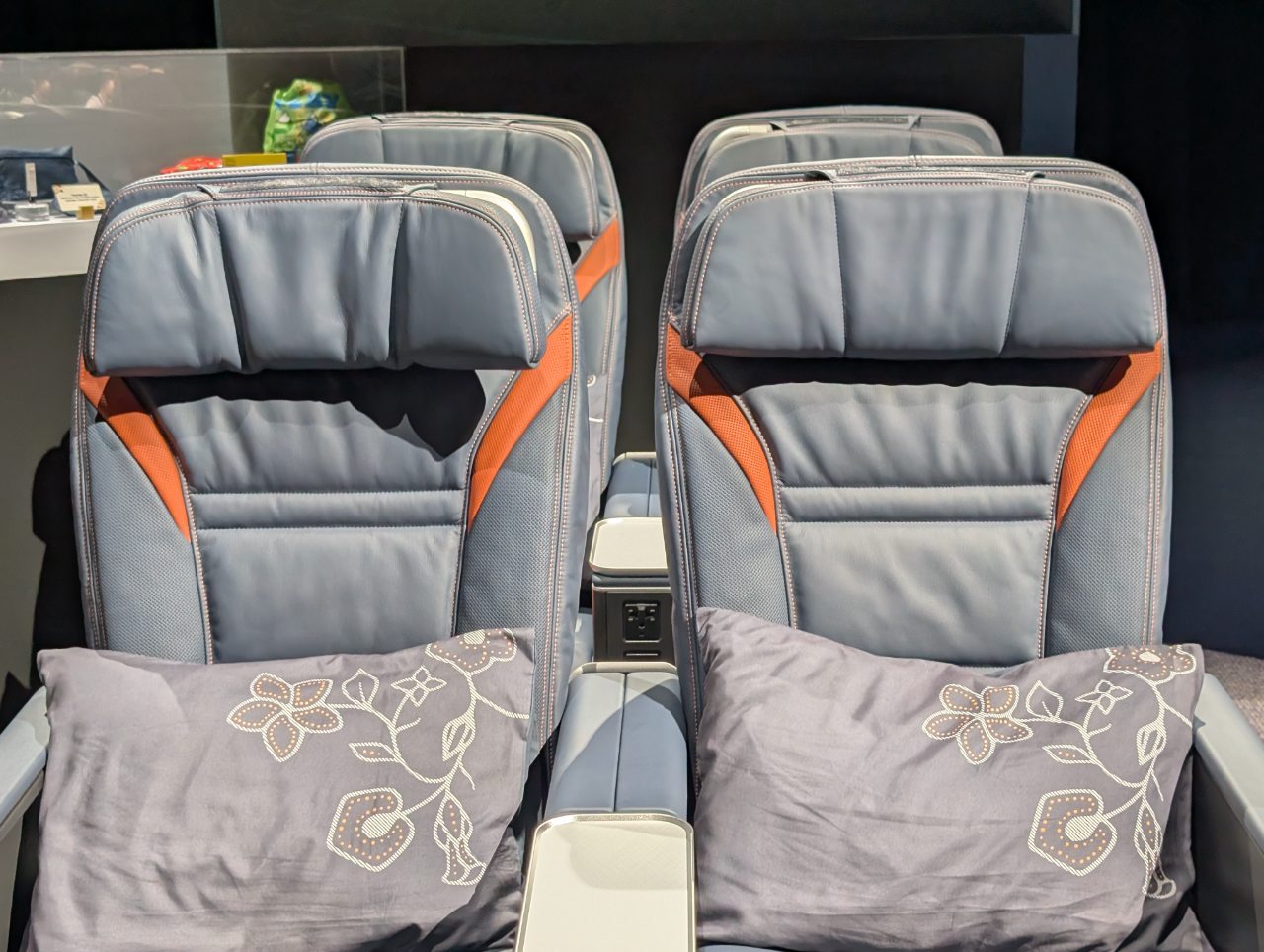
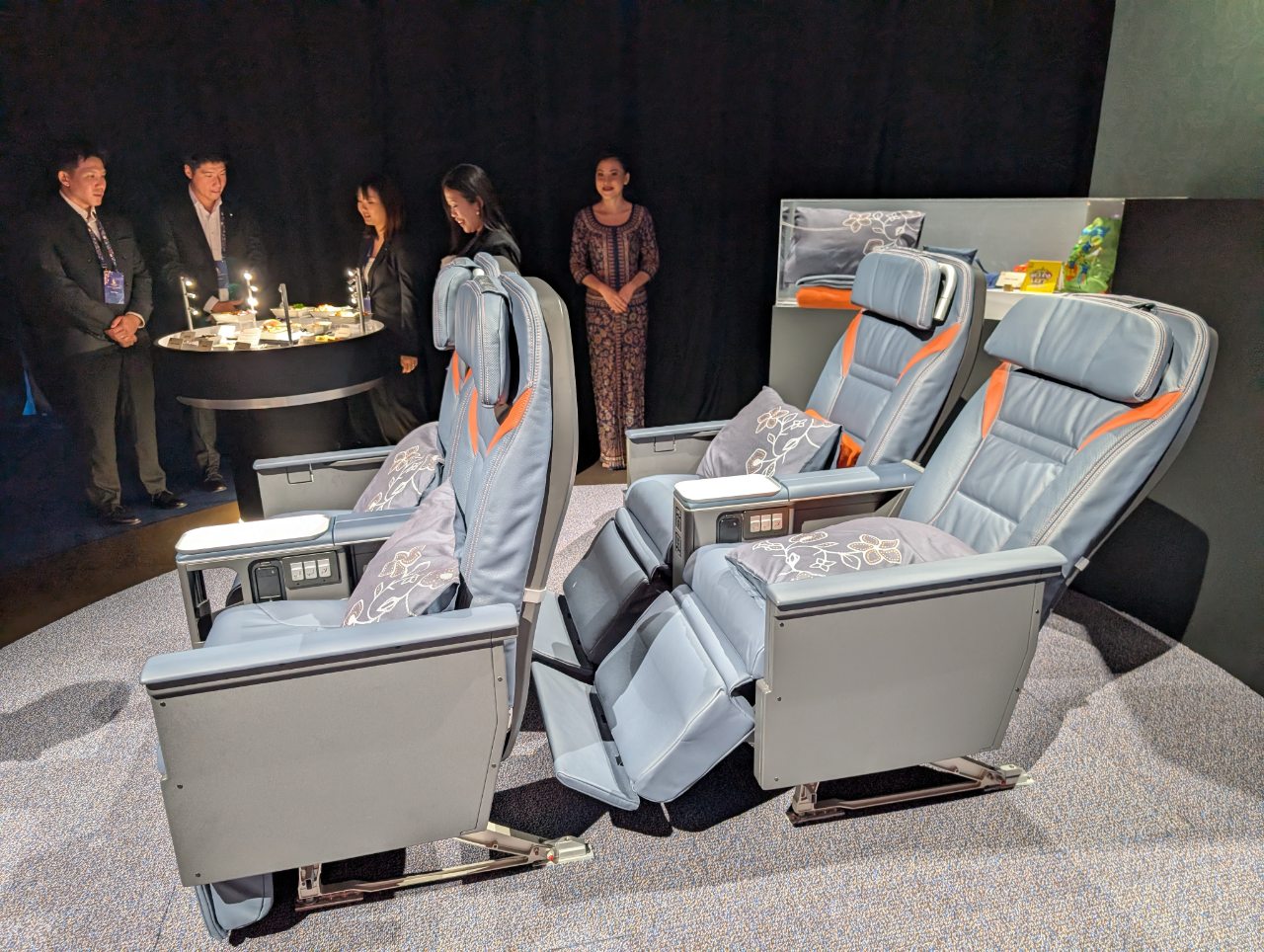
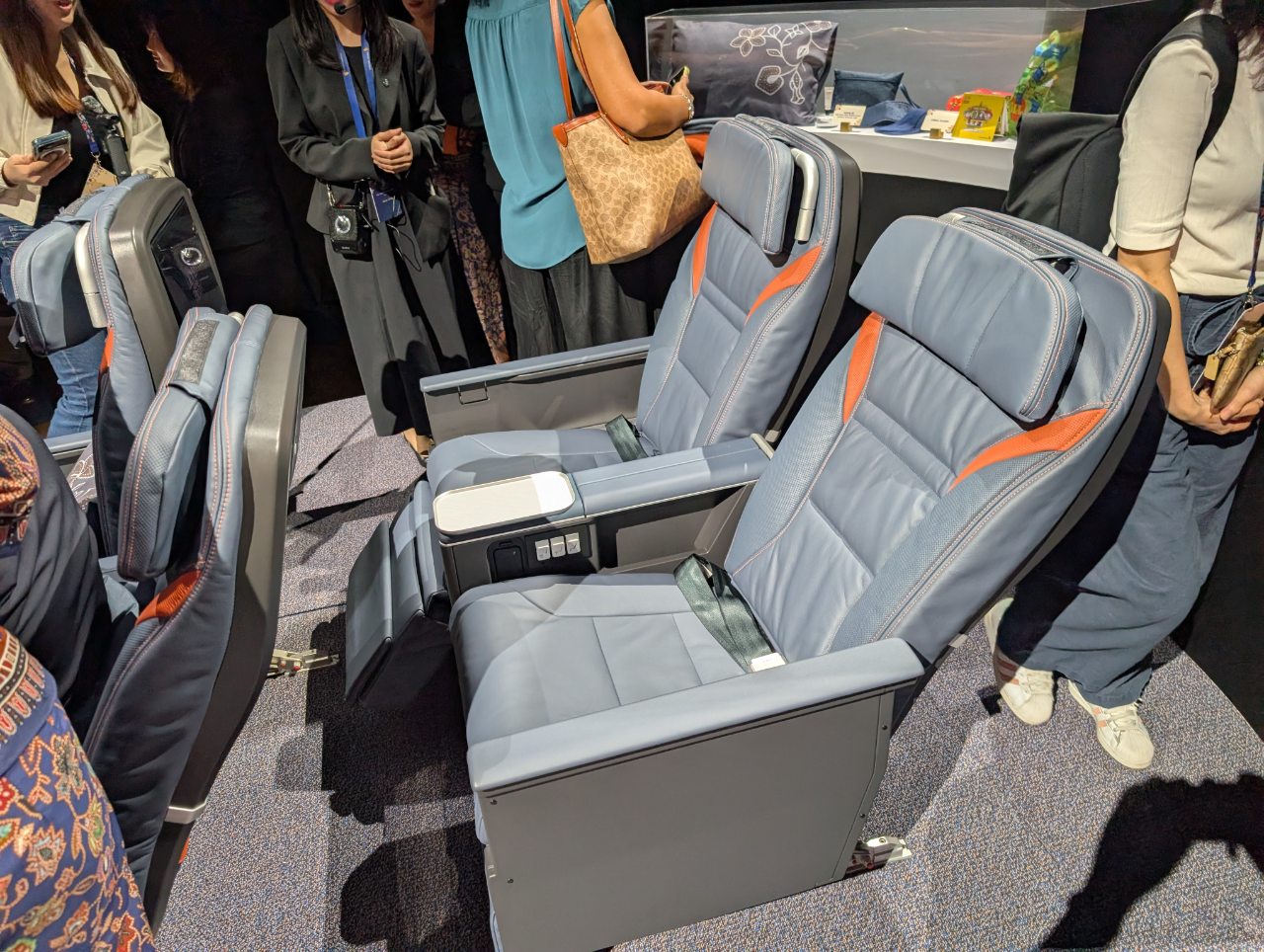
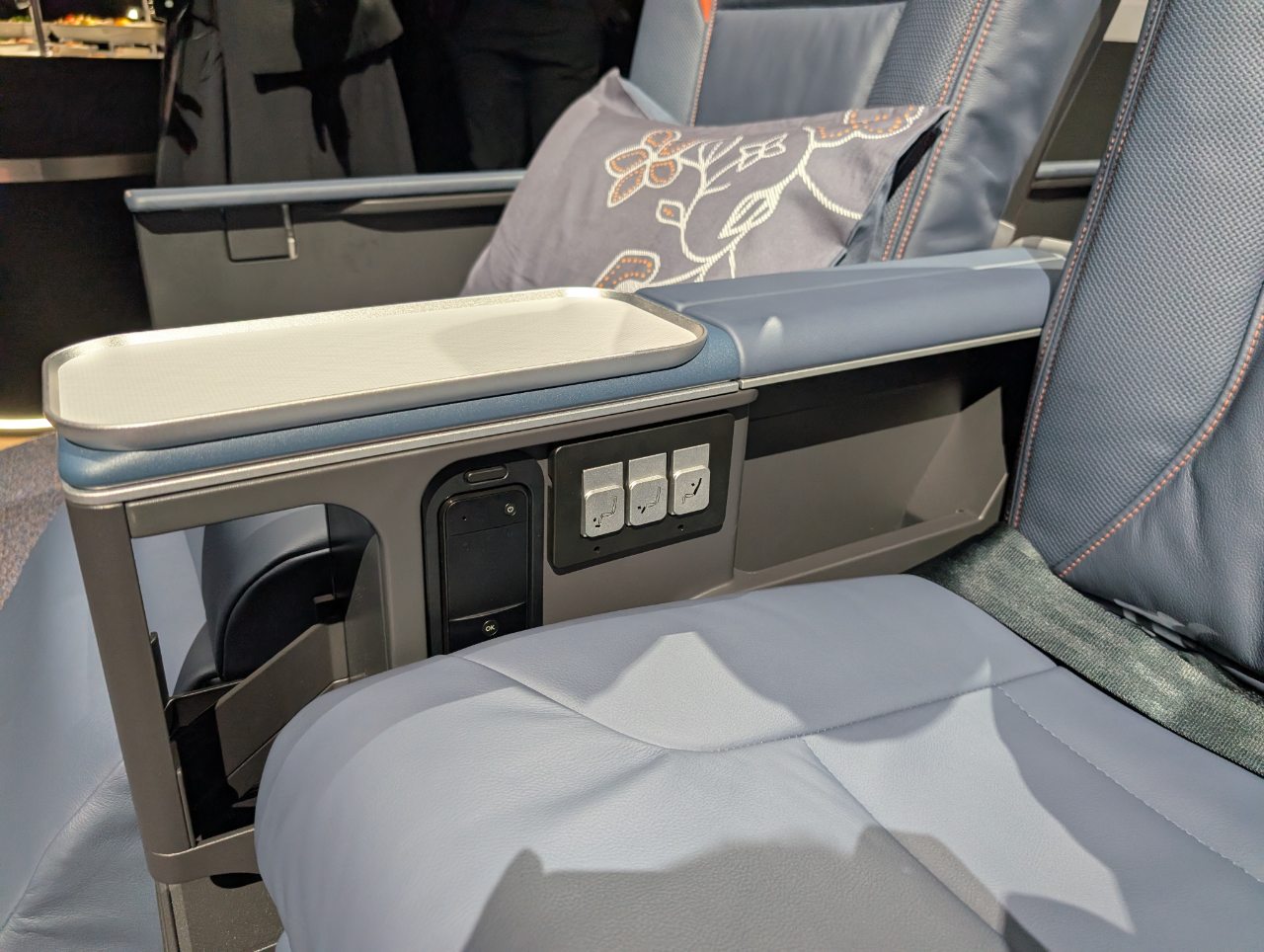
SIA has largely kept its existing Premium Economy colour scheme, with blue-grey leather, burnt orange accents and charcoal grey plastic. The biggest change is the pillow, where bright orange has been replaced with a more muted lavender-grey, embroidered with cream batik-style florals.
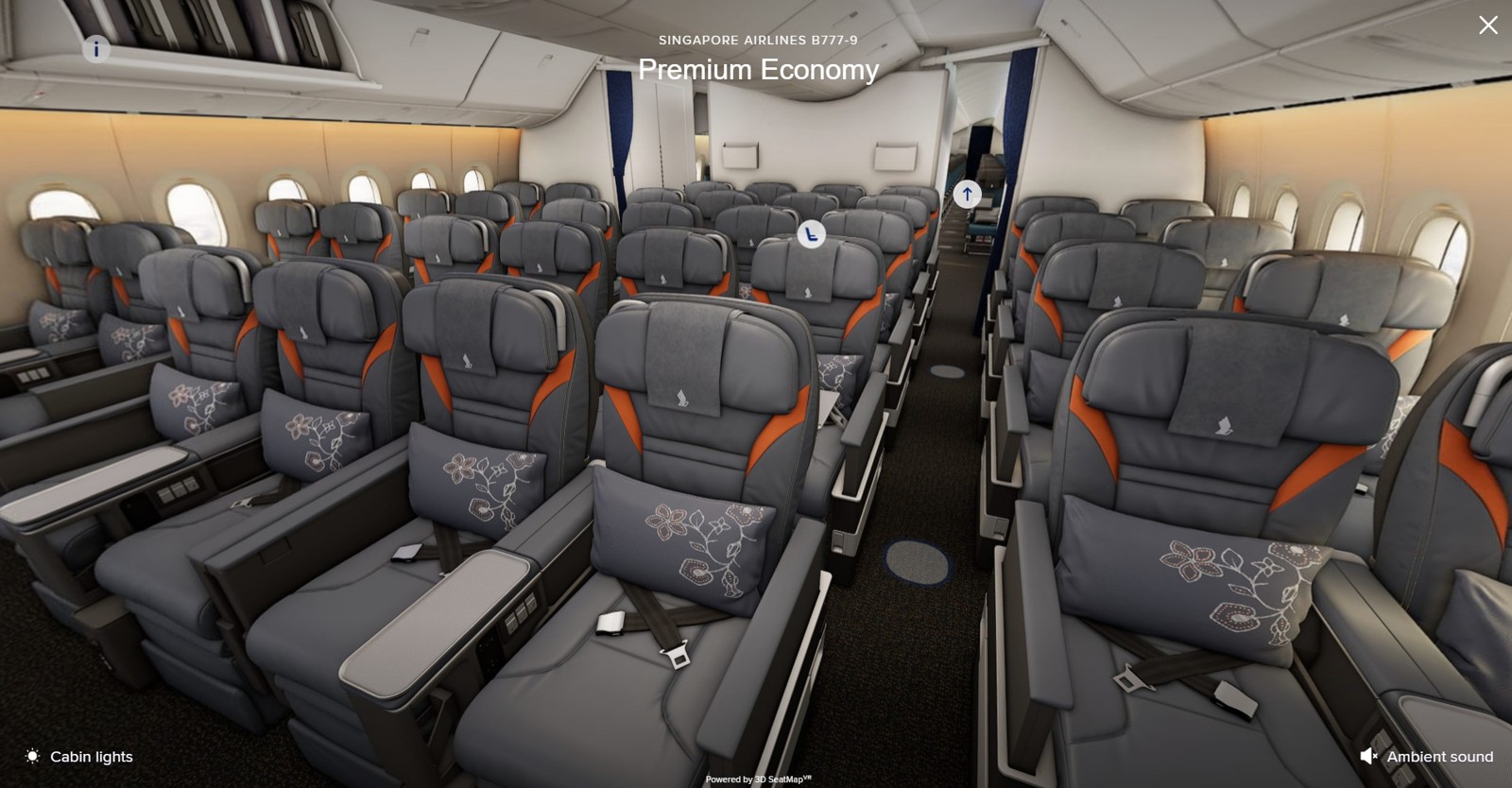
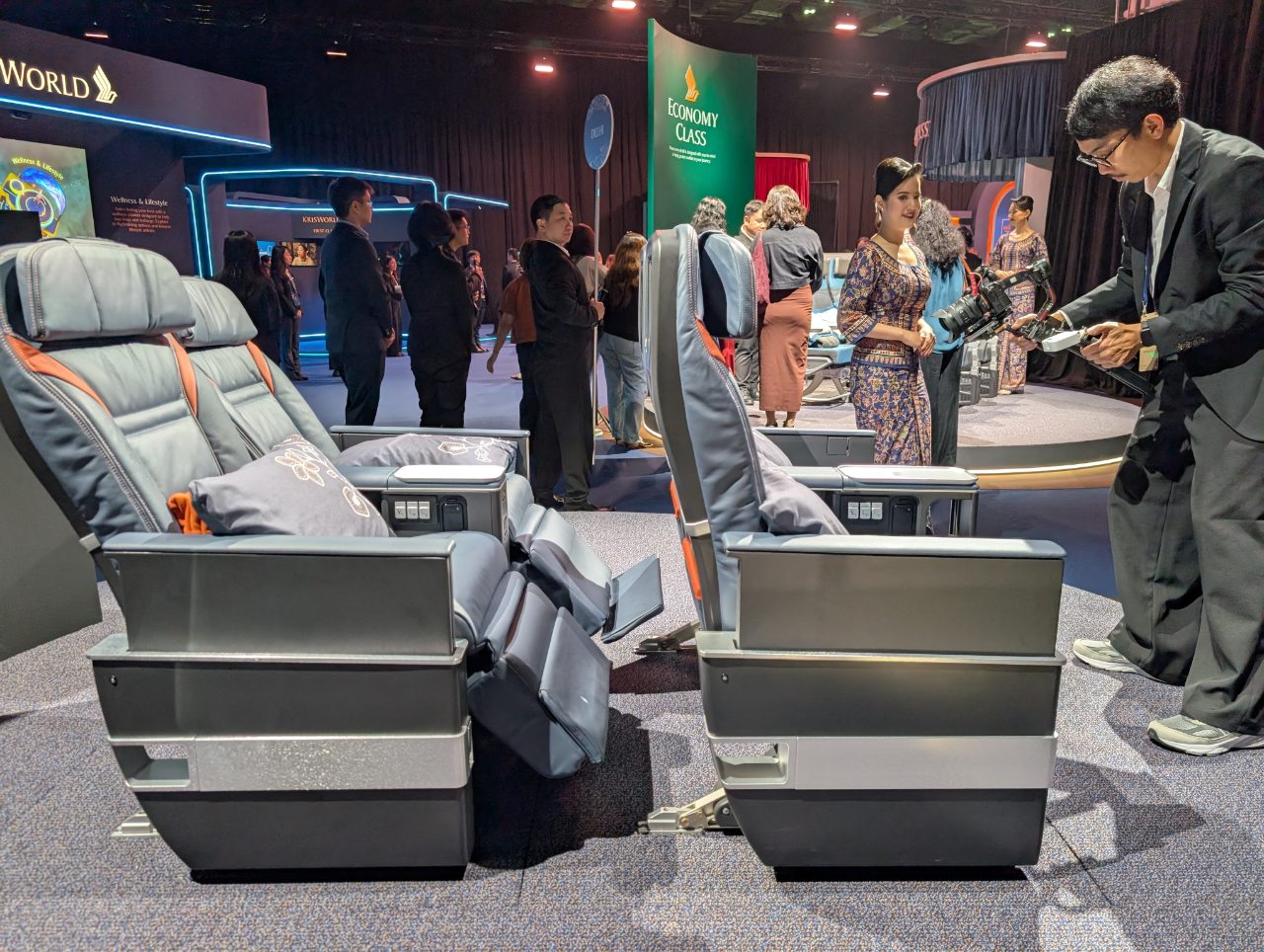
The seats are clad in full-grain premium leather, with a four-way adjustable headrest and legrest with adjustable footrest. This marks the first time that all Premium Economy seats have an integrated footrest; on existing cabins, the footrest folds down from the seat in front.
Configuration and seat width
Premium Economy on the B777-9 will be in a 2-4-2 configuration, the same as the other SIA aircraft which offer this product.
The seat is 19 inches wide, slightly narrower than the 19.5-inch versions found on the A380-800 and B777-300ER. This could be because of wider armrests, though I really couldn’t tell the difference anyway.
| Aircraft | Premium Economy Layout | Seat Width |
| B777-300ER | 2-4-2 | 19.5 inches |
| A380-800 | 2-4-2 | 19.5 inches |
| B777-9 | 2-4-2 | 19 inches |
| A350-900LH A350-900ULR |
2-4-2 | 19 inches |
SIA has emphasised the improved seat cushioning, and I certainly thought it felt good — but again it’s so hard to say because things feel very different on an ultra-long-haul flight to New York (oh never mind, the A350ULR isn’t getting new seats!).
Privacy (or lack thereof)
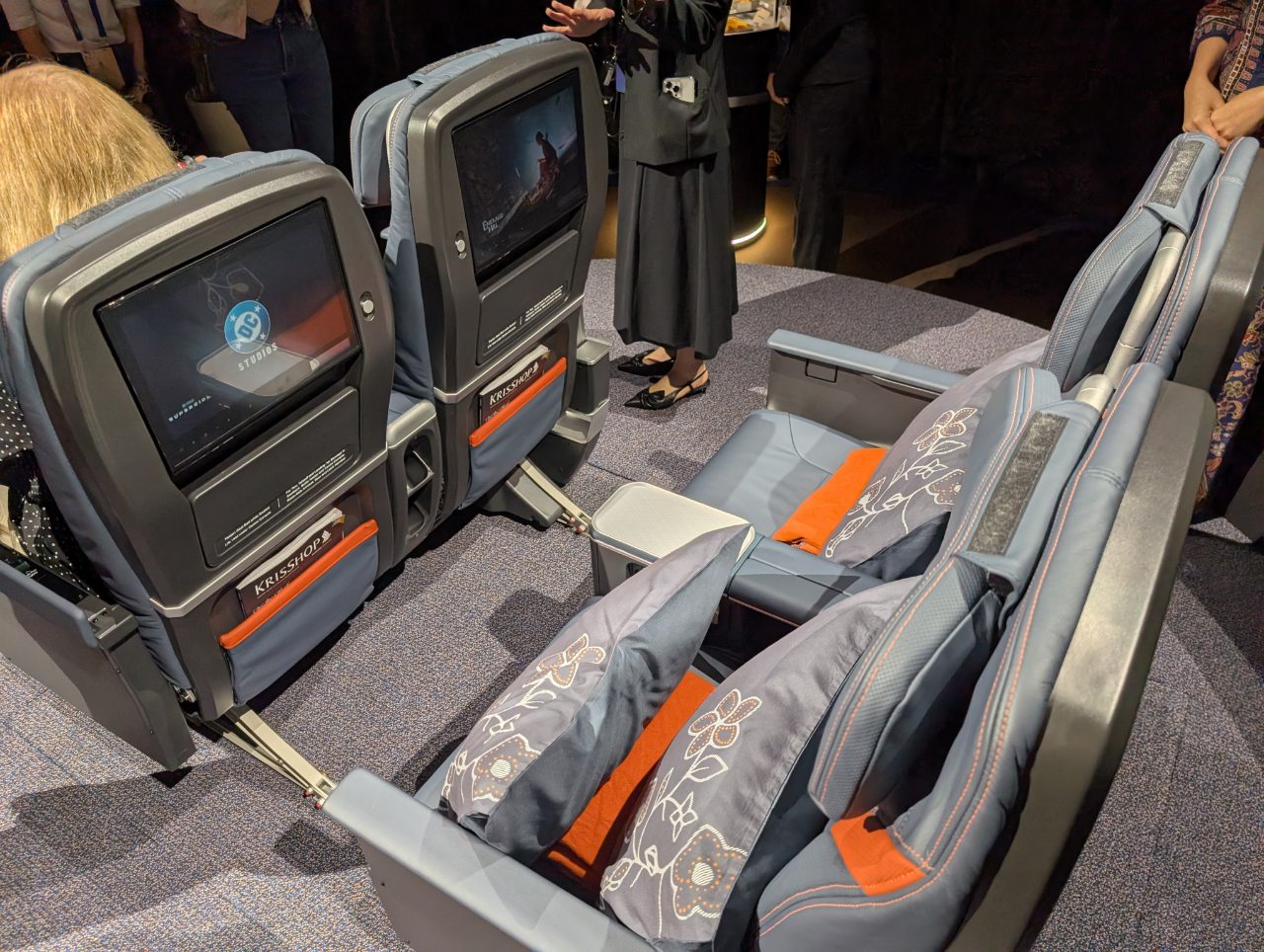
My biggest gripe about the new Premium Economy is that it has absolutely zero privacy. Turn to your left or right, and you can see everything your seatmates are doing.
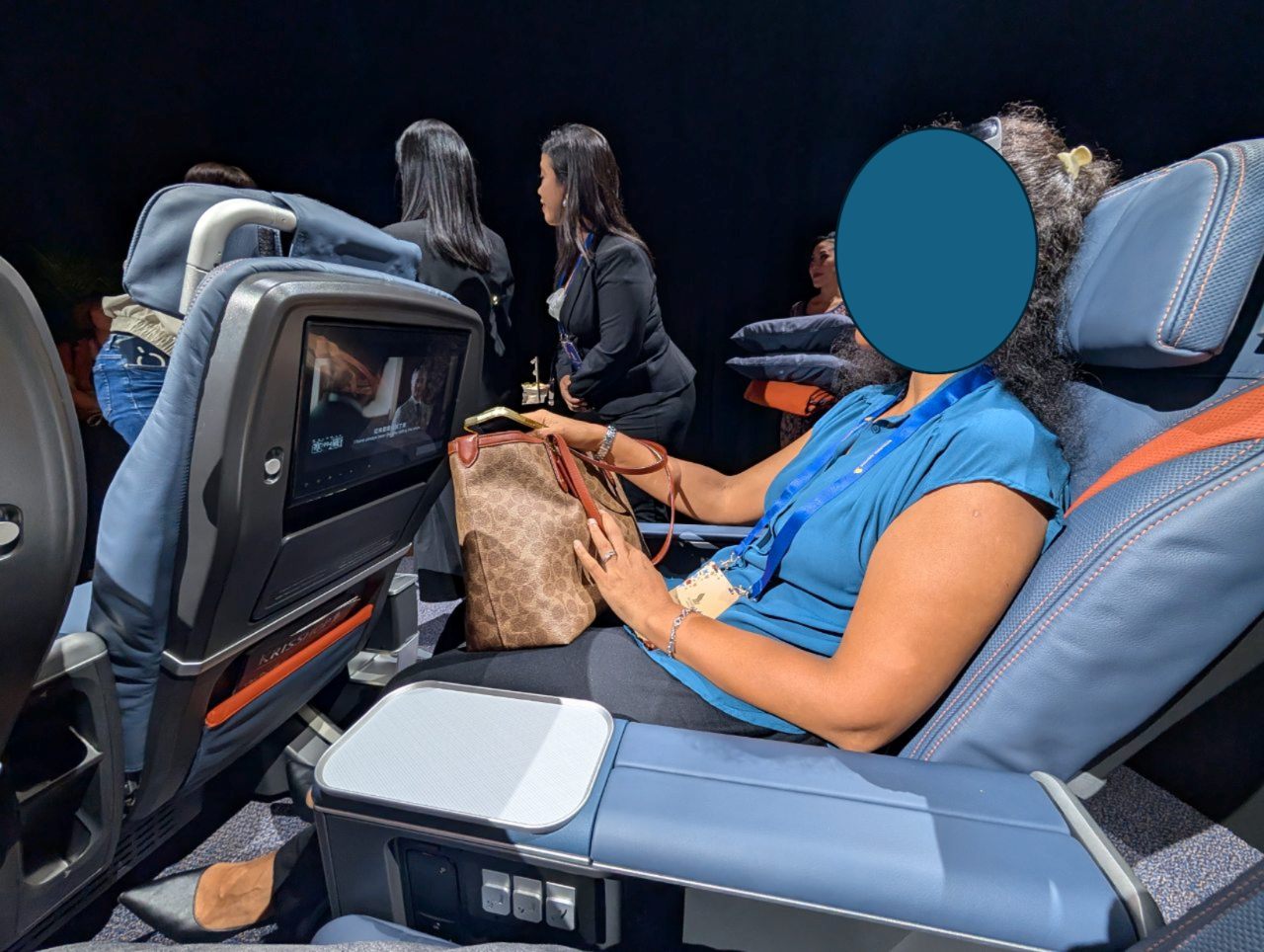
That’s simply not good enough for a supposedly next-generation seat, not when airlines such as Emirates and JAL are adding movable privacy dividers. British Airways and Cathay Pacific have added privacy wings that wrap around the head at eye-level.
Adding some privacy would be the one thing that could meaningfully differentiate this product from Economy Class, without having to worry about cannibalising Business Class demand. I’m really disappointed they’ve decided against it.
Seat controls
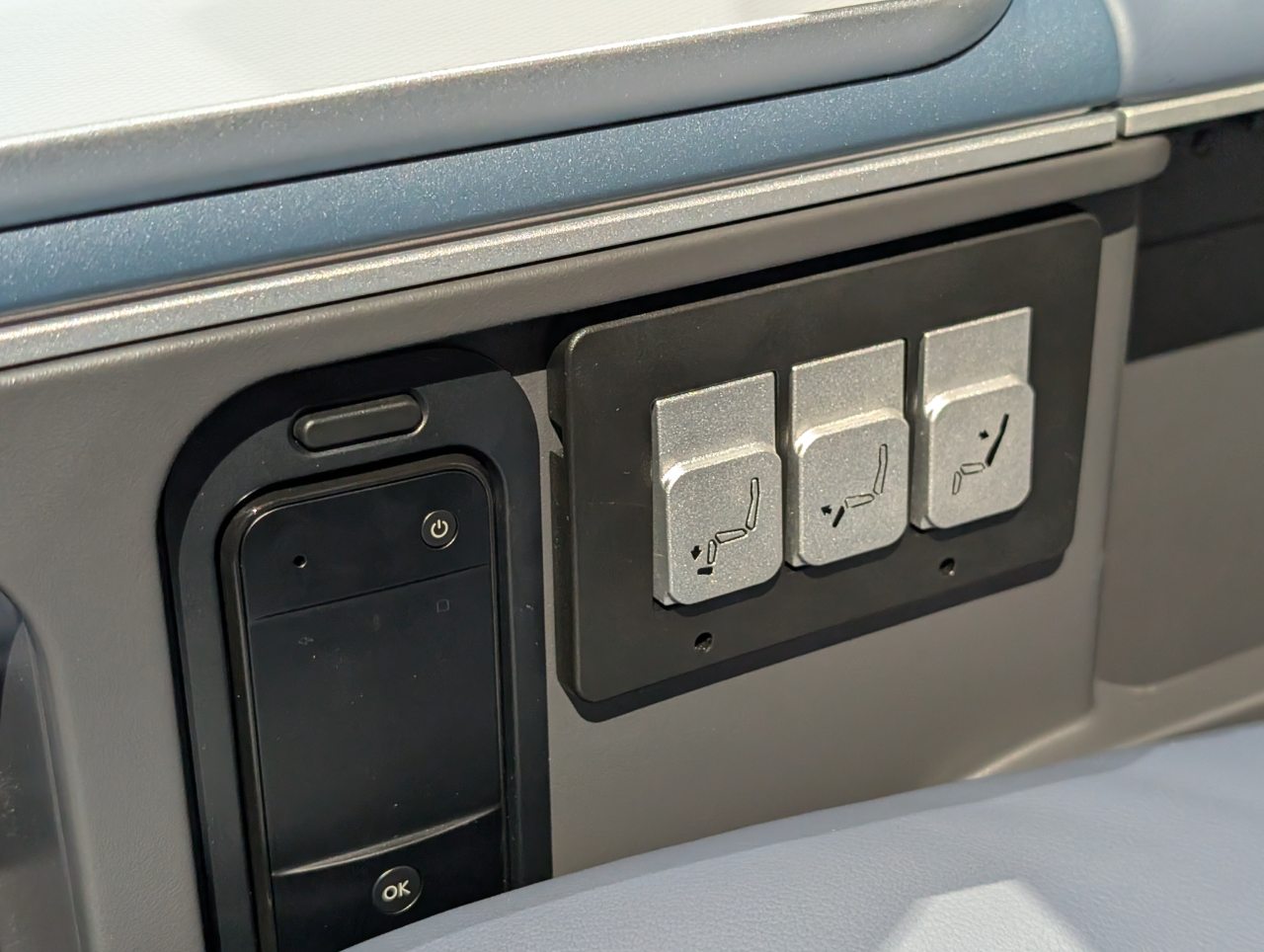
Premium Economy seat controls are manual, with one button for the backrest, one for the legrest and another for the extendable footrest. Considering that new seats sometimes require breaking in, I was pleasantly surprised that it was relatively easy to move the various components — but then again, these “display sets” had probably seen a lot of testing before today.
Manual seat controls aren’t a deal-breaker for me. While Emirates and JAL have added electric seat controls to their upcoming or current Premium Economy seats, they remain the outliers. Electric seat controls are useful for those with mobility issues, and can make a seat feel more premium (closer to a regional Business Class), but I can understand that the airlines don’t want the extra weight and maintenance issues.
Seat pitch and legroom
On the B777-9, Premium Economy seat pitch will increase to 40 inches (compared with 38 inches today). This is generous, though not quite market-leading. Japan Airlines offer 42 inches on the A350-1000, along with EVA Air and Vietnam Airlines on their B787-9s.
This extended pitch is what enables every Premium Economy seat to have an integrated extendable footrest (instead of having to mount it under the seat in front). It also allows for a slightly extended seat recline of up to nine inches (compared with eight inches today).
If your seatmate does not have their legrest extended, 40 inches should provide just enough space for the middle or window passenger to exit their seat, without the aisle passenger having to get up.
Storage
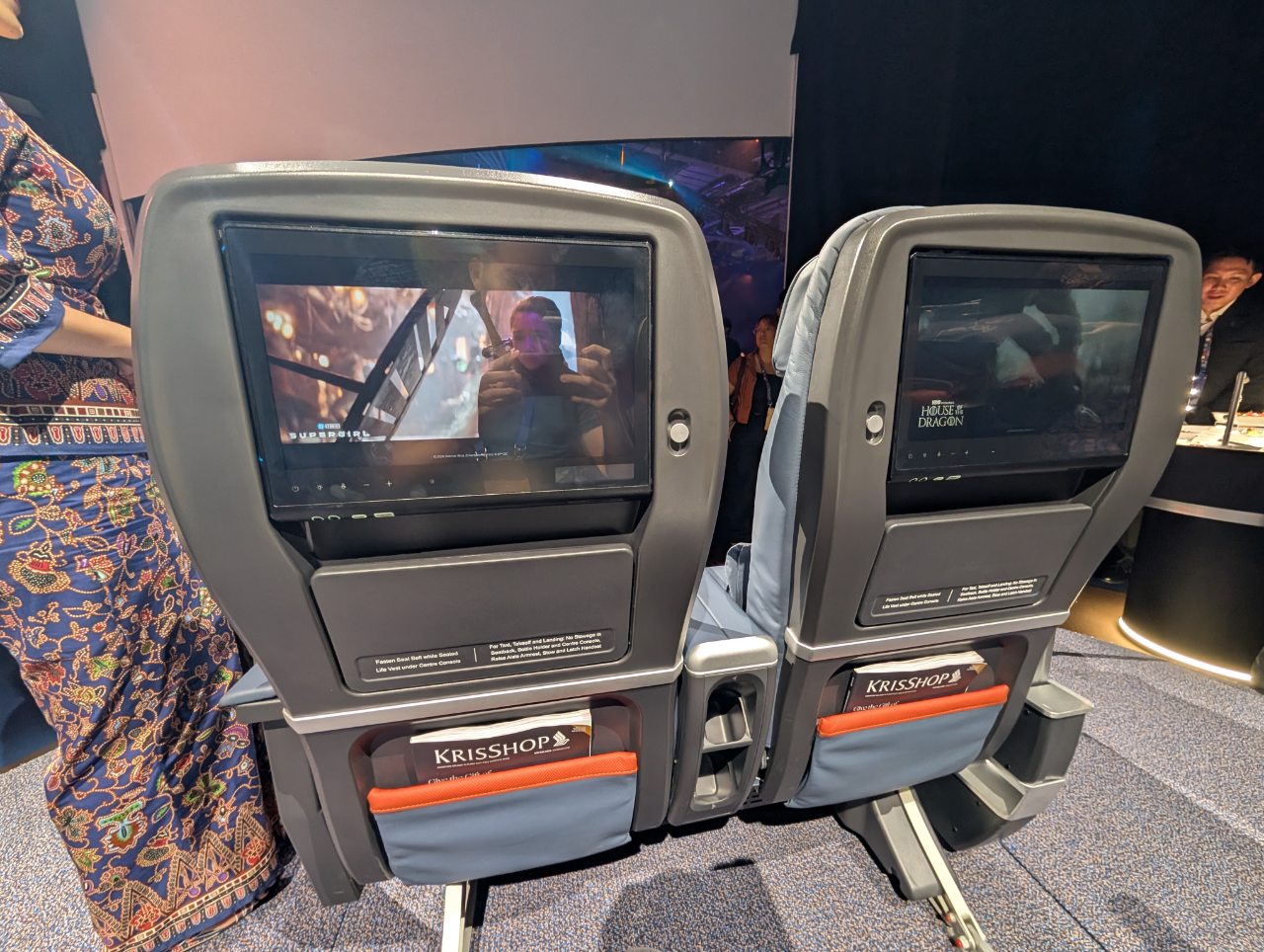
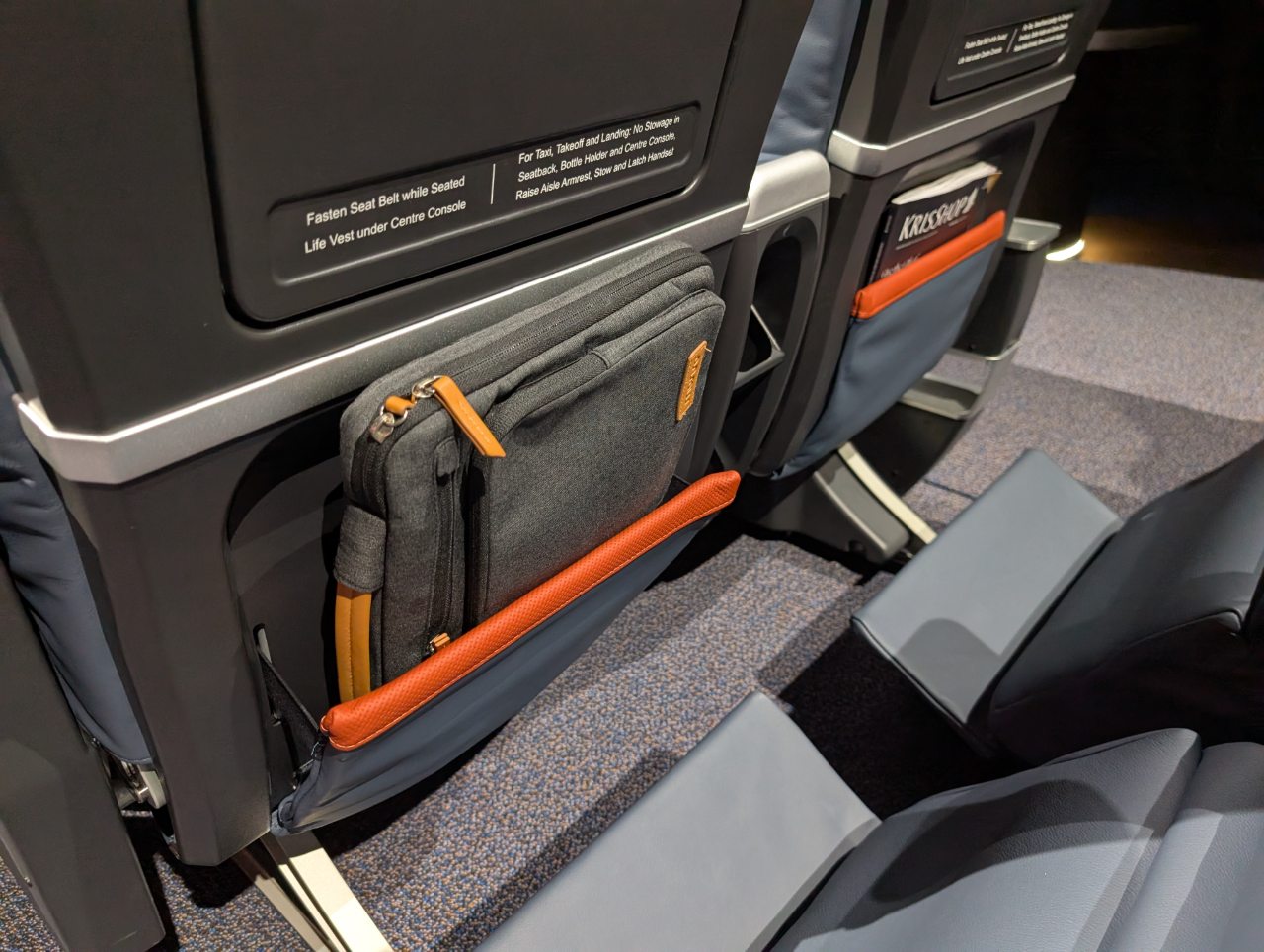
There are several storage options available, such as a pocket beneath the IFE monitor for loose items like passports and earphones.
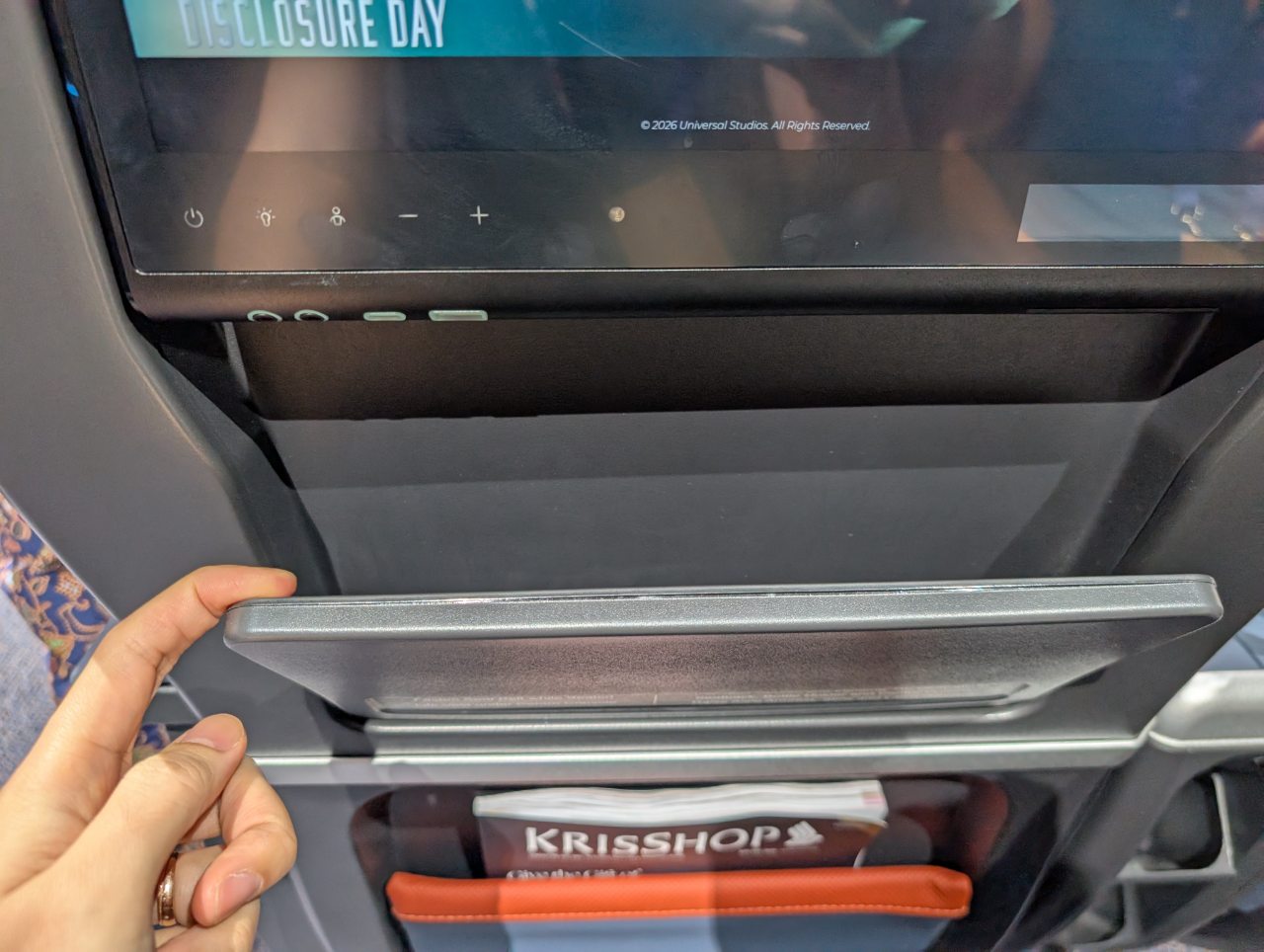
The seat pocket is large enough to store a laptop, though in practice the items here will have to compete for space with the KrisShop magazine and safety card.
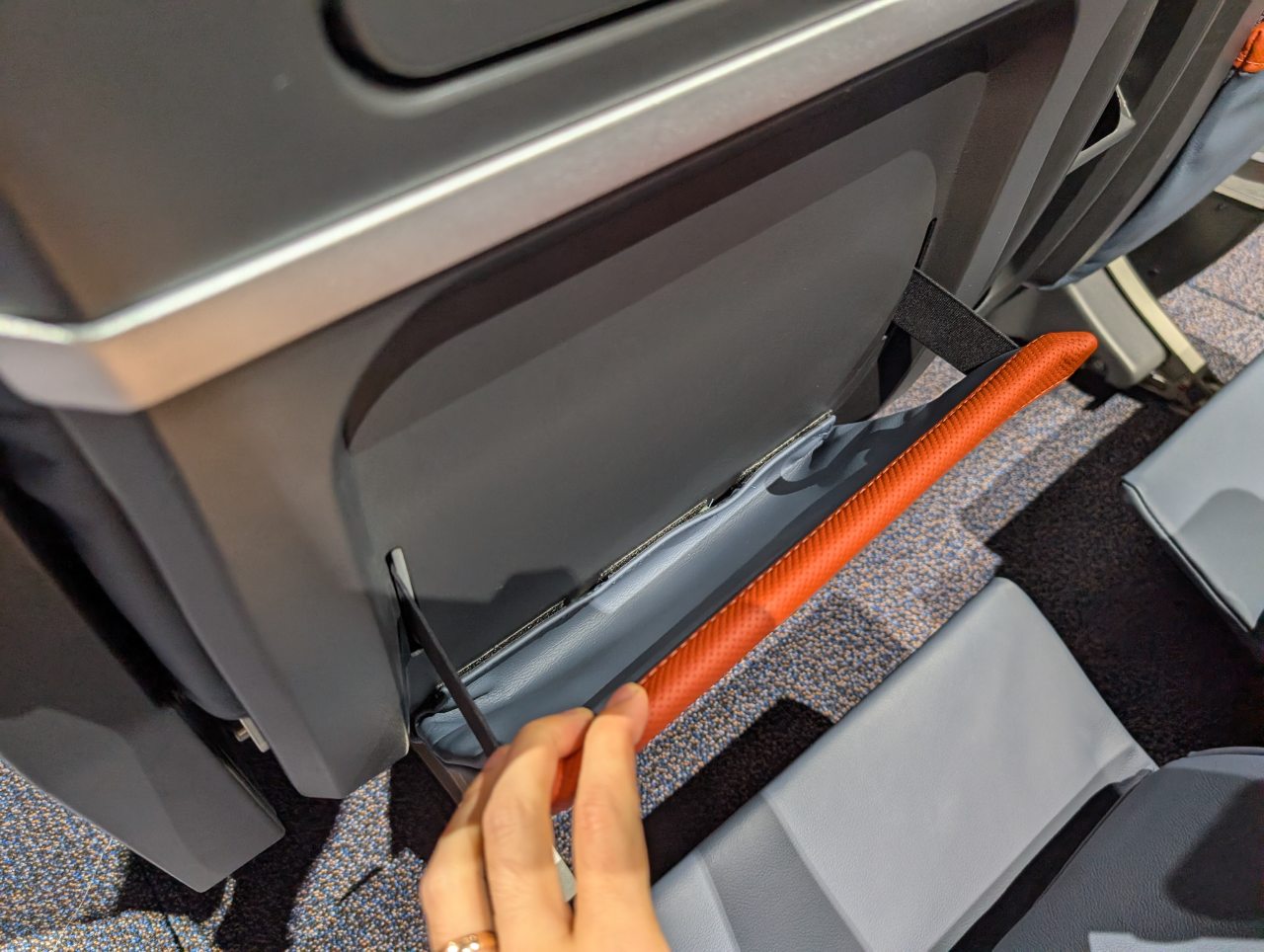
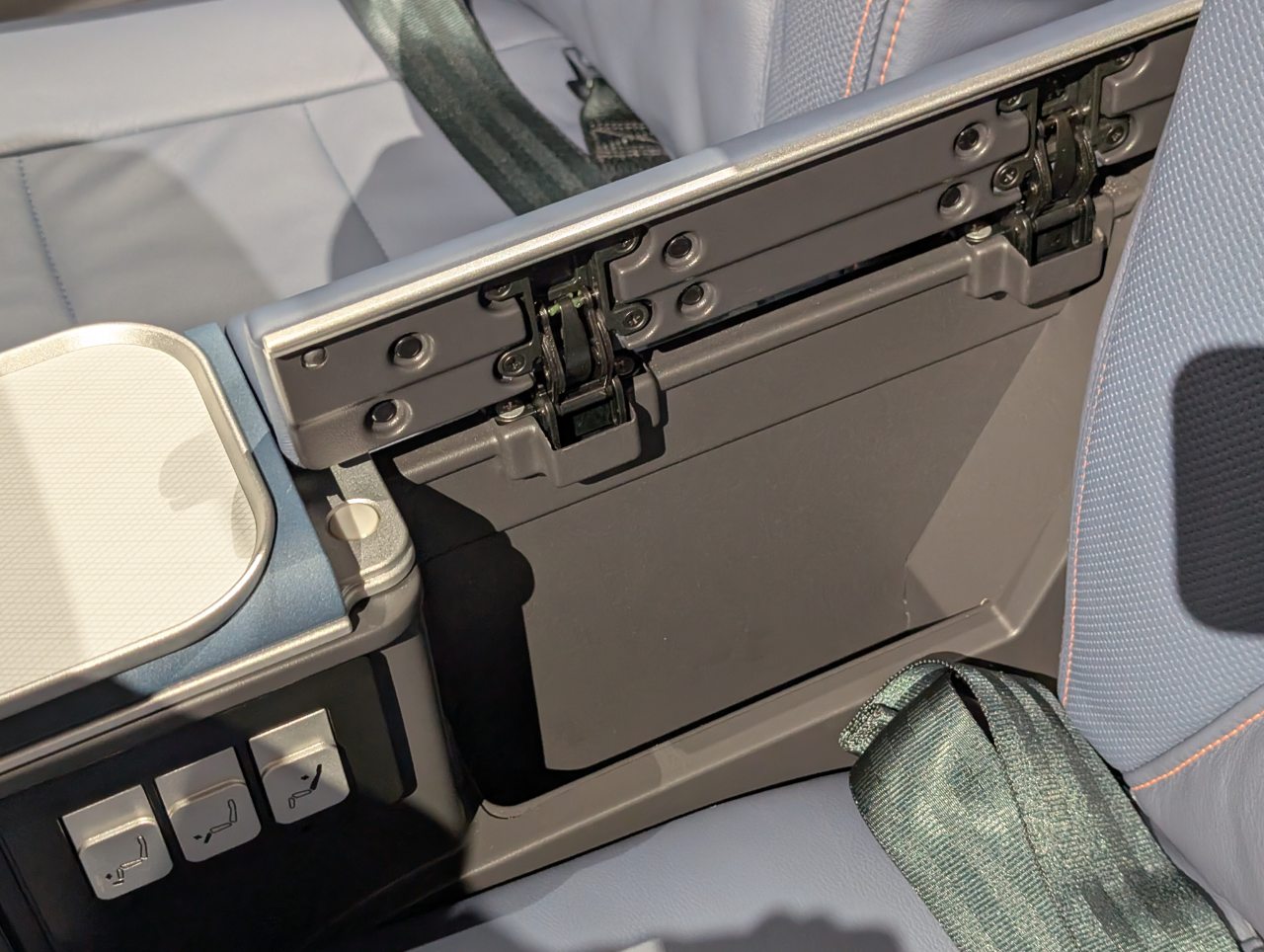
More storage can be found by lifting this flap under the armrest. I measured the pocket to be 20cm wide and 17cm high, which makes it suitable for a smartphone, e-reader, iPad mini or paperback.
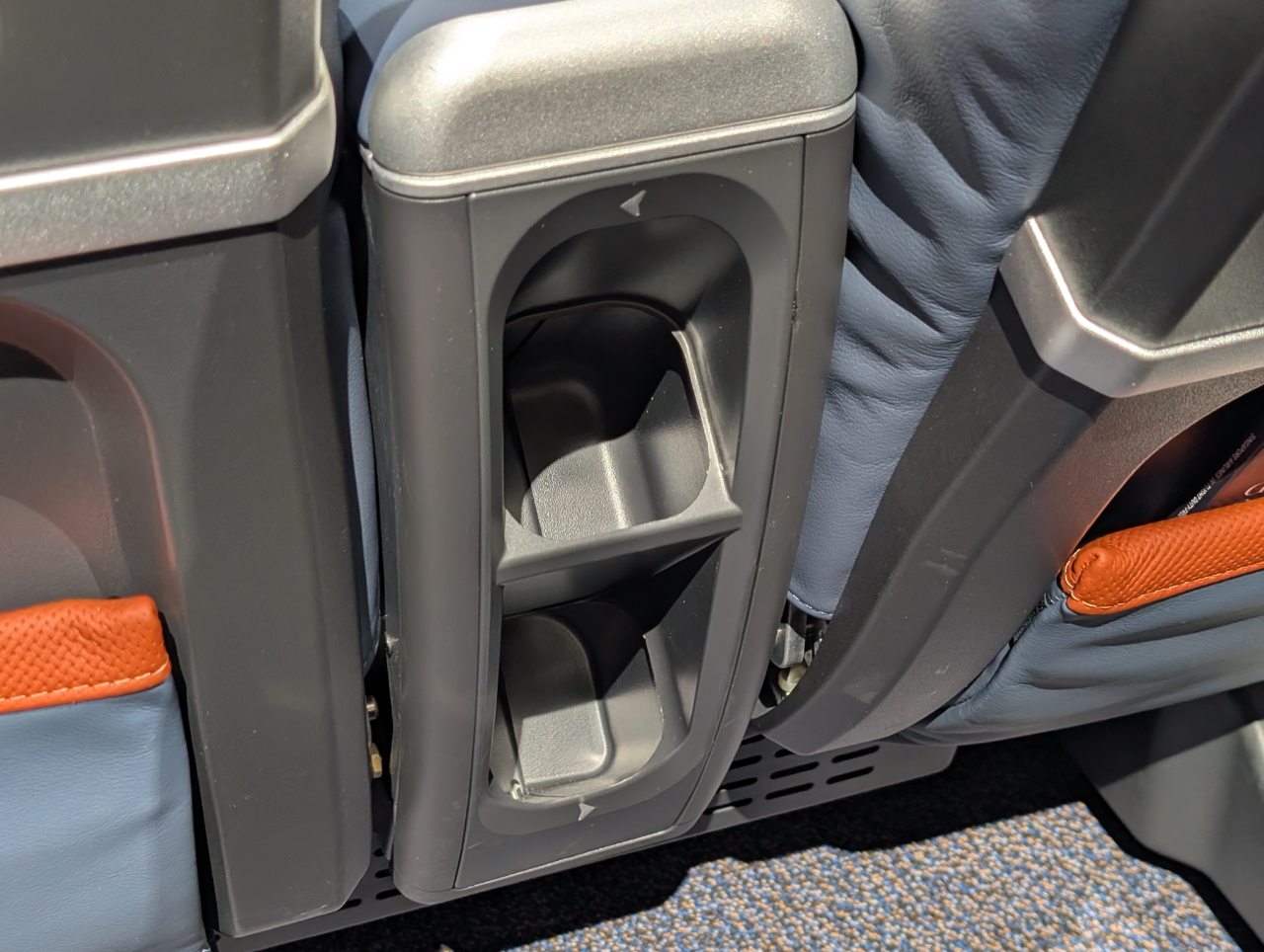
Water bottles can be stored between each pair of seats.
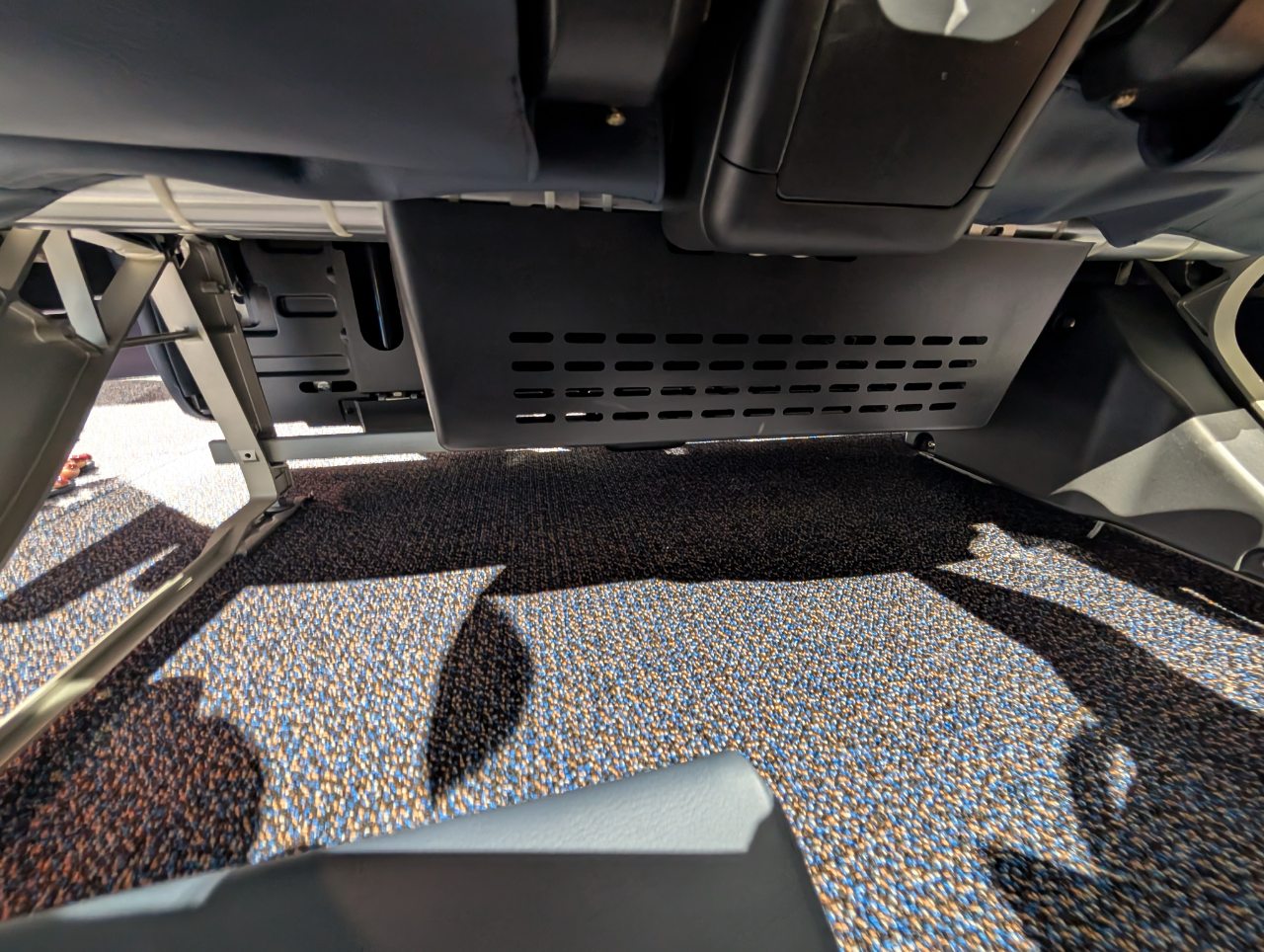
One thing that concerned me was these bulky IFE boxes beneath each pair of seats, which severely restrict the amount of space to stow bags. If you want to store a backpack down there, you’ll have very little space left for your feet.
There’s hope for the v2 aircraft, as Panasonic markets Astrova’s seat box as smaller and lighter, mounted between seat beams so it doesn’t eat into legroom. However, since v2 aircraft retain AC power in Premium Economy, it’s possible that some of the bulk comes from power conversion hardware, rather than the IFE itself. We’ll only know for sure once SIA shows off a v2 seat.
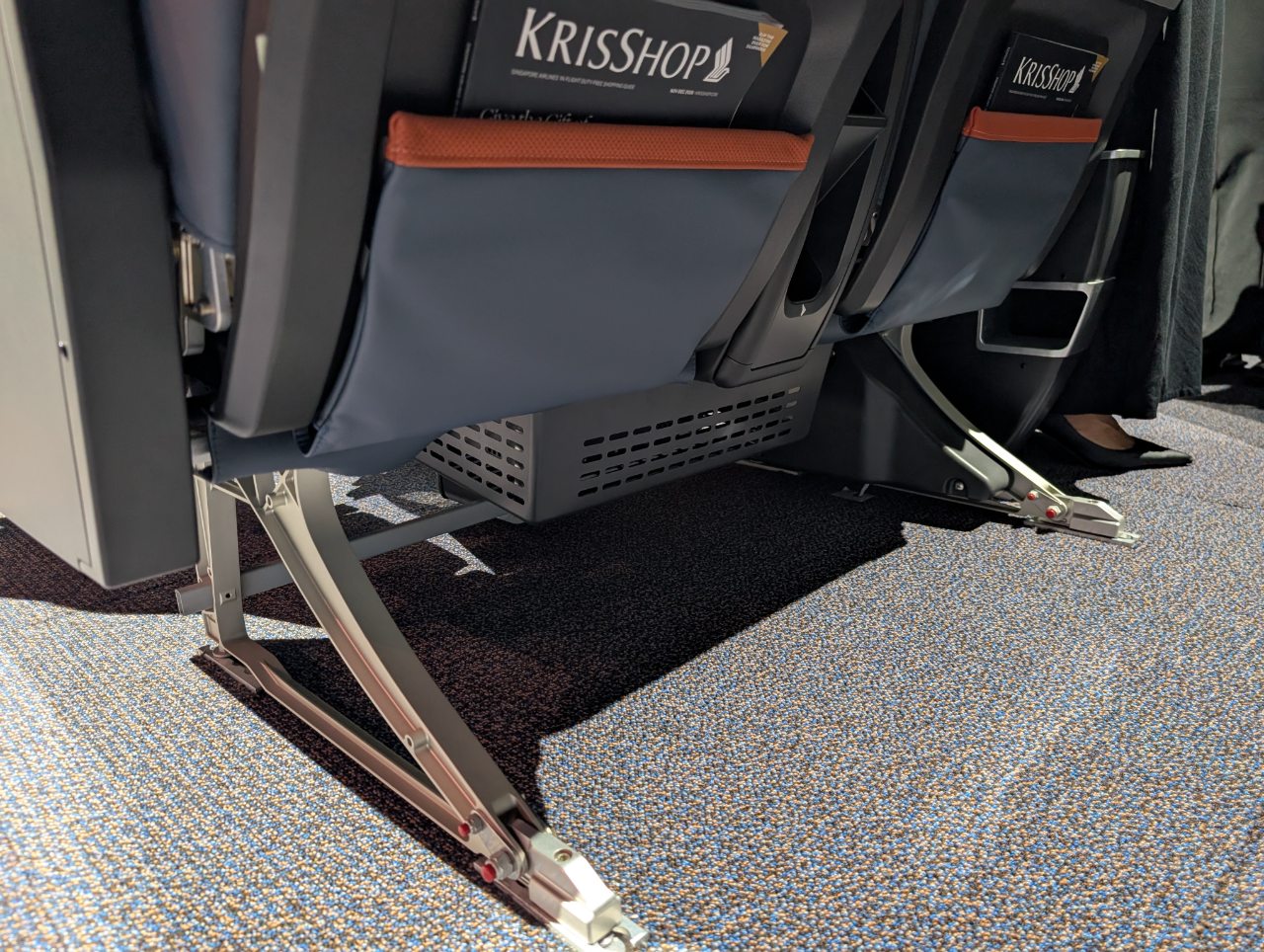 IFE box under seat
Tray table
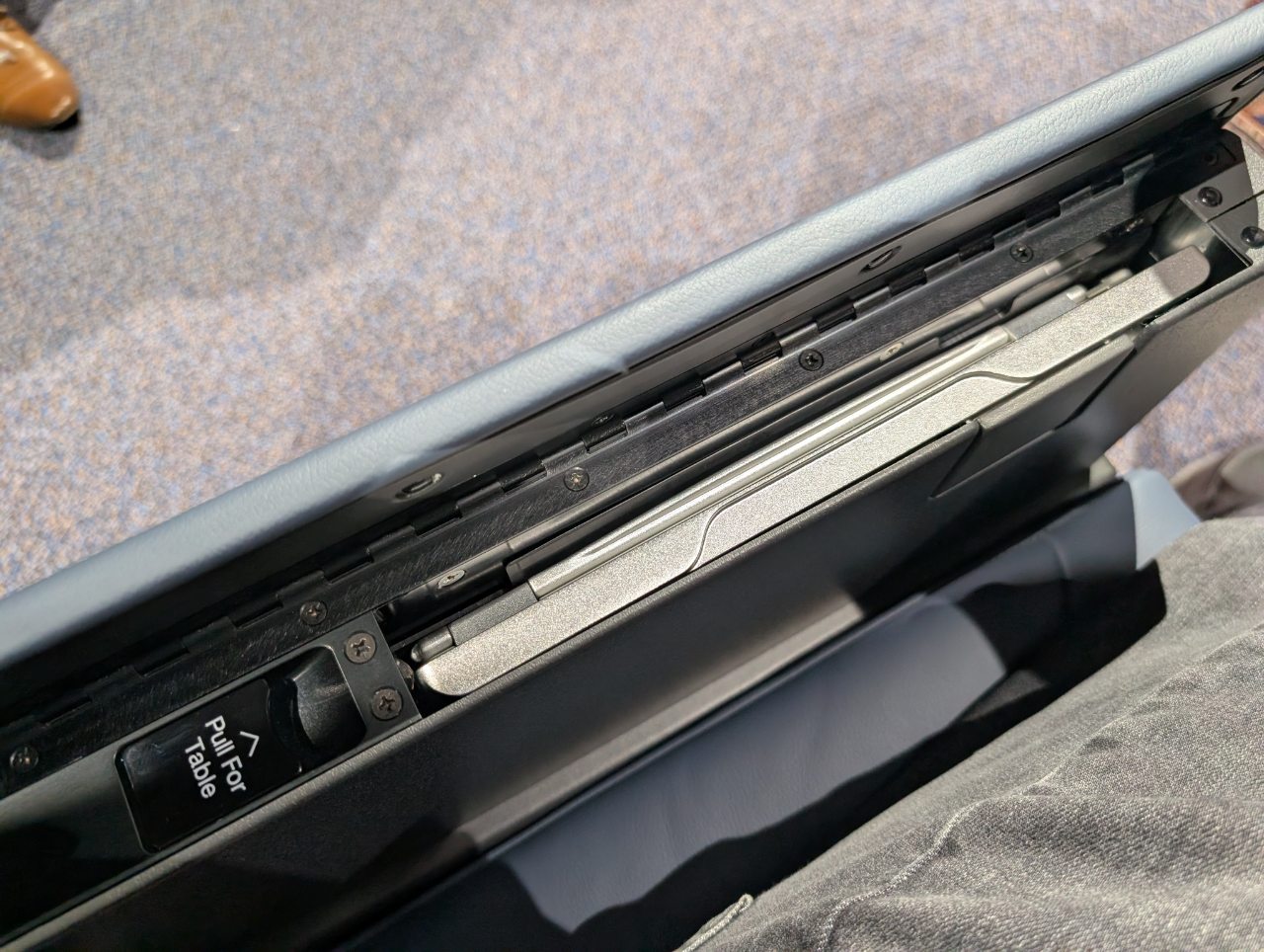
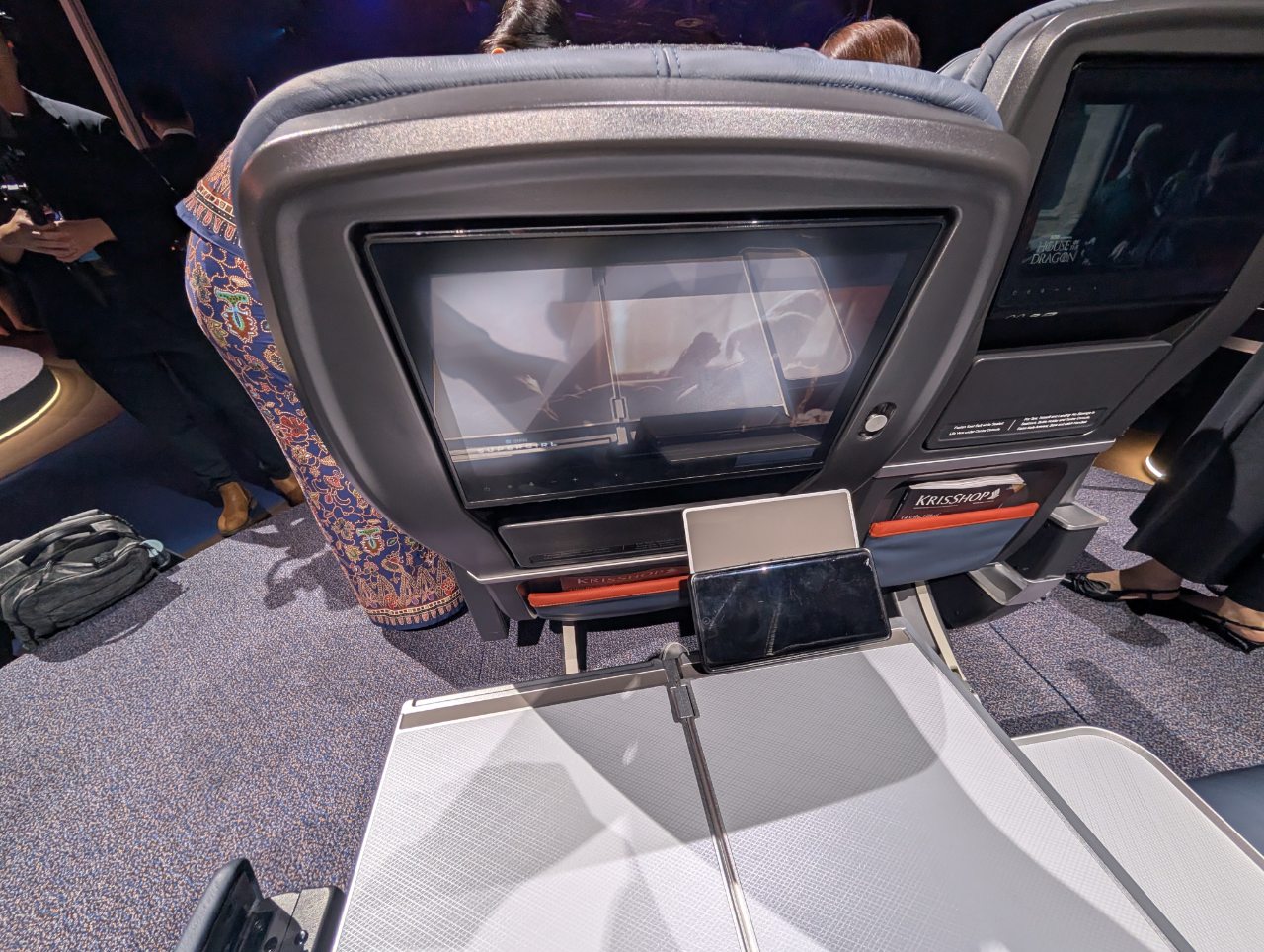
The bi-fold tray table is stored in the armrest, and can be removed by lifting a latch. On the underside is a personal device holder, so you have the option of using it as a half tray table…
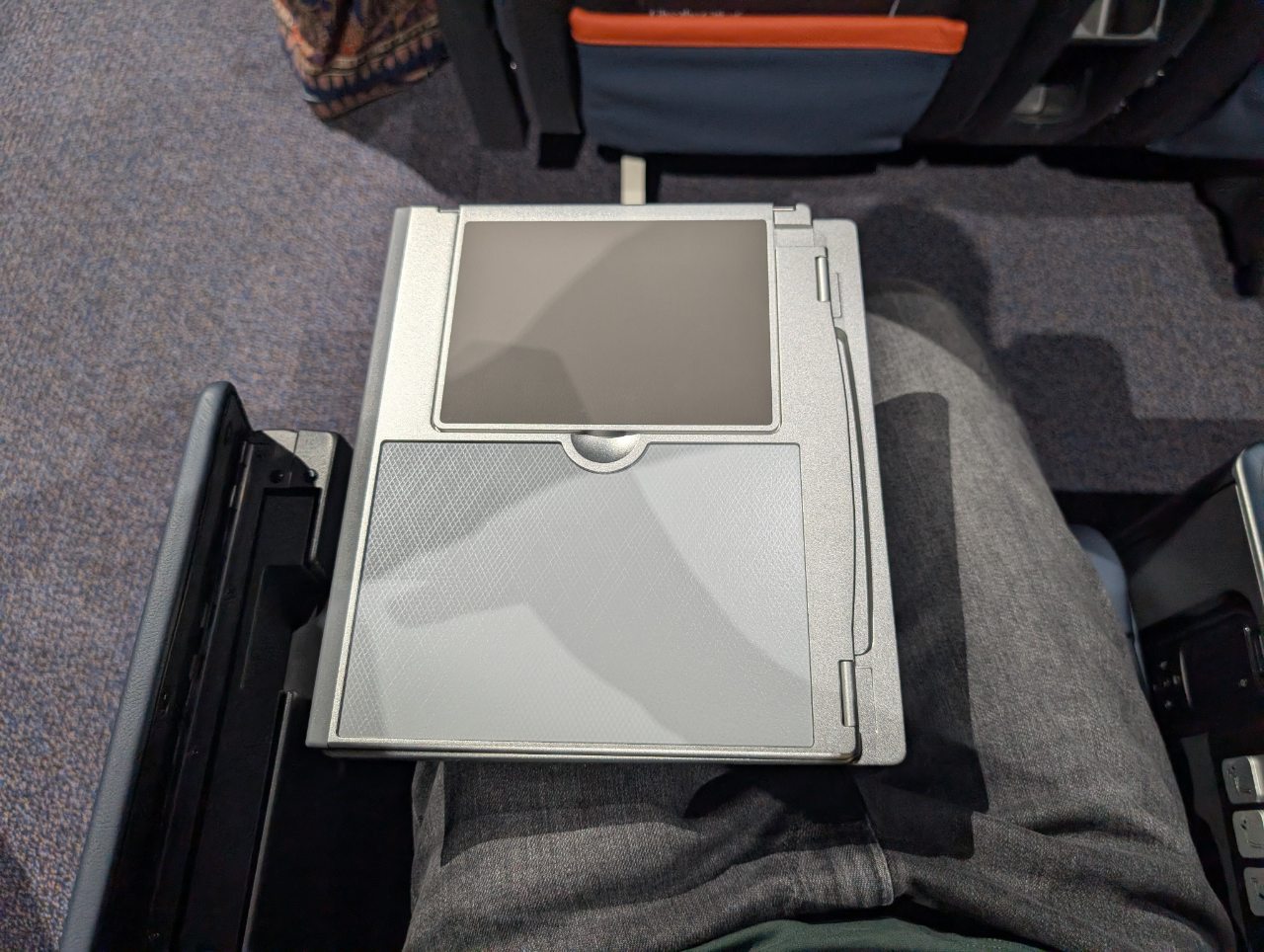
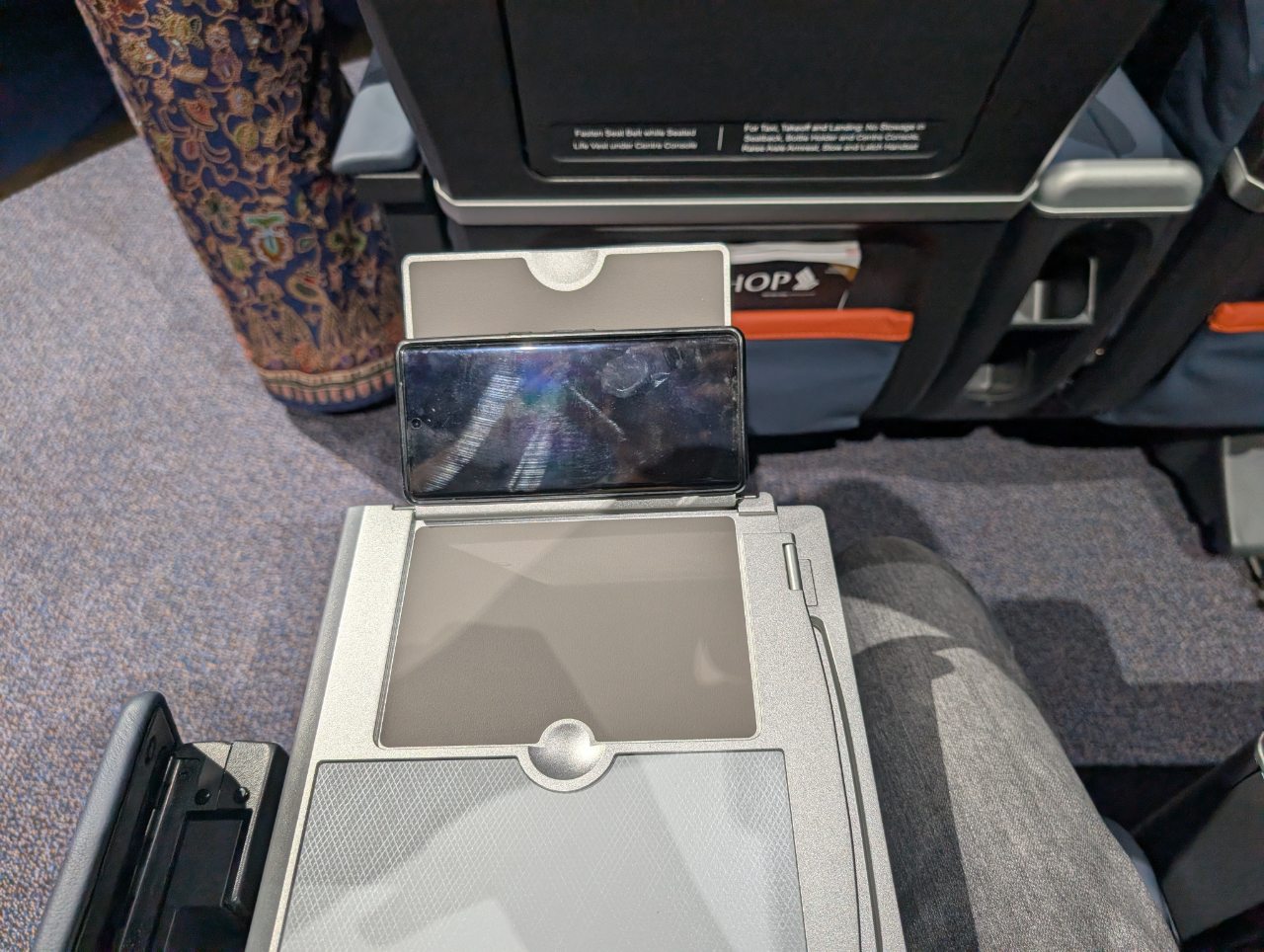
Or flipping the device holder beyond 180 degrees and using it with the full tray table. Even with the seat in front fully reclined, laptops or devices on the tray table should be safe from impact.
Charging options
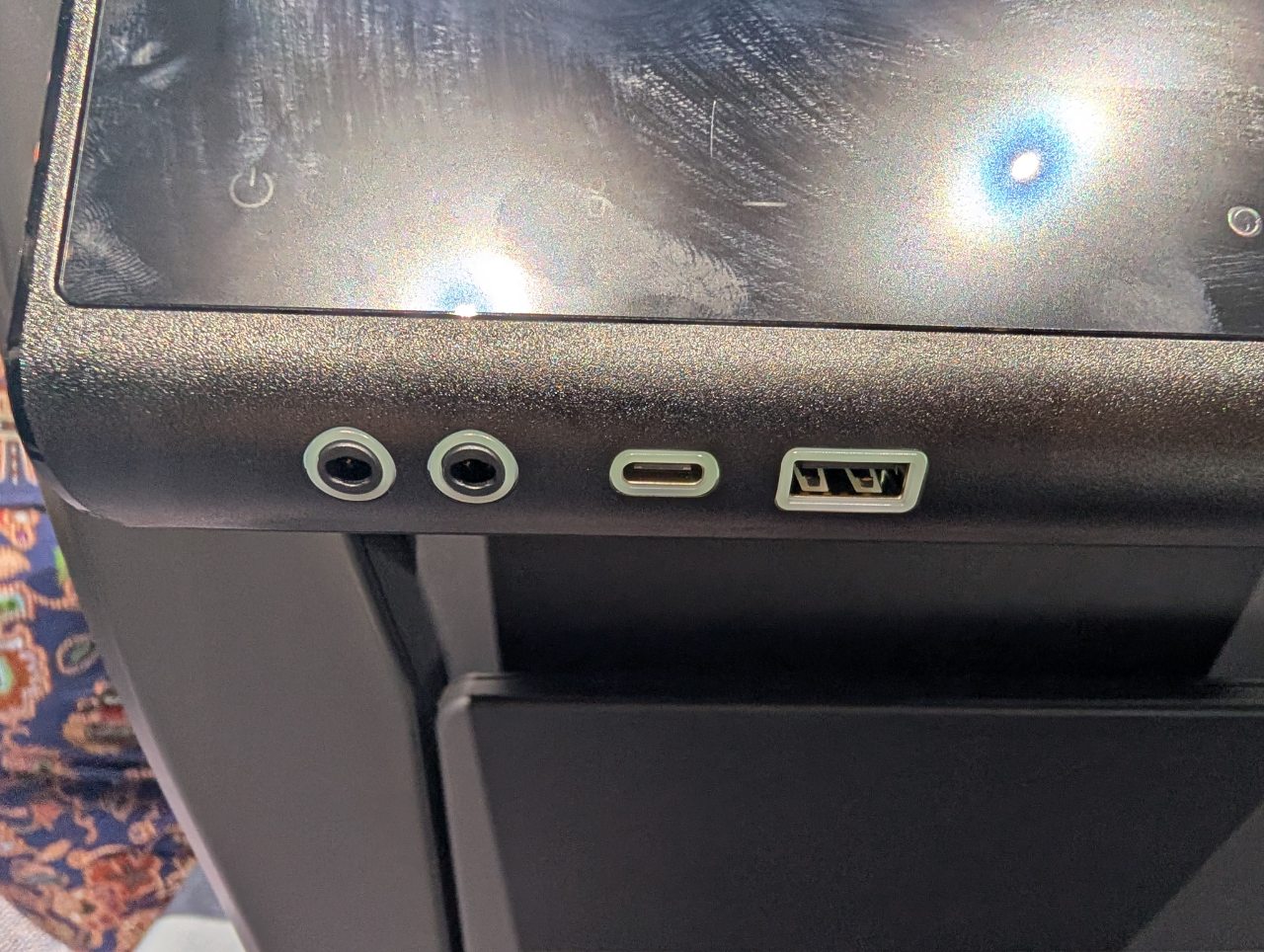
Beneath each IFE monitor is a USB-A port (only on v1 aircraft) and a USB-C port. The USB-C port will output 45W on v1 aircraft, and 67W on v2 aircraft. It’s unclear whether v2 aircraft will replace the USB-A port with a second USB-C, or just have a single USB-C.
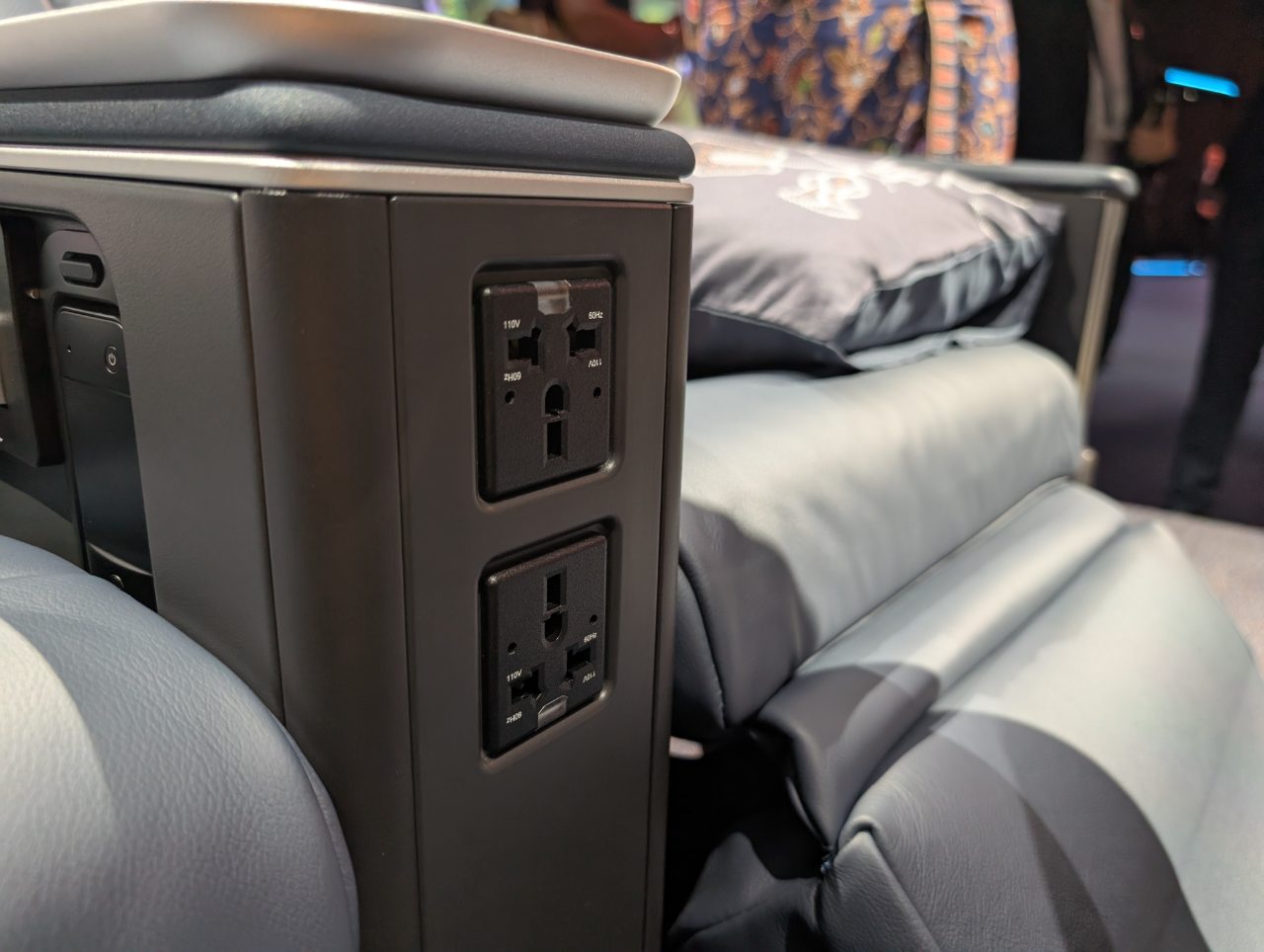
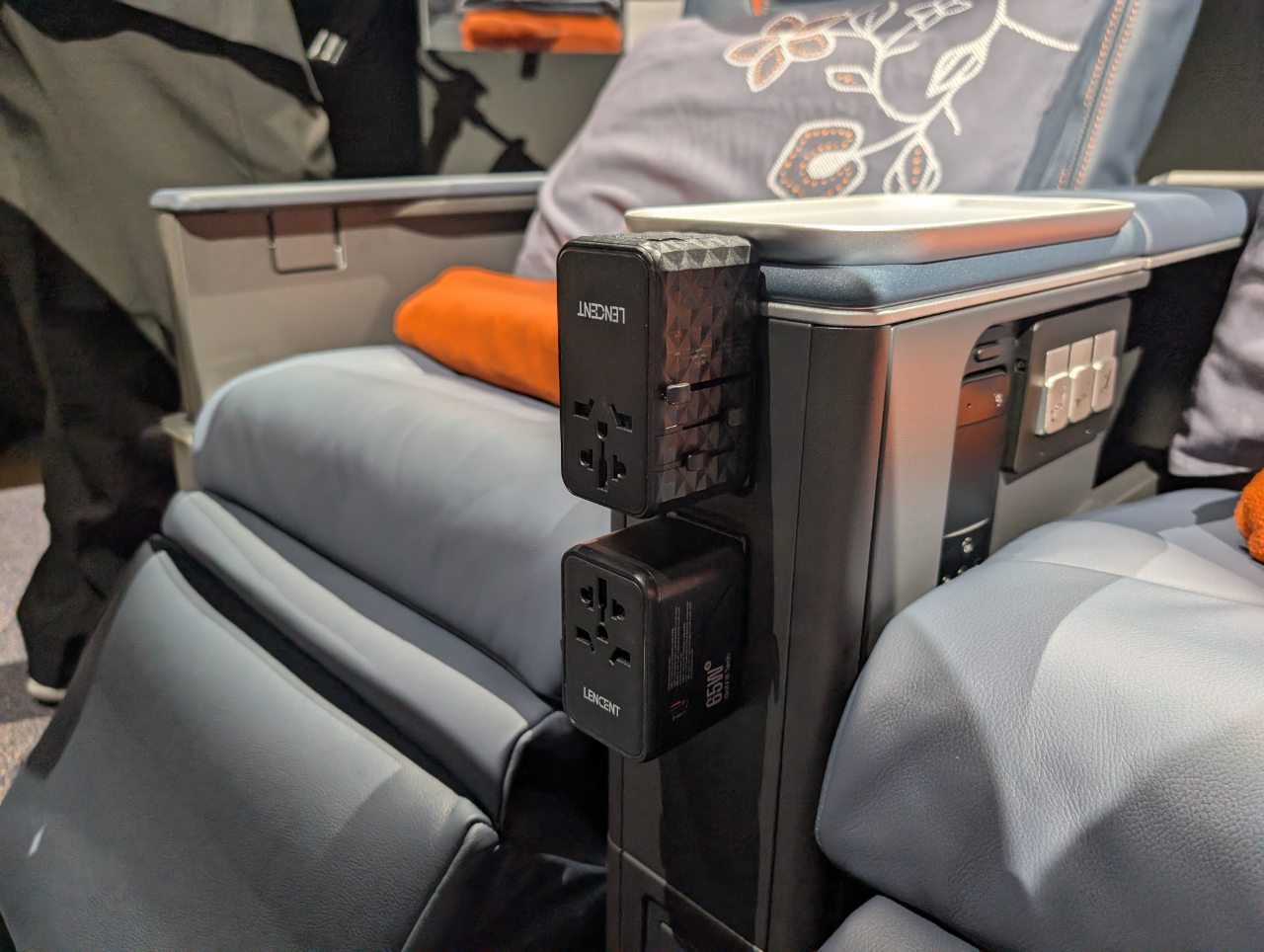
All Premium Economy passengers have individual AC power outlets, which are found between seat pairs. One points up and the other down, which means that both passengers can use universal power adapters at the same time.
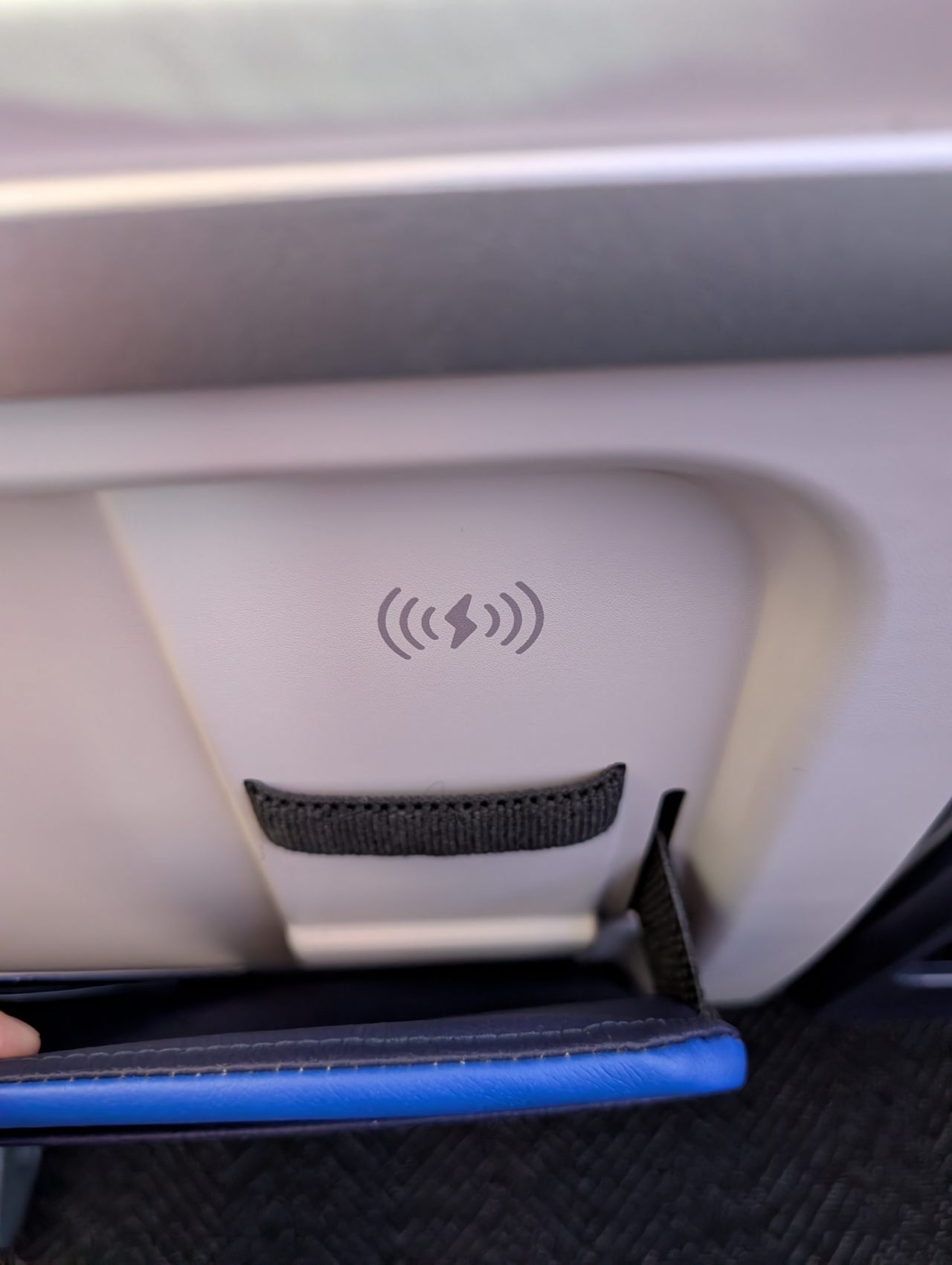
Even though several airlines have introduced wireless charging in Premium Economy, I don’t think its absence here is a big miss for SIA. There’s just so little surface space to begin with in Premium Economy that wireless charging isn’t a practical option.
In fact, on some airlines the implementation feels rather forced. On United, for example, the wireless charging pad is tucked into the seat pocket, with an elastic strap to hold the phone in place. It begs the question: if your phone is going to be in the seatback pocket anyway, why not just charge it using a wire?
Inflight entertainment screen
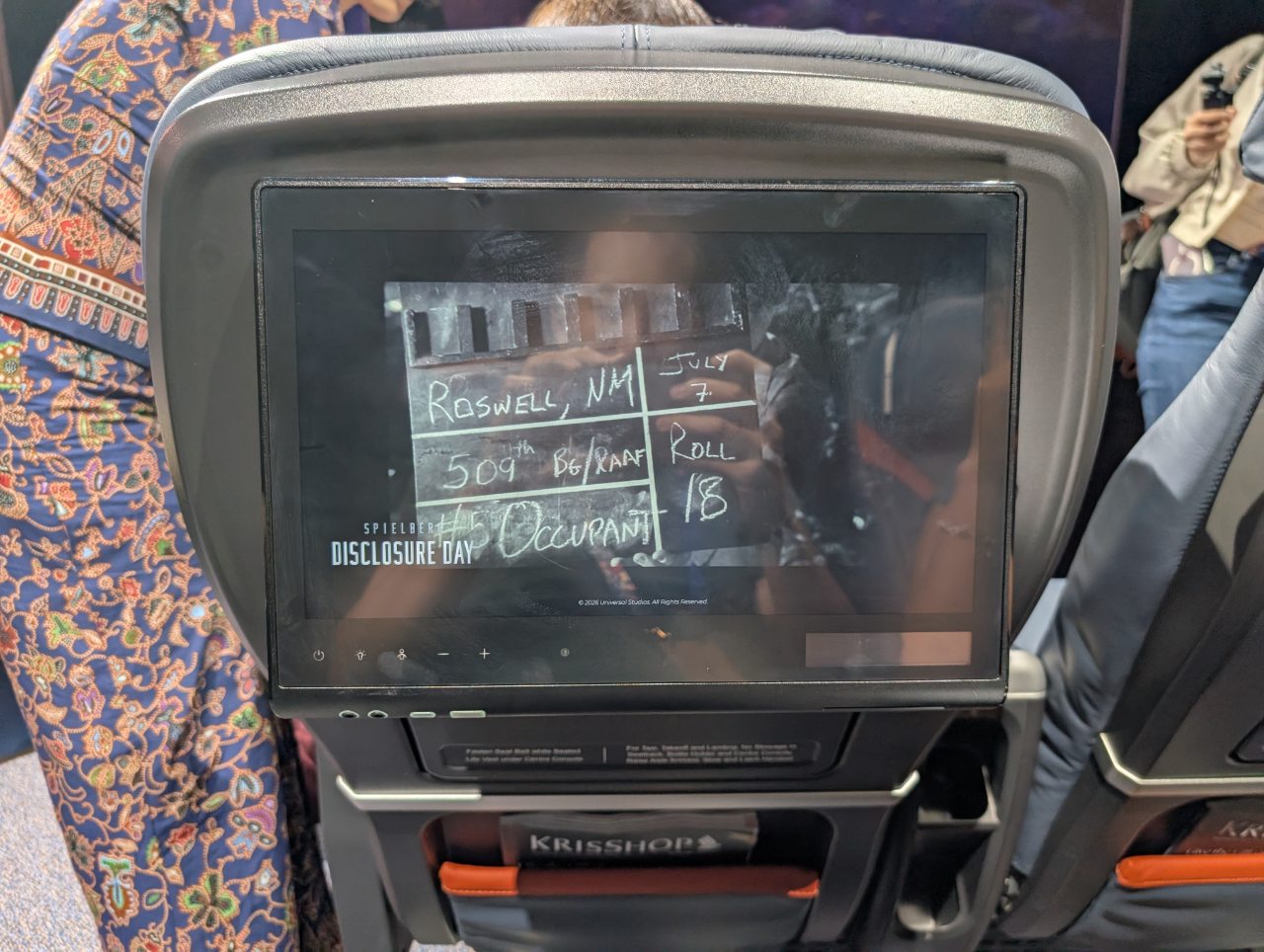
Premium Economy Class passengers have 4K touchscreens of up to 16 inches (the larger screens are for exit rows, as their screens fold out from the armrest). Bluetooth audio allows them to pair their own headphones.
The screen was quite the fingerprint magnet, and I was surprised the oleophobic coating was so weak. You can also see the anti-reflective performance wasn’t great, though it’s better to reserve judgment until we see them in an actual cabin, rather than under spotlights.
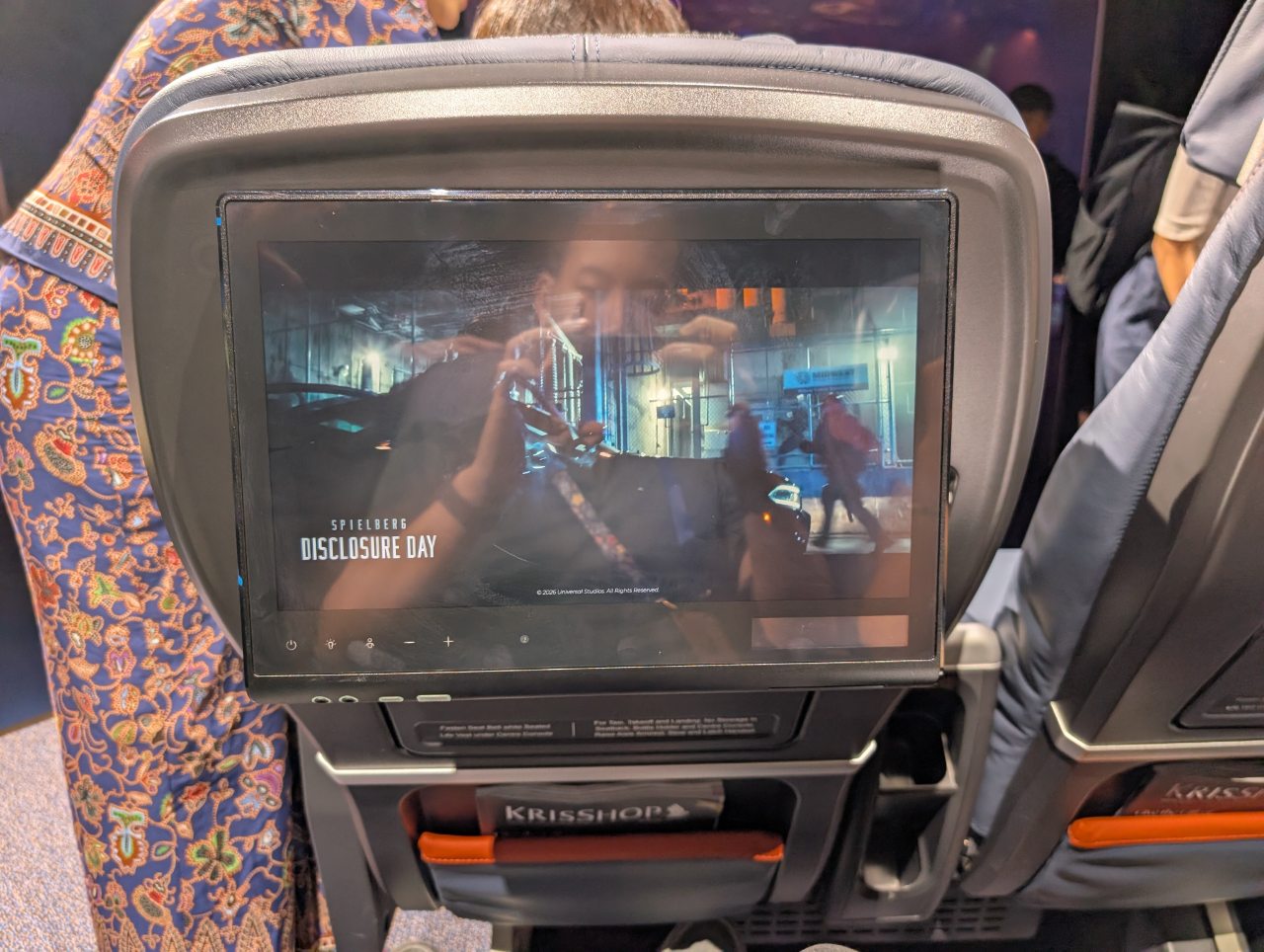
The screen can be pulled out to adjust the viewing angle (which made that harsh overhead lighting look even worse!).
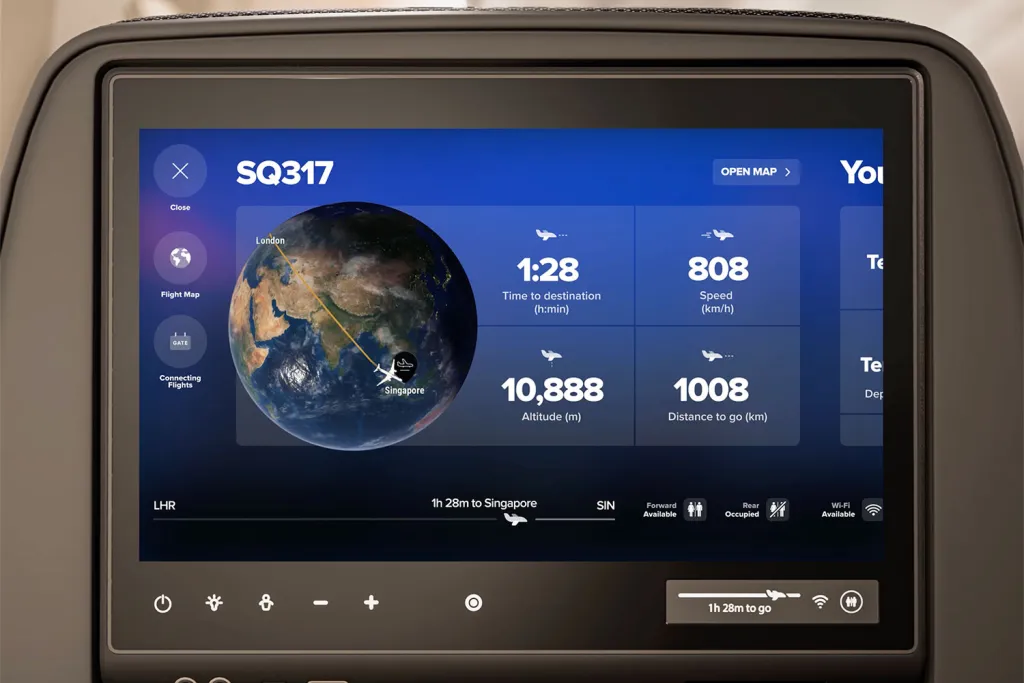
You may have spotted that screen at the bottom right-hand corner, which looks like a solar panel. It’s actually a secondary display that shows information like lavatory occupancy, Wi-Fi status and remaining flight time. Here’s what it looks like, based on a mock-up.
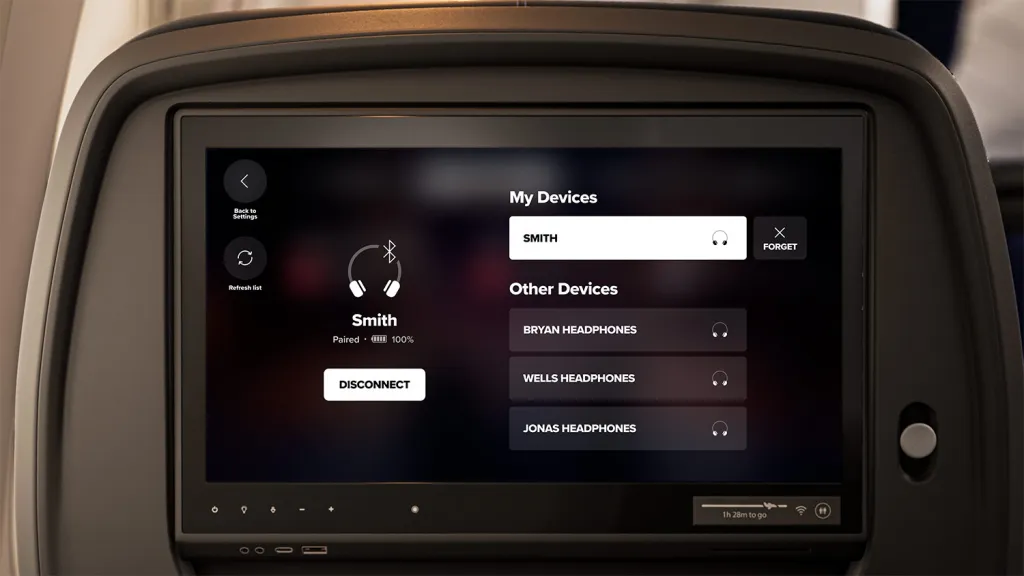
The information is useful, though it could have been integrated into the main screen itself, and the bezel size reduced. In fact, I suspect the bezels were just that large to begin with, and SIA was trying to make use of what would otherwise be dead space. That said, if this is a low-light kind of display, then I can see the value in allowing passengers to check essential information without blinding themselves and everyone around them with blue light — there’s far too much light pollution in the cabin as it is.
The bezel isn’t the only hint that this is older tech, though. When you play around with the screen, you can tell it’s not as crisp or responsive as other modern displays. I’m hopeful this will improve with the v2 aircraft, with OLED panels and Astrova.
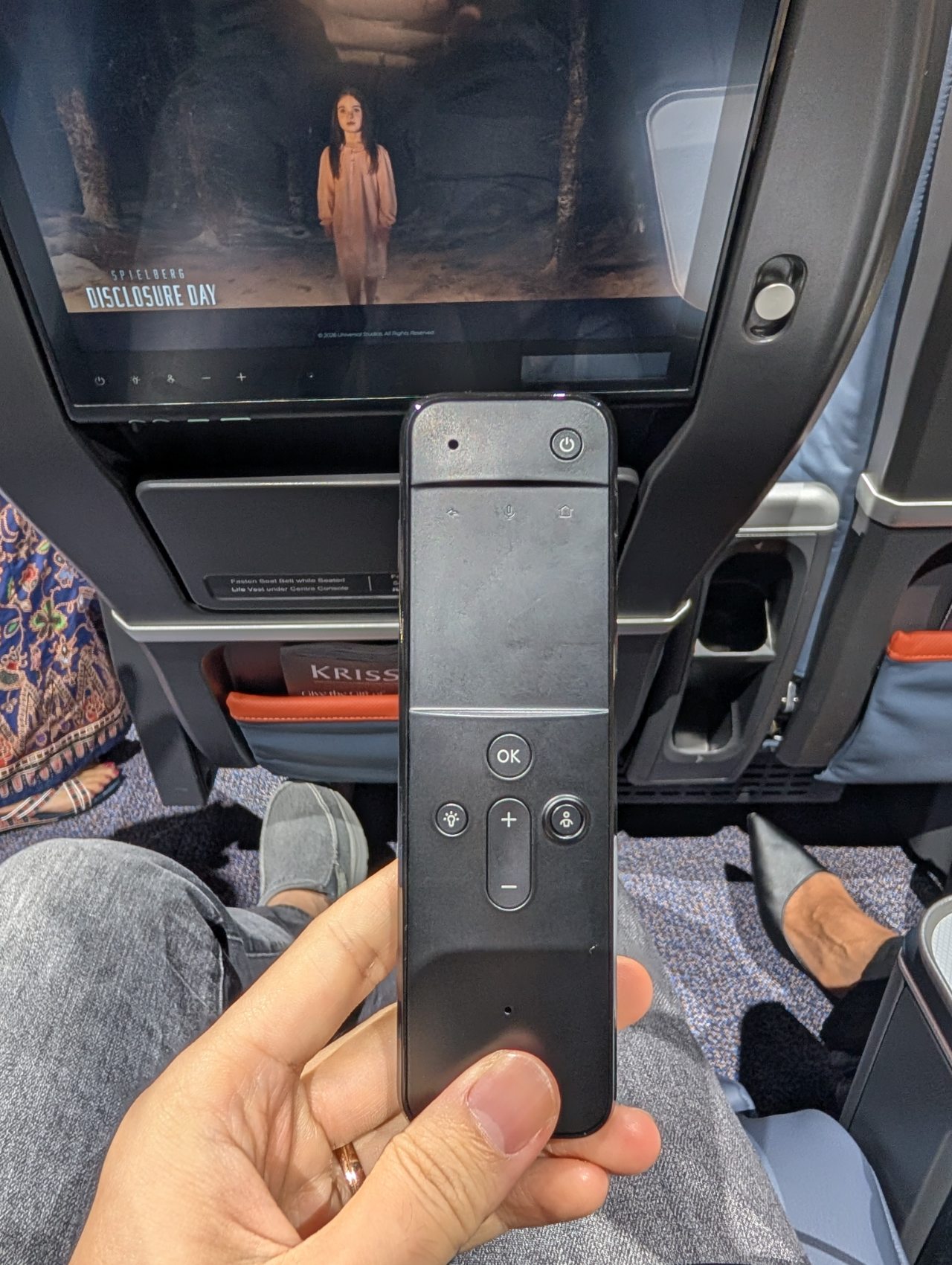
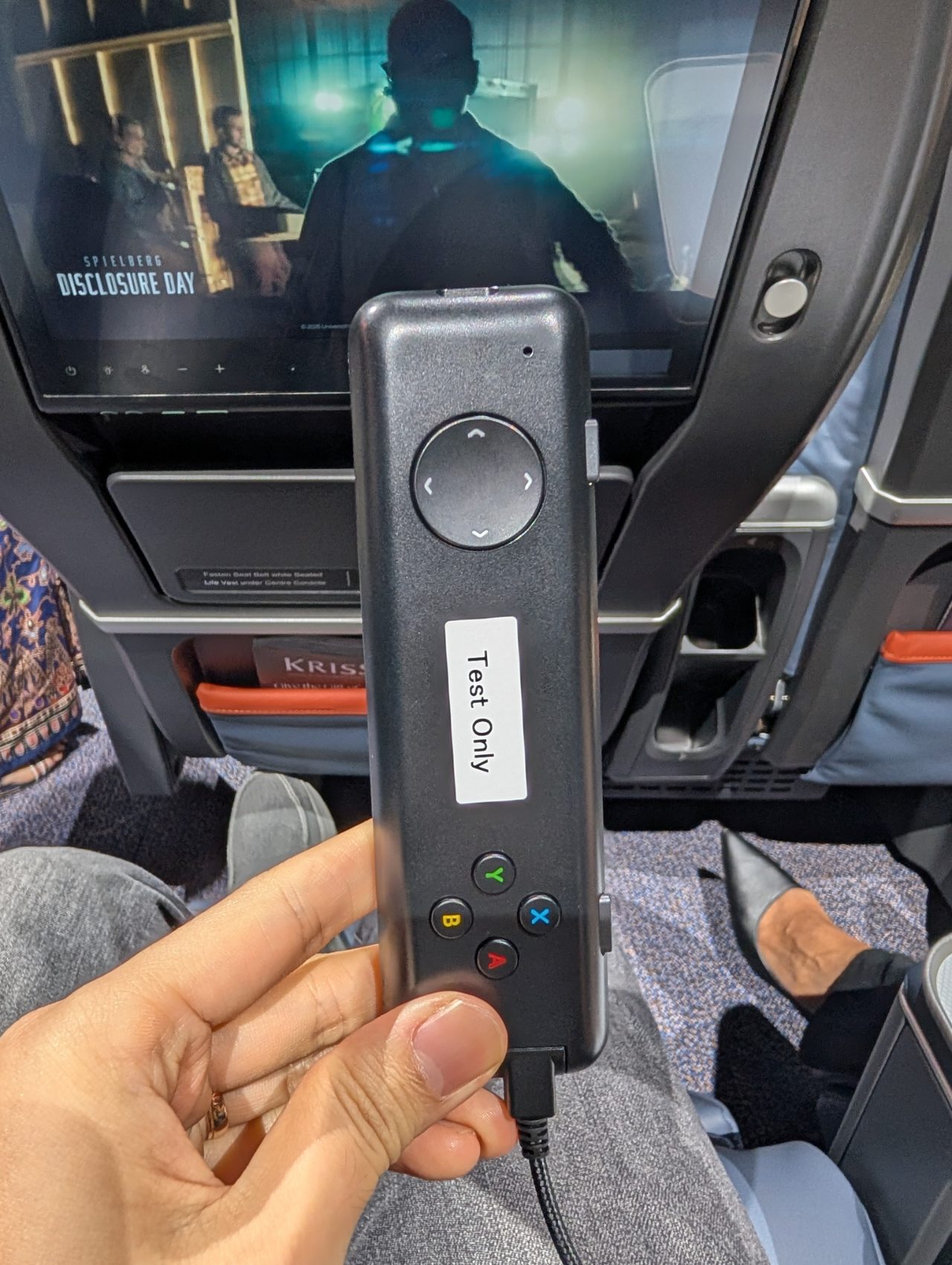
Passengers can make their selection on the screen, or use the wired remote, which has a gamepad on the reverse side.
Other features
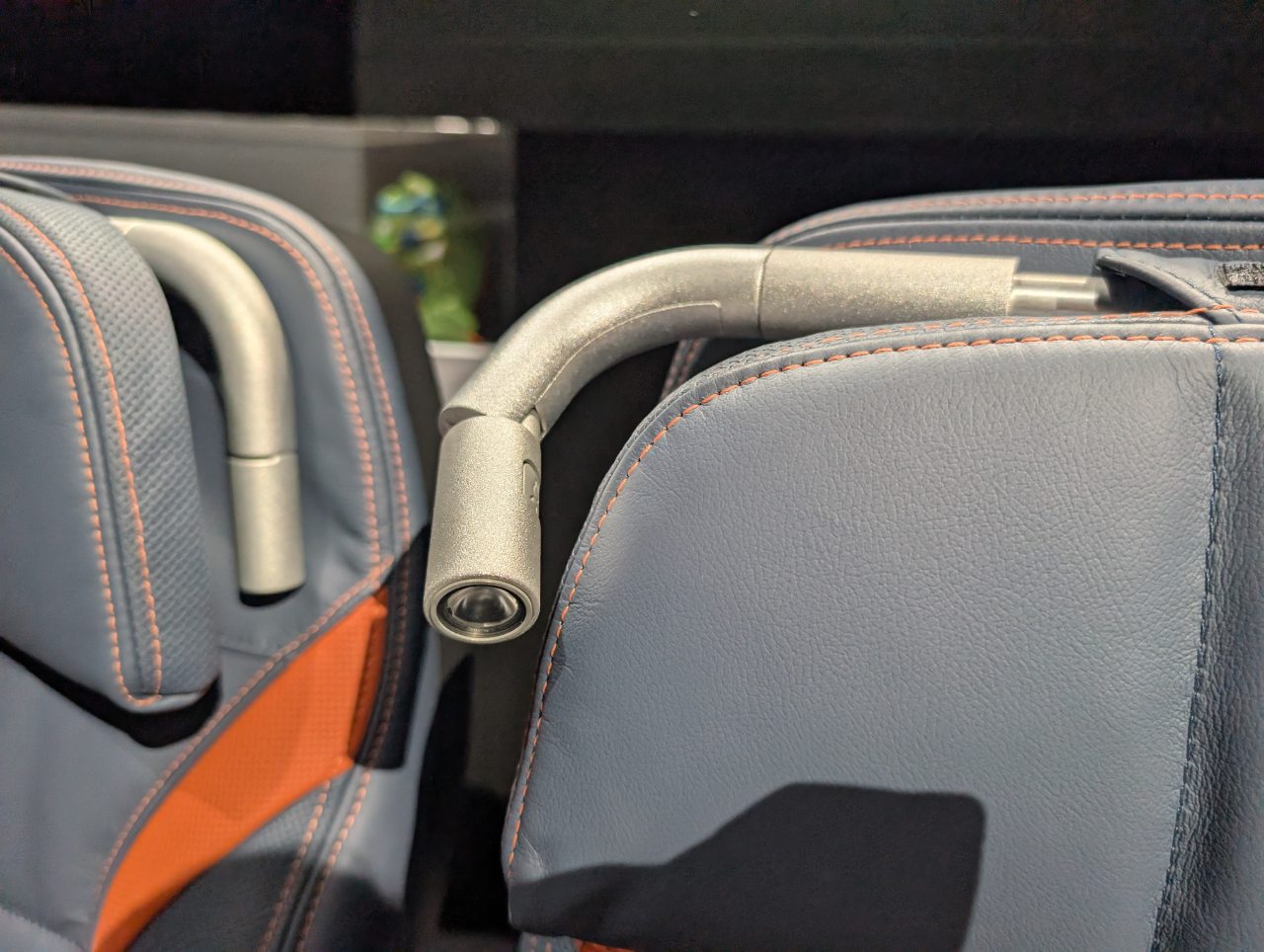
Each seat has an adjustable reading light mounted into the headrest.
There is also a cocktail tray between seat pairs with a notable lip to prevent items from sliding off, useful when you want to enjoy a drink without deploying the full table.
Economy Class
Overview
 |
||
| B777-9 v1 |
B777-9 v2 |
|
| No. of Seats | 204 | |
| Configuration | 3-4-3 | |
| Seat Pitch | 31-32″ | |
| Seat Width | 17.6″ | |
| Seat Recline | Up to 6″ | |
| IFE Screen | Up to 13″ 4K | |
| Touchscreen | ✅ | ✅ |
| OLED | ❌ | ✅ |
| Spatial Audio | ✅ | ✅ |
| Bluetooth Audio | ✅ | ✅ |
| AC Power | ✅ | ❌ |
| USB-A | ✅ | ❌ |
| USB-C | ✅ 45W |
✅ 67W |
| Wireless Charging | ❌ | ❌ |
| Other Features |
|
|
Singapore Airlines’ new Economy Class seat is manufactured by Collins Aerospace, and styled by Factorydesign.
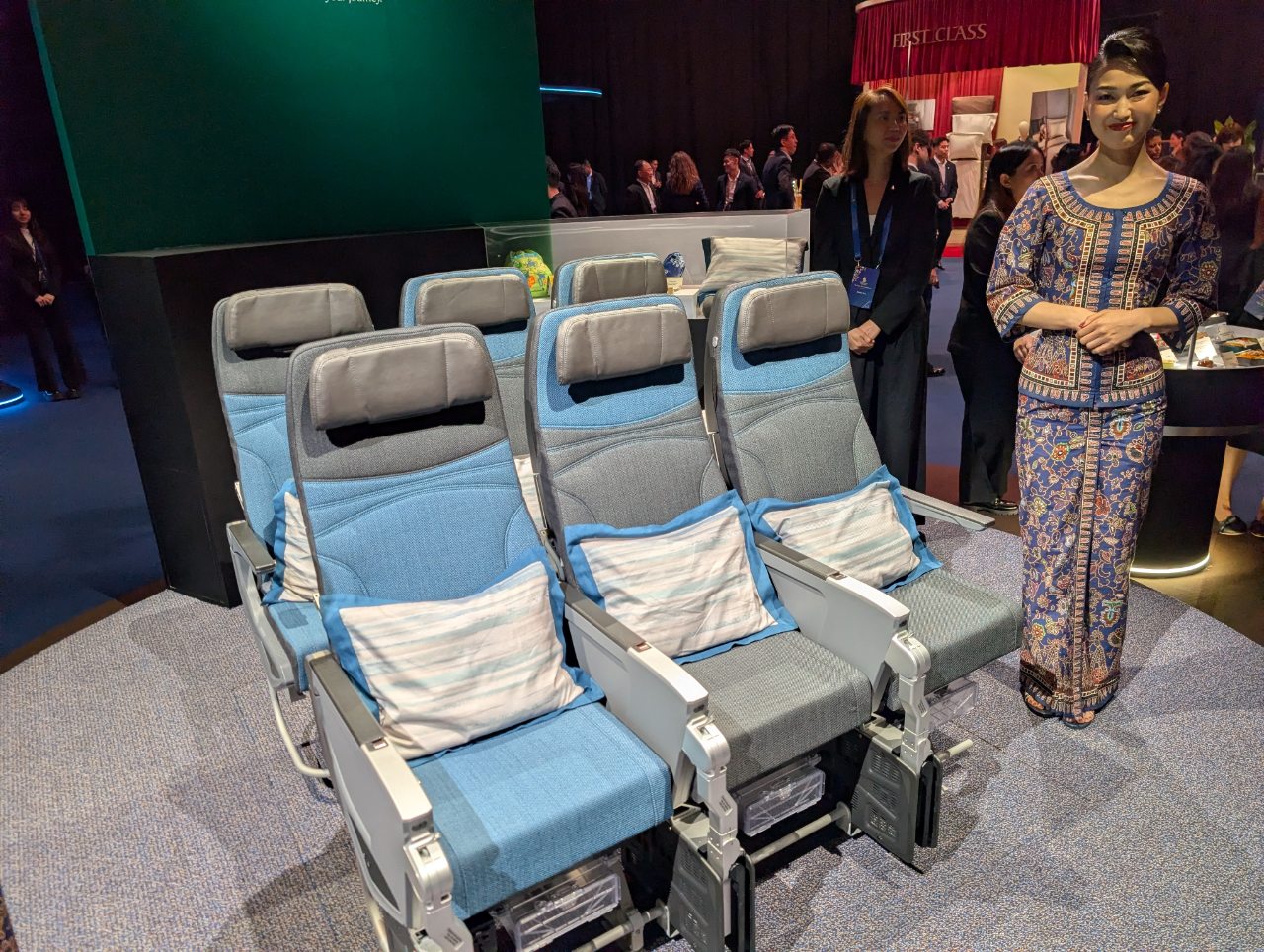
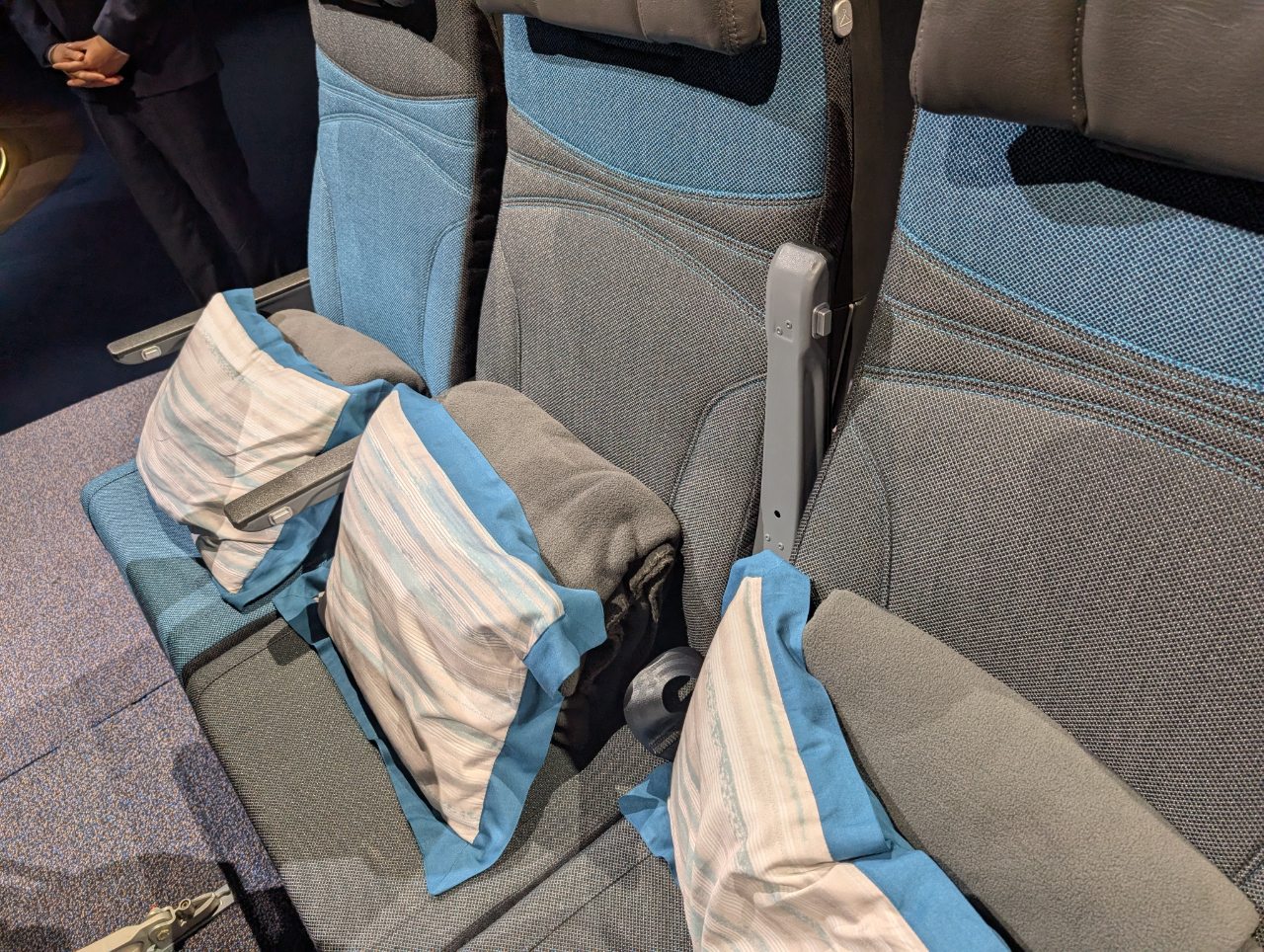
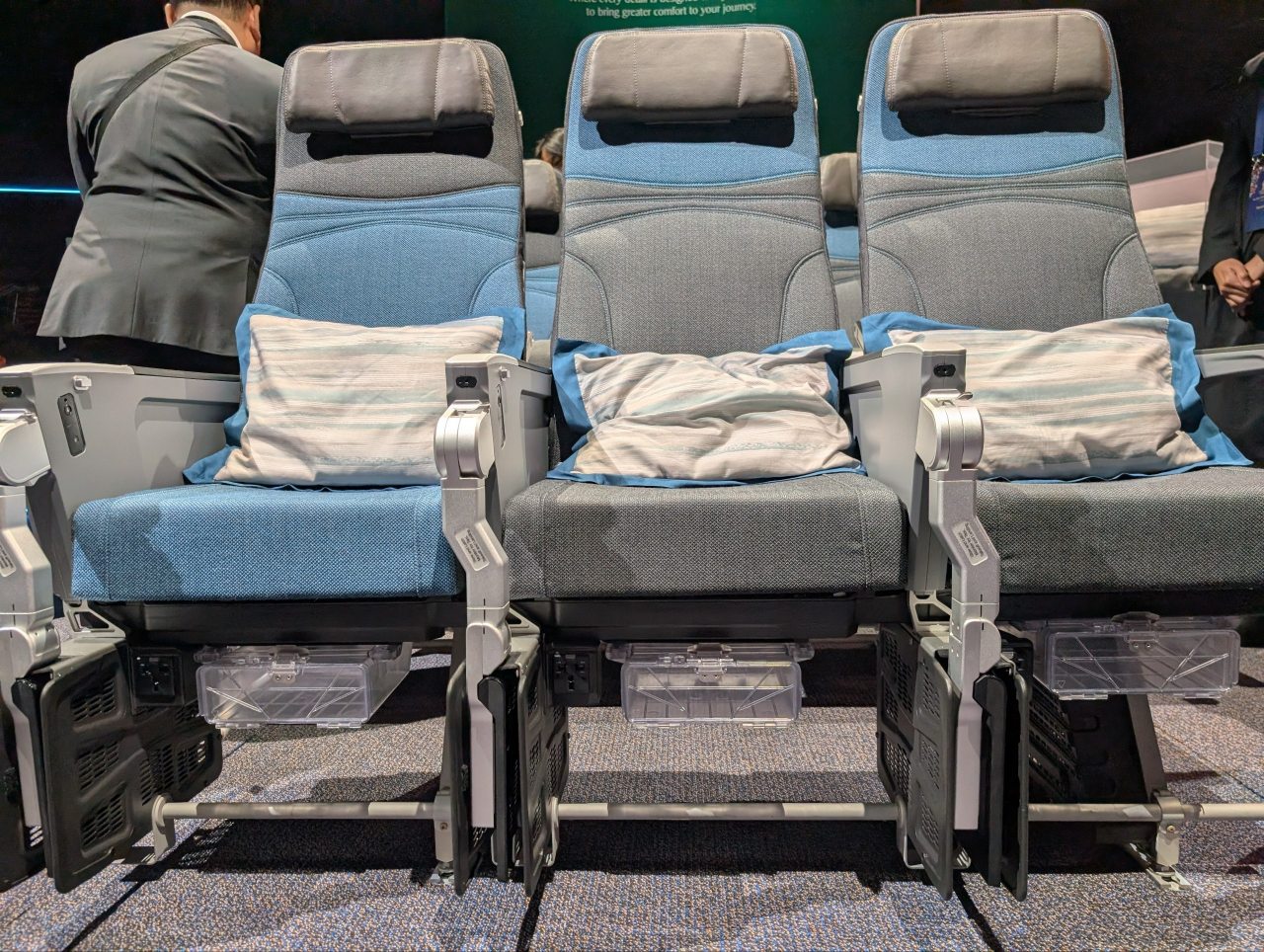
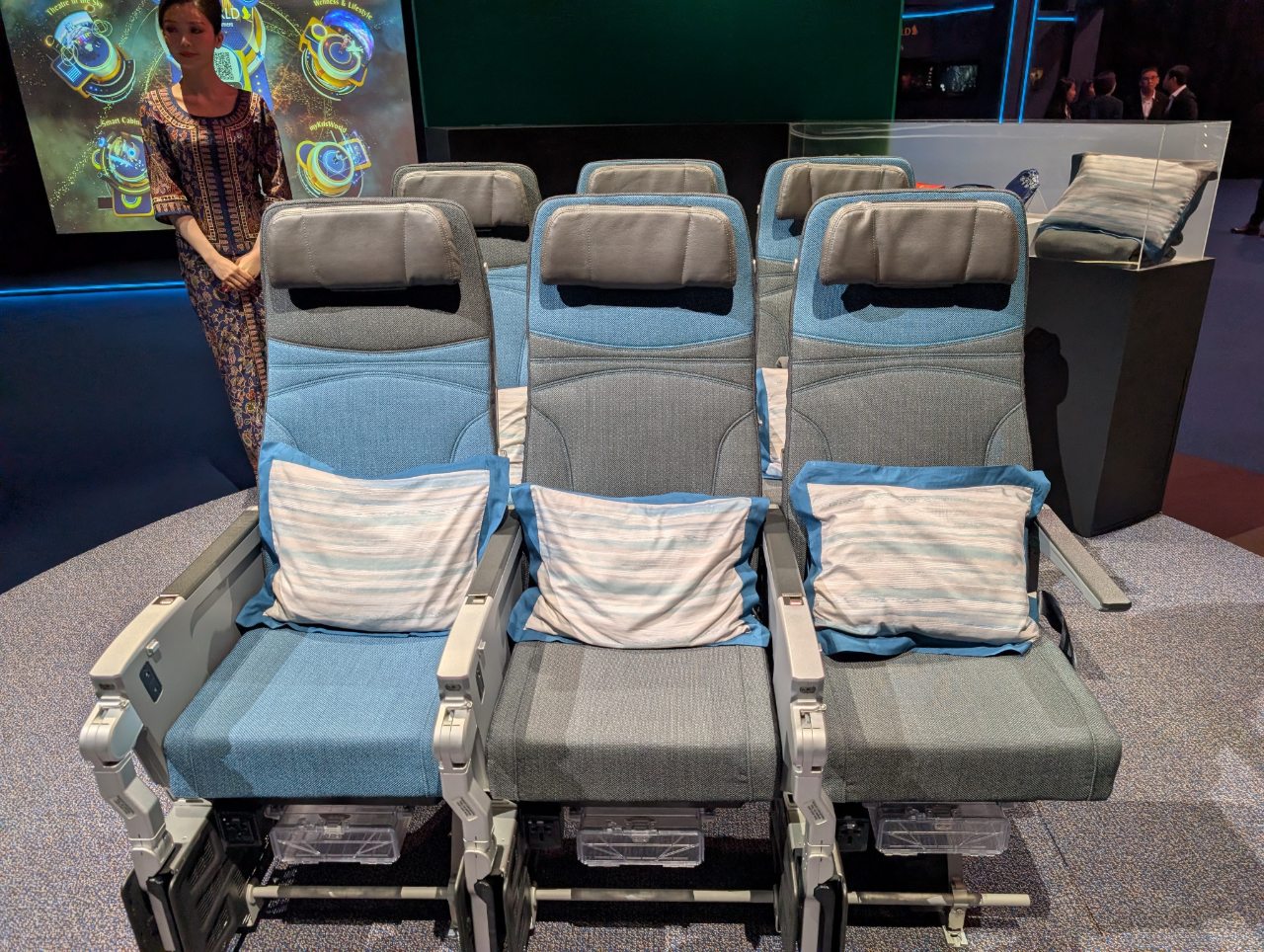
The wool-blend fabric upholstery has a unique colour scheme — though not nearly as unique as Business Class! — which uses a two-tone mix of light sky blue and mid-grey which meet along a diagonal wave rather than a horizontal line.
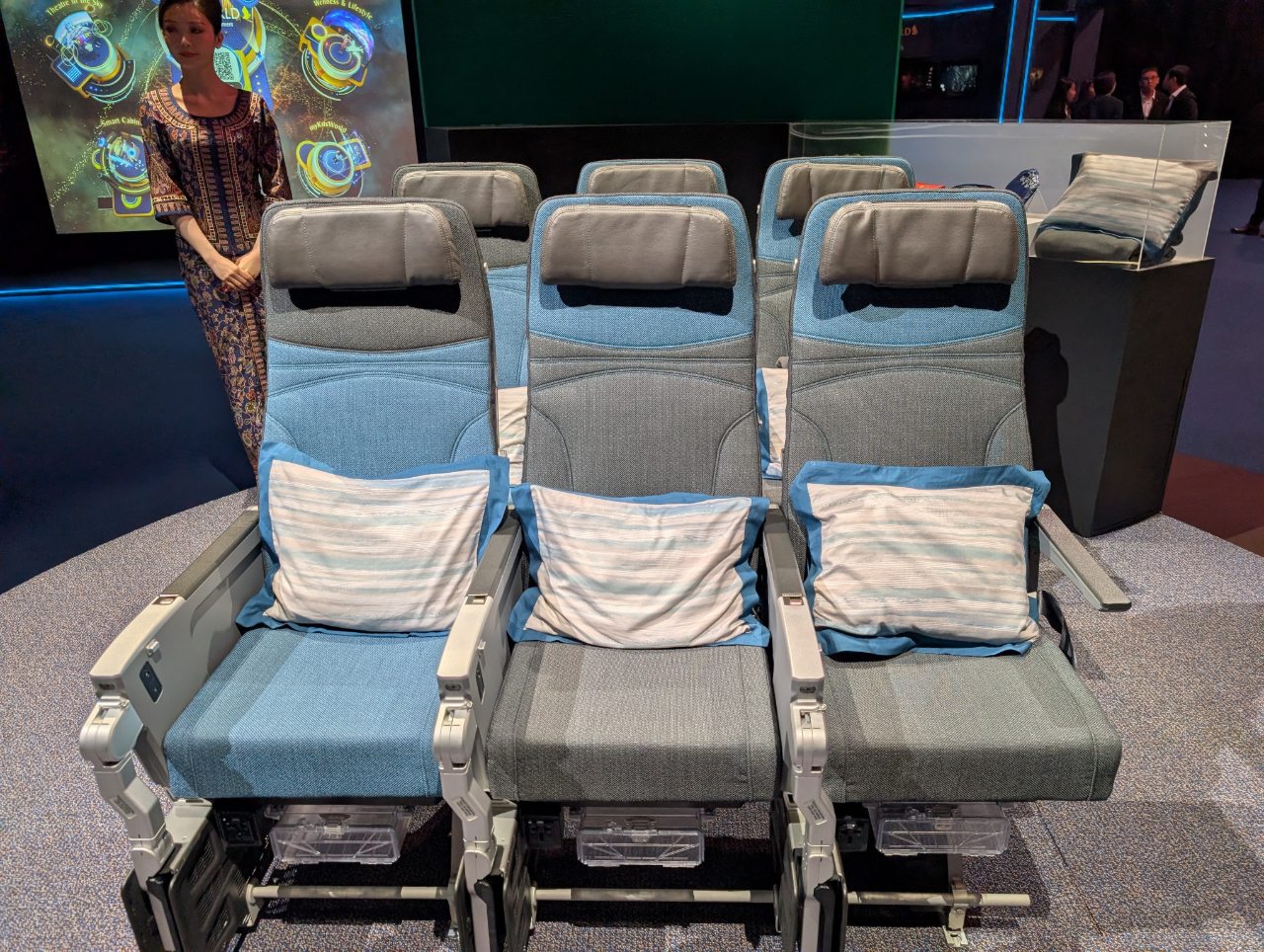
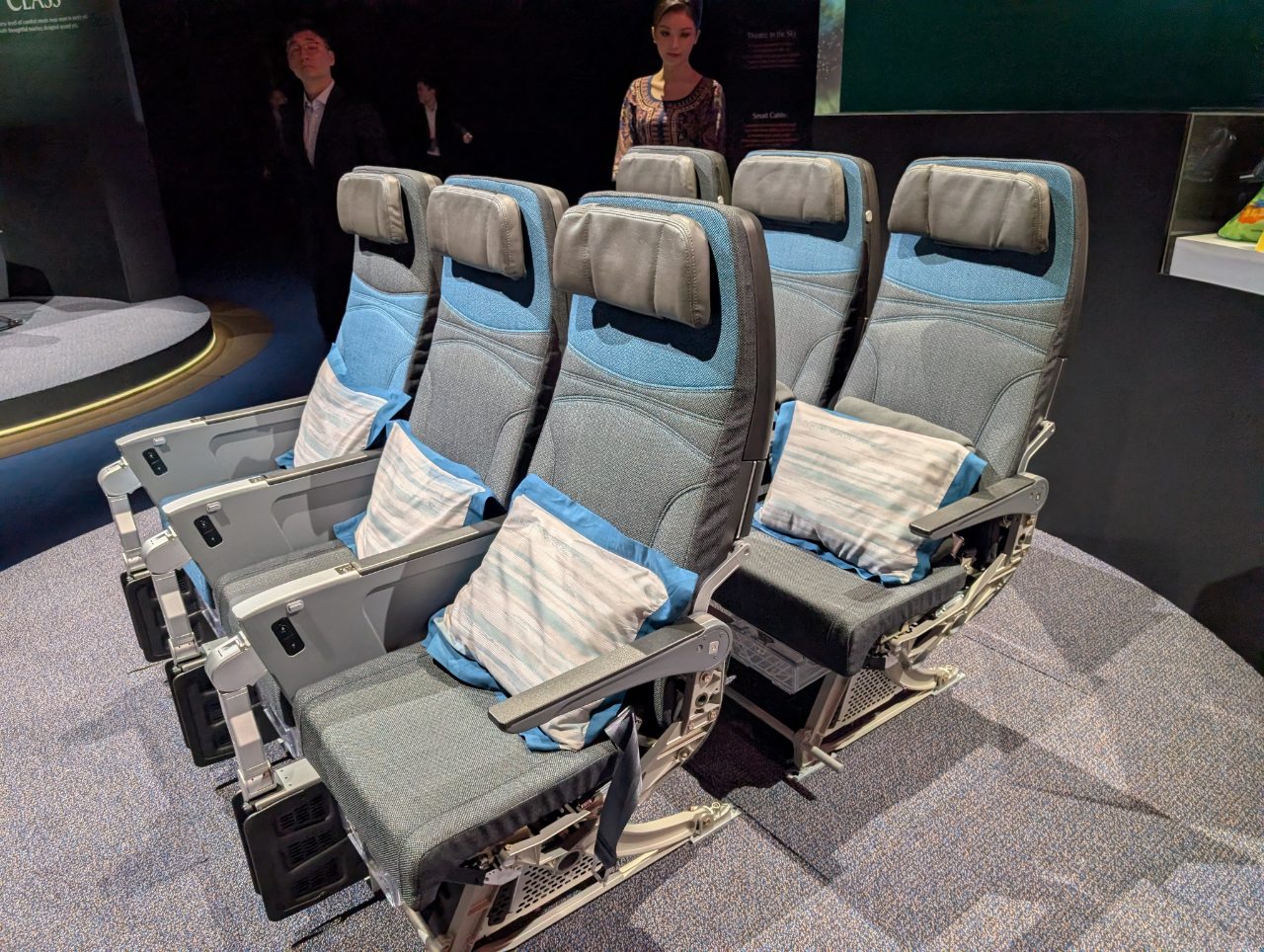
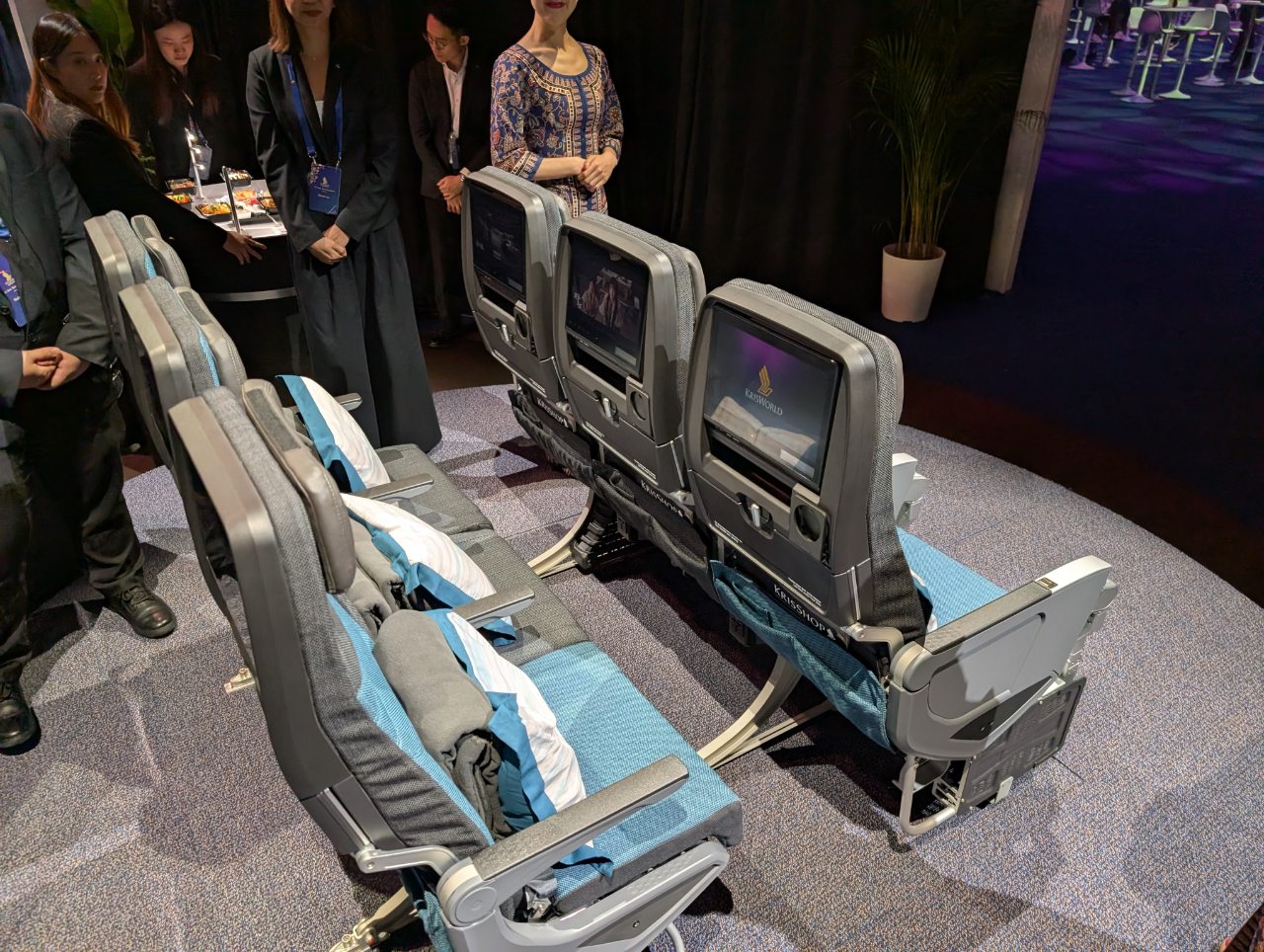
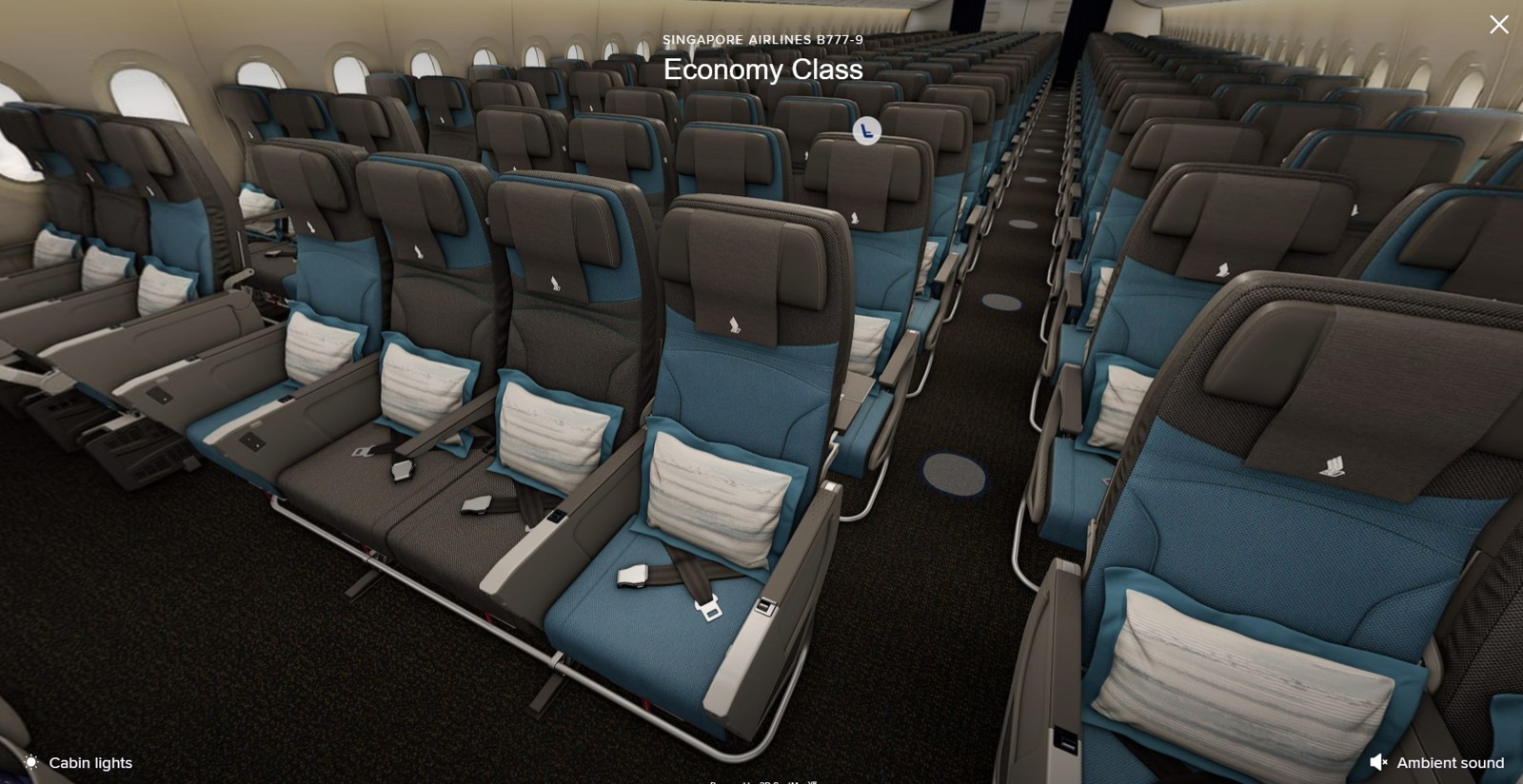
This apparent asymmetry may trigger your OCD (it certainly did for me), but calm down. The blue-dominant scheme is used for aisle seats, while window and middle seats are grey-dominant.
The static display only shows a cluster of three seats on the port side of the aircraft. You can get the full picture from SIA’s virtual cabin walkthrough.
Configuration and seat width
A total of 204 Economy Class seats will be installed on the B777-9, in a 3-4-3 configuration. This 10-across layout is one seat denser than the 3-3-3 found on the B777-300ER, which the -9 directly replaces.
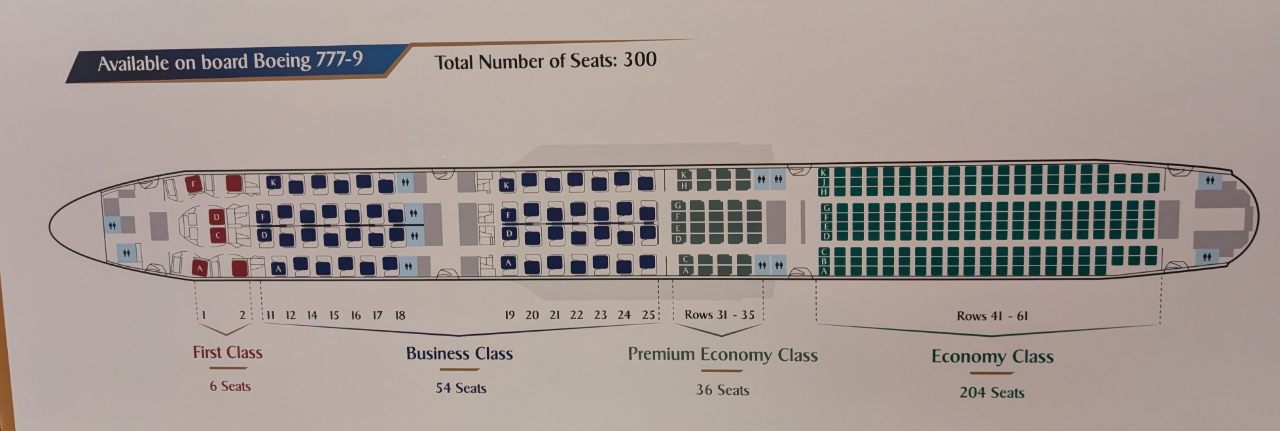
However, it’s worth noting that SIA was the outlier when it came to Economy Class in this cabin. Most of its competitors — including Emirates, Cathay Pacific and Qatar Airways — had long adopted 10-across seating on the Boeing 777. So I find it hard to knock points for that, and if anything, I think it’s commendable that SIA stuck with 9-across for as long as it did.
If it’s any consolation, the seat width hasn’t suffered as much as you might think. Thanks to thinner walls, the B777-9’s cabin is four inches wider than the B777-300ER’s, so seat width “only” drops by 1.4 inches to 17.6 inches.
It’s not quite SIA’s narrowest seat — that accolade is held by the Boeing 787-10, marginally smaller at 17.5 inches. However, the B787-10 is meant for regional routes of up to seven hours, while the B777-9 will be rostered on globe-spanning missions. I mean, the narrowbody Boeing 737-8 MAX just beats it at 17.7 inches!
| Aircraft | Economy Layout | Seat Width |
| B777-300ER | 3-3-3 | 19 inches |
| A380-800 | 3-4-3 | 18.5 inches |
| A350-900LH A350-900MH |
3-3-3 | 18 inches |
| 737-8 MAX | 3-3 | 17.7 inches |
| B777-9 | 3-4-3 | 17.6 inches |
| B787-10 | 3-3-3 | 17.5 inches |
Non-aisle armrests can be raised, so if you’re travelling with a companion you can eke out some additional real estate.
Another implication of the new layout is that 4 in 10 seats will be middles, up from 3 in 9, and the share of aisle and window seats will likewise fall.
We can mourn the squeeze, but it ultimately boils down to a commercial decision. Economy passengers, by and large, make selections based on fares and schedule. If 10-across seating enables lower fares, then that’s what will carry the day.
Seat pitch and legroom
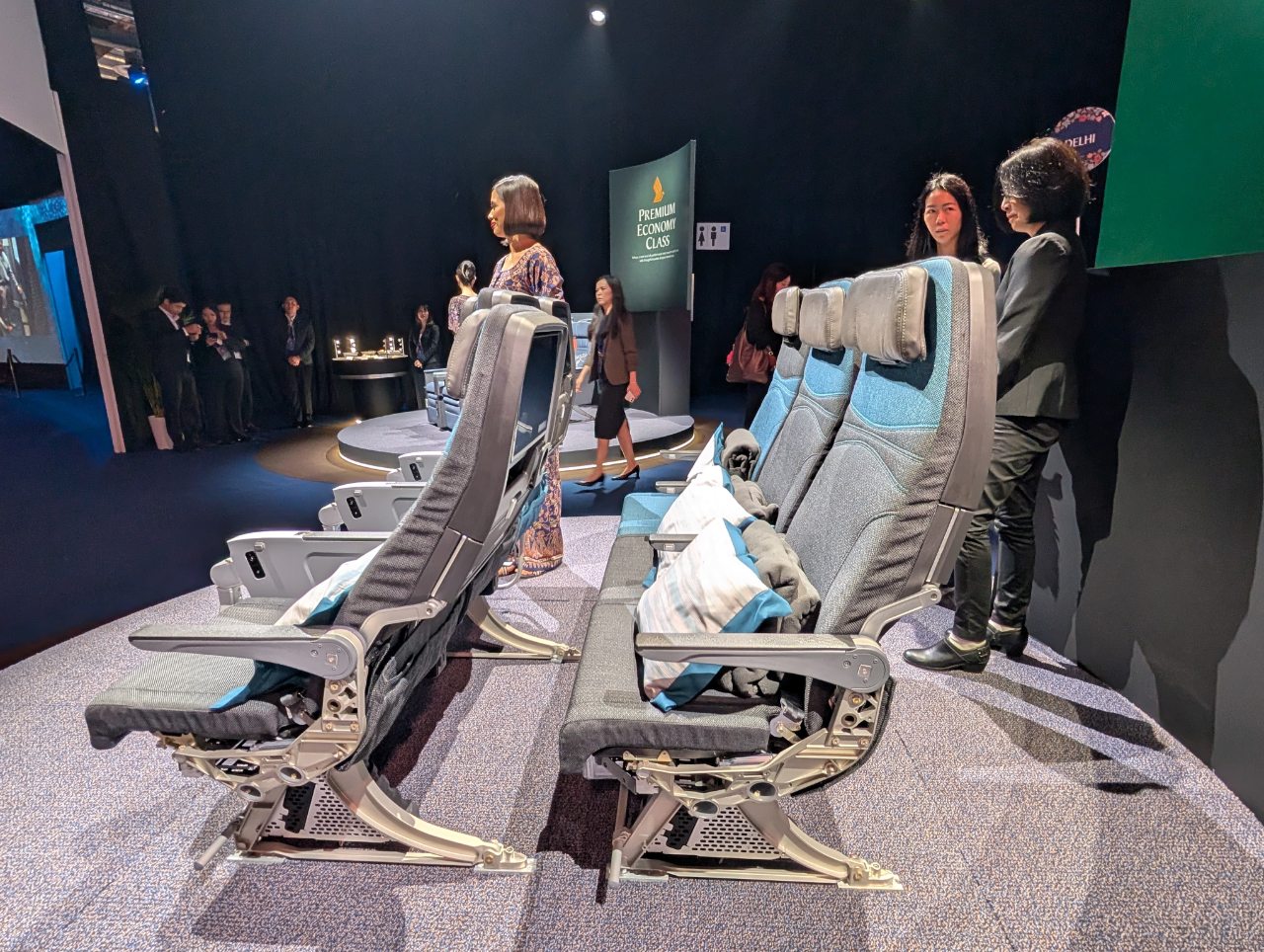
Economy Class seats will have 31-32 inches of pitch, which means that some seats will offer less than the 32 inches that SIA currently has across its long-haul fleet.
Sharp-eyed readers suggest from the seatmap that:
- the clusters of three seats by the windows have 32 inches
- the four seats in the middle only have 31 inches
If so, that’s a double whammy for ending up in the middle of the middle section.
Seats recline by up to 6 inches, which is one inch more than on the A380-800 and B777-300ER, and on par with the A350-900LH. The “up to” qualifier is probably because the last row of seats has its recline interrupted by the bulkhead behind.
In the press release, SIA talked about a “redesigned seat reclining mechanism with greater knee and shin clearance”. I have to admit that I was sceptical at first, and dismissed it as mere marketing puffery. I mean, it’s still Economy, right?
But with the seat in front fully reclined, I found that I had a good amount of room around my knees — and at 1.8m, I’m not exactly petite.
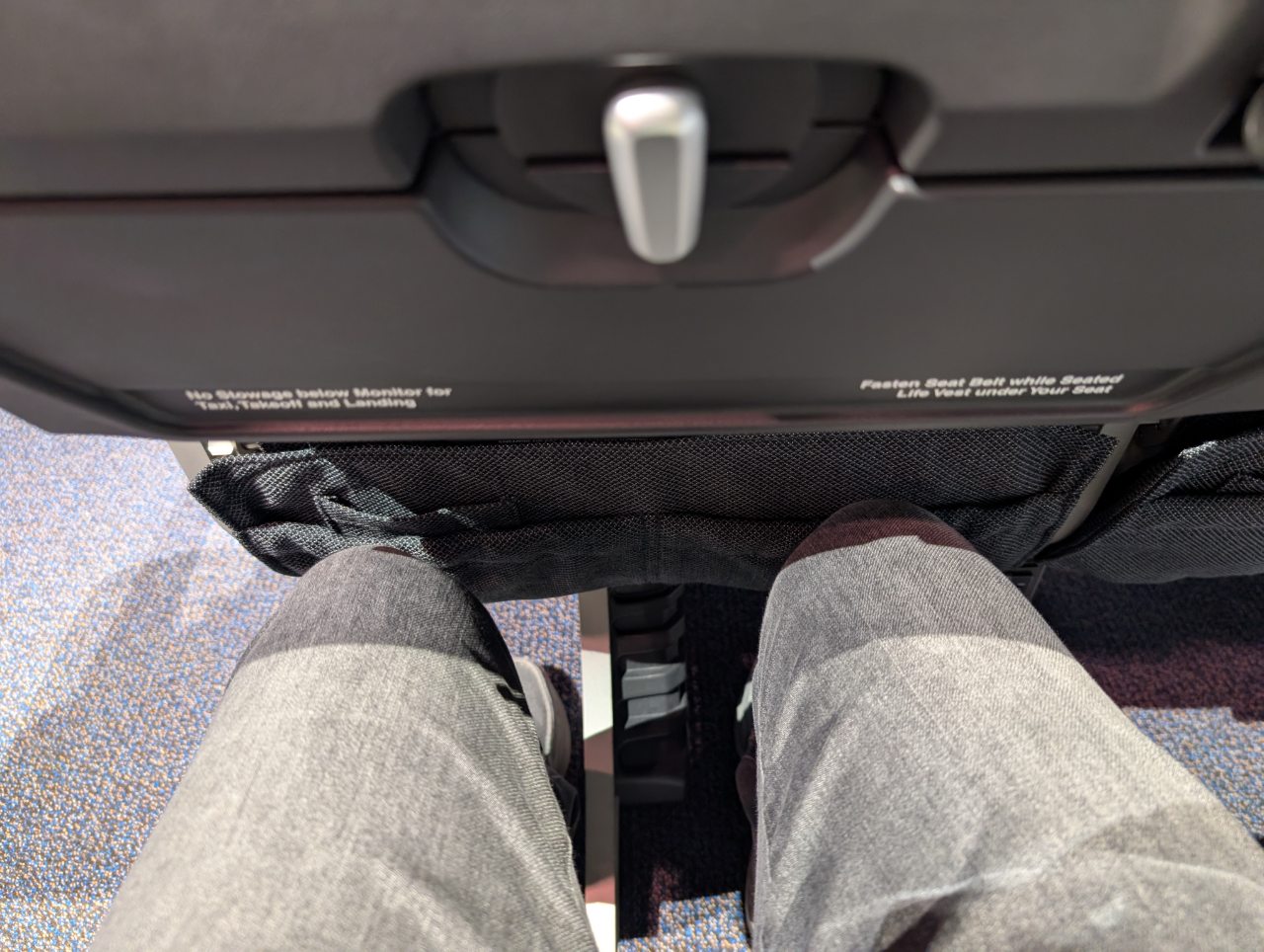
I wasn’t able to find out how exactly they’ve achieved this, but I did notice that as you recline, the seat cushion slides forwards as the backrest goes back, which means the backrest intrudes less into the row behind. I believe the 2013Y seat already uses a similar mechanism, so this is probably a further refinement with a relocated pivot point so the lower backrest, where the knees of the passenger behind sit, barely moves rearward.
Storage
Storage options are limited, as you would expect in Economy, with a small under-screen rigid pocket that holds loose items like earbuds, passports and glasses.
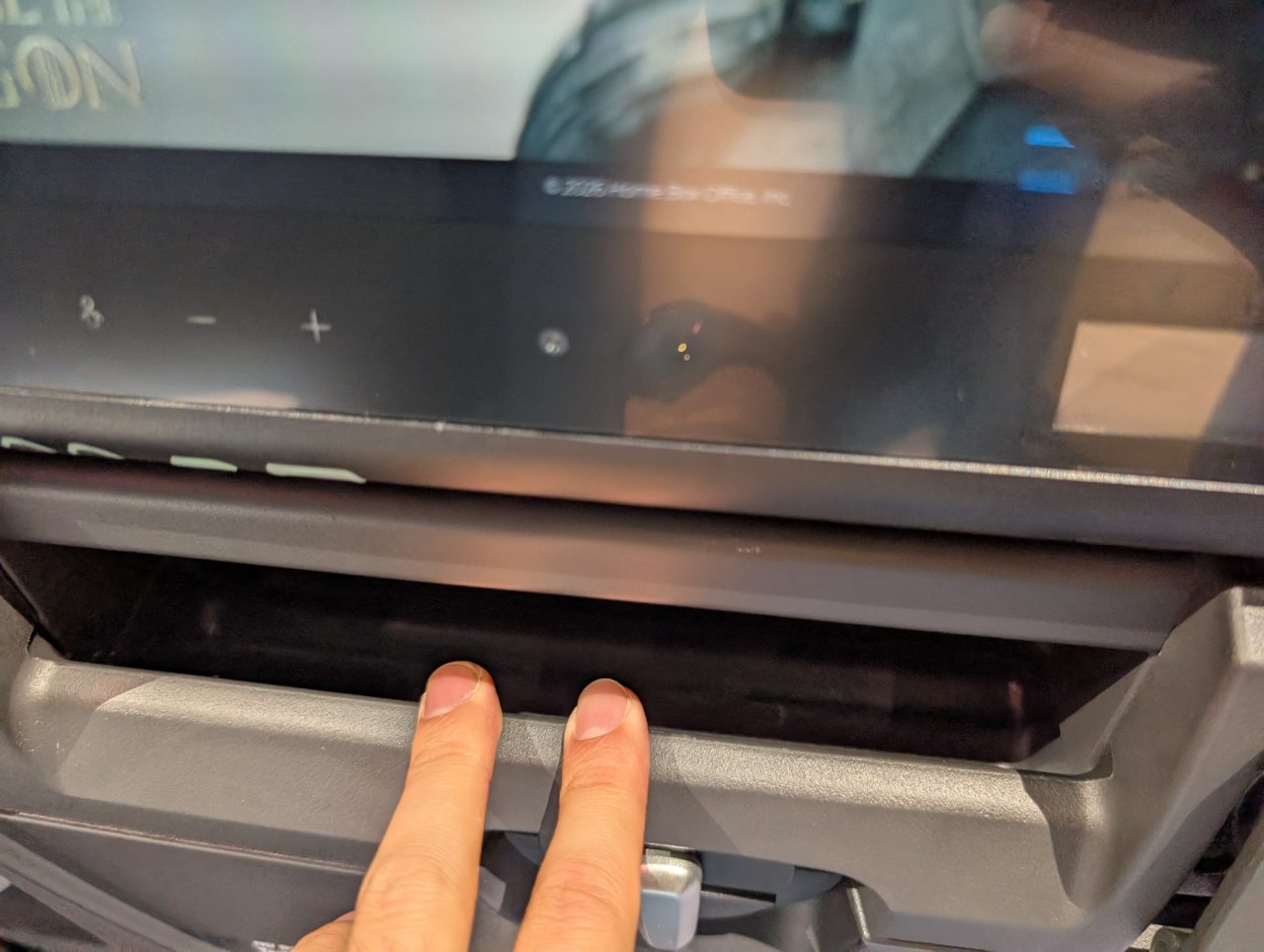
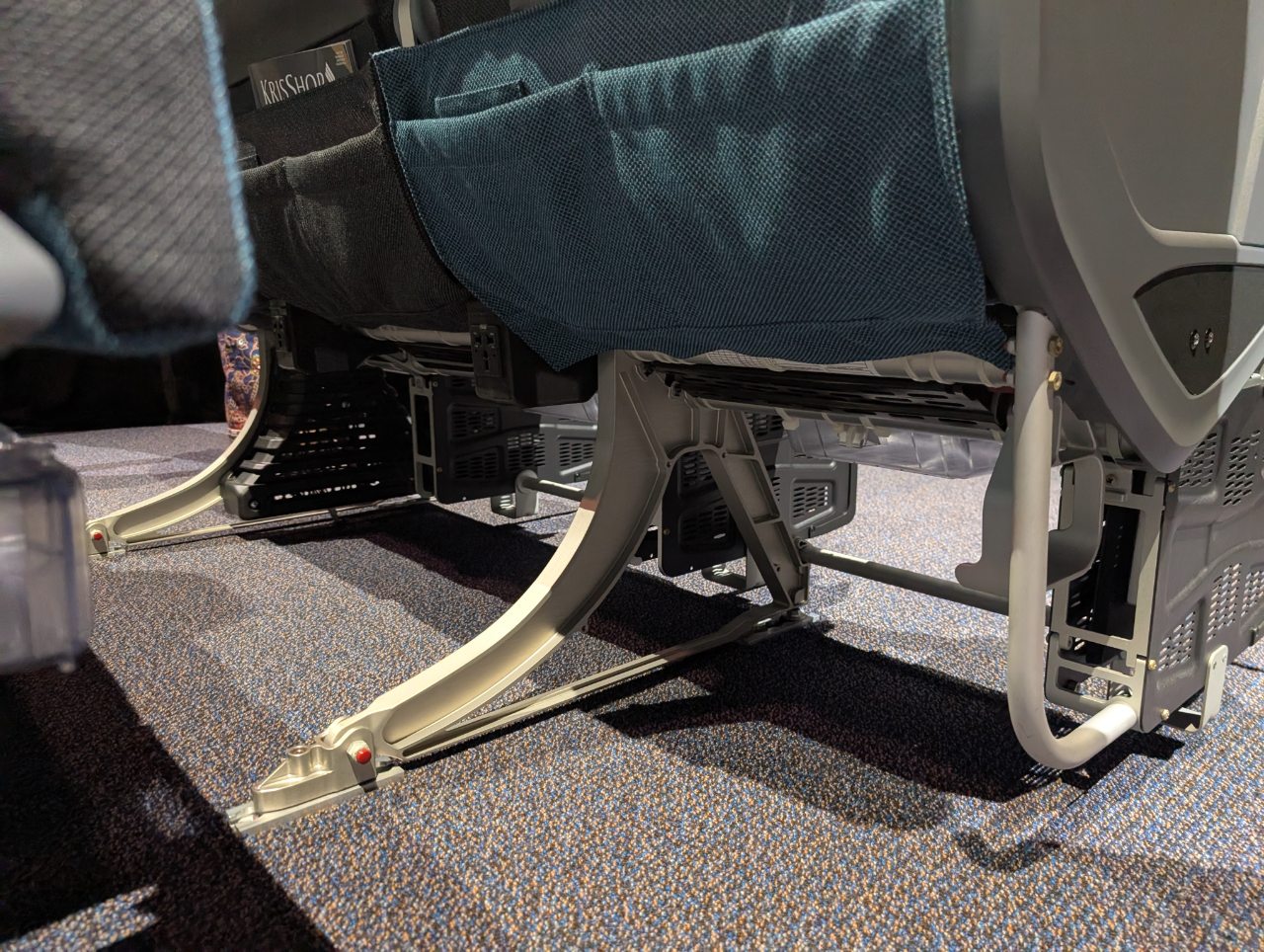
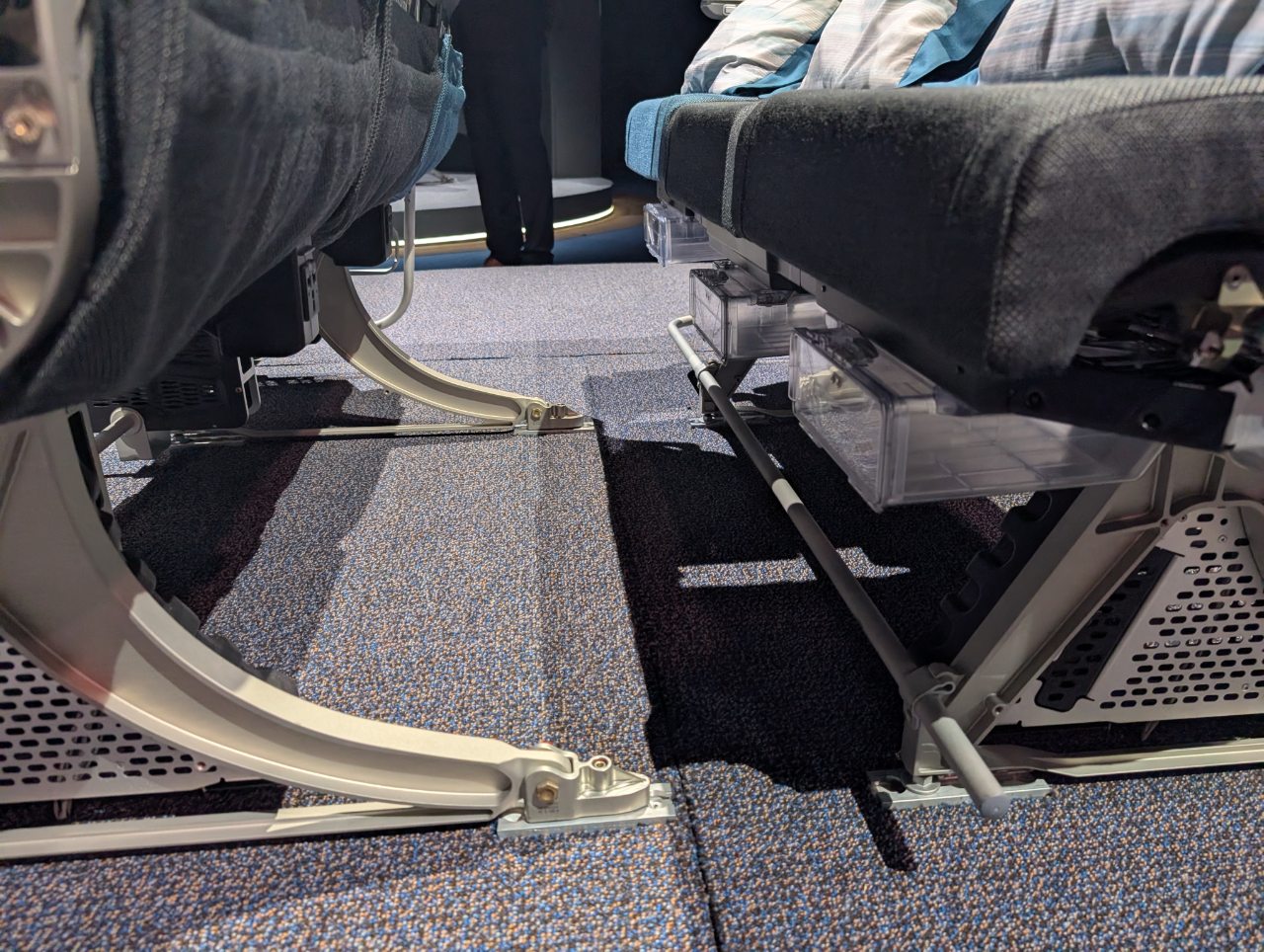
Under-seat storage looks to be adequate, with no bulky IFE box to get in the way (the transparent box you see is for life vests). The aisle and middle seats in each three-seat block have a unified, shared space because of how the strut is positioned.
Tray table
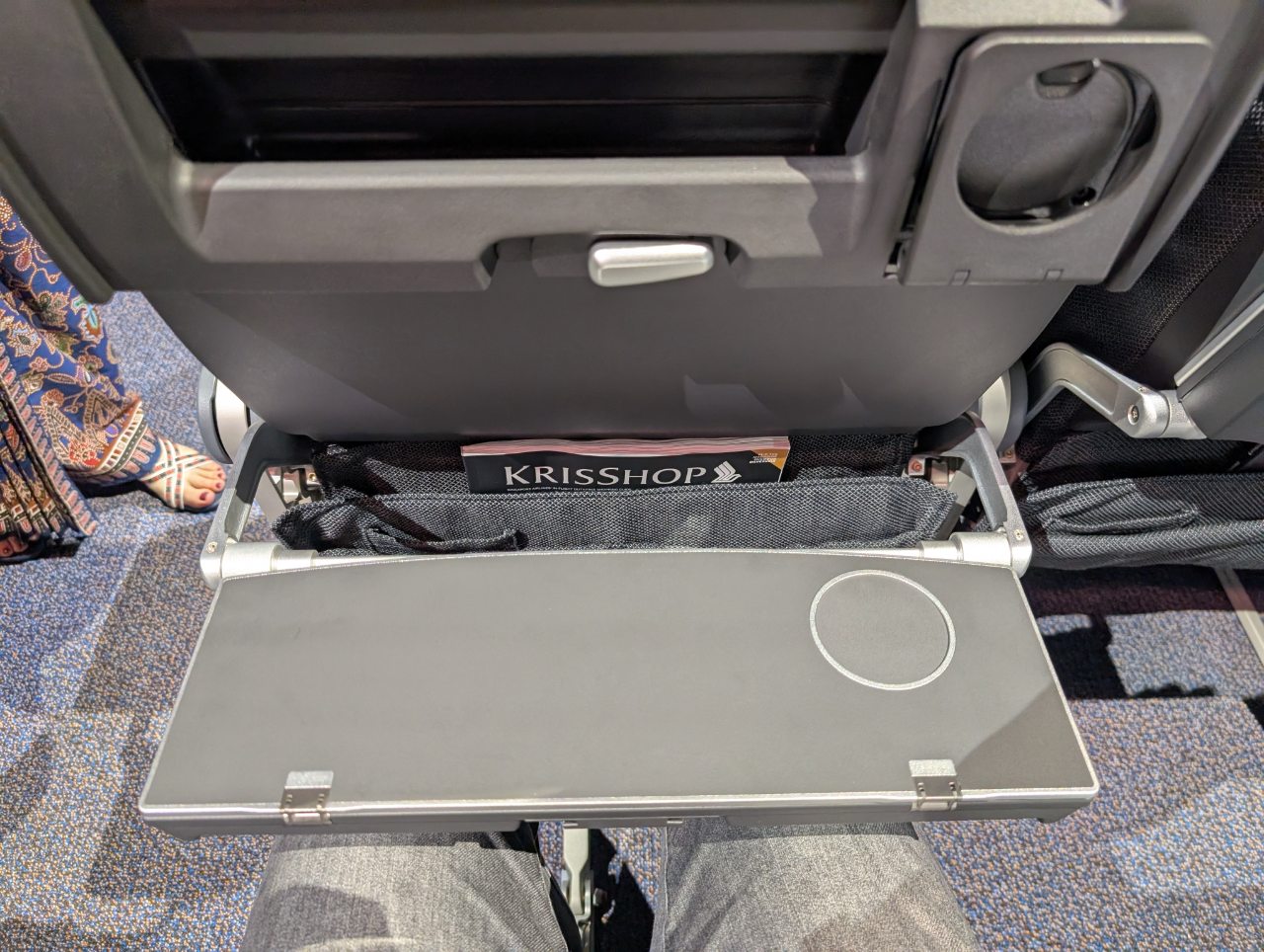
The bi-fold tray table measures 16″ x 10.5″ (40.6 cm x 26.7cm), but unlike Premium Economy, does not have a device holder. I also noticed it no longer has the mirror that the 2017 and 2013 Economy Class seats have. In fact, there’s no vanity mirror anywhere in this seat (insert “never forget what they took from you” meme).
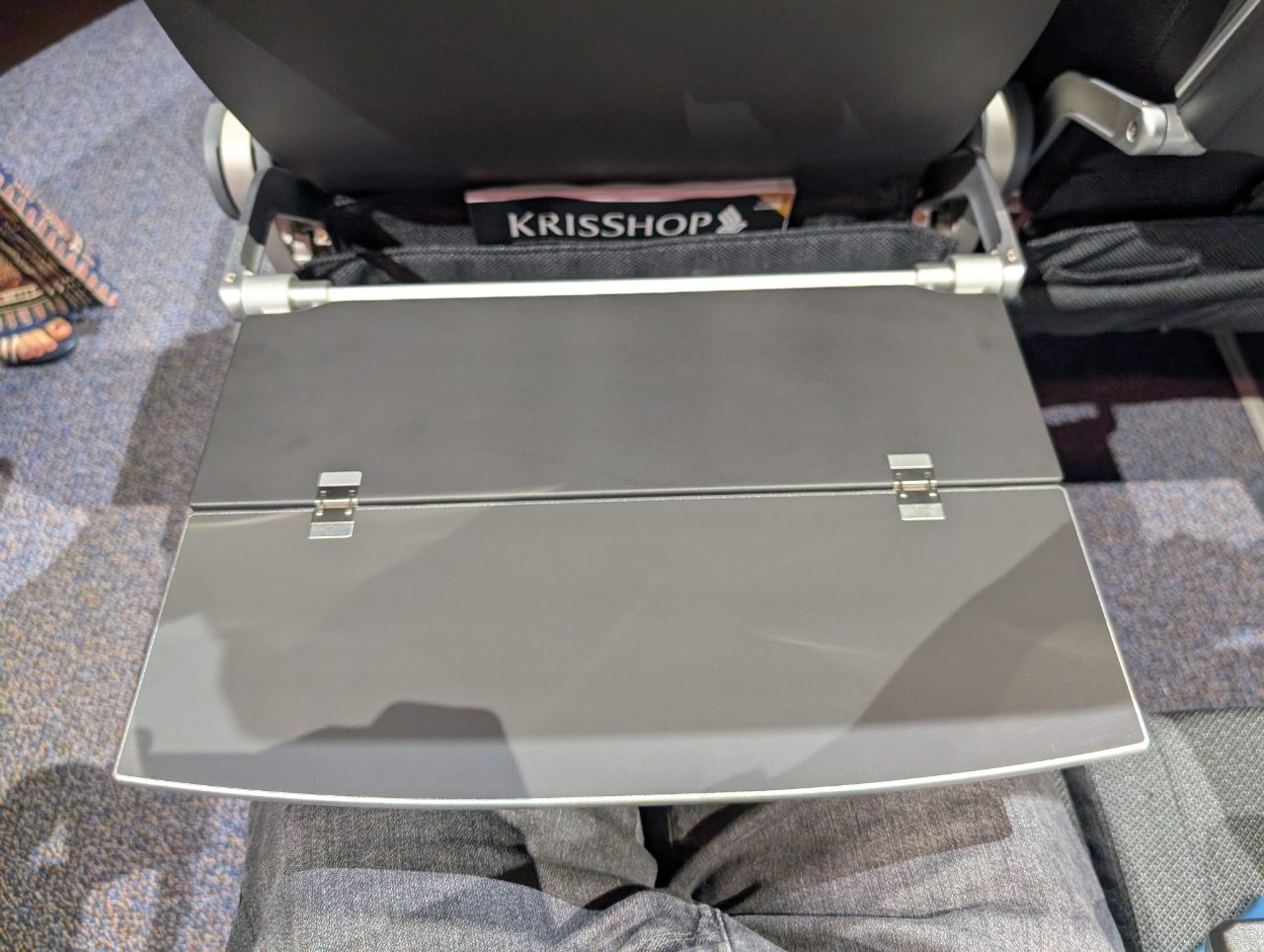
There is some give when typing on a laptop, but not enough to be annoying (though again, I should emphasise that on-ground testing is no substitute for inflight use, where turbulence and the passenger in front come into play).
Charging options
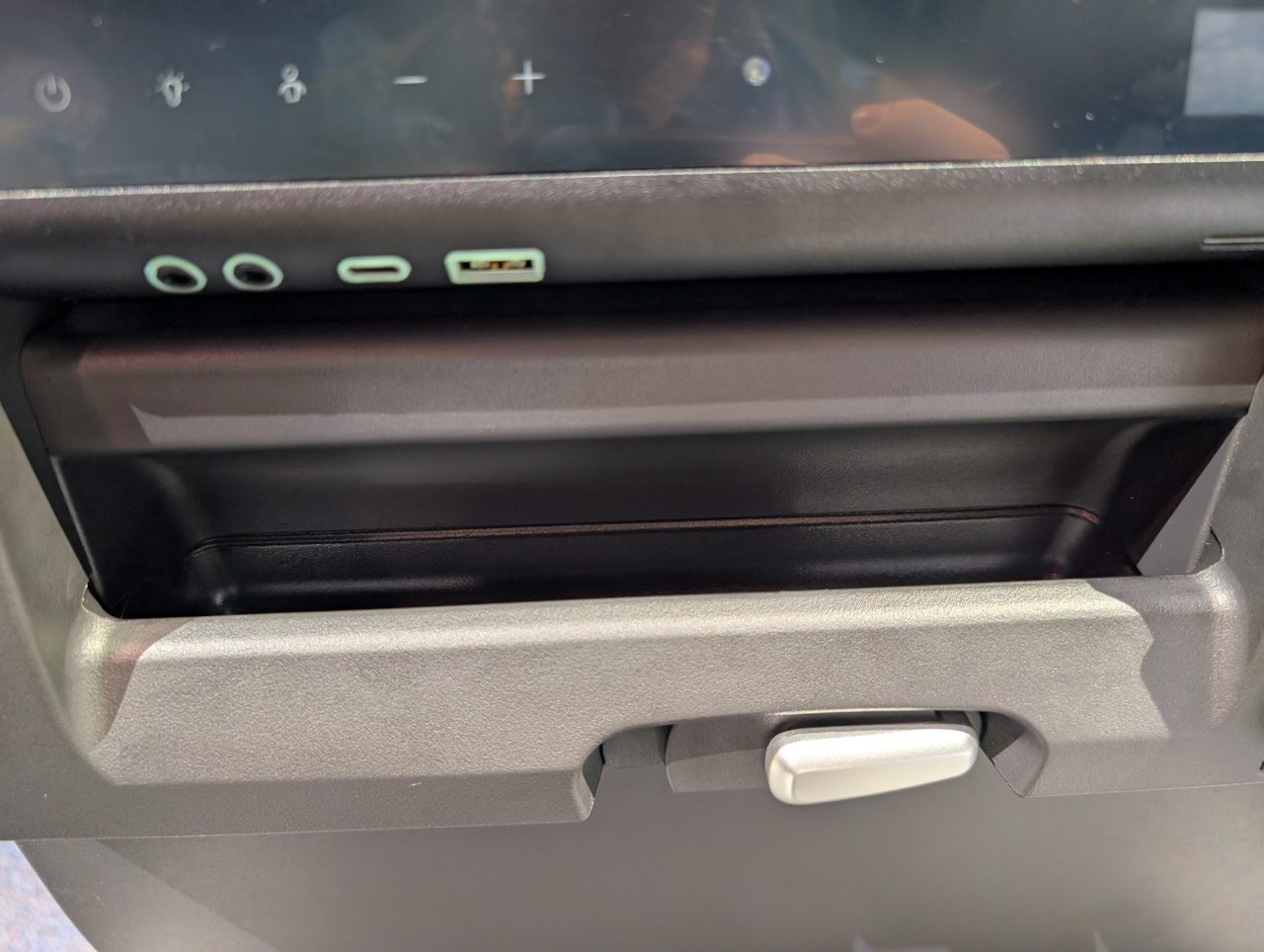
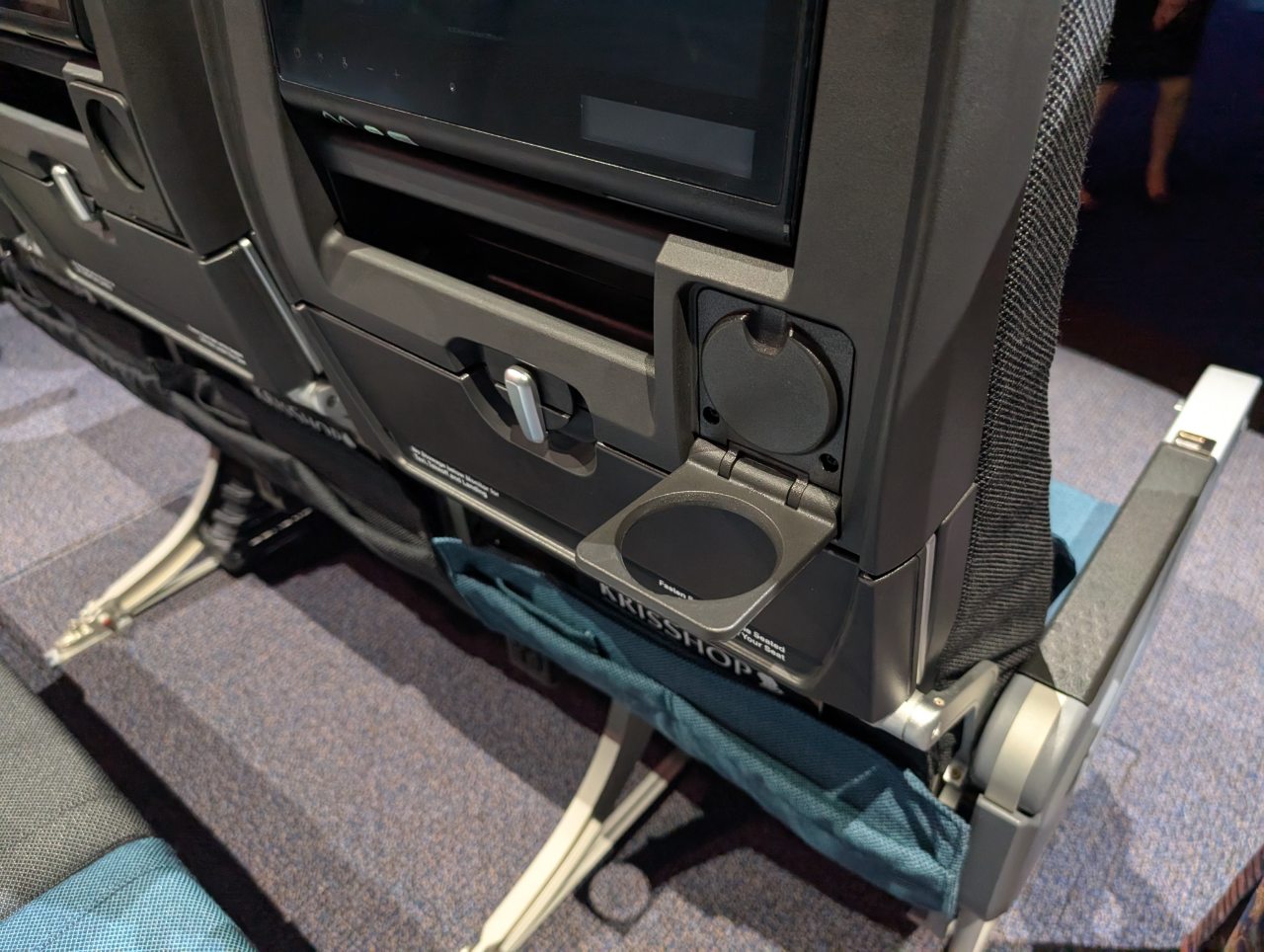
Beneath the IFE screen are a USB-A port and USB-C port, together with a headphone jack. Remember: it’s only the v1 aircraft which have USB-A. I would assume that the v2 aircraft will swap it for a second USB-C port.
The USB-C port will output 45W on the v1, and 67W on the v2. Some laptops require 65W charging, so if you’re on a v1 aircraft, you’ll need to bring the charging brick.
The AC socket — which only the v1 aircraft will offer in Economy — is found below the seat in front, with a 3:2 passenger-to-socket ratio. The faceplate is inverted, which makes it slightly easier to use a universal power adapter (since the ports are usually at the bottom, which then faces up).
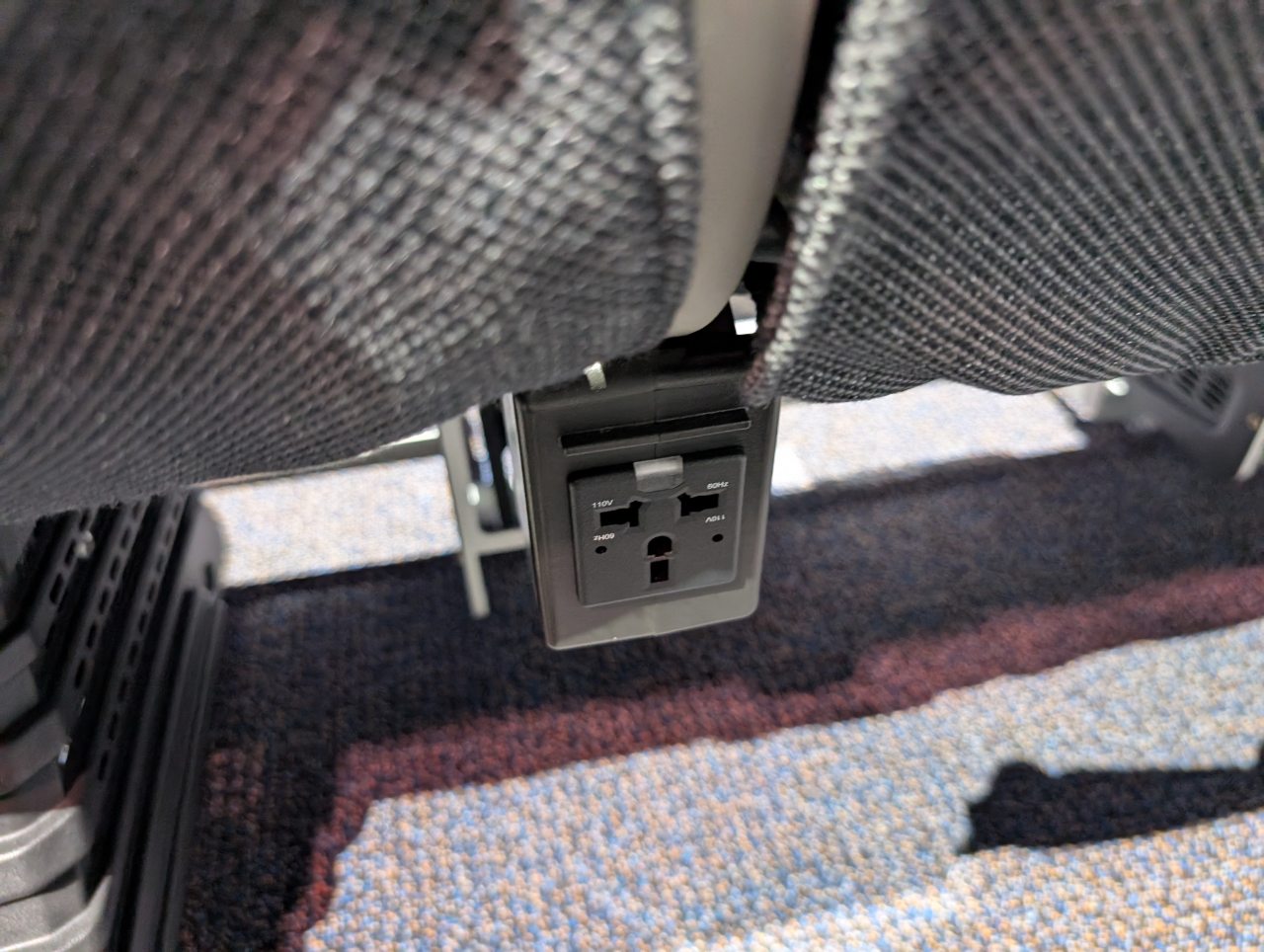
In bulkhead rows, however, the AC socket is found below the seat, and every passenger gets their own socket.
Inflight entertainment screen
Economy Class passengers have 4K touchscreens of up to 13 inches (again, the larger screens are for exit rows), with Bluetooth audio support.
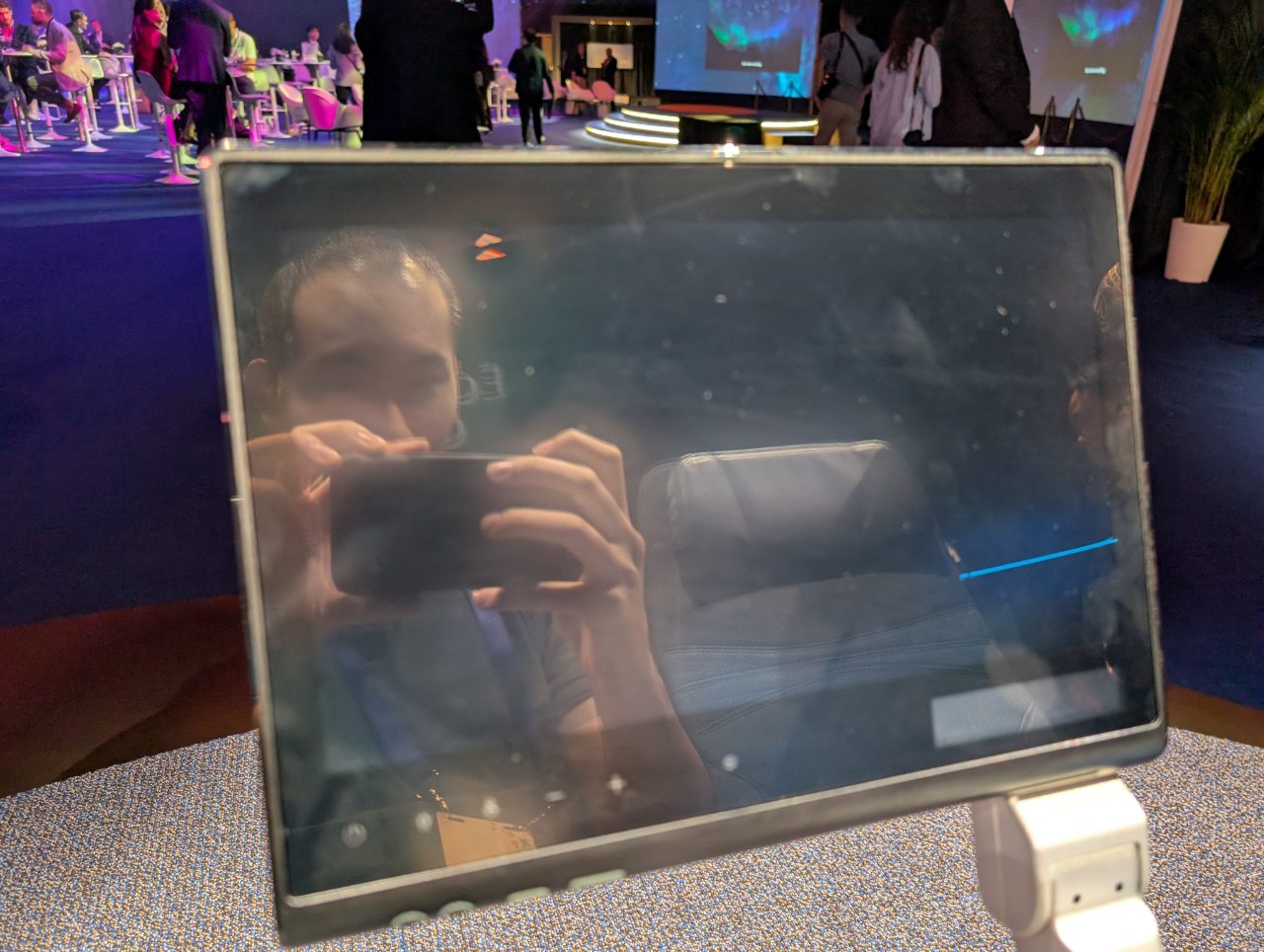
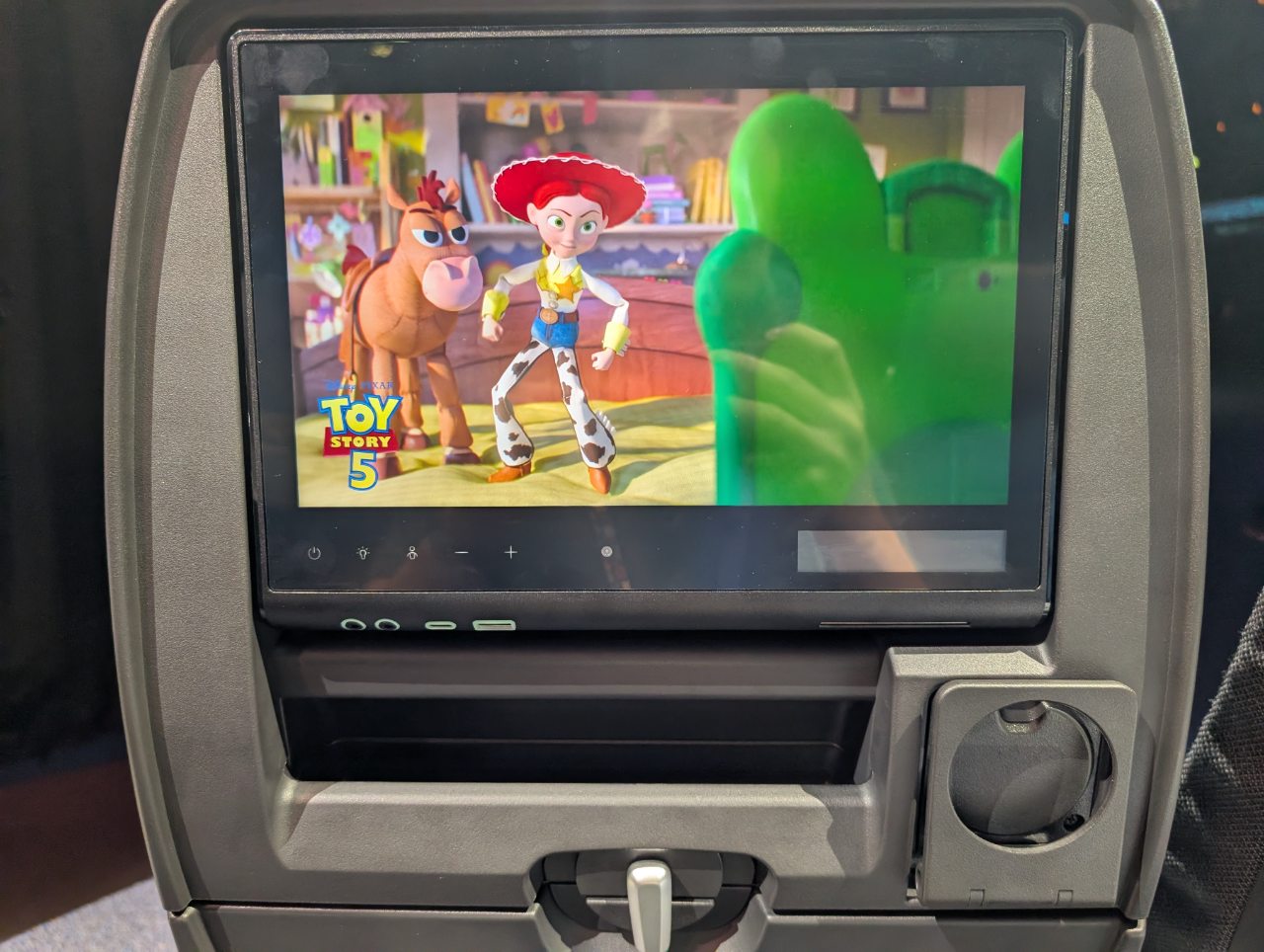
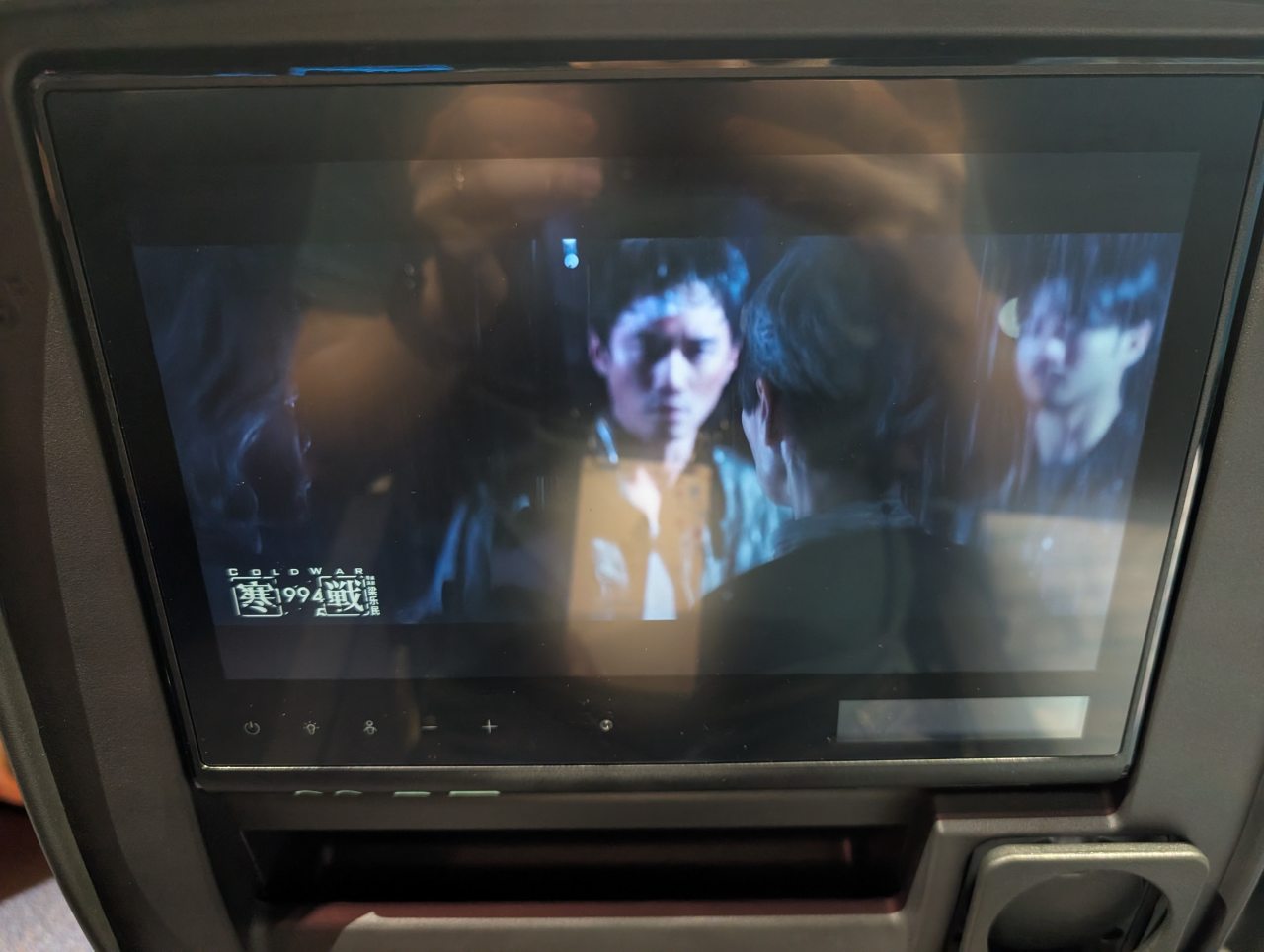
I have the same criticism here as I did of the Premium Economy screens: fingerprint magnets, very reflective.
You also have the secondary display in the bottom right corner, and again, it looks like a “when life gives you lemons” way of dealing with the oversized bezel. I really hope that the v2 aircraft with Astrova use different panels, as these lose so much valuable real estate…
Other features
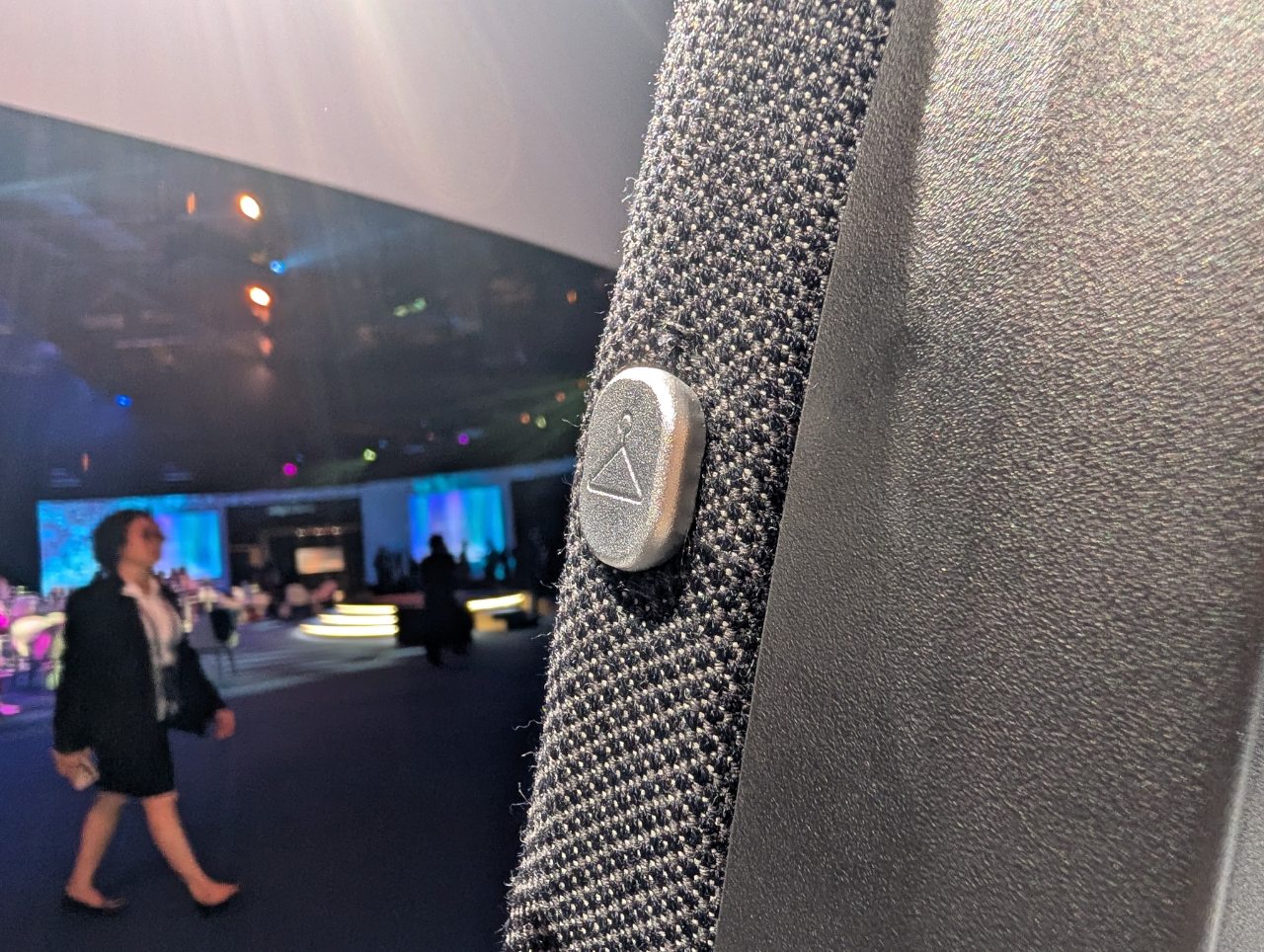
All seats have a four-way adjustable headrest, coat hook and cupholder.
Overall thoughts
Premium Economy
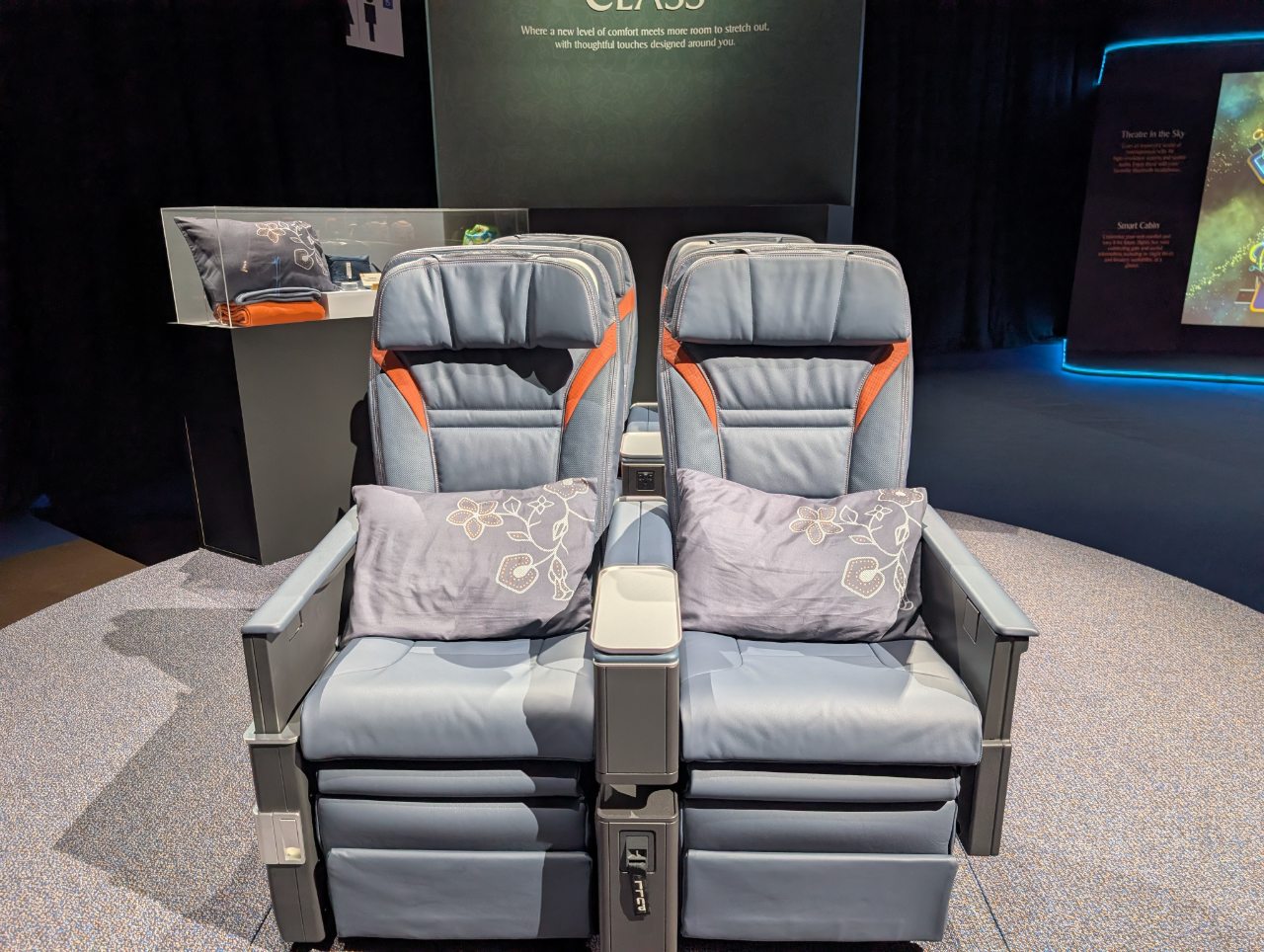
Singapore Airlines’ new Premium Economy Class seat brings incremental improvements at best.
On the plus side: more seat pitch, slightly more recline, better cushioning, better tech, and no more migraine-inducing orange pillows.
Unfortunately, it’s hard not to dwell on the negatives here, because for a next-generation product, many aspects of this seat are decidedly backwards.
I feel like I’m flogging a dead horse about the privacy issue, but it’s really what’s weighing on my mind right now. The overall trend in Premium Economy is to help passengers feel they have more space, even if the specs can’t move by much. A big part of that is psychological. If I can’t see my seatmate, then it’s as if I have my own private little cocoon, though I’m mere inches from them.
Privacy panels do this best, as illustrated by Emirates and Japan Airlines.
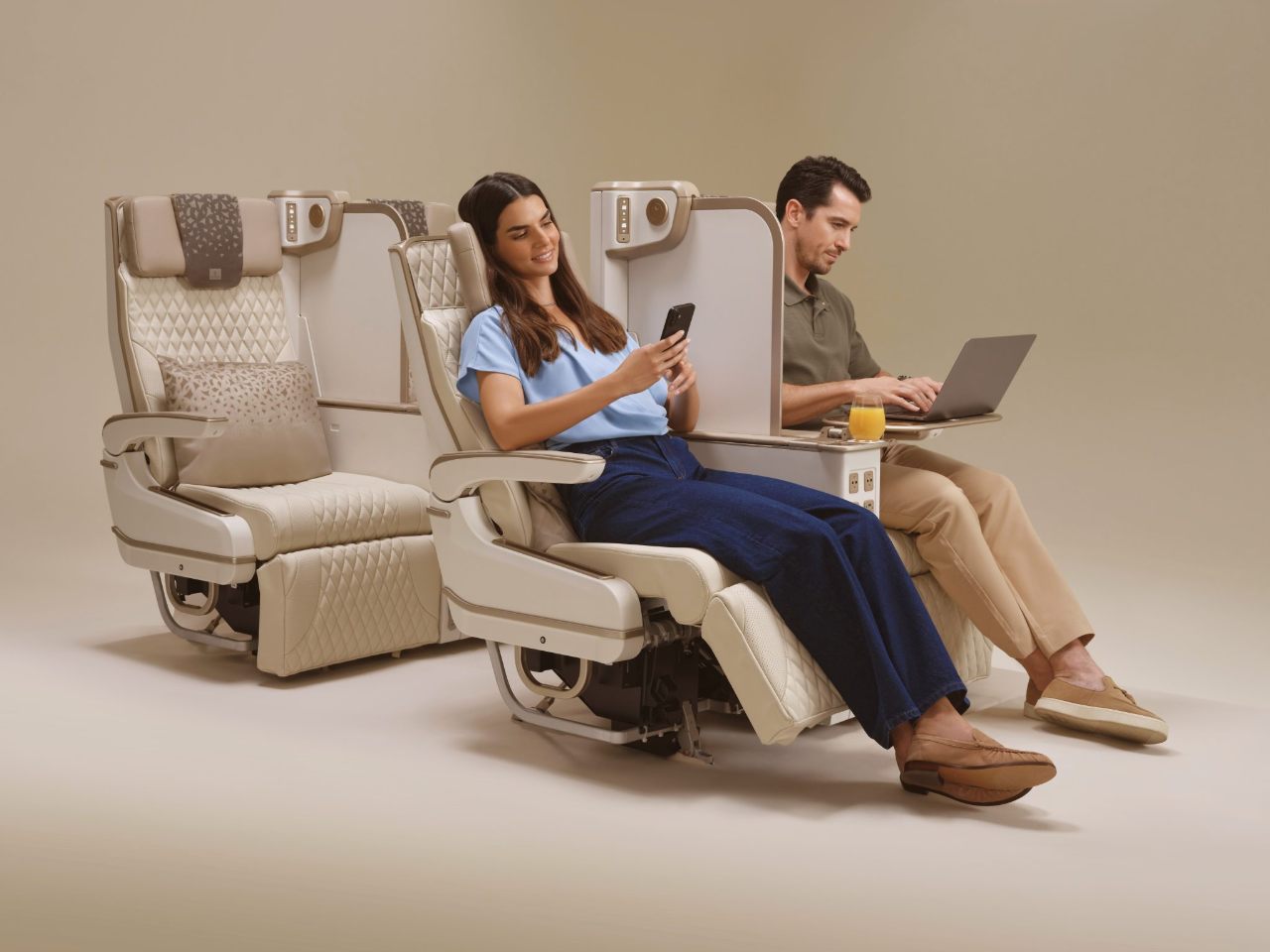
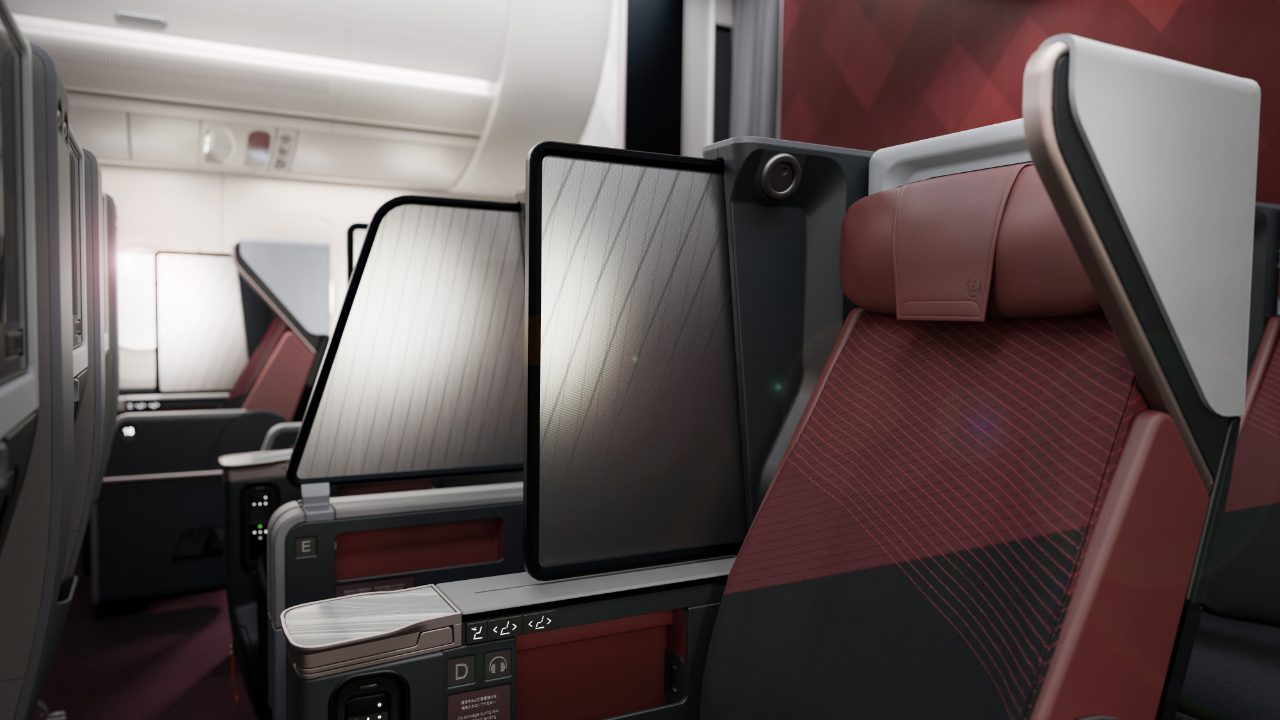
But if privacy panels are a bridge too far, then even a privacy wing at eye level would go a long way towards building the illusion, as shown on Cathay Pacific and British Airways.
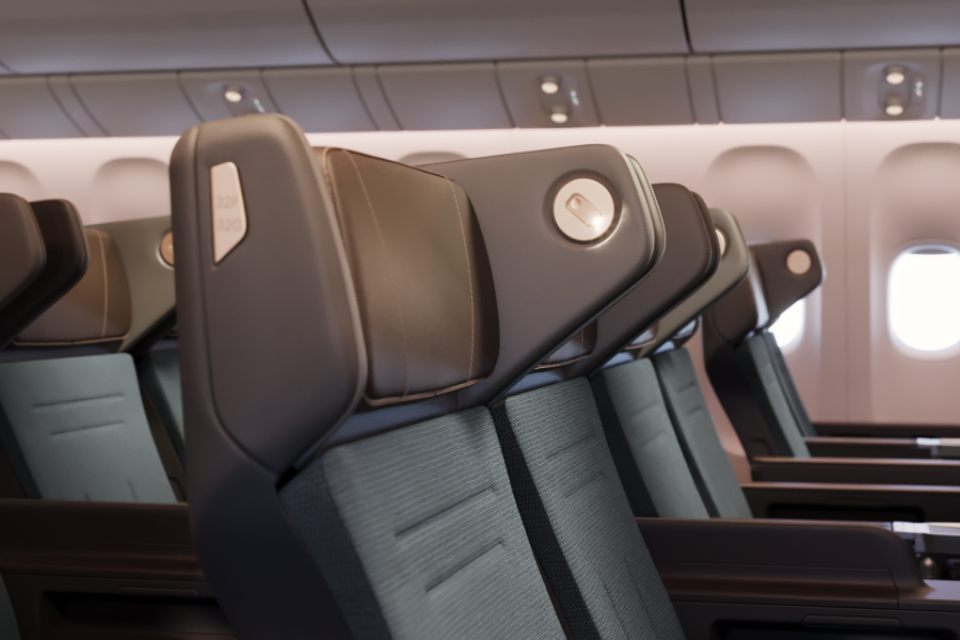
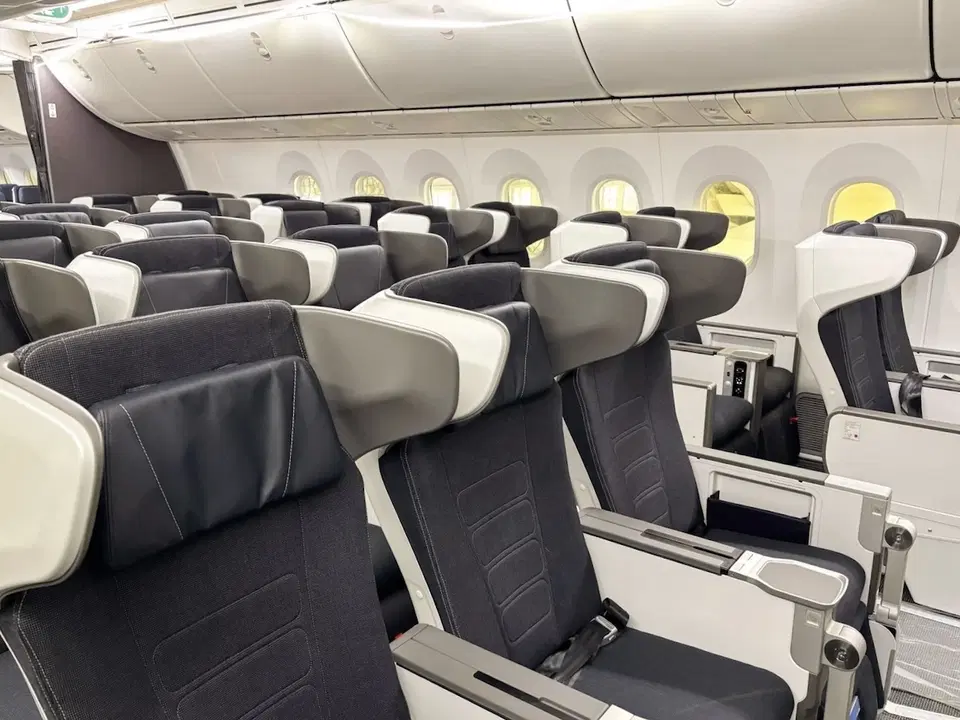
Even the tech improvements may not be as quantum-leapy as hoped for, because the fundamental issue remains that the first 12 B777-9s will have an IFE system from 2017.
USB-C is capped at 45W, the touch panel wasn’t as crisp as those I’ve had on modern Astrova-equipped planes, and the bulky IFE box beneath the seat feels like a relic of eras past.
Is it an improvement over the status quo? Of course. But I wanted this to be so much better.
|
 |
|
| 2027W | 2015W | |
| Manufacturer | Collins Aerospace | ZIM & Safran |
| Configuration | 2-4-2 | 2-4-2 |
| Seat Width | 19″ | 19″ to 19.5″ |
| Seat Pitch | 40″ | 38″ |
| Seat Recline | Up to 9″ | 8″ |
| IFE Screen | Up to 16″ 4K | 13.3″ HD |
| Touchscreen | ✅ | ✅ |
| OLED | ✅ (v2 a/c) |
❌ |
| Spatial Audio | ✅ | ❌ |
| Bluetooth Audio | ✅ | ❌ |
| HDMI | ❌ | ❌ |
| AC Power | ✅ |
✅ |
| USB-A | ✅ (v1 a/c) |
✅ |
| USB-C | ✅ |
❌ |
| Wireless Charging | ❌ | ❌ |
| Reading Light | ✅ | ✅ |
| Leg Rest | ✅ | ✅ |
Economy Class
I’ve been told that I overuse the phrase “Economy is Economy”, but it’s a pithy saying.
In Business Class, designers are playing with 20, 30 or even 40 square feet of cabin space. In Economy, every passenger gets a box roughly 18 inches wide and 32 inches deep, and every inch given to passengers is an inch that can’t be sold. If anything, that box is shrinking, as seen from SIA’s decision to go from nine-across to 10-across seating. There’s only so much room to innovate in Economy Class — literally.
Therefore, the main improvements here are mechanical, or tech-related, and Singapore Airlines’ new Economy Class seat has both. The new recline mechanism sounds fluffy, but actually makes a difference. The new seats add 4K screens, Bluetooth audio connectivity and USB-C ports, though the same caveat as Premium Economy applies: the system powering it is going to be a decade old by the time the seats launch (at least on the v1 aircraft). All in all though, it’s probably the best that Economy passengers could hope for.
With Economy, my concern is not about the new seat itself, it’s the rollout. SIA only plans to fit this on the B777-9, so across the rest of its fleet, you’ll still be saddled with older seats and older tech. The thought of flying into the 2030s with USB-A ports is somewhat disconcerting, but the airline has made its investment decision. It remains to be seen whether Economy passengers switch to other carriers that offer these modern conveniences, or whether price and schedule still trump all.
Again, the new seat is no doubt an improvement. What’s in doubt is when you’ll have the chance to fly it.
|
 |
 |
|
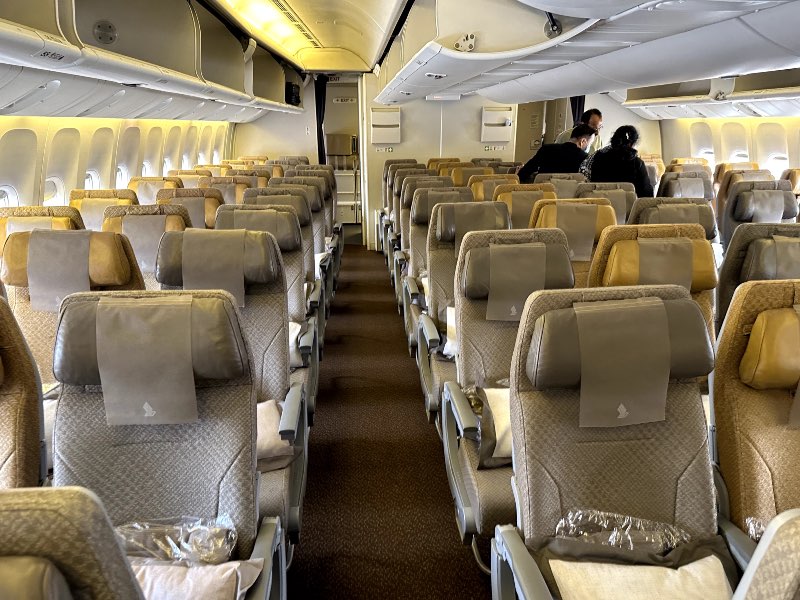
| 2027Y | 2017Y | 2013Y | |
| Manufacturer | Collins | Recaro | Safran |
| Configuration | 3-4-3 | 3-3-3 or 3-4-3 |
3-3-3 |
| Seat Pitch | 31 to 32″ | 32″ | 32″ |
| Seat Width | 17.6″ | 17.5 to 18.5″ | 19″ |
| Seat Recline | Up to 6″ | 5 to 6″ | 5″ |
| IFE Screen | Up to 13″ 4K | 11.1″ | 11.1″ |
| Touchscreen | ✅ | ✅ | ✅ |
| OLED | ✅ (v2 a/c) |
❌ | ❌ |
| Spatial Audio | ✅ | ❌ | ❌ |
| Bluetooth Audio | ✅ | ❌ | ❌ |
| HDMI | ❌ | ❌ | ❌ |
| AC Power | ✅ 3:2 (v1 a/c) |
✅ 3:2 |
✅ 3:2 |
| USB-A | ✅ (v1 a/c) |
✅ | ✅ |
| USB-C | ✅ |
❌ | ❌ |
| Wireless Charging | ❌ | ❌ | ❌ |
Conclusion
When Singapore Airlines committed to the Boeing 777-9, the aircraft was expected to enter service at the turn of the decade. NEXT was the shiny new IFE platform, 45W USB-C charging seemed generous, and Premium Economy was predominantly about more legroom, not more privacy.
Fast forward to today, and you can see exactly what the wait has cost SIA. Its new Premium Economy seat looks dated on arrival, and for both Premium Economy and Economy, the tech upgrades will come (at least for the first 12 aircraft) on an IFE system that’s a decade old. Moreover, the rollout is so narrow that most SIA passengers won’t sit in either seat for years to come.
Let me be clear: there are certainly things to like about the new seats. Premium Economy has improved pitch and cushioning; Economy gets a better reclining mechanism. I’ve not even talked about Starlink, which will almost certainly be available on the B777-9 — and passengers will be a lot more forgiving of IFE shortcomings when they can watch content on their own devices.
Still, when talking to the SIA teams behind these seats, it’s hard not to feel a pervasive sense of regret over what could have been. They were ready. Boeing wasn’t.
BRB, heading to the shower.

How far have the mighty fallen. I’m not excited about the new Business, Premium Economy, and Economy offerings.