| I travelled to Los Angeles as a guest of United Airlines for the media preview of the new Elevated cabin and Polaris seats. |
United Airlines has officially unveiled its next-generation Elevated interior for the Boeing 787-9, which will make its international debut on the San Francisco to Singapore route on 22 April 2026.
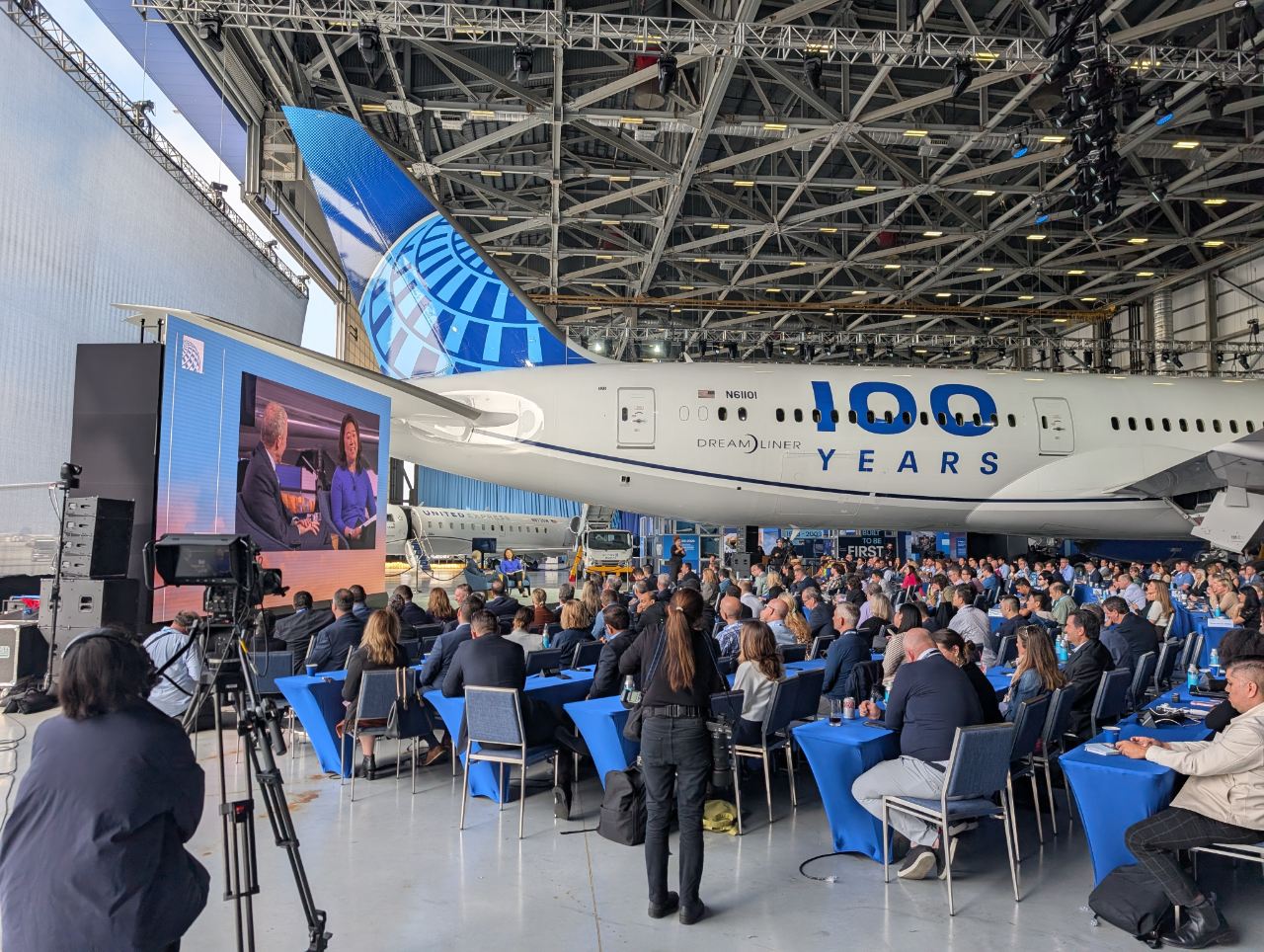
The biggest upgrades are, of course, upfront, where Business Class passengers can look forward to all-new Polaris suites (including four “Business+” Studio suites) with double beds and privacy doors.
But there are also several meaningful improvements in Premium Economy and Economy, such as 4K OLED screens, Bluetooth audio connectivity and USB-C charging at every seat. Starlink connectivity is planned for the future, though at launch these aircraft will be equipped with the slower Panasonic system.
I was at the media event in Los Angeles last week, and in this post, I’ll walk you through what passengers can expect from the new Elevated cabin interior.
Overview: United Elevated interior
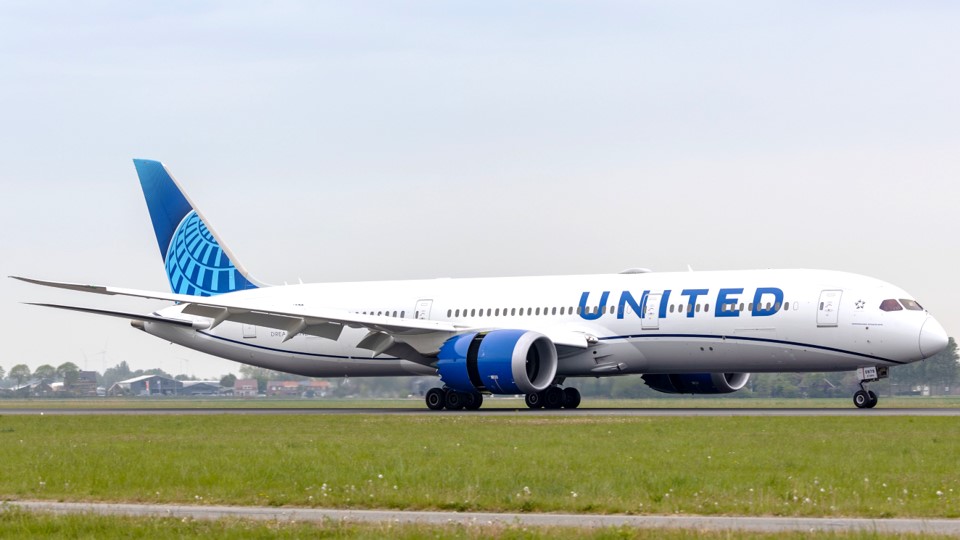
The United Elevated interior features a total of 222 seats, spread across three cabins:
| Cabin | Details |
| Business |
|
| Premium Economy |
|
| Economy |
|
This marks a significant “pivot to premium”, with 45% of all seats in Premium Economy or higher, compared to just 27% on existing B787-9 aircraft.
| Old B787-9 | Elevated B787-9 | |
| Polaris Studio | – | 8 |
| Polaris Business Class | 48 | 56 |
| Premium Plus | 21 | 35 |
| Economy Plus | 39 | 33 |
| Economy | 149 | 90 |
| Total | 257 | 222 |
The premium-heavy configuration should also remove the need for seasonal payload restrictions on the San Francisco to Singapore route, which is one of the longest flights that United operates.
United has received a total of three aircraft with the Elevated interior so far:
A fourth (N51104) is expected to be delivered shortly. United expects to take delivery of 20 such aircraft this year (the most twin-aisle jets a US airline has received in a single year since 1988), and a further 10 by the end of 2027. For context, United has ordered a total of 221 B787 Dreamliners, the most of any airline in the world.
Polaris Studio suites
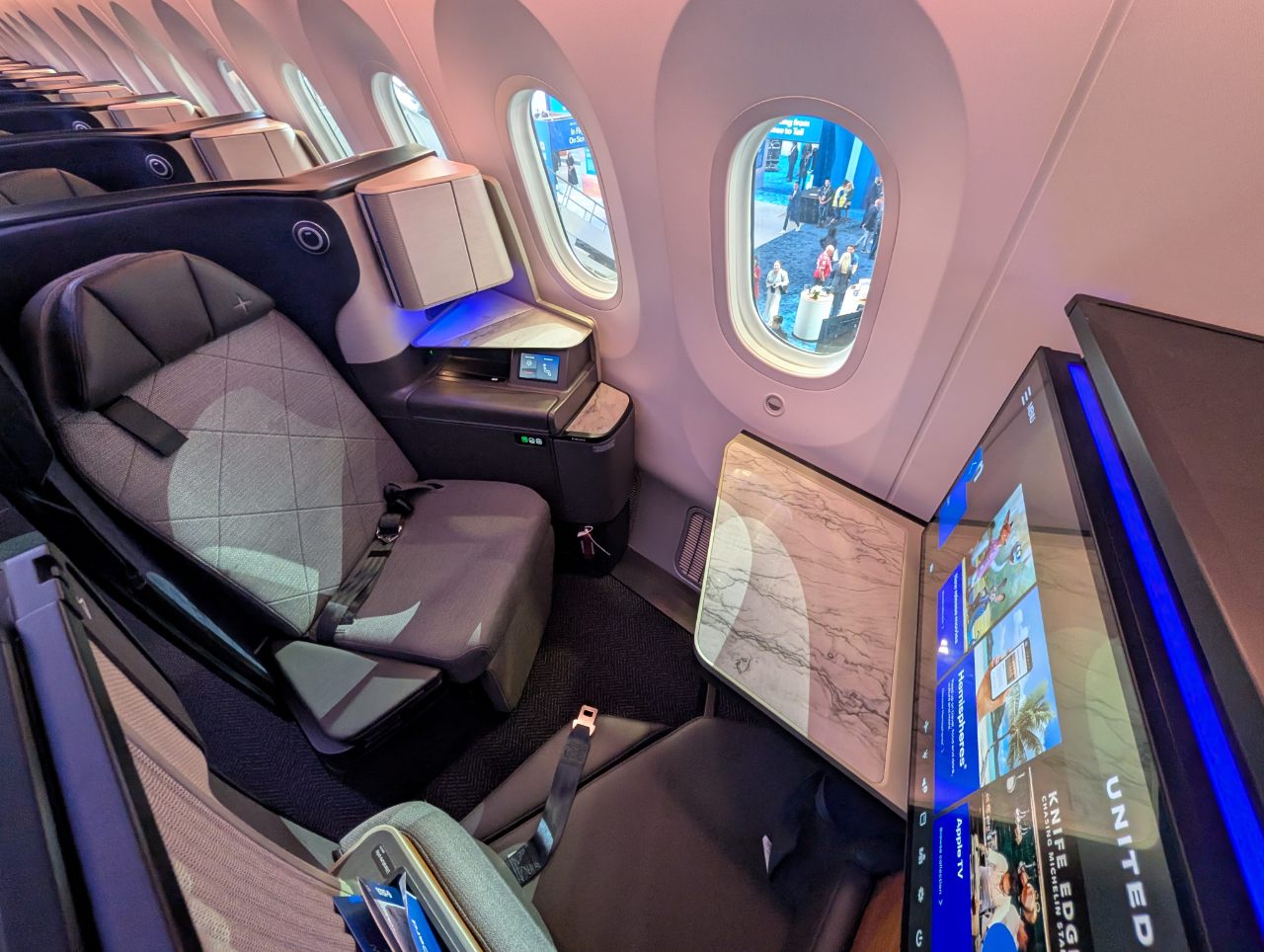
United is debuting a new flagship product called the Polaris Studio, eight “Business+” seats that occupy the bulkhead rows (1 & 9) of the two Business Class cabins.
Polaris Studio Suites are 25% larger than standard Polaris suites, making use of the extra space available in the first row of the cabin. They also have 27-inch 4K OLED touchscreens — the largest seatback entertainment display offered by any carrier in the USA.
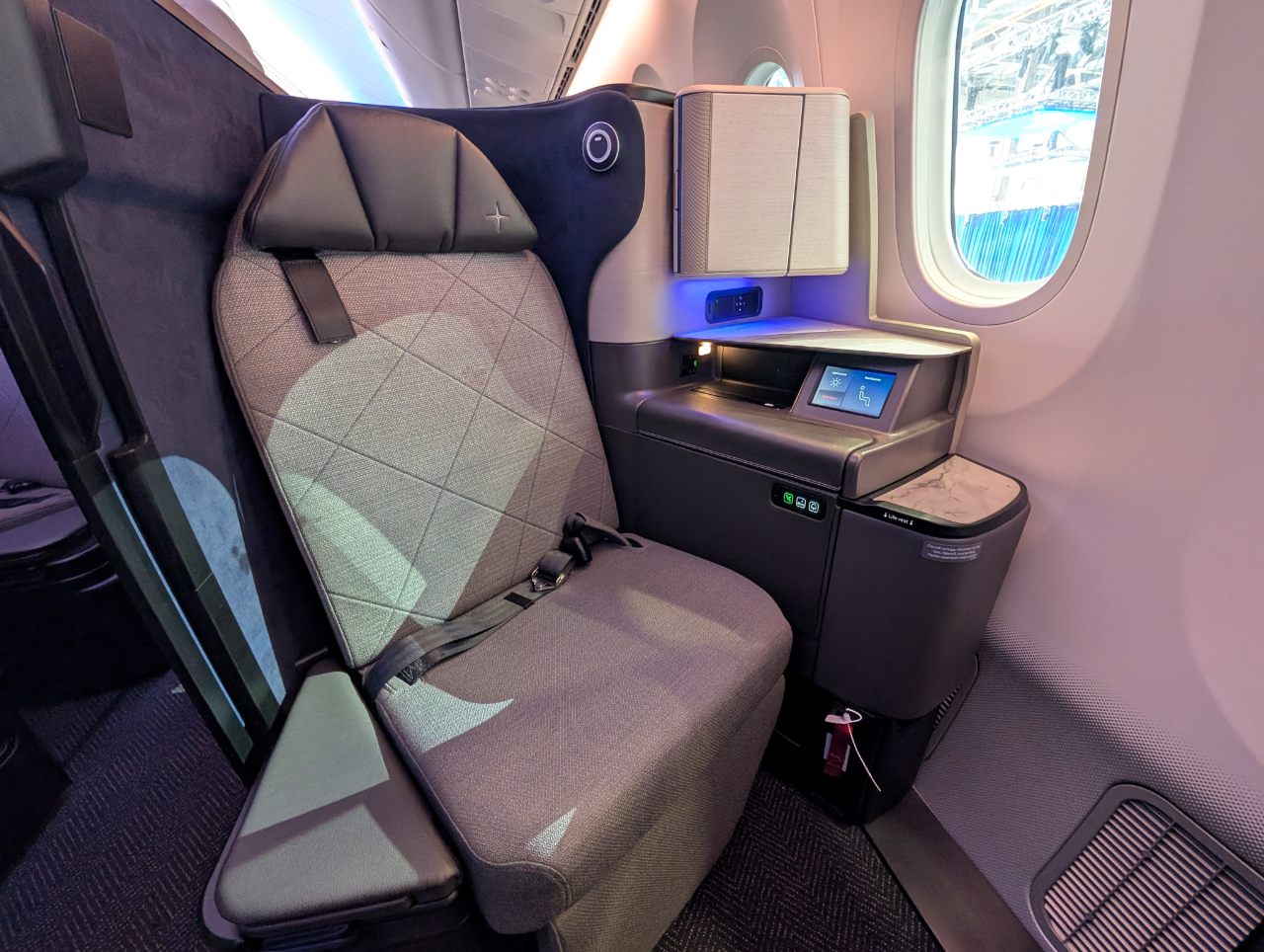
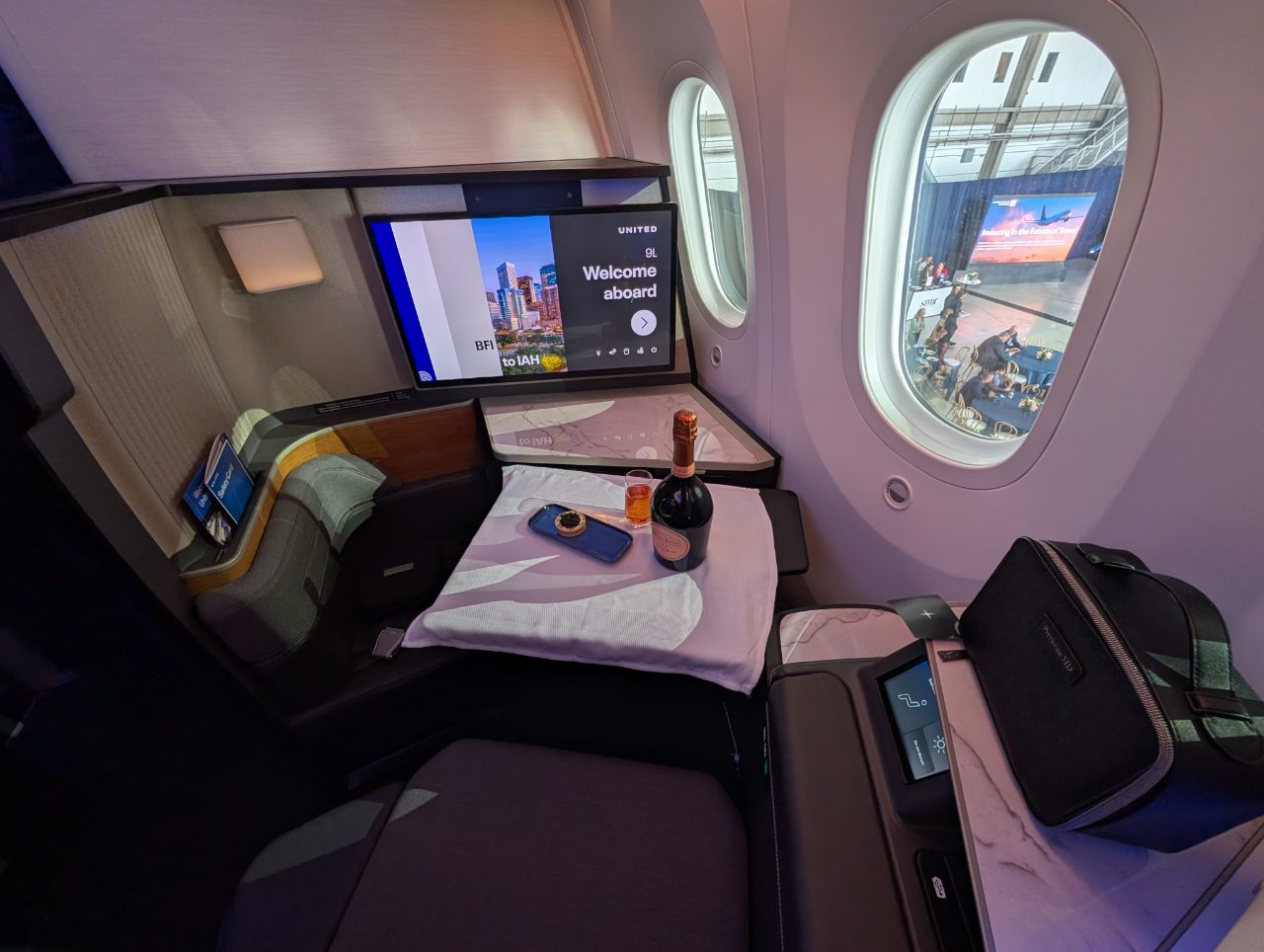
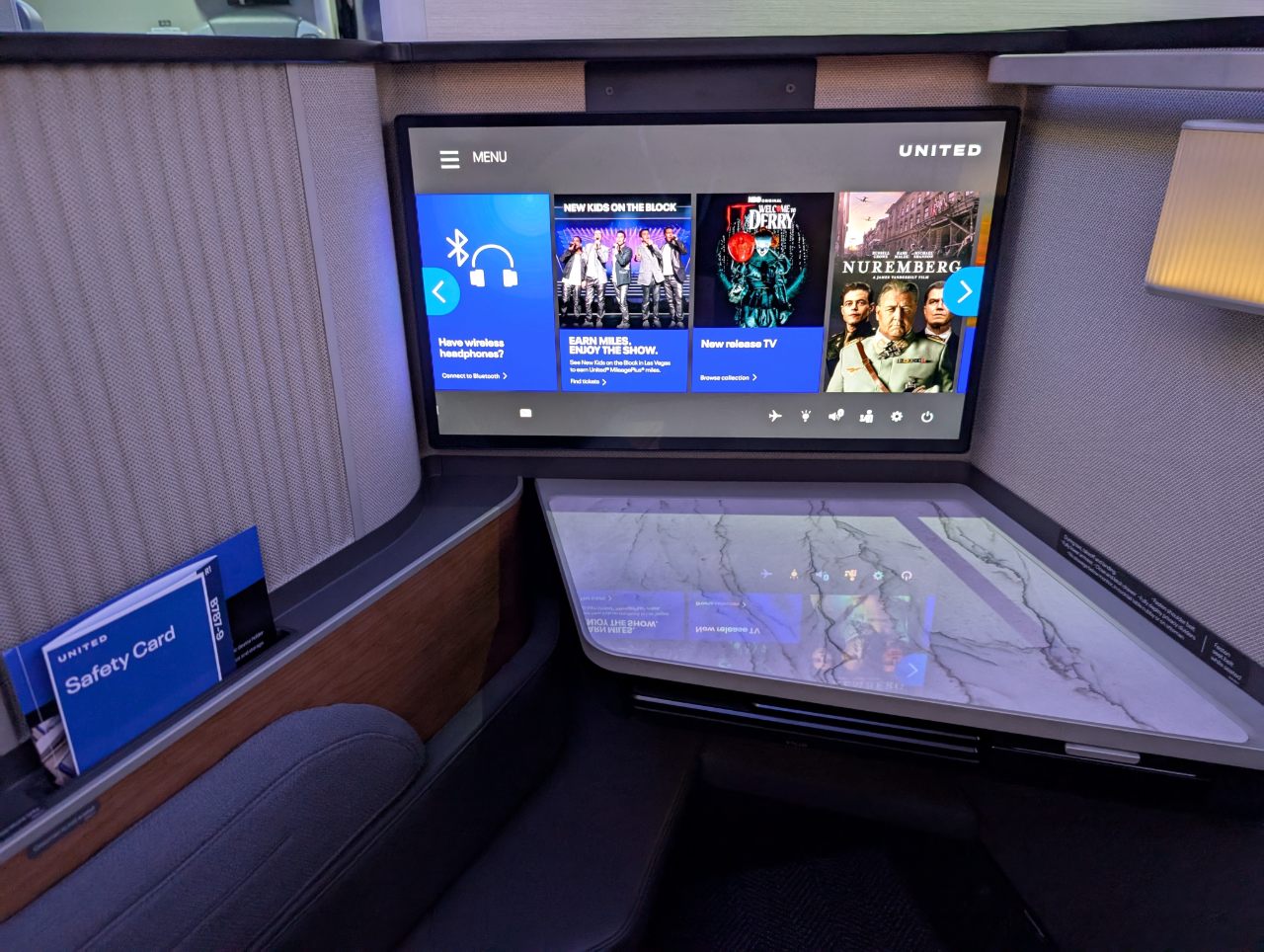
Each suite features privacy walls and a door, but — like the standard Polaris suites — the doors will initially be locked in the open position until certification is granted. United expects this to be resolved by summer, and you might recall that American Airlines had a similar issue with their Flagship Suites onboard the B787-9P, as did Korean Air.
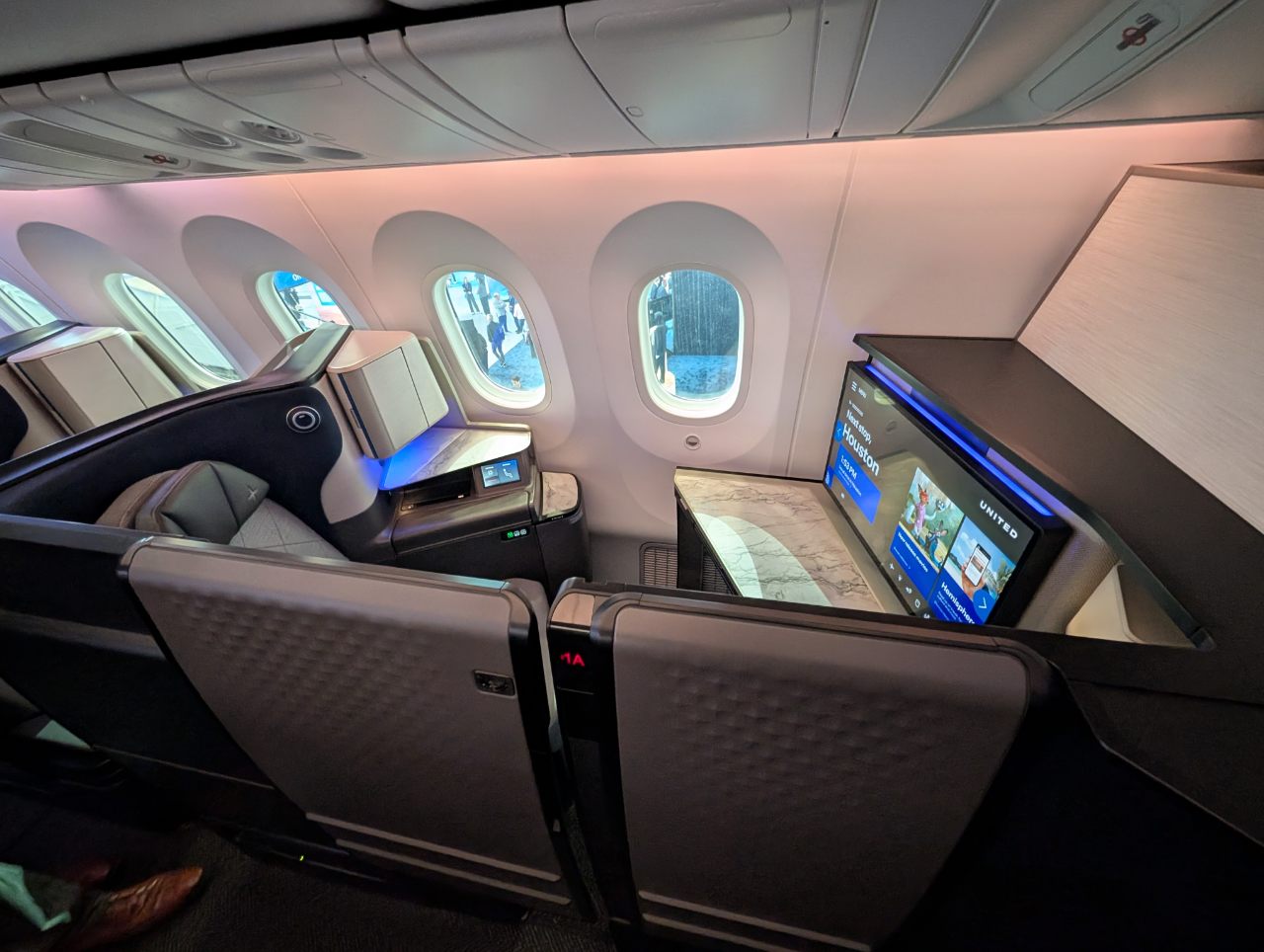
Six out of eight suites (1 A/L, 9 A/L, 9 D/F) have an ottoman with a seat belt, allowing a companion from Polaris to visit and dine with you during the flight.
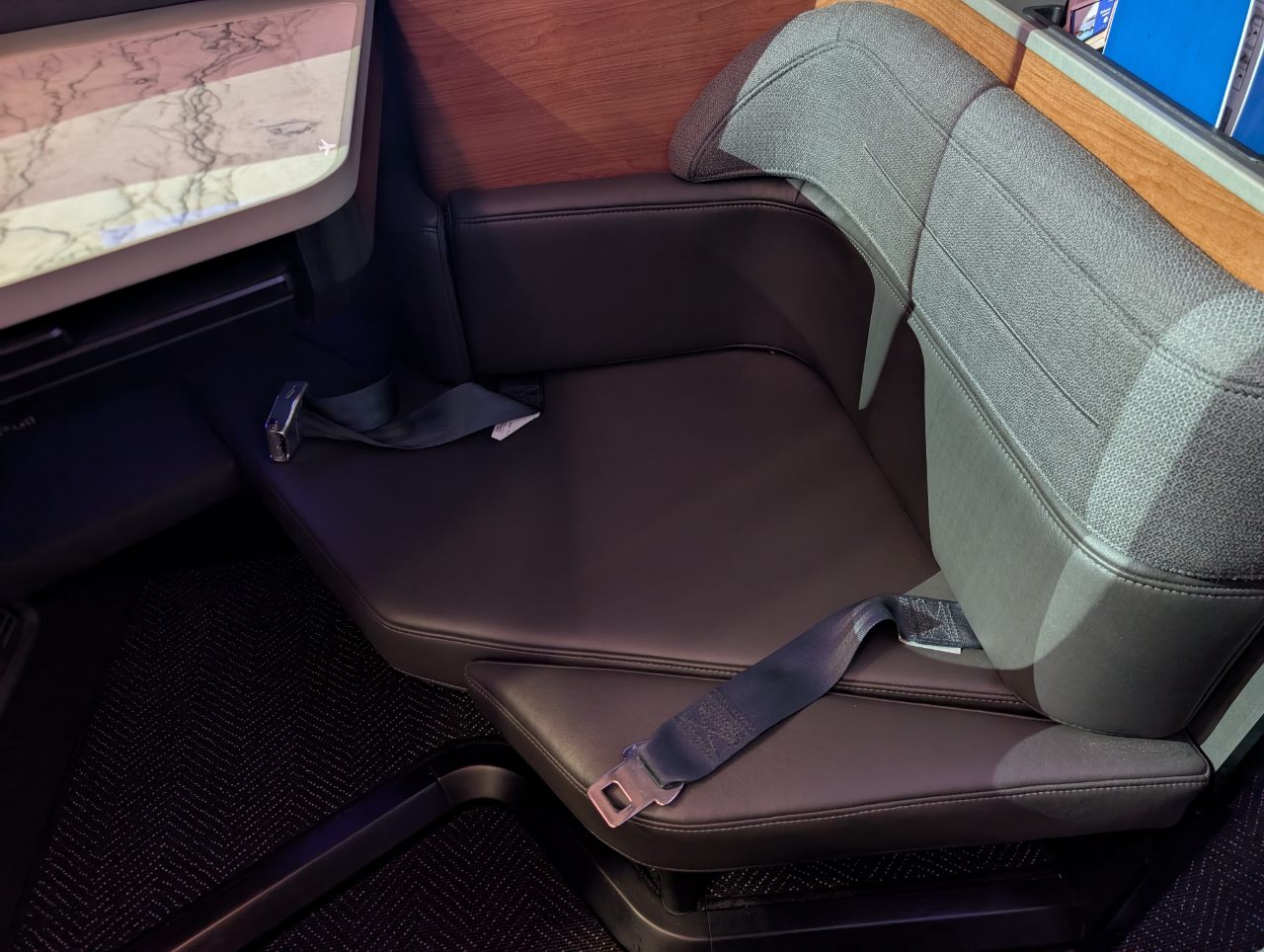
That said, I’m a bit confused about how companion dining will work. If you look at the photo below, you’ll see that the ottoman is at an odd angle to the tray table. So either the companion’s food fits on the tray table — in which case they’ll have the corner jutting into them — or it fits on the quartzite table — in which case they’re dining perpendicular to the main passenger. We’ll need to wait and see how this arrangement pans out in practice.
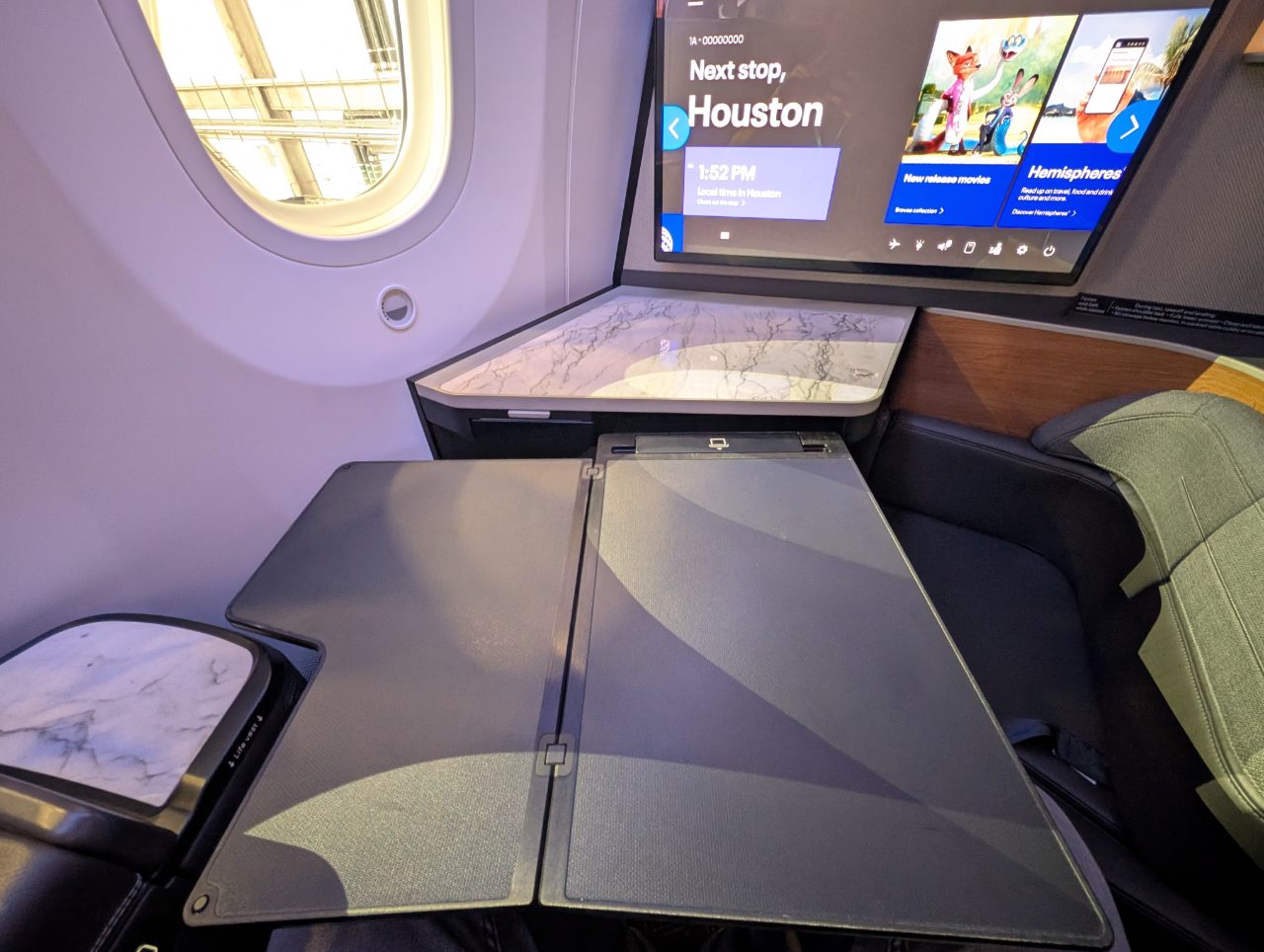
The centre Studios (1 D/F, 9 D/F) can be converted into a double suite by lowering the centre partition. United has even tailored a special triangular mattress pad to cover the retracted partition. While this enhances the overall illusion, it’s worth noting that the partition is still there, and is a hard surface. You definitely won’t be stretching out across both suites!
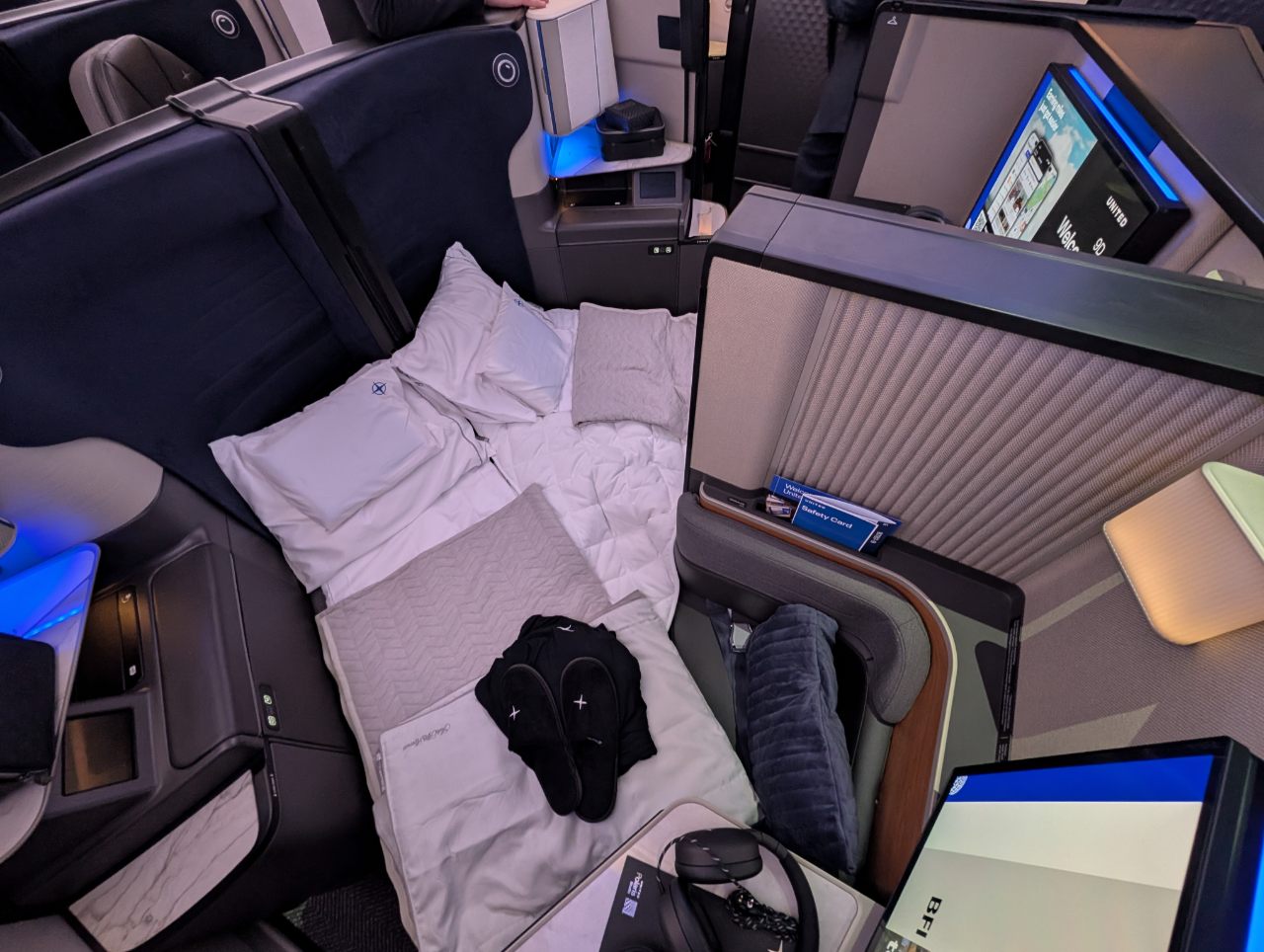
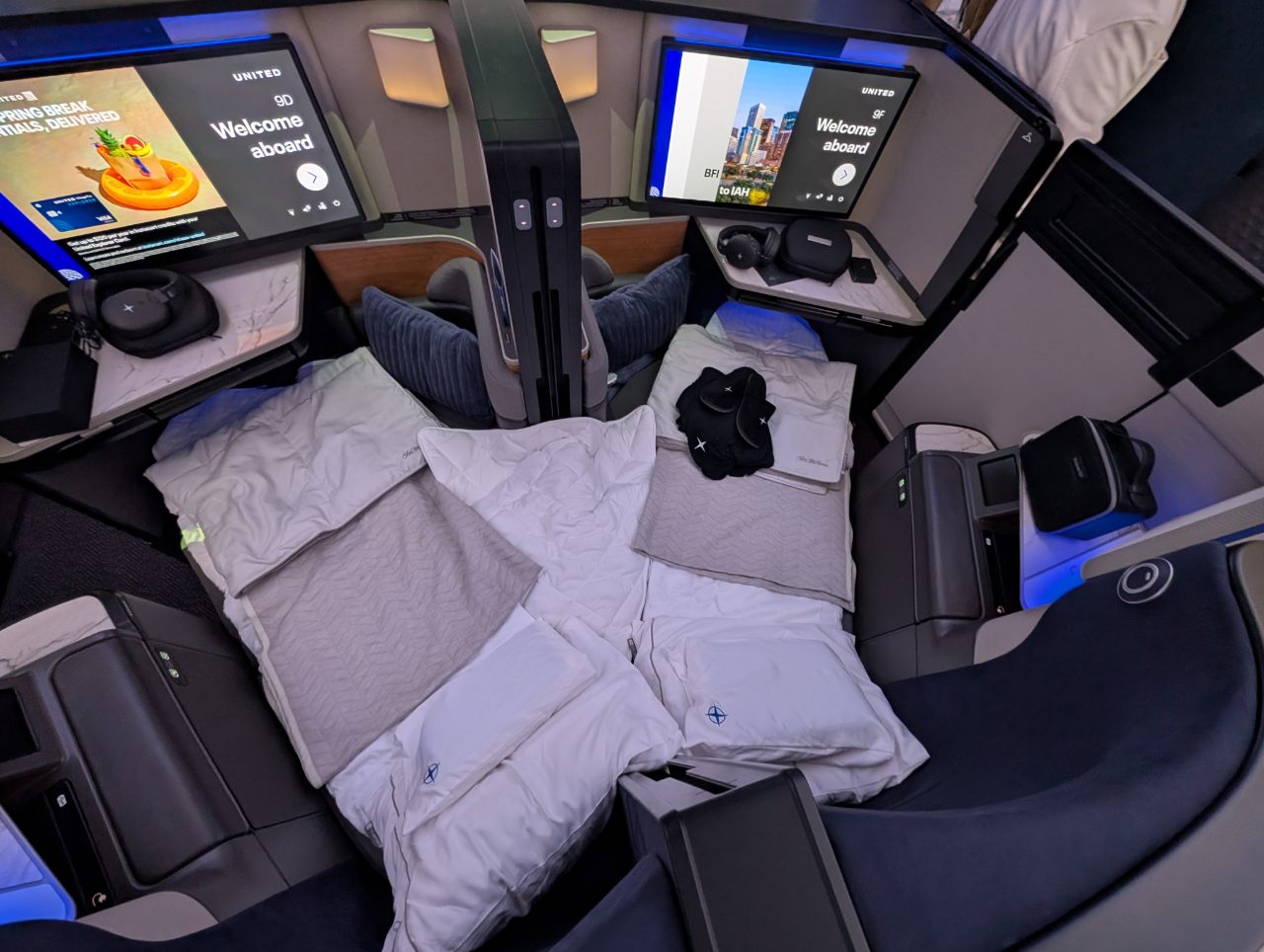
Customers who book a Polaris Studio suite will also get an enhanced soft product experience, which includes:
- Preferred boarding alongside United Global Services customers
- United’s tarmac transfer program, which uses electric Jaguar cars to drive passengers with short connections between gates
- Meridian noise-cancelling headphones
- Perricone MD Cold Plasma Plus+ luxury skincare products
- Enhanced dining options including an Ossetra caviar amuse-bouche
- Hoodie-style pajamas

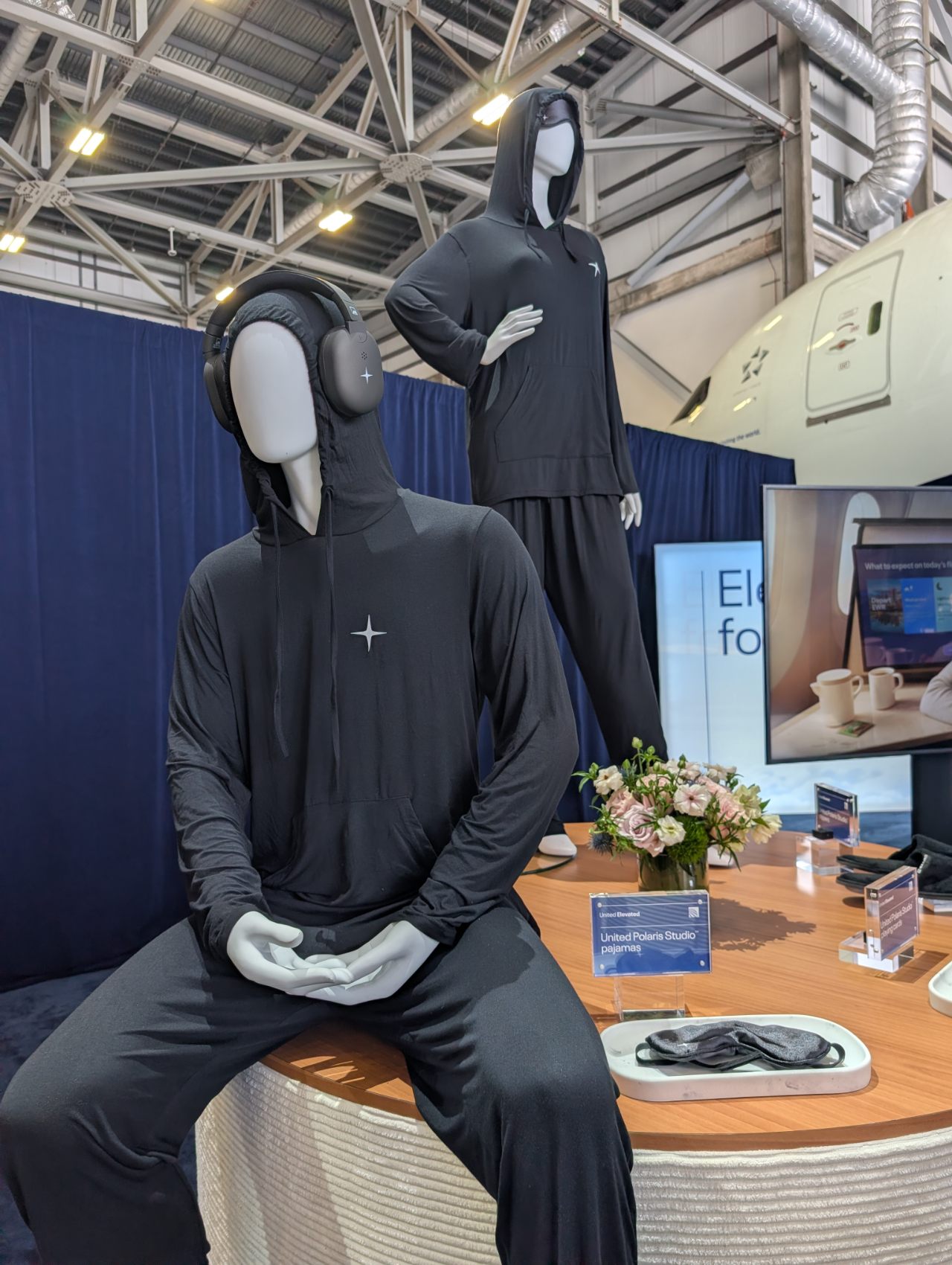
Any Polaris passenger can select the Polaris Studio by paying an additional seat assignment fee, which is currently priced at US$499 per flight, regardless of the route length (i.e. it’s the same price to Singapore as it is to London).
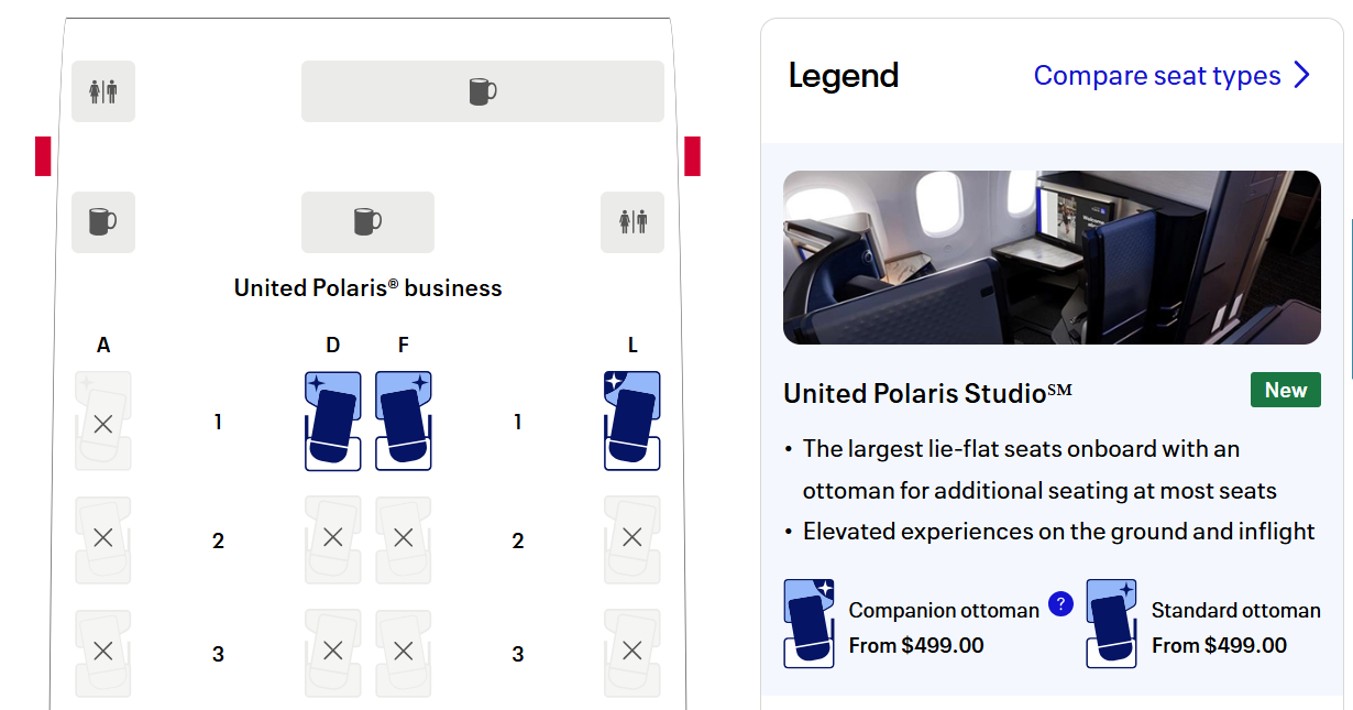
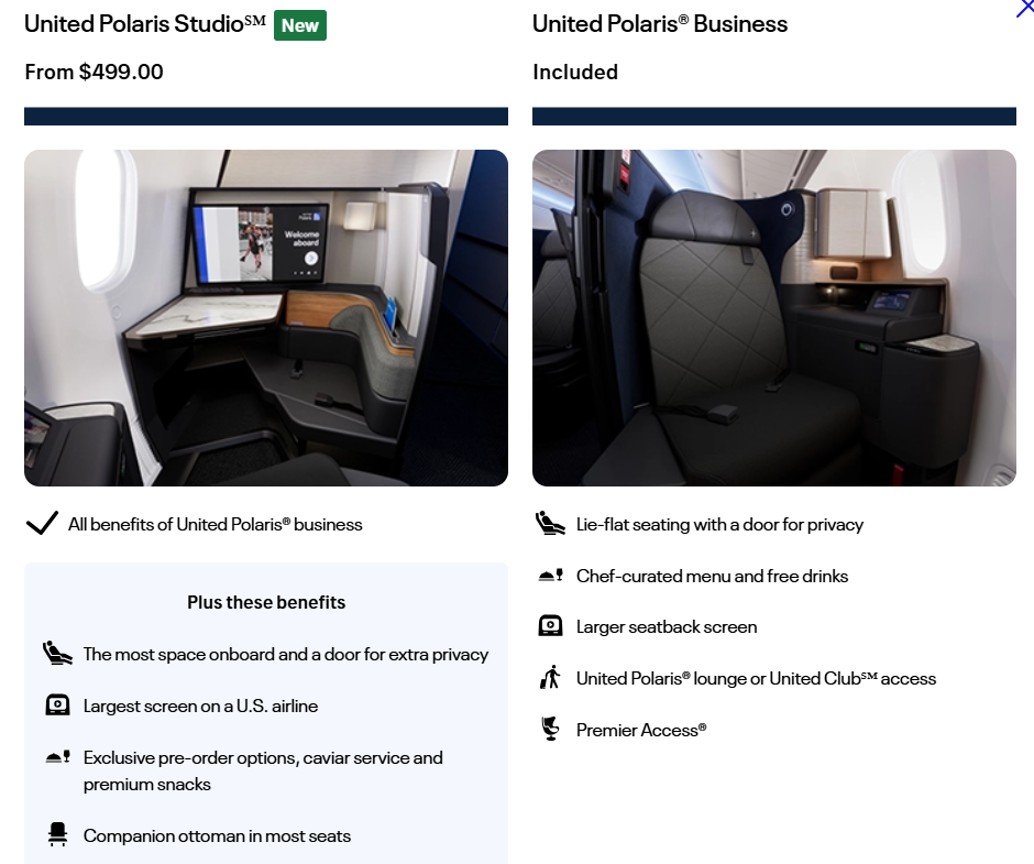
This feels like impulse-buy territory, perhaps to entice customers to try it out, and I suspect it could be adjusted upwards in the future. From my discussions with United leadership, I understand that there are currently no plans to open the Studios for elite upgrades, and the pricing will not be further discounted closer to departure.
Polaris Suites
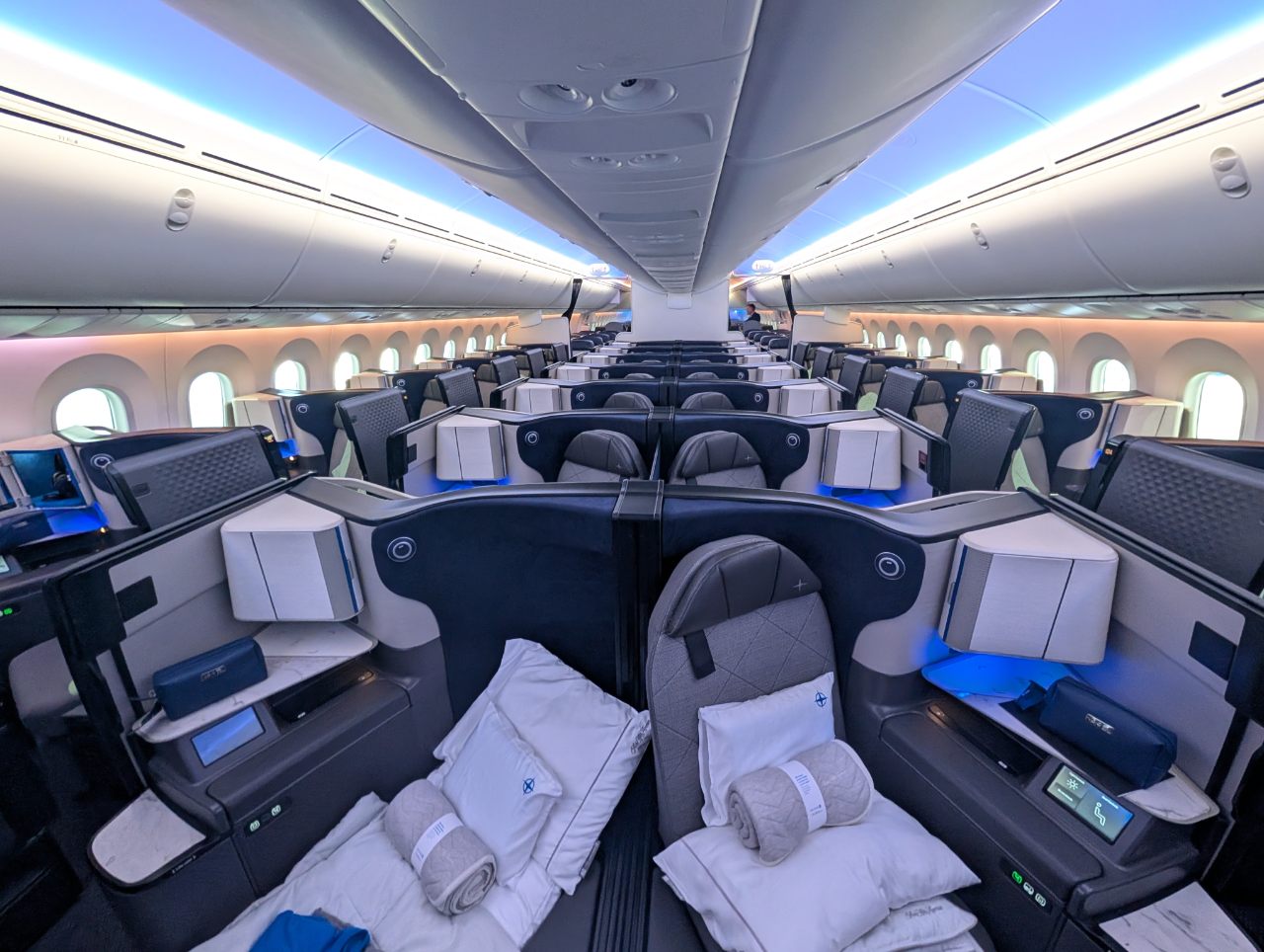
The 56 United Polaris suites are based on the Adient Ascent platform, also used by Qatar Airways and Hawaiian Airlines on their B787-9s.
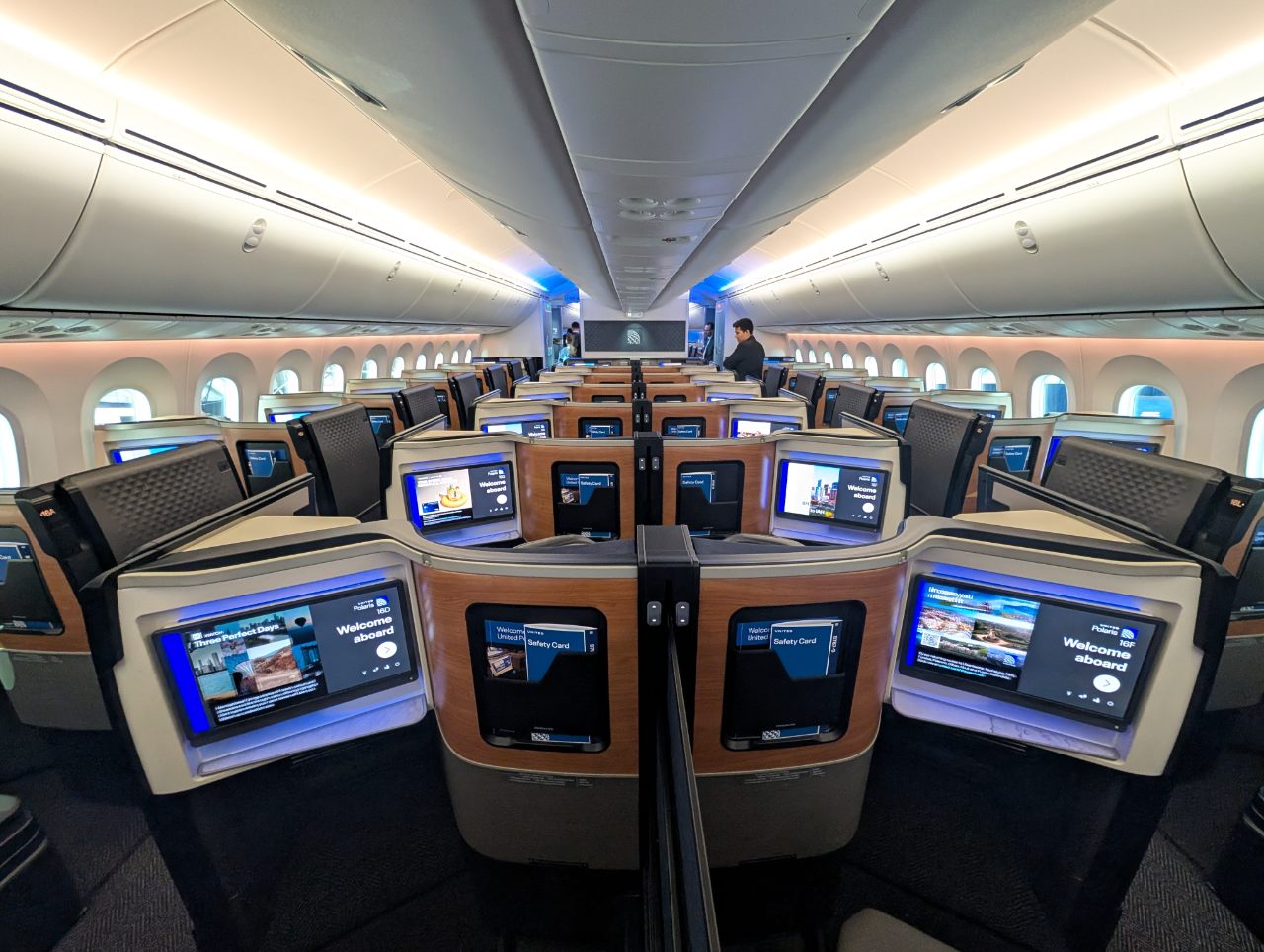
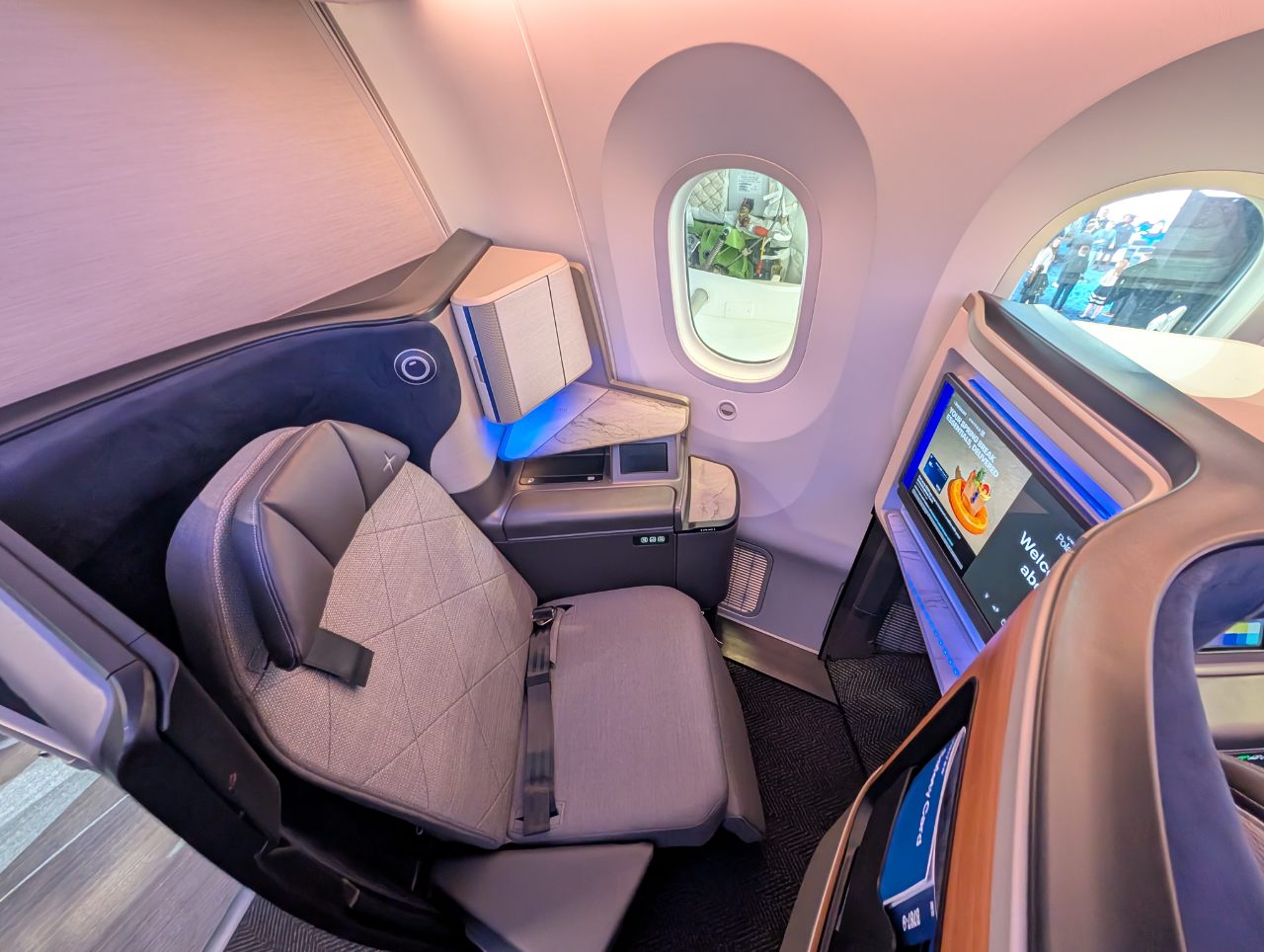
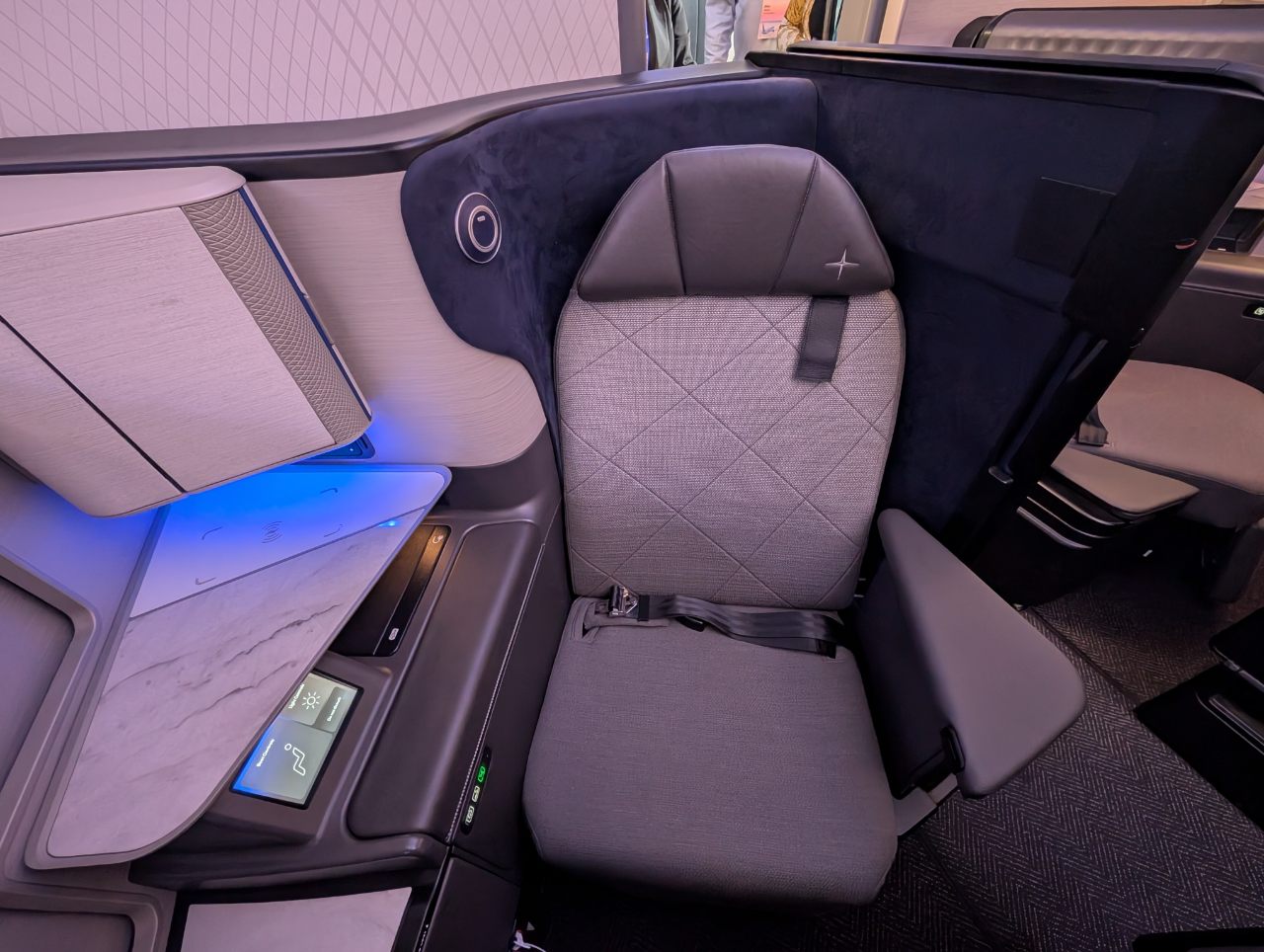
Suites are 21″ wide, and arranged in a 1-2-1 configuration with direct aisle access for all passengers. United is also offering customers a choice when it comes to the centre seats:
- Seats in the forward cabin follow a reverse herringbone layout (pointing towards each other)
- Seats in the rear cabin follow a herringbone layout (pointing away from each other)
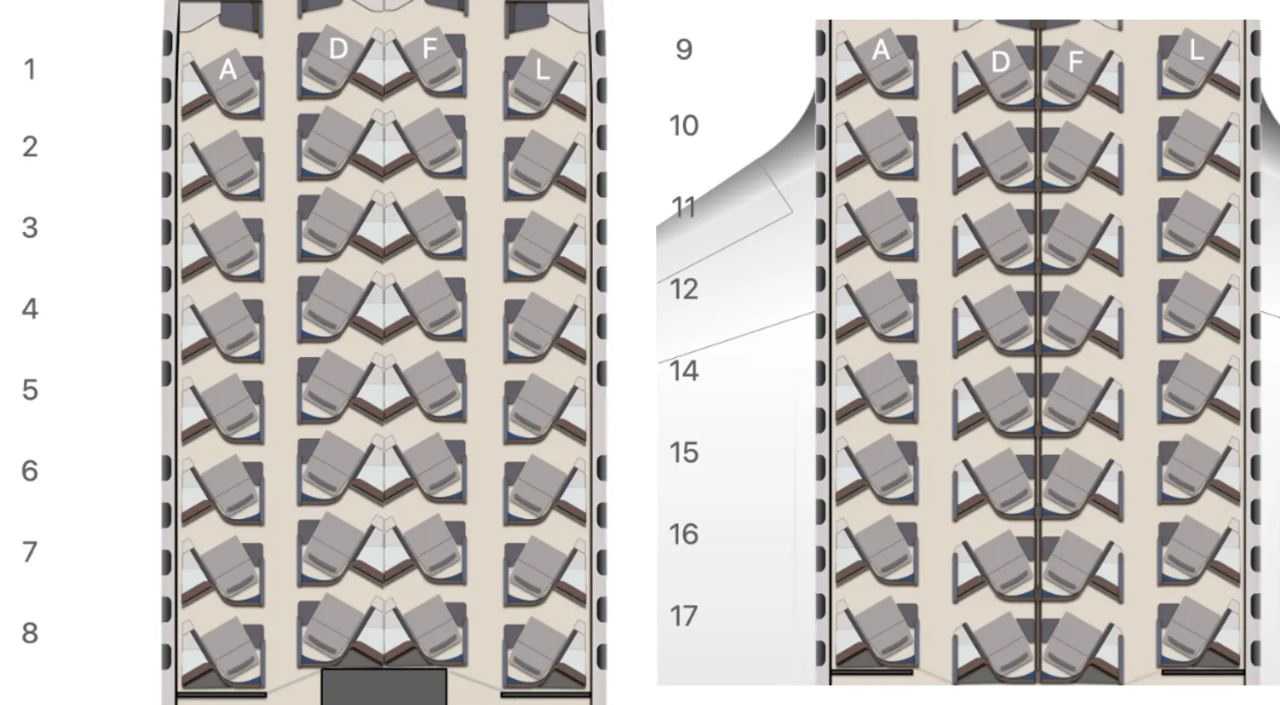
The forward cabin is your classic reverse herringbone, where the centre seats are separated by the console tables. With the privacy divider slid into position, you’re guaranteed privacy from whoever’s in the other seat.
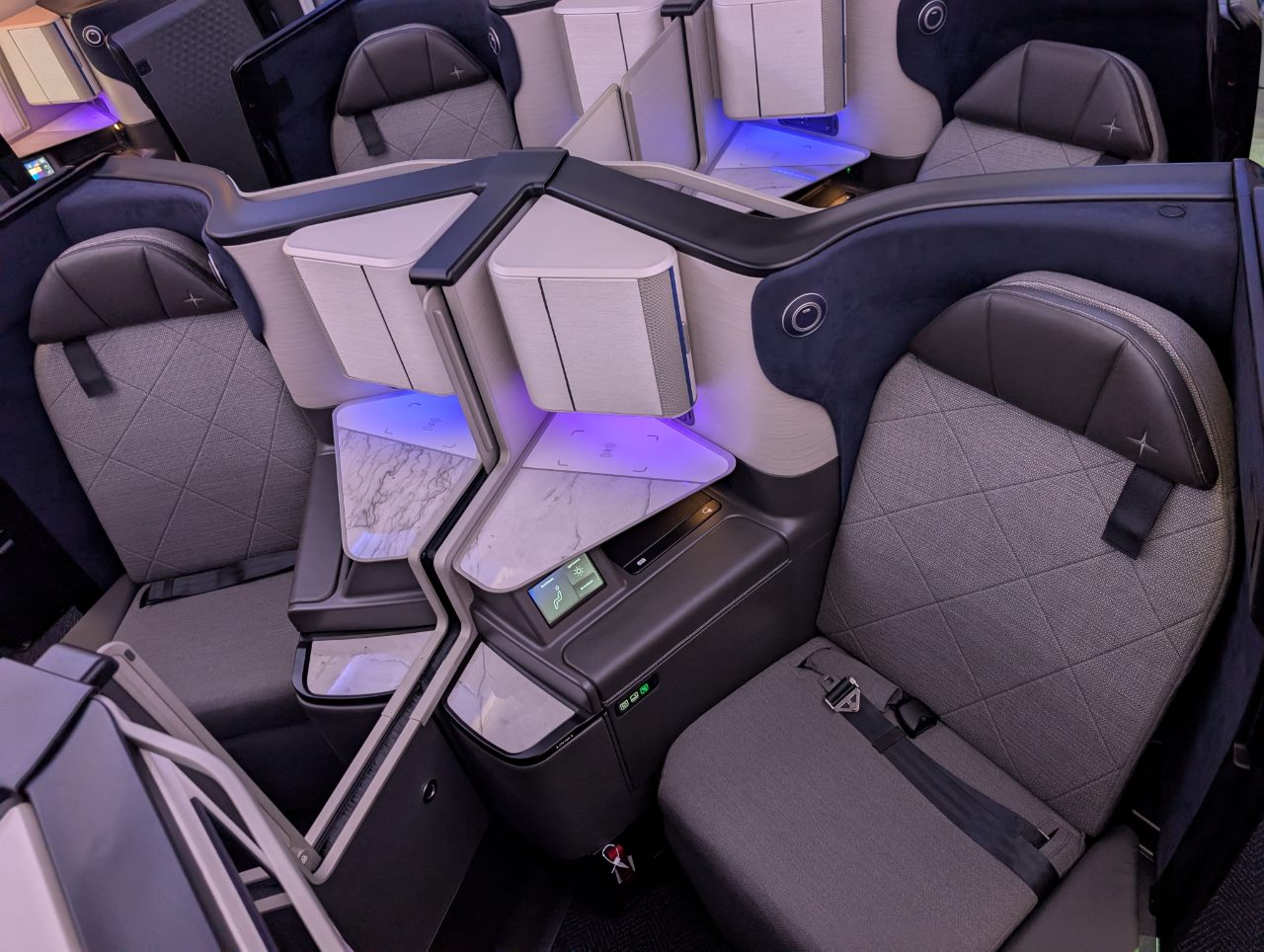
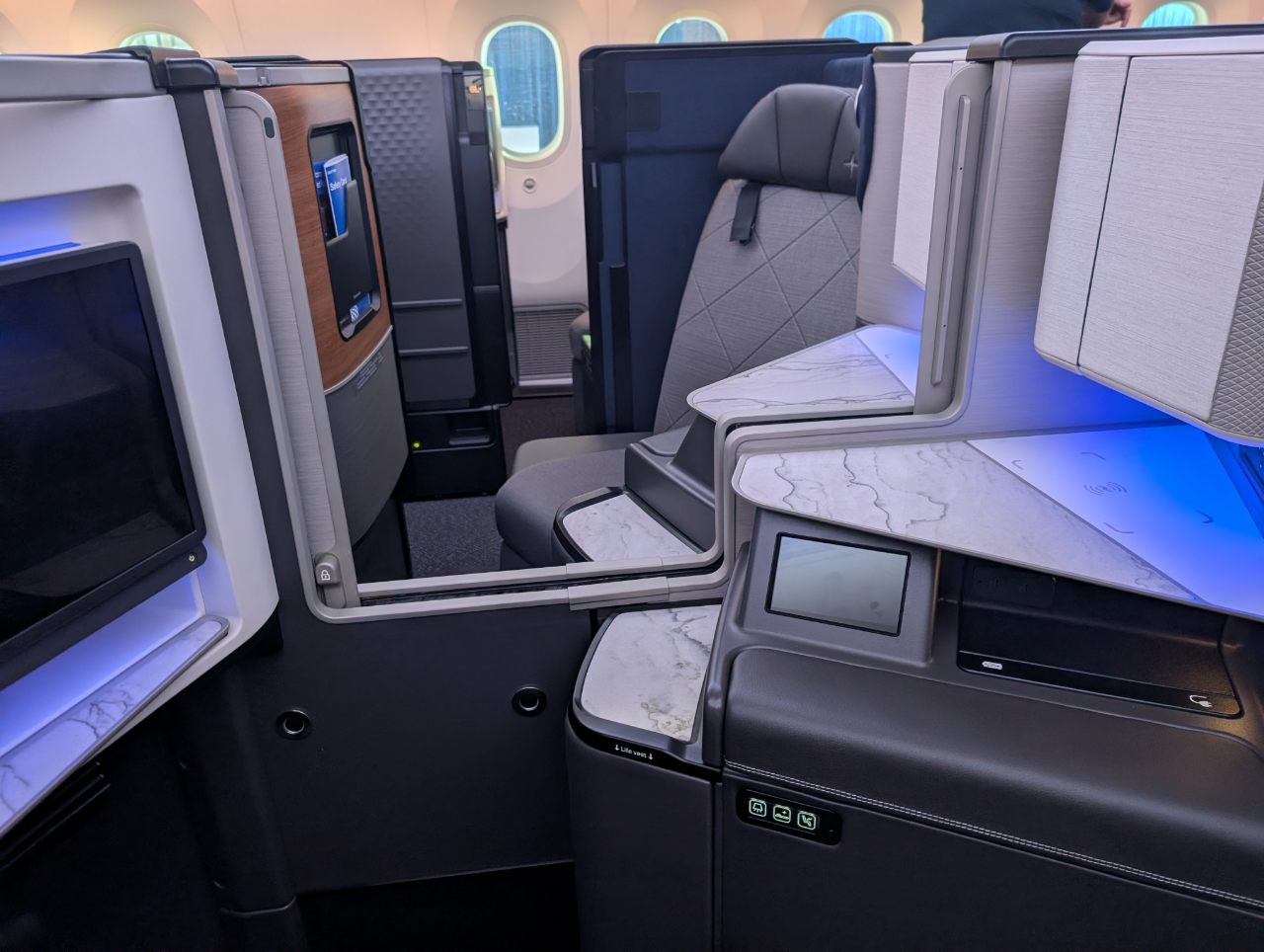
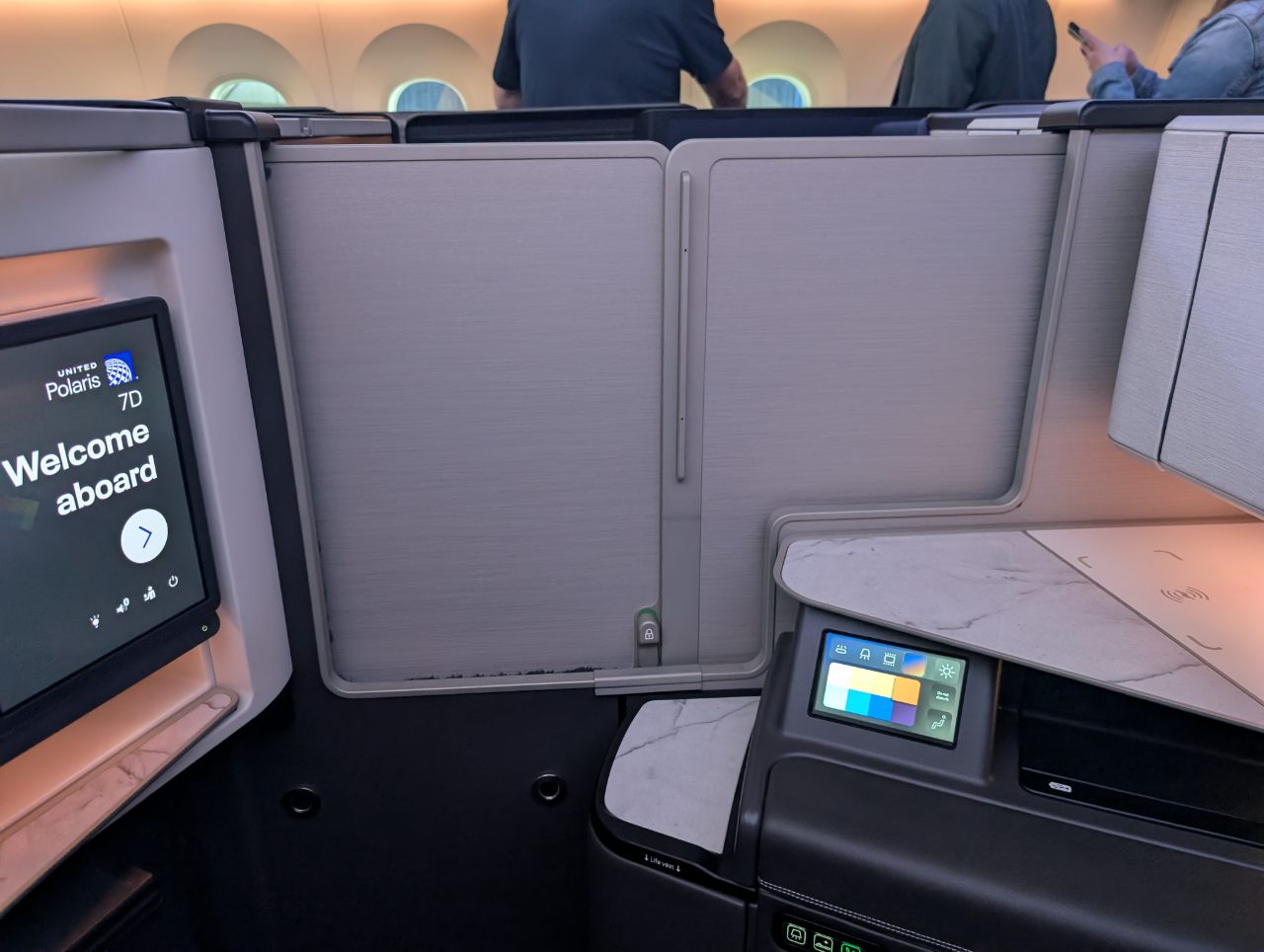
The rear cabin is more suited to couples, as it’s easier to communicate when your heads are next to each other. Moreover, the centre divider can be lowered completely, so when the seats are fully reclined, you have a double bed, or a close approximation of it.
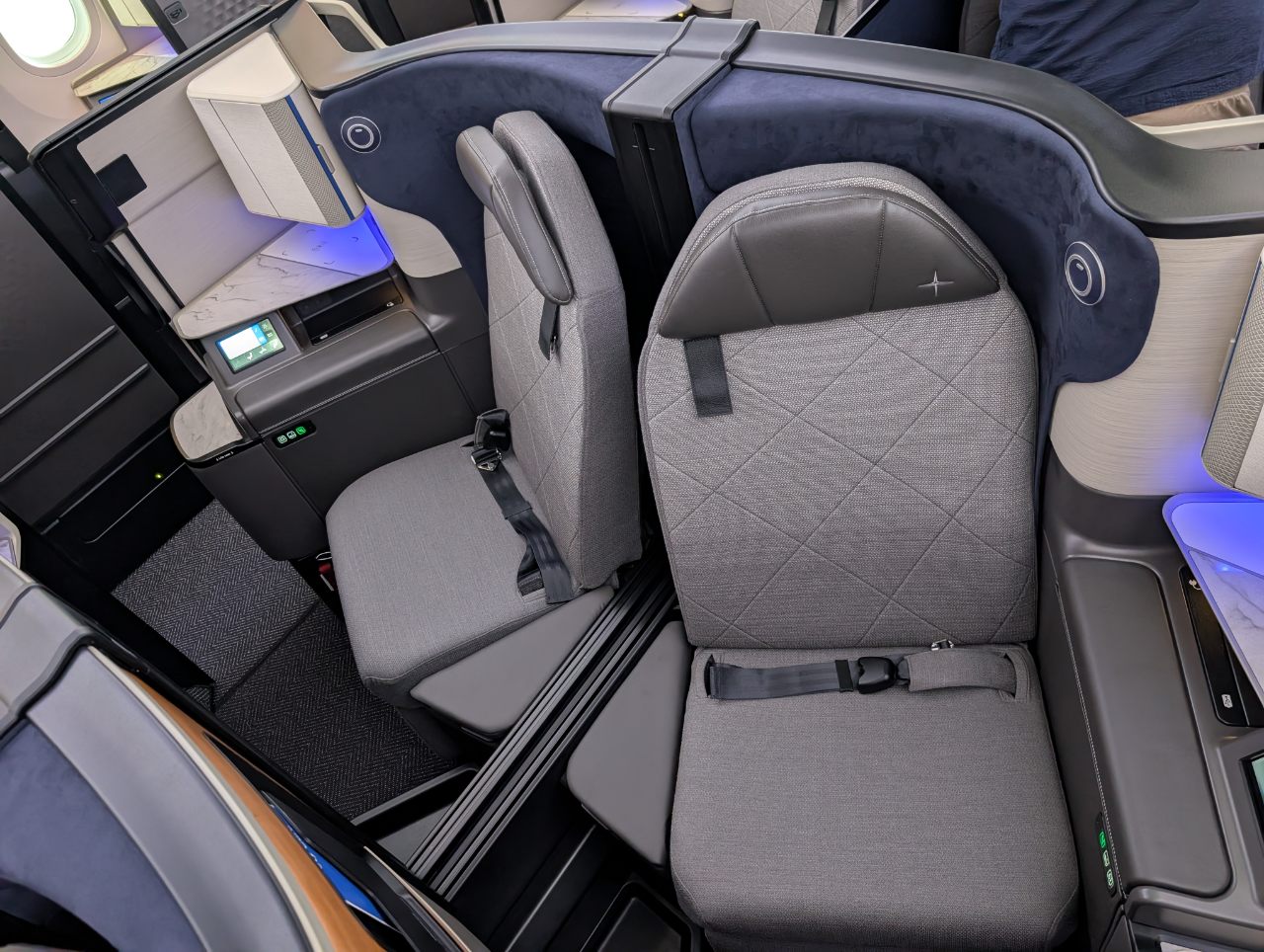
If you’re travelling solo but end up in this cabin for whatever reason, it’s not all bad as the privacy divider can be fully raised.
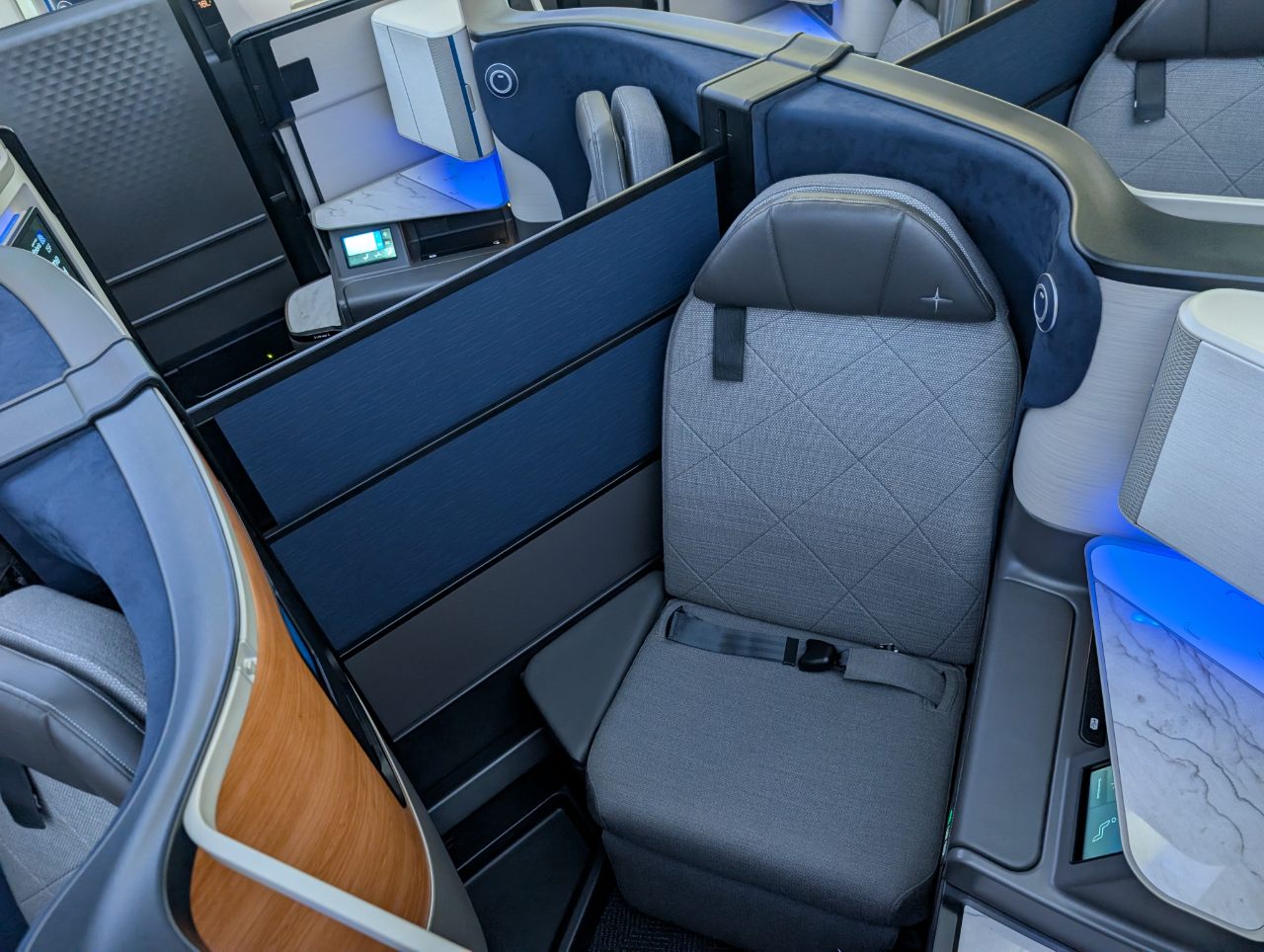
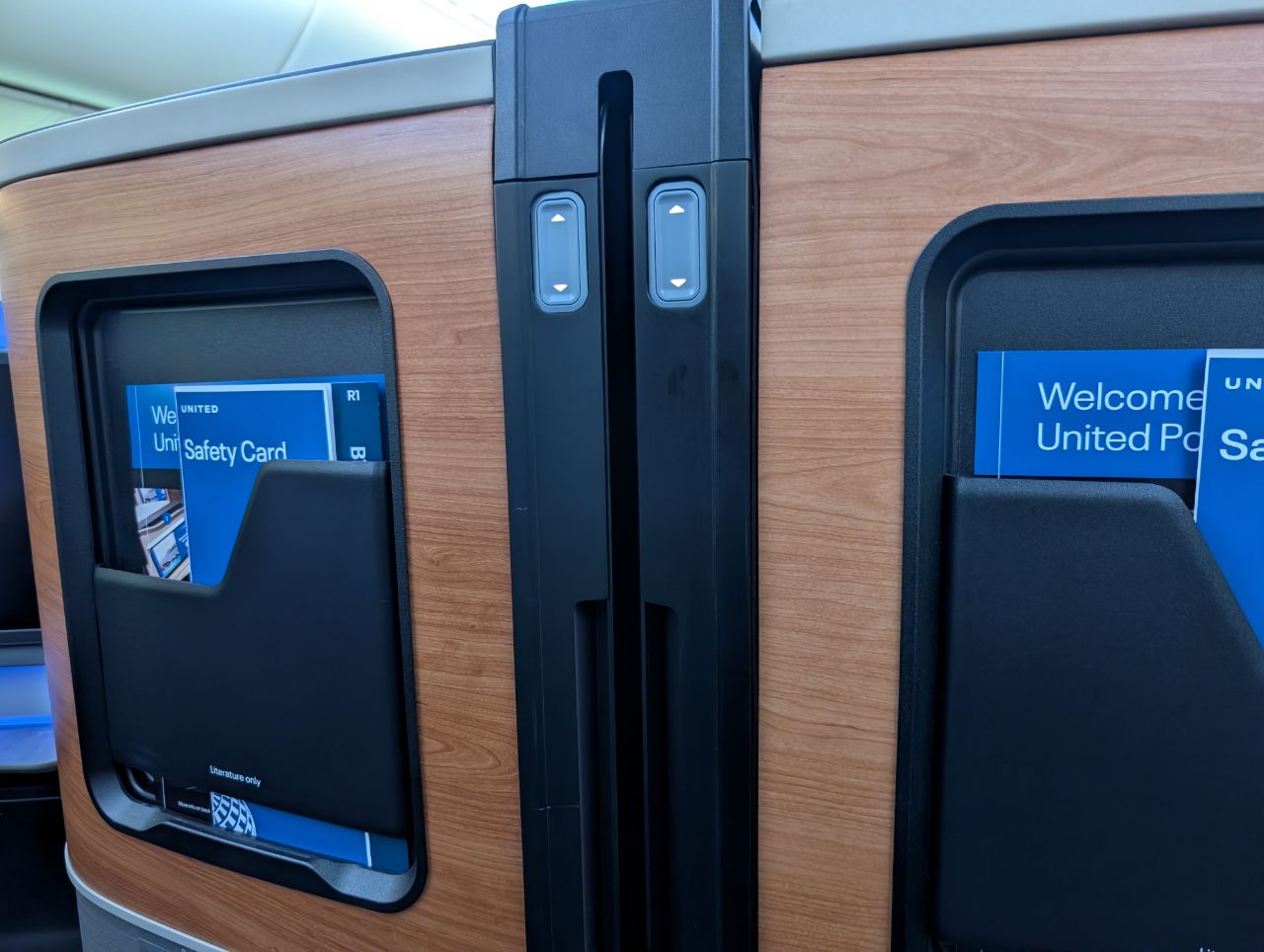
Another interesting feature is the centre divider. In the forward cabin, it’s manually operated. In the rear cabin, it’s powered electrically. The centre divider can be raised by either passenger, but can only be lowered if both passengers press the down button at the same time. This “two-factor authentication” mechanism prevents a passenger from unilaterally lowering the divider.
The sliding doors (which again, won’t be operable at the time of launch) were easy to operate, though it’s worth noting there is a noticeable gap even when they’re fully closed. The gap is more obvious from the inside than the outside, however.
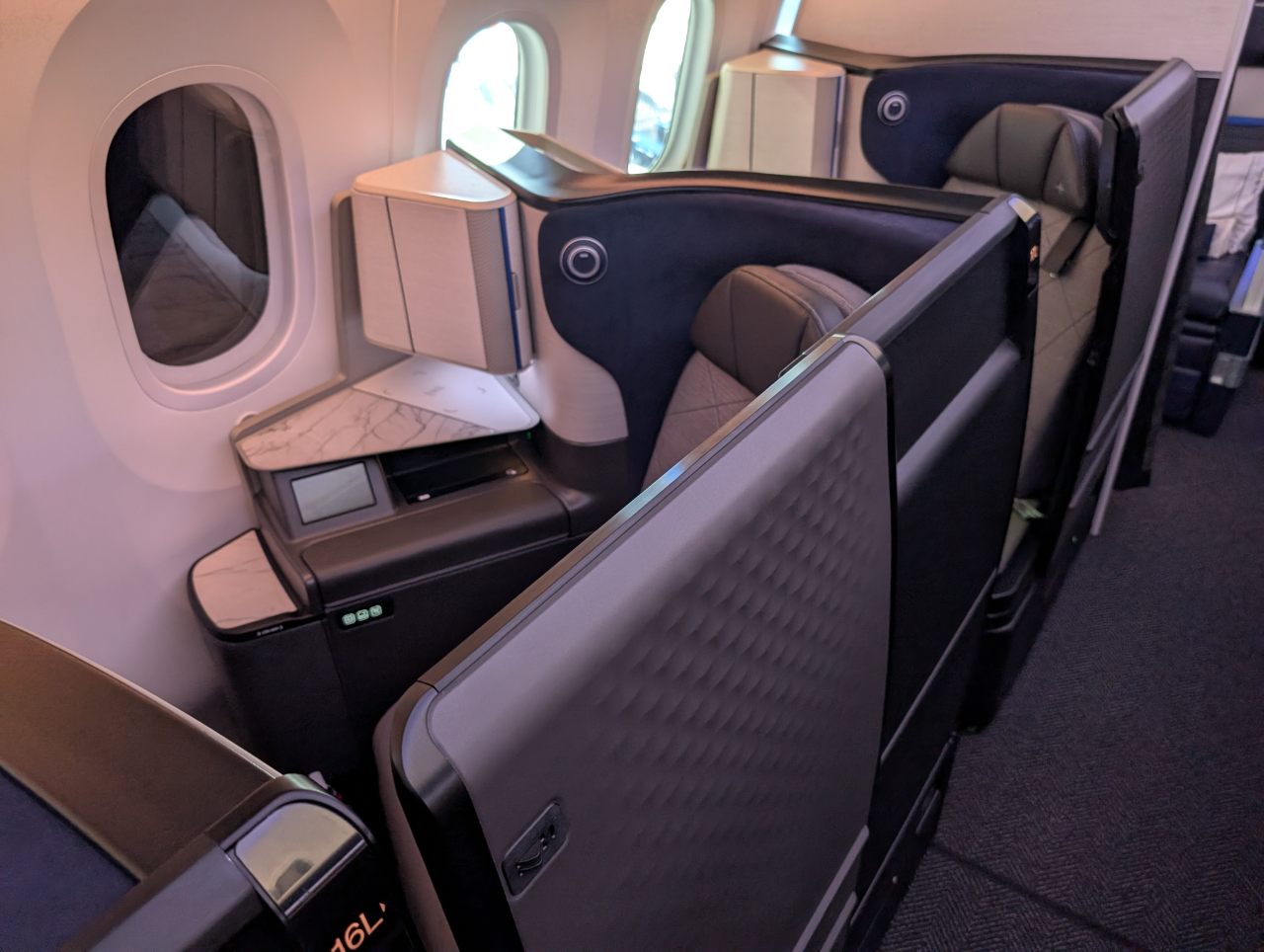
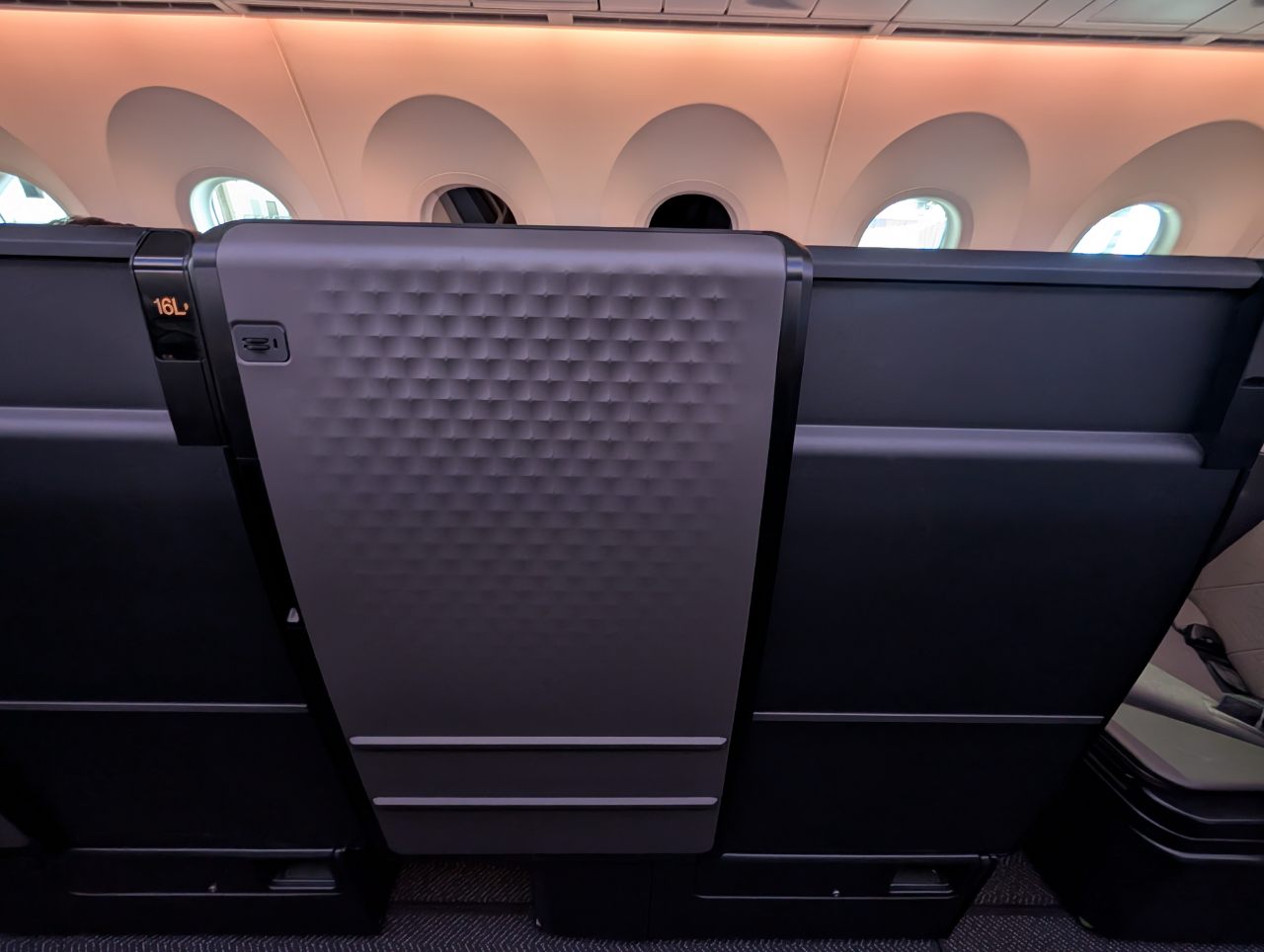
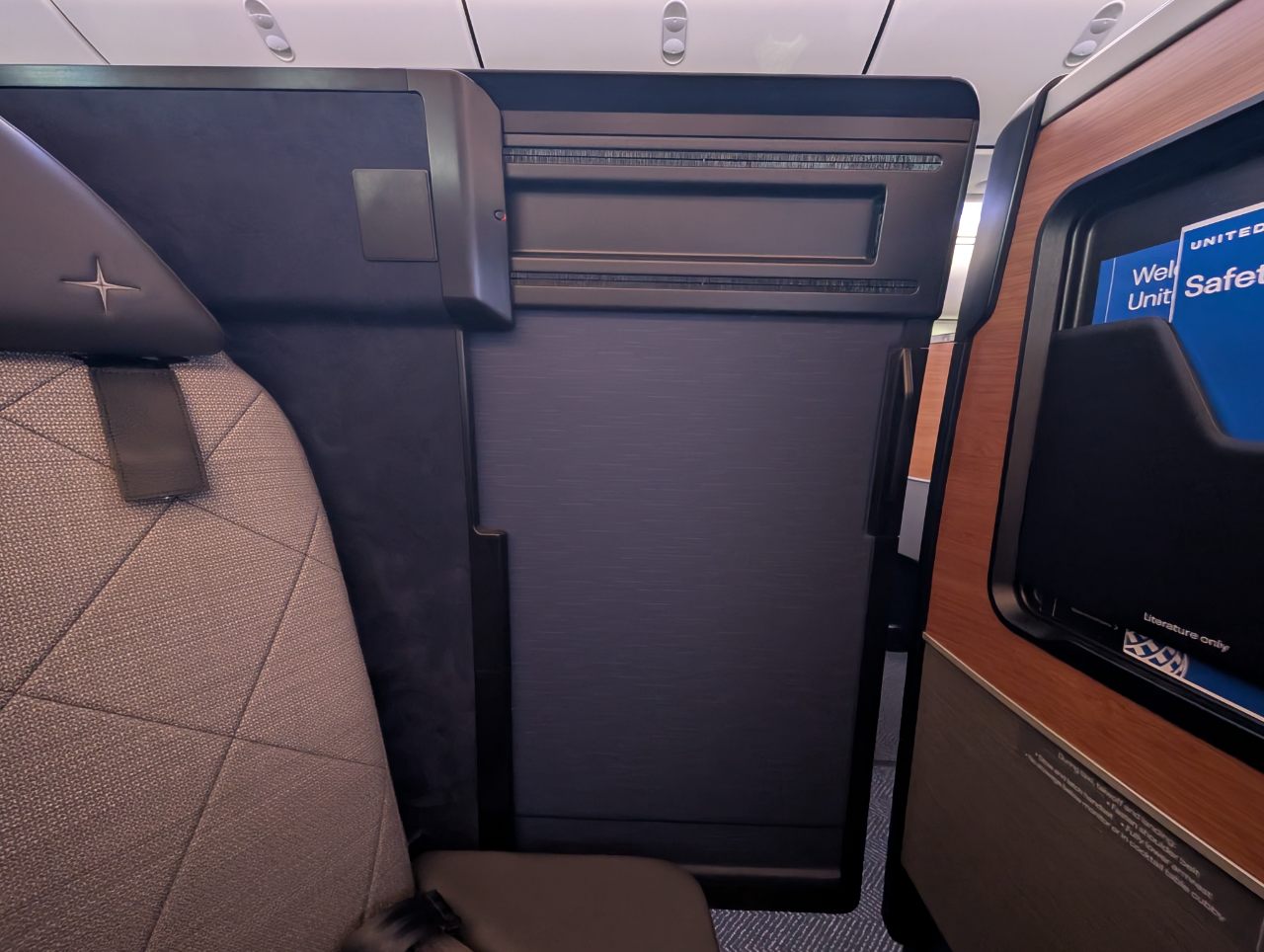
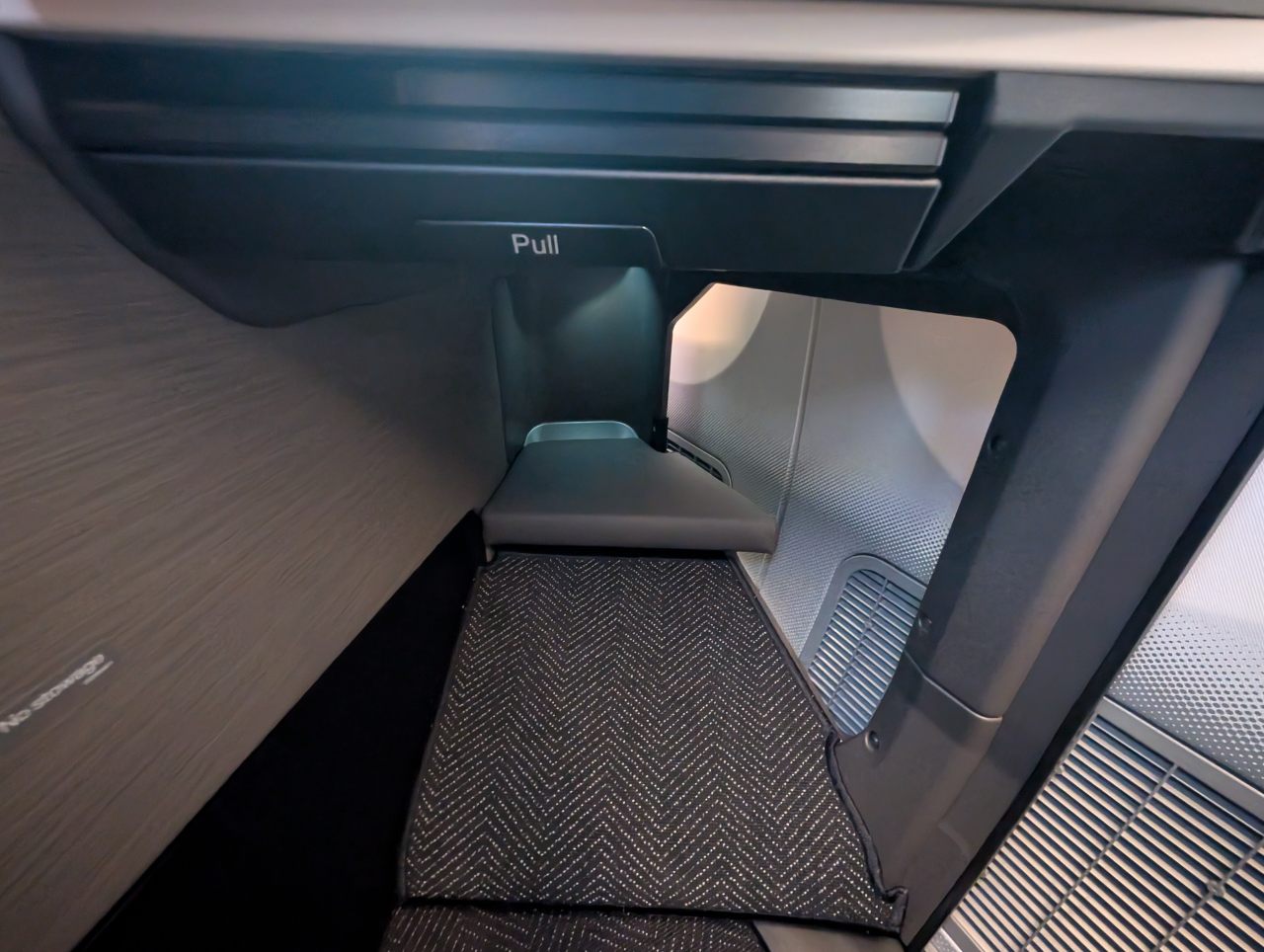
Seats convert into full flat beds measuring 1.98 m long. The footwell does narrow towards the front, but even when fully reclined, my feet didn’t go inside far enough for it to become an issue (I’m 1.8 m and a back sleeper).
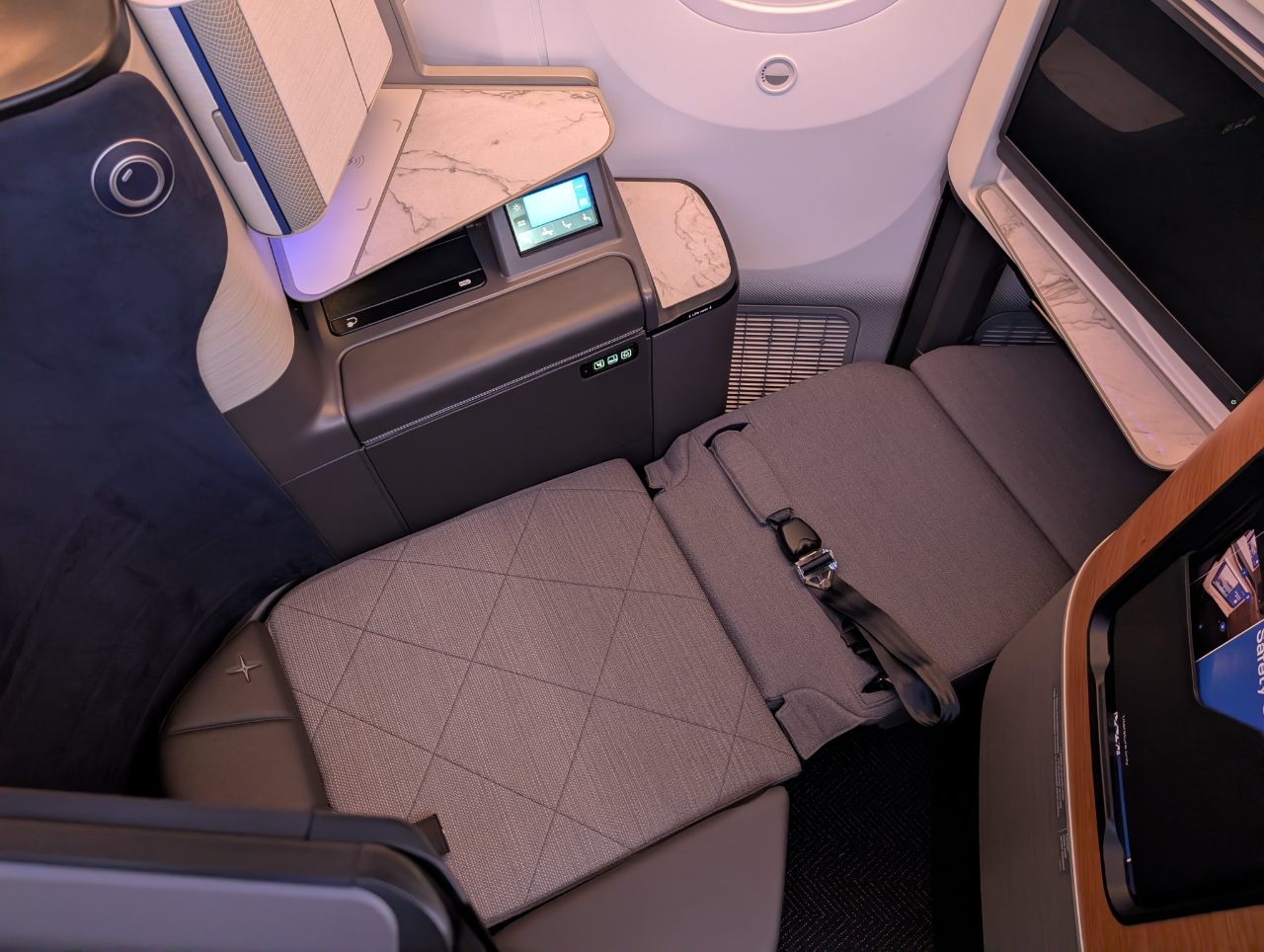
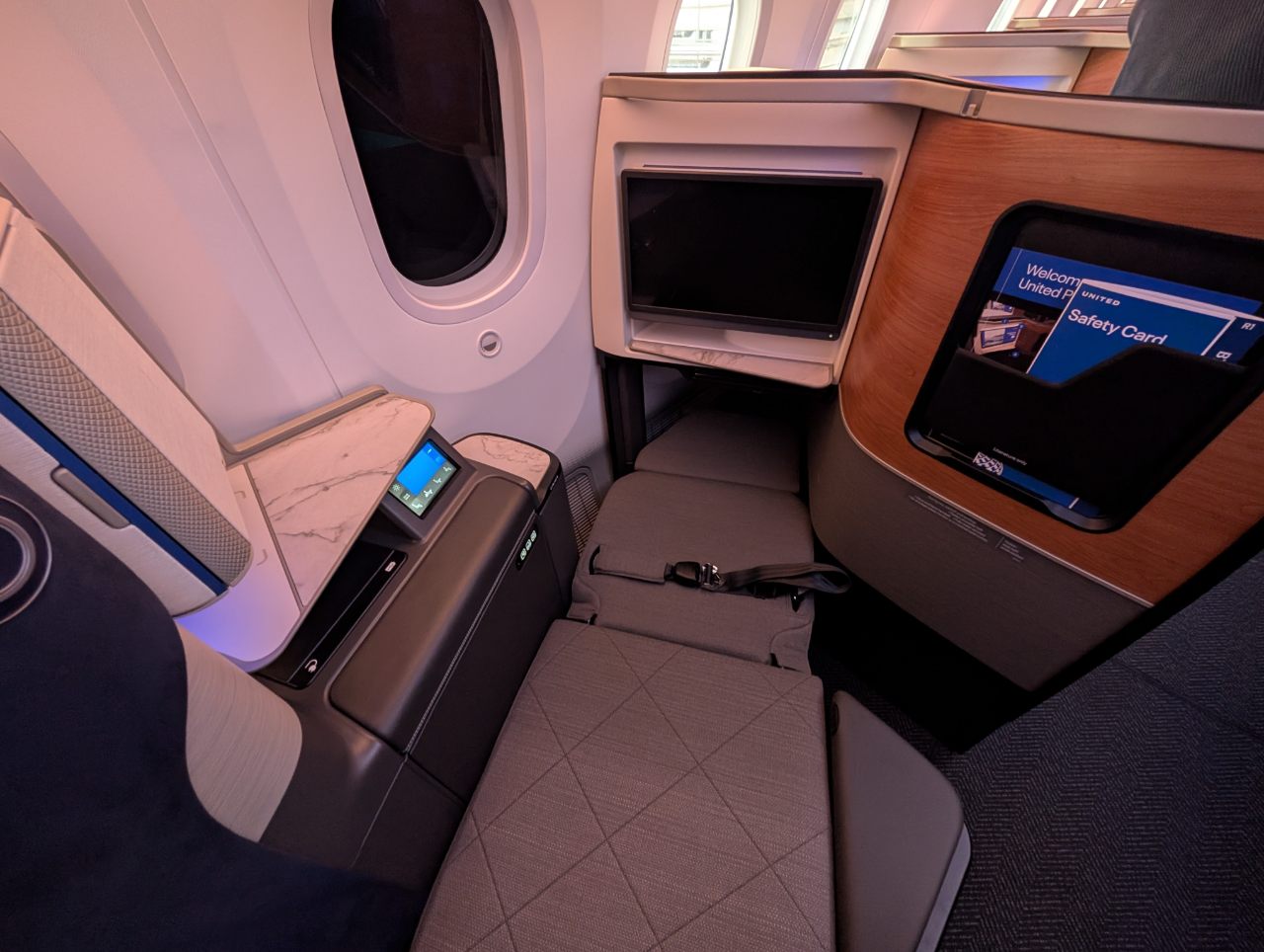
United has some of the best bedding of any airline in Business Class, and there won’t be any changes there. Customers will enjoy a Saks Fifth Avenue mattress pad, day blanket, duvet, large pillow and cooling gel pillow. Pajamas are also available on request.
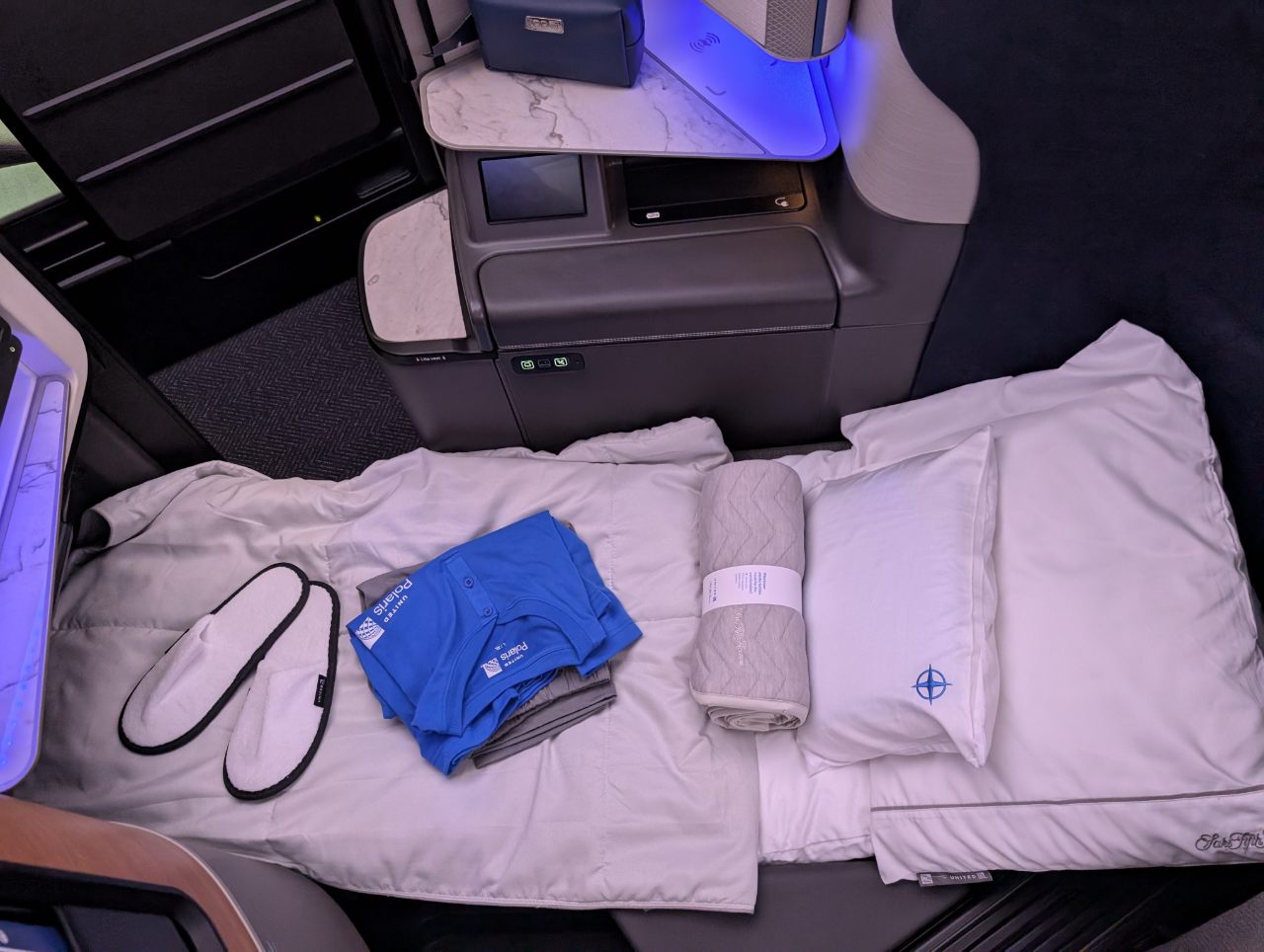
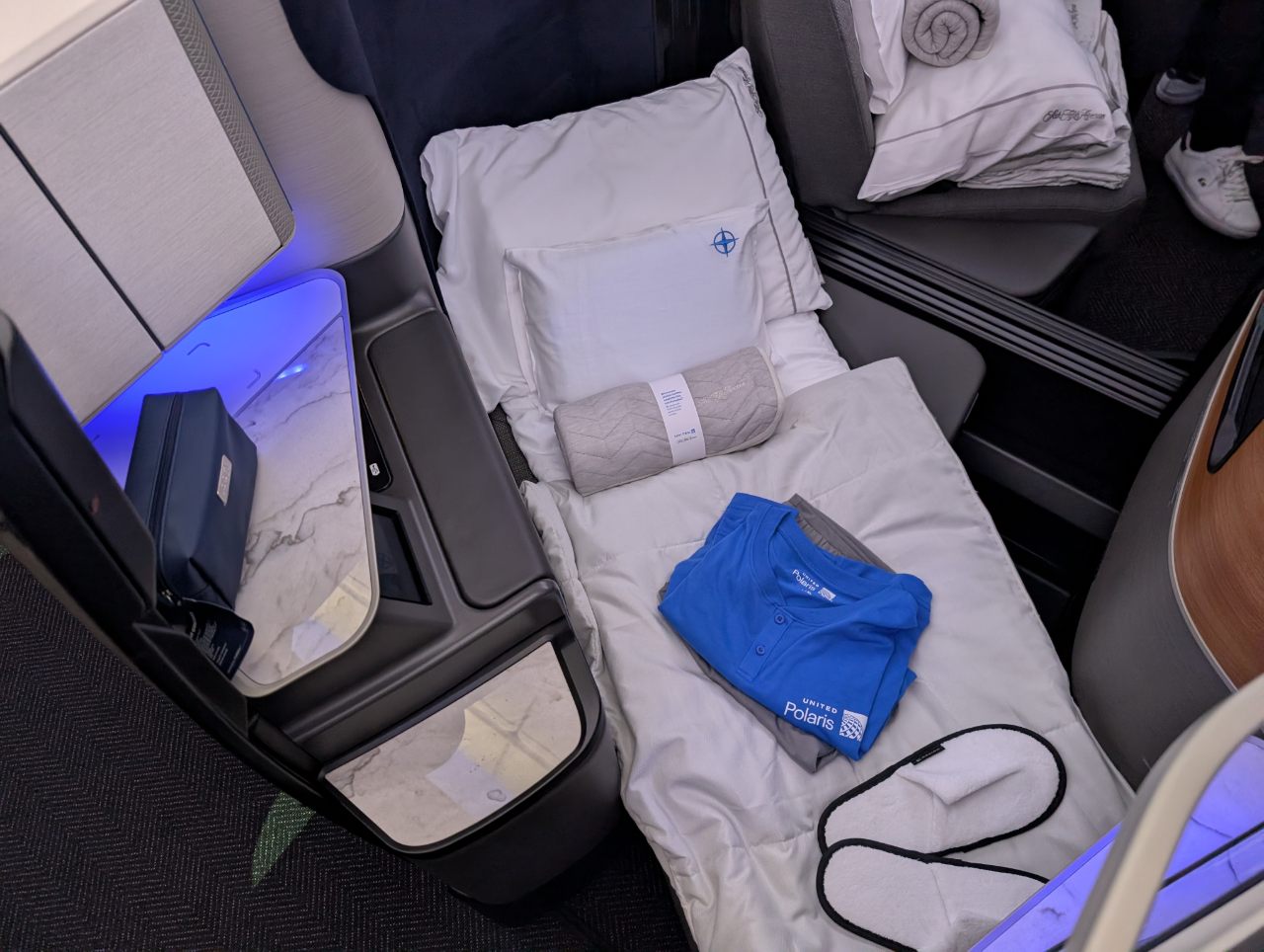
All Polaris suites have 19-inch 4K OLED touchscreens with Bluetooth audio connectivity that allows you to pair your own headsets with the system.
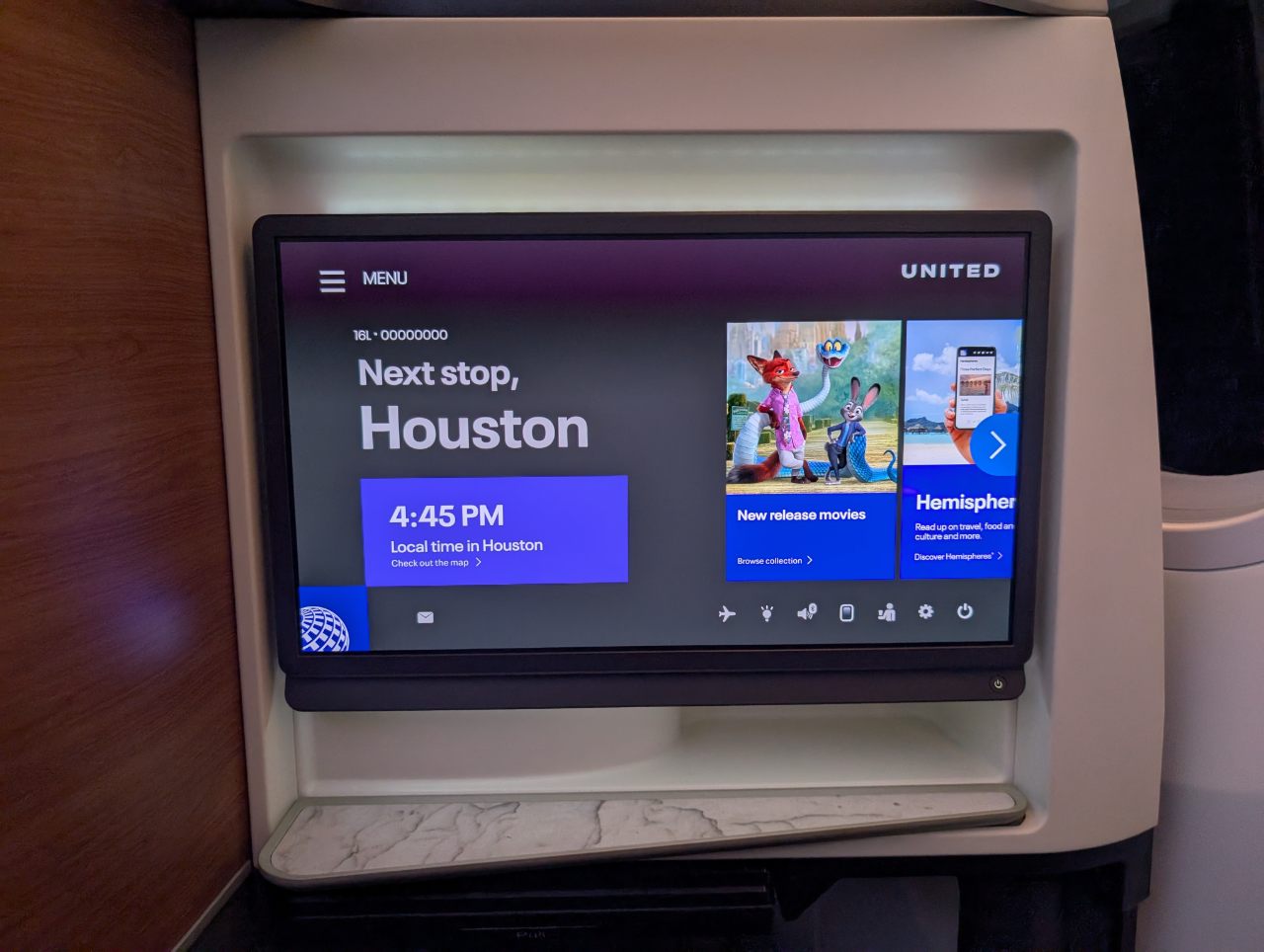
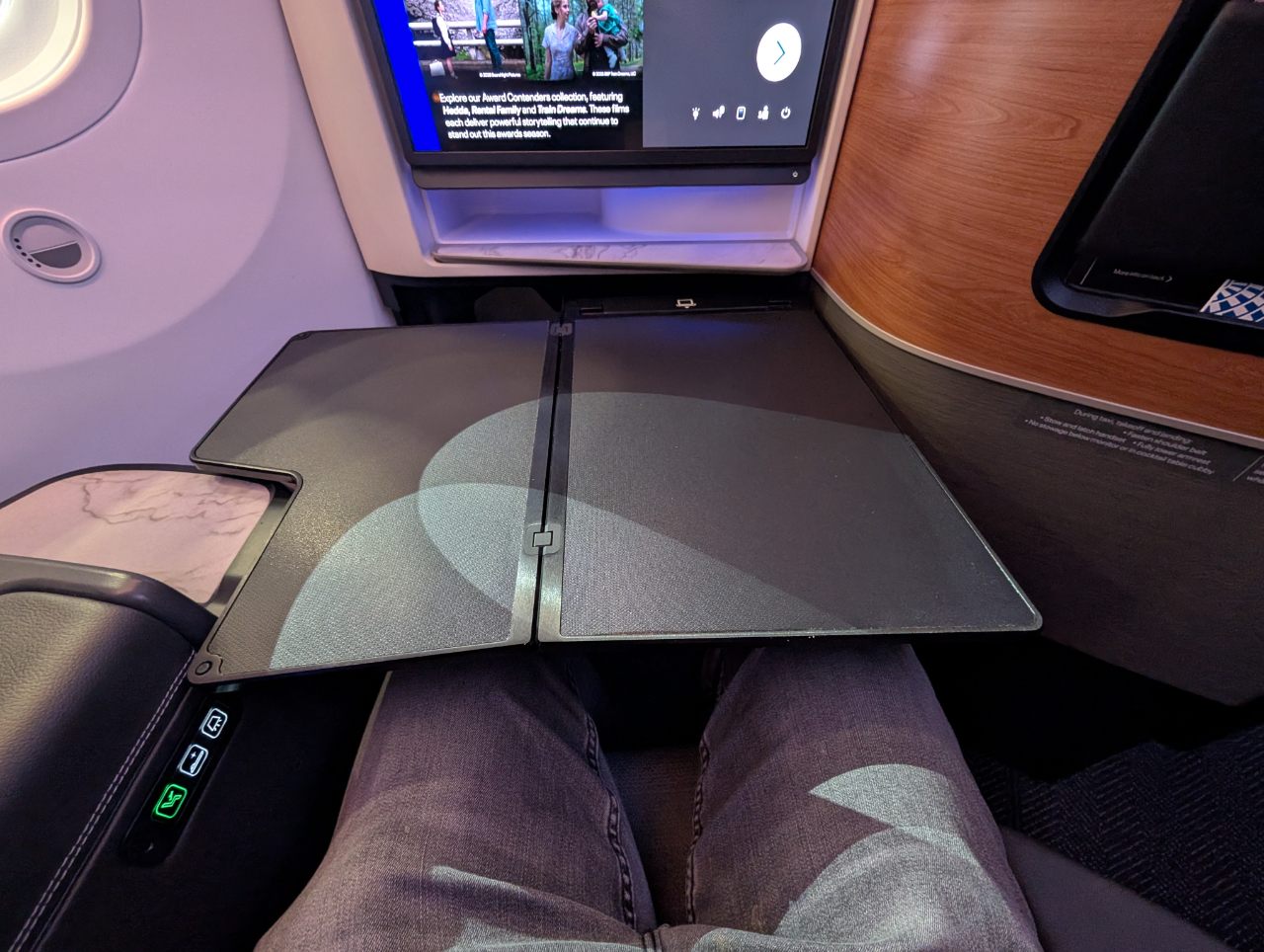
The tray table slides out from under the screen, and even when deployed, can be slid forward so you can easily enter and exit your seat during meal service.
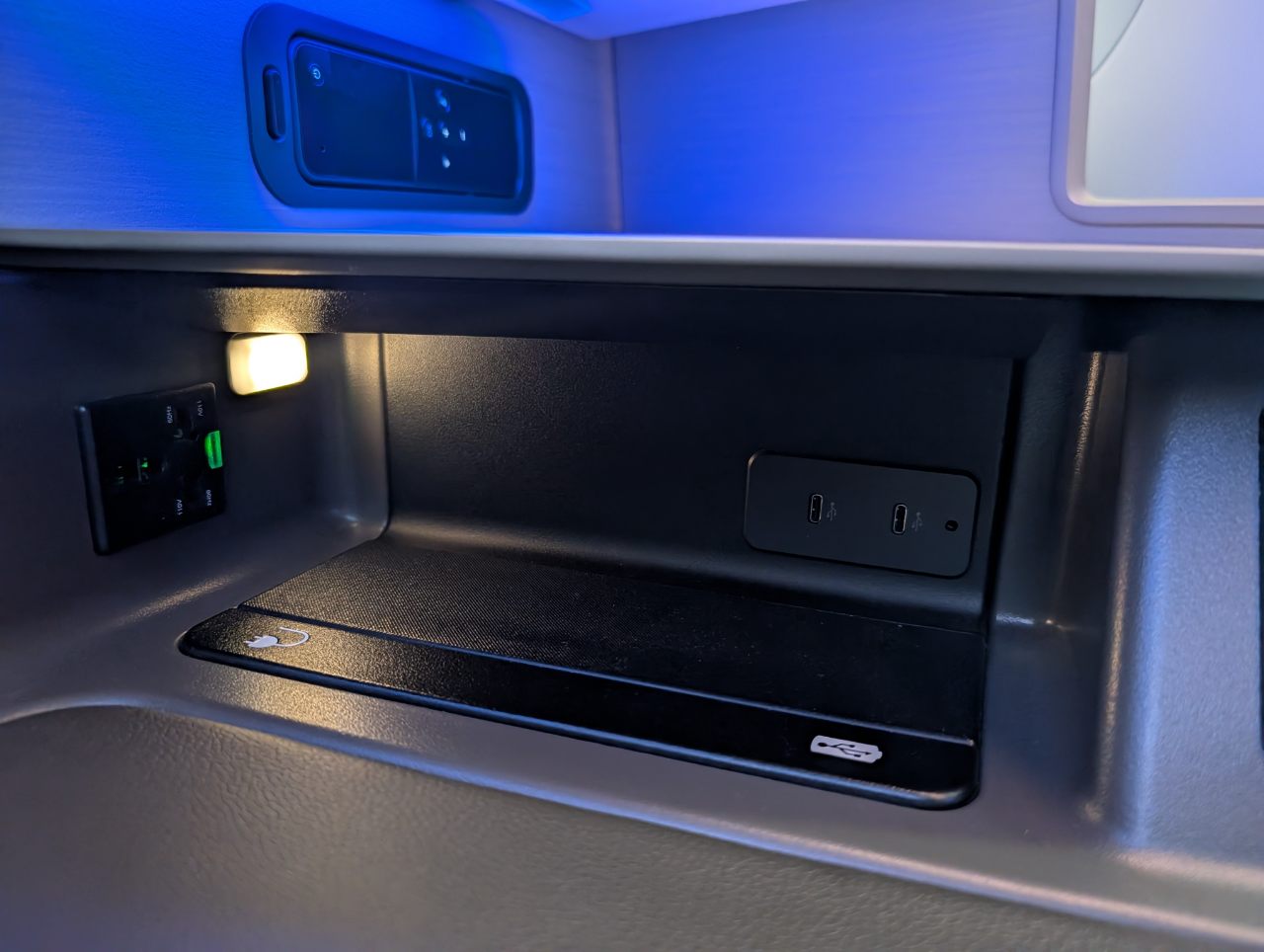
Charging options include a wireless charging pad, two USB-C outlets and a universal power socket. With this aircraft, United is removing support for USB-A, so if you have older devices, you’ll need to bring a separate adapter.
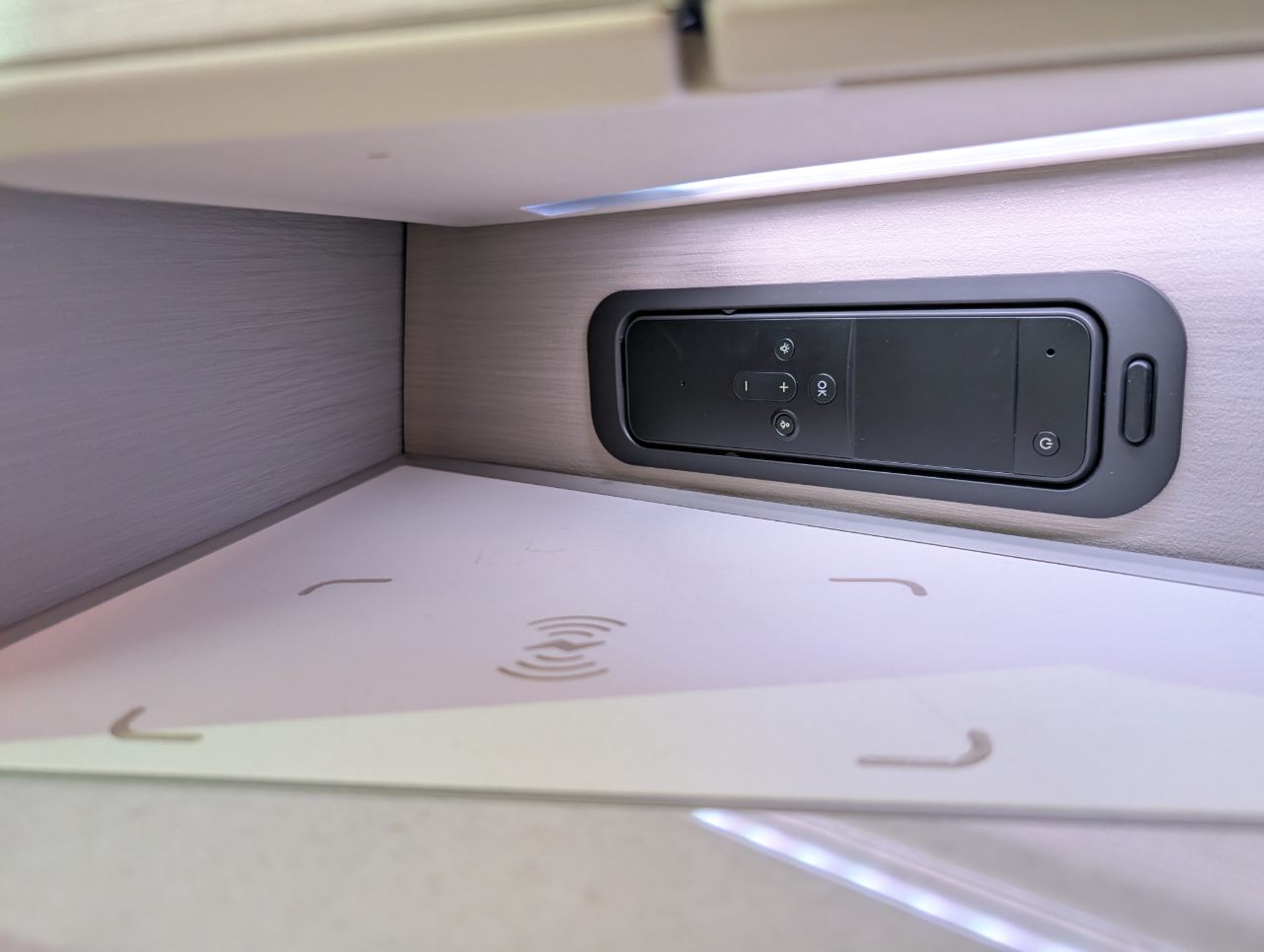
Unlike the previous generation Polaris seats, which had a physical rocker switch and buttons, seat controls are now fully digital. These can be found in a touch panel which also offers mood lighting options.
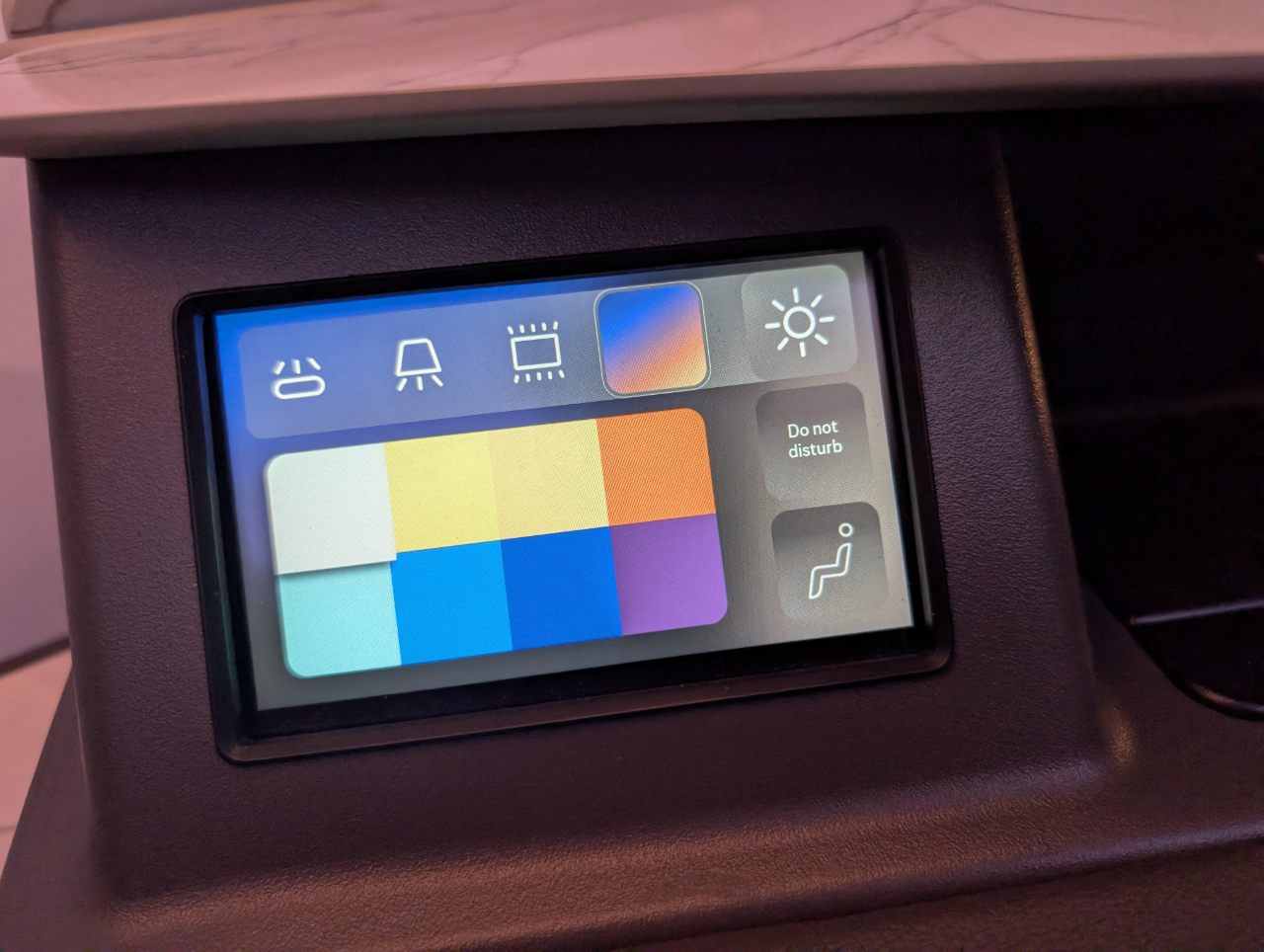
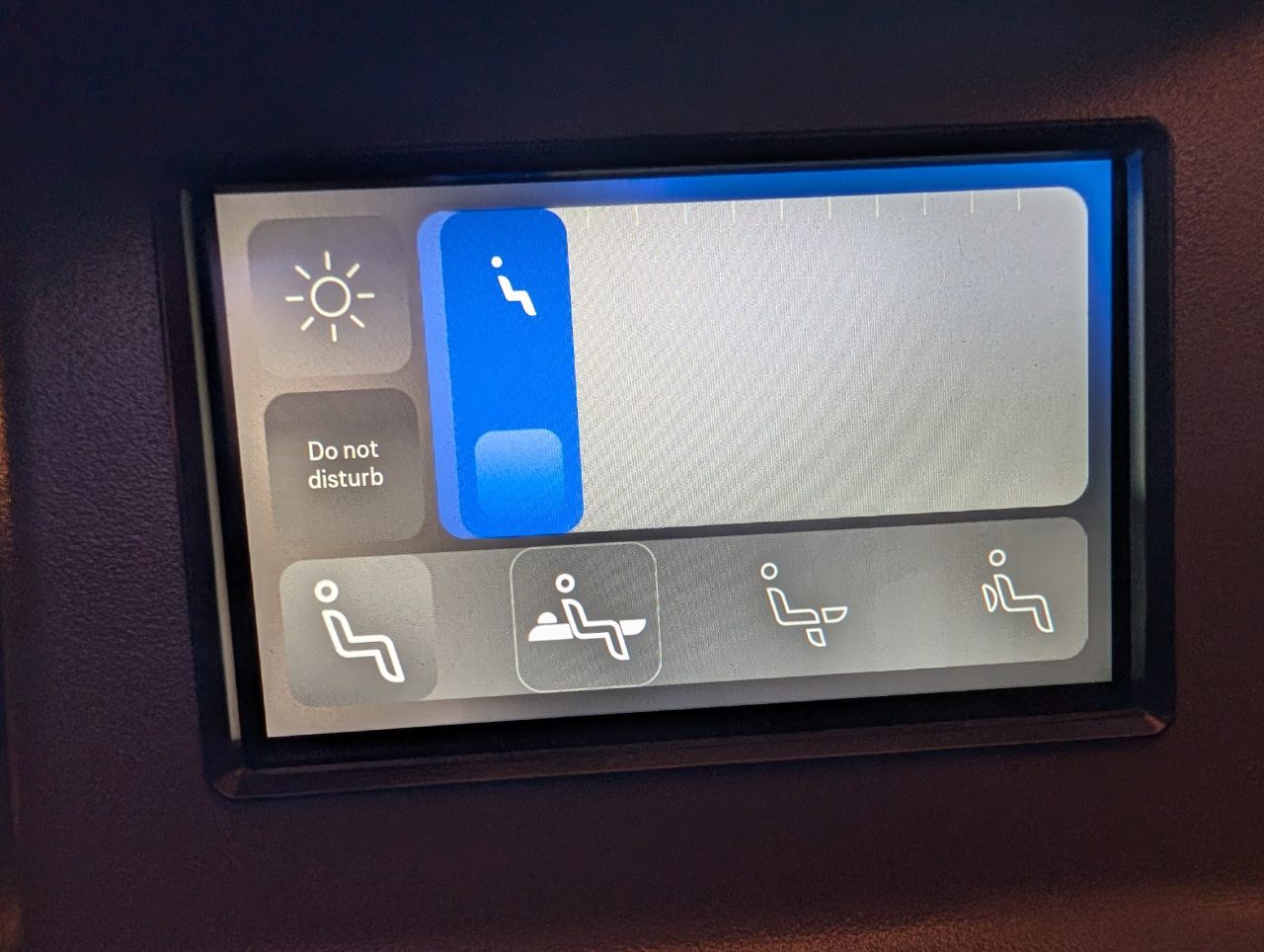
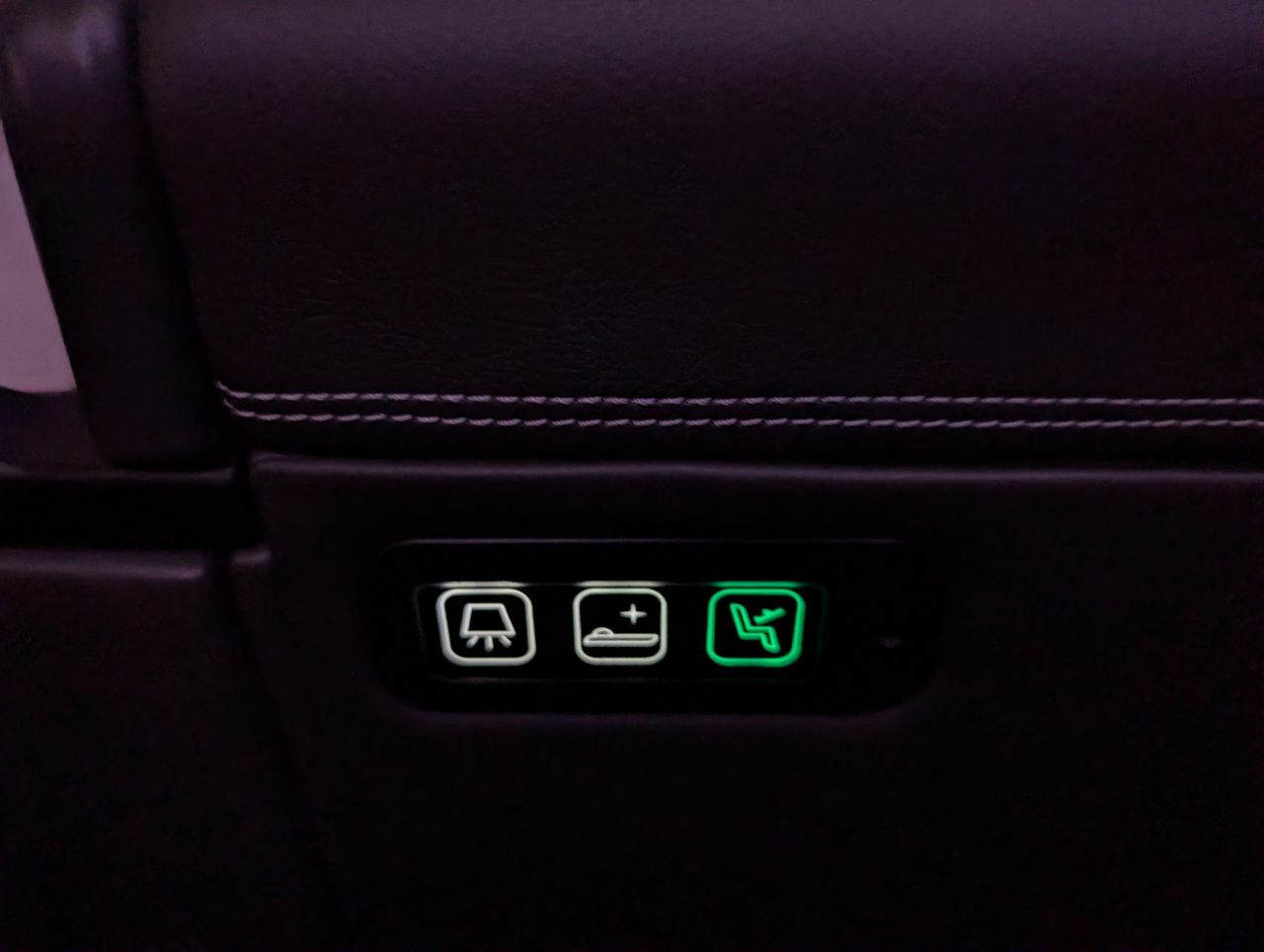
However, three dedicated touch-sensitive buttons have been retained for lighting, full-flat and full-upright.
United has also made a smart upgrade to storage with Polaris 2.0. The side table features a thoughtfully-designed three-tier layout that keeps items neatly separated. Drinks go on the lowest level, so even if there’s a spill, your electronics and reading materials stay protected. A middle shelf, positioned near the charging ports, is ideal for smaller devices, while the main tabletop is left free for larger items.
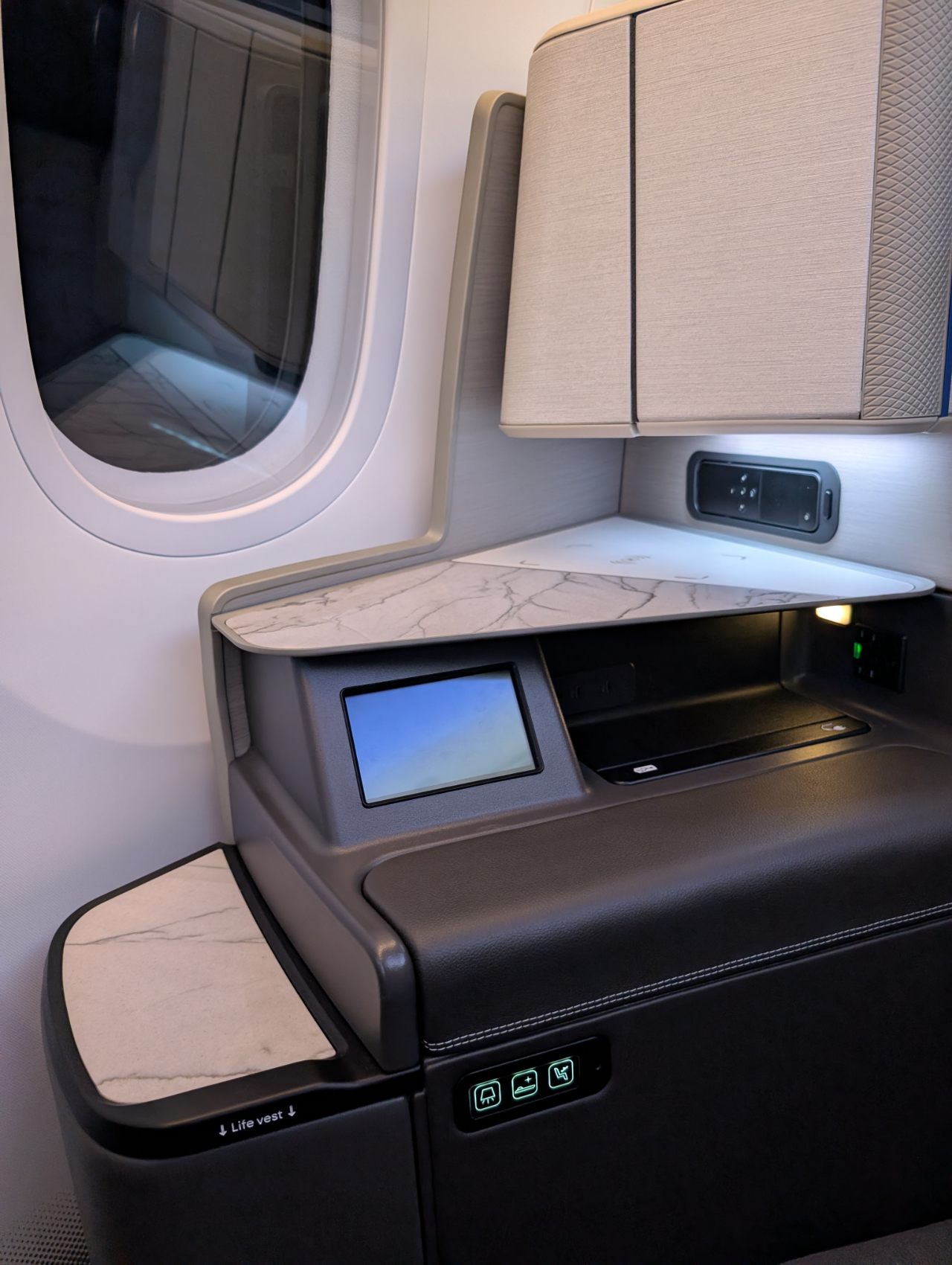
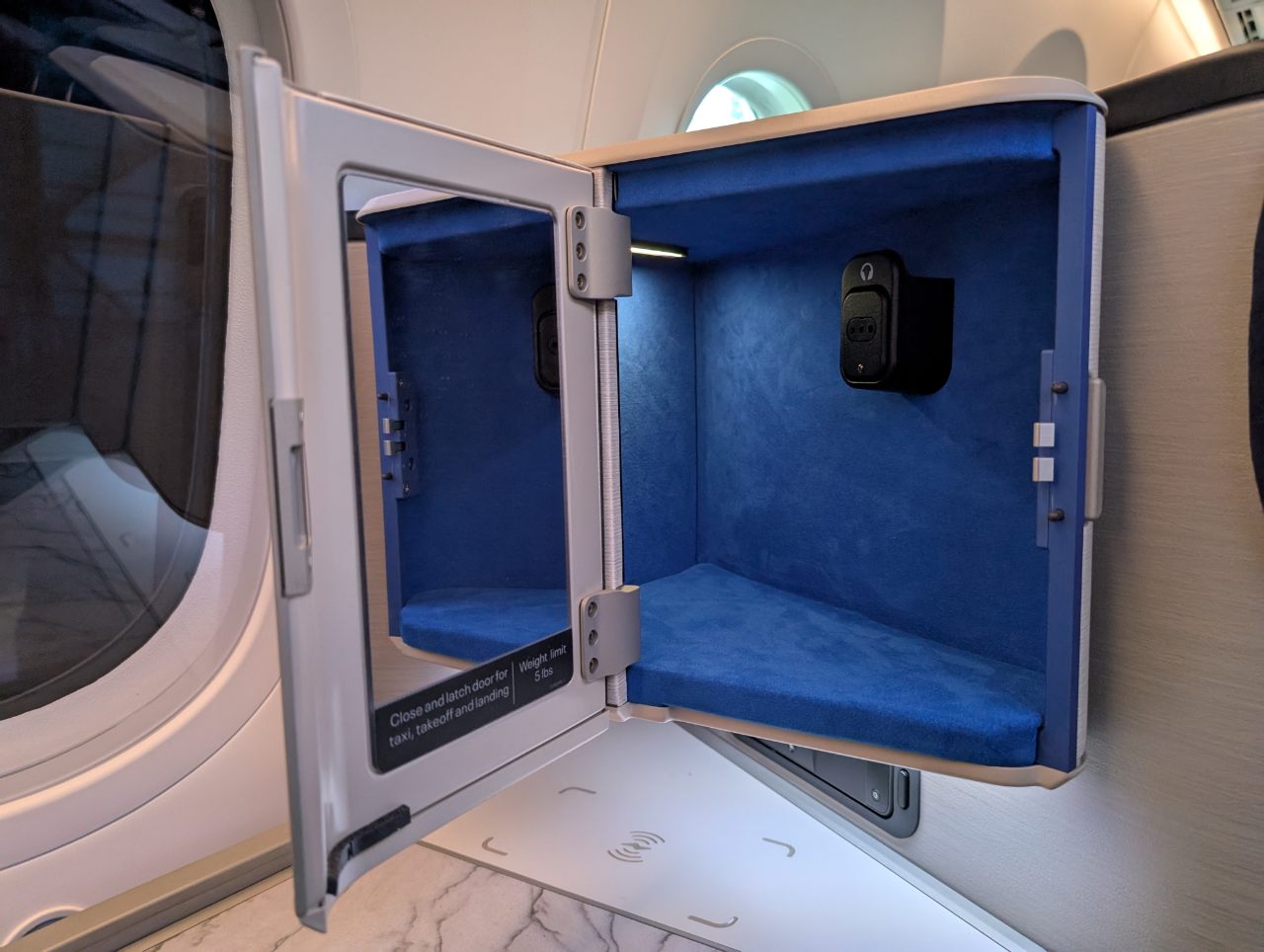
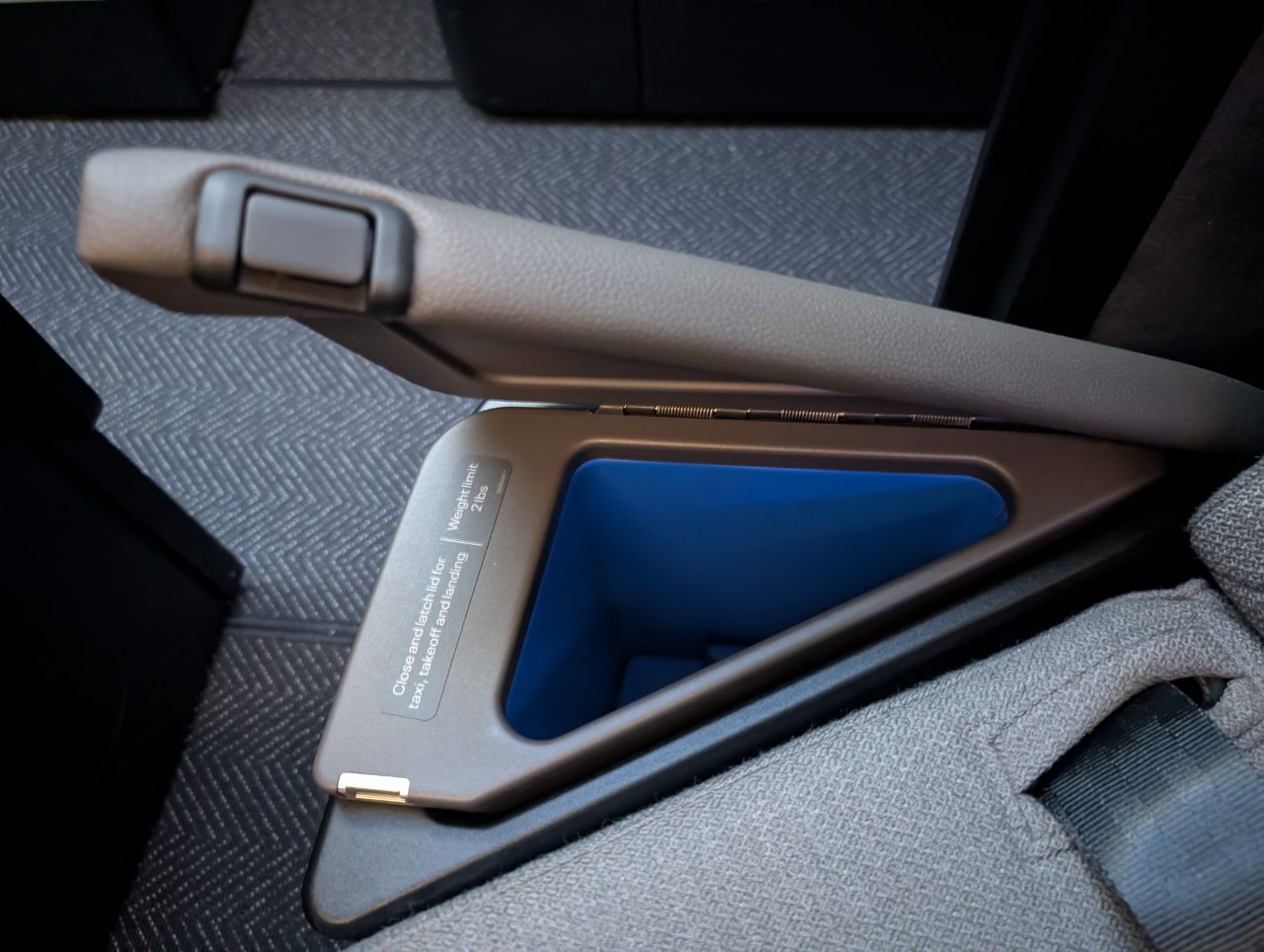
There is also a cubby (note the mirror), lined with blue felt to minimise noise from moving items, and additional storage inside the armrest.
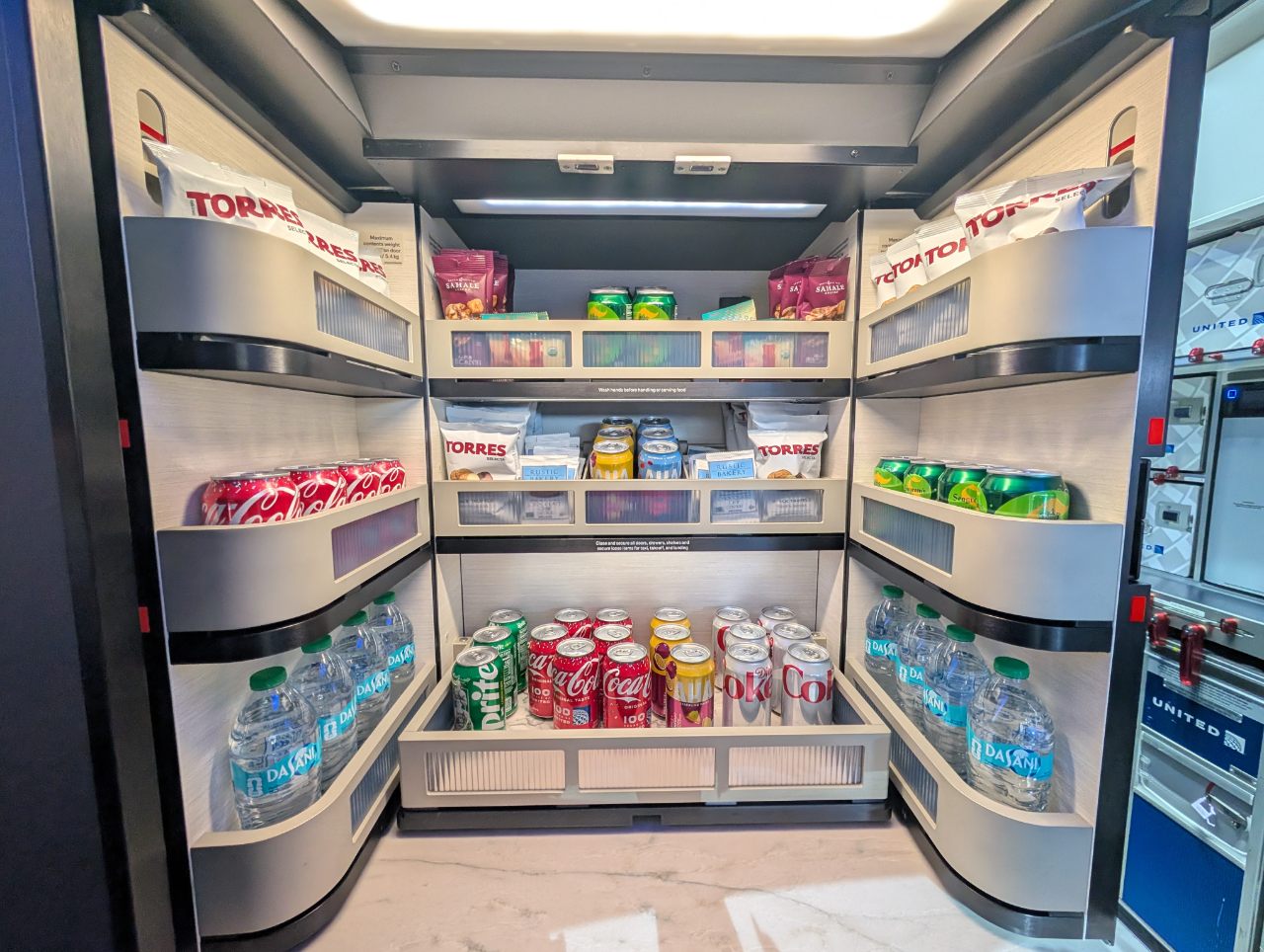
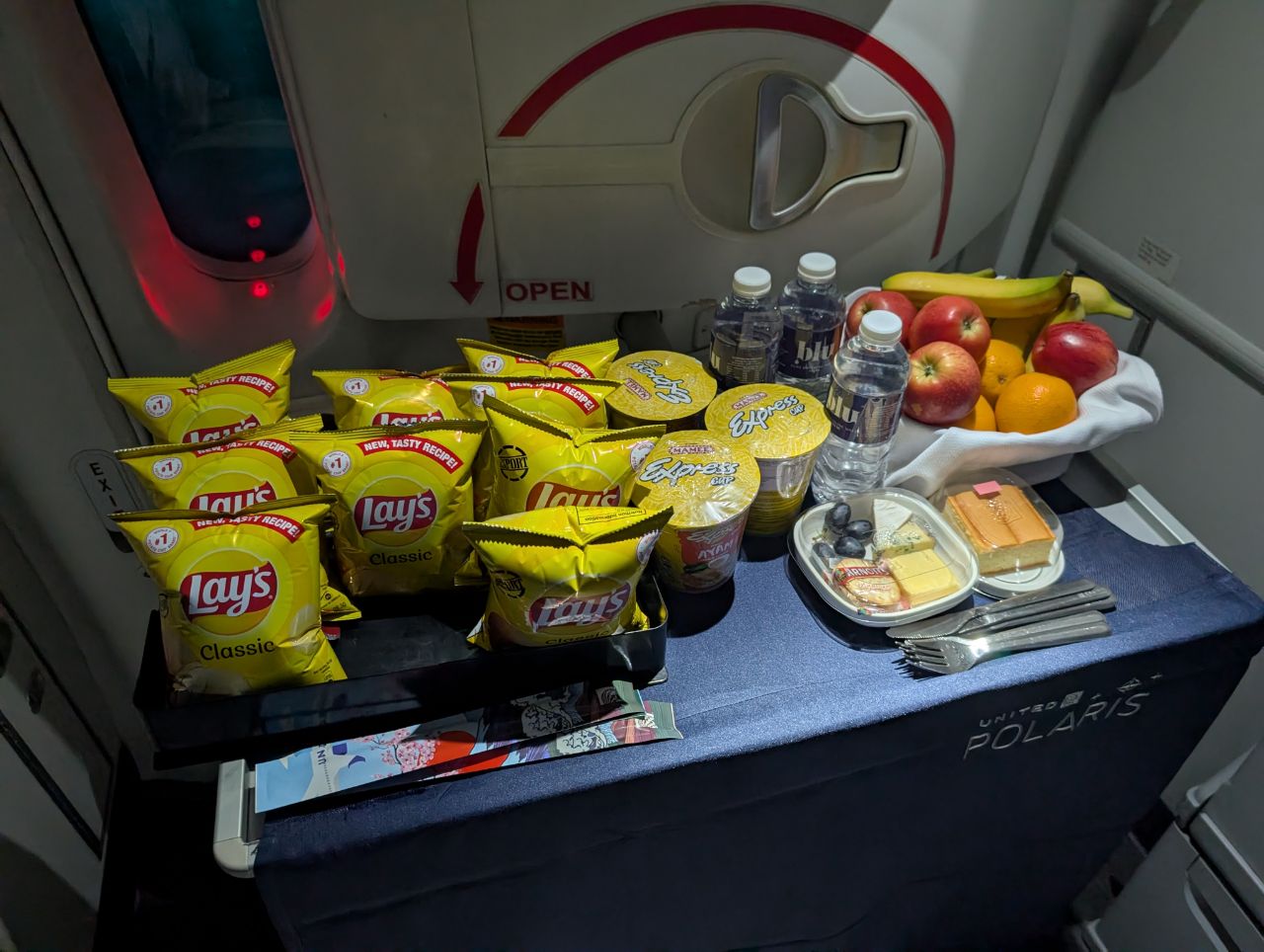
Finally, United has installed a snack bar between the first and second cabins, where customers can help themselves to drinks and nibbles during the flight. This is a much sleeker solution than the previous snack cart, which always had a kind of makeshift feel to it.
United Premium Plus
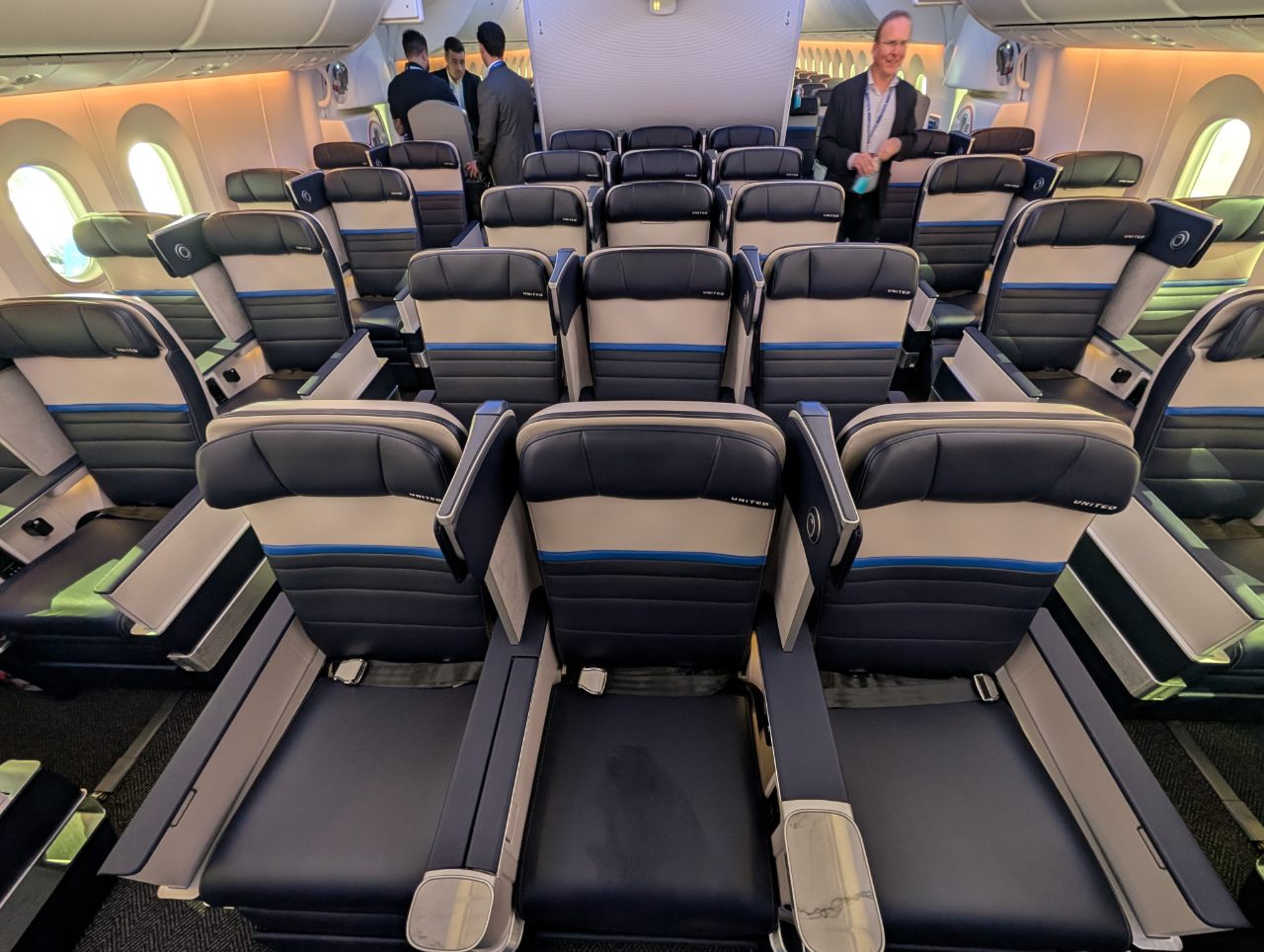
The Premium Plus section features 35 Premium Economy seats in a 2-3-2 layout.
United has replaced the purple colour scheme with a blue-and-white motif that matches Economy Class. While it creates a more consistent overall palette, it’s a curious choice, given you’d expect the airline to want to visually distinguish this as a premium cabin.
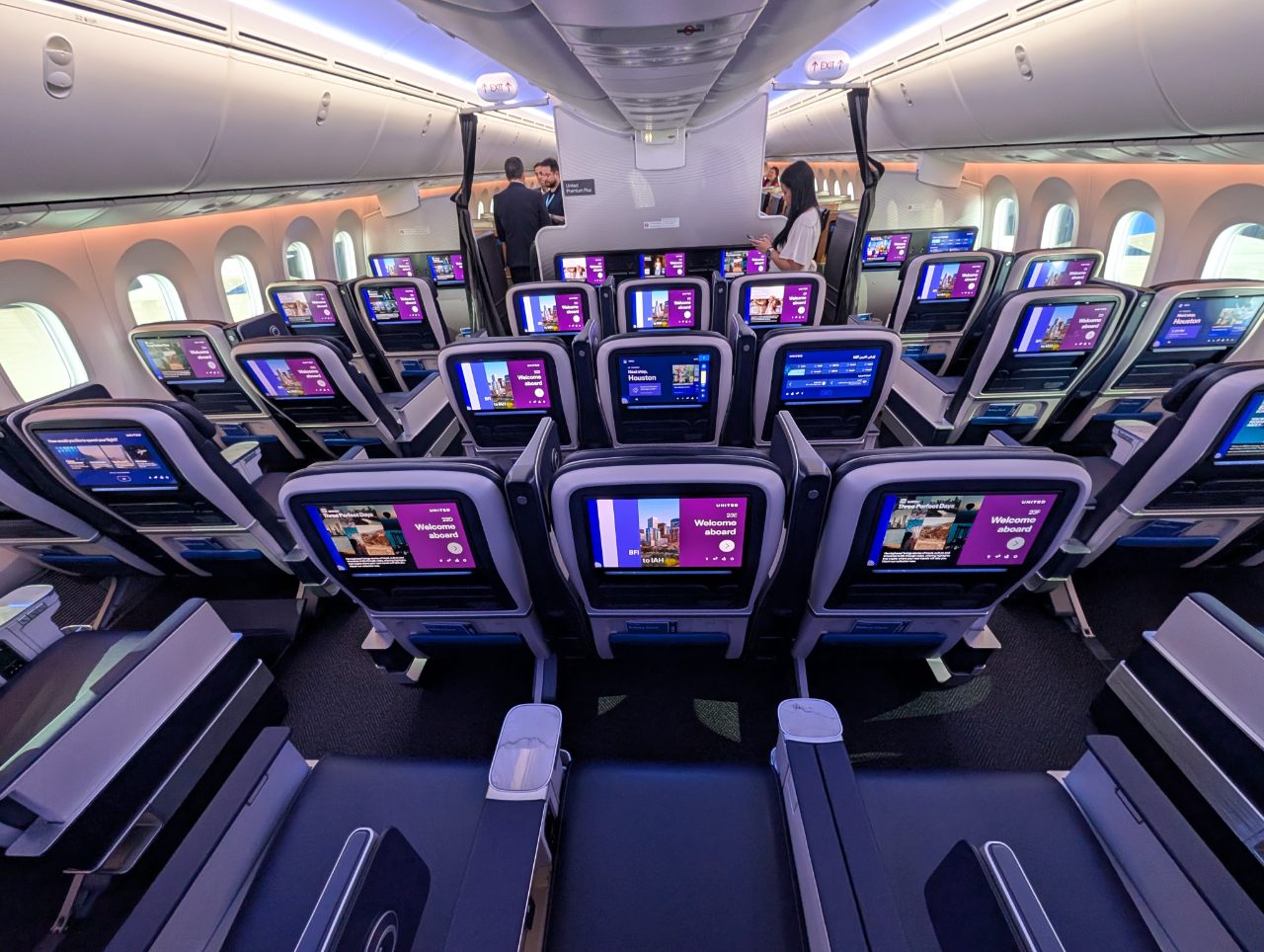
Seats feature soft-touch materials, quartzite cocktail tables and a new privacy divider that provides a decent amount of visual separation at eye-level.
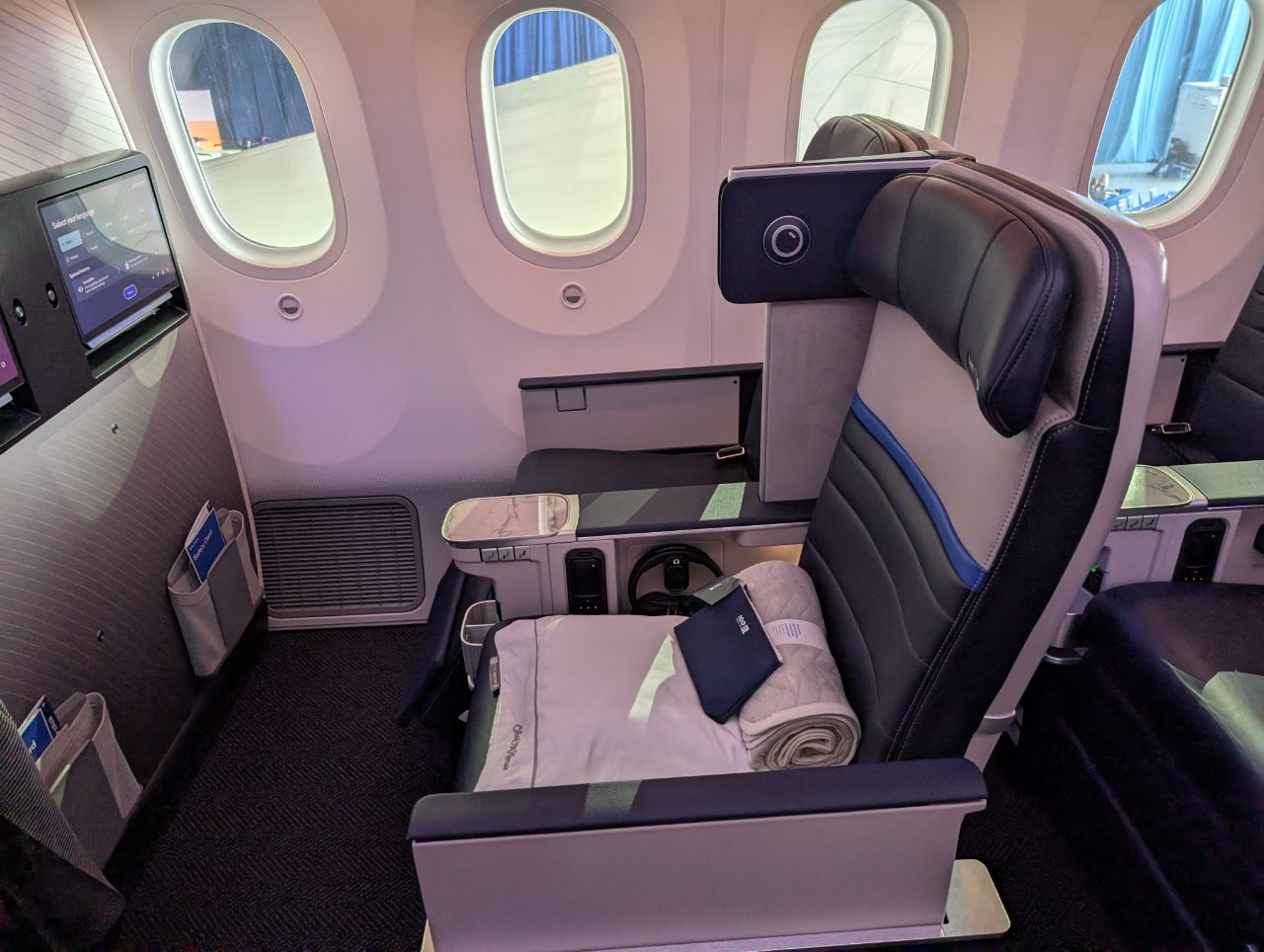
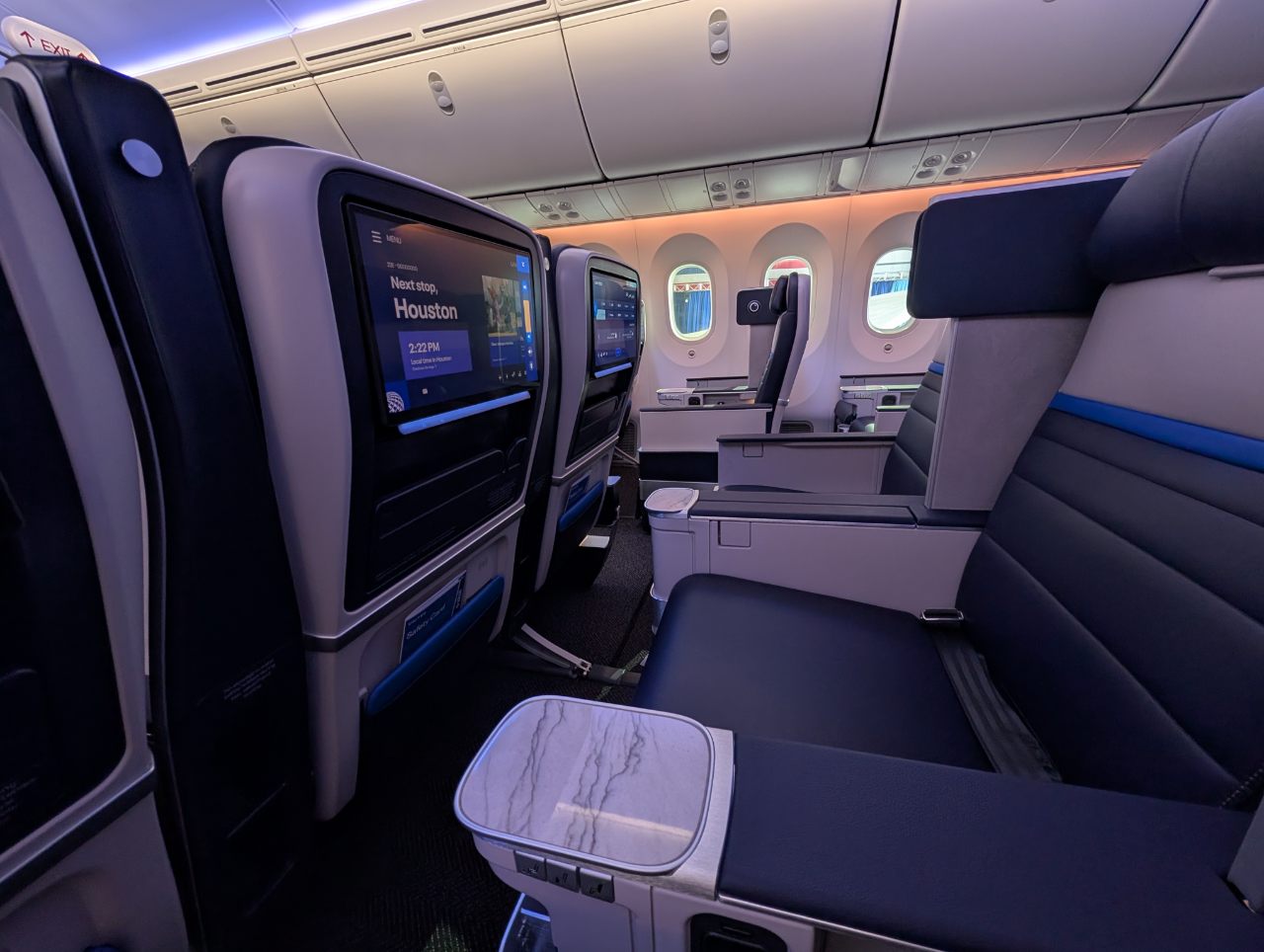
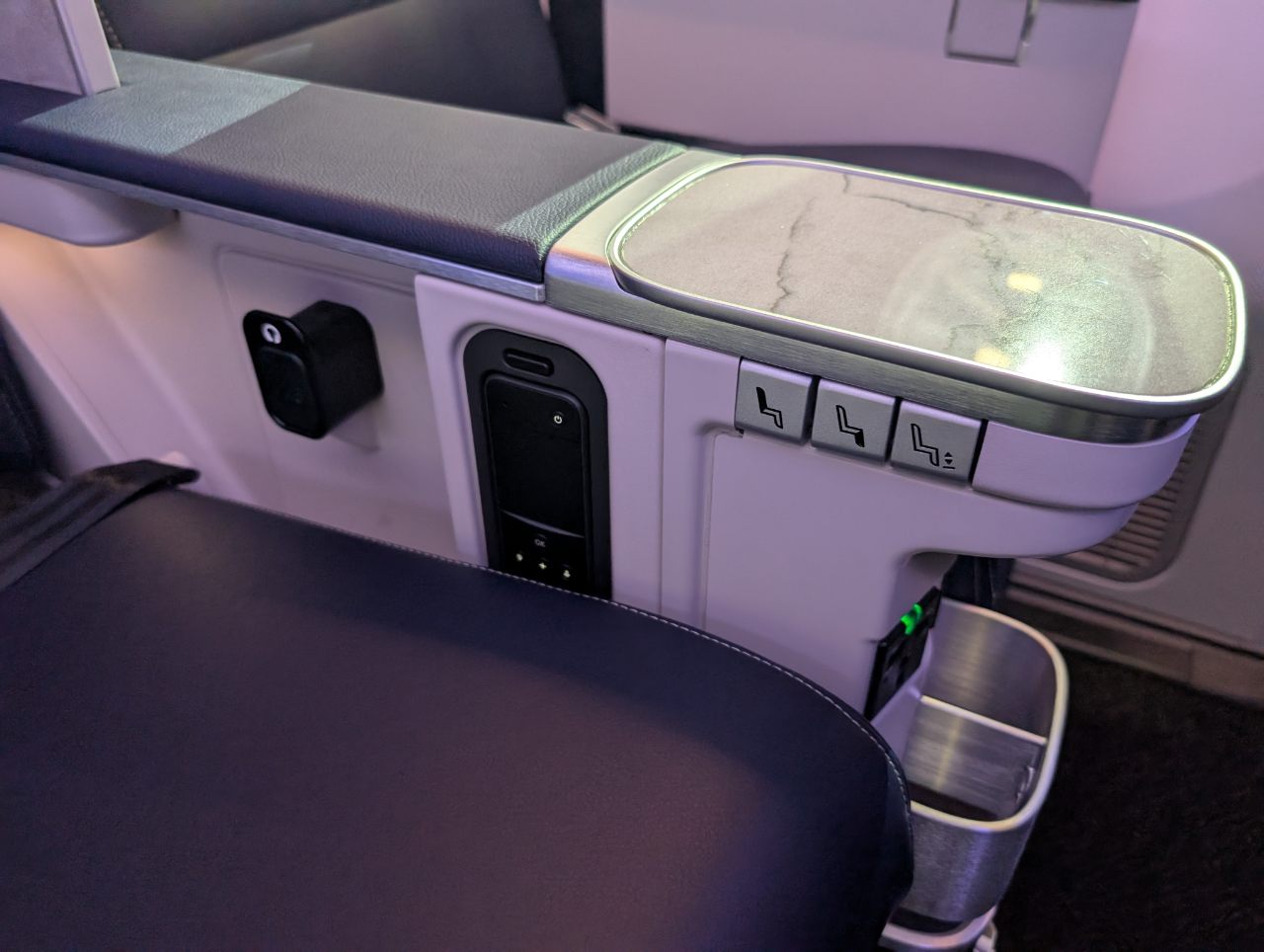
Seat controls are manual (Japan Airlines is the only carrier to install electric seat controls in Premium Economy to date), with one button for recline, one button for the leg rest and one button to extend the foot rest.
When fully reclined with the leg rest deployed, the seat offers a comfortable snoozing position.
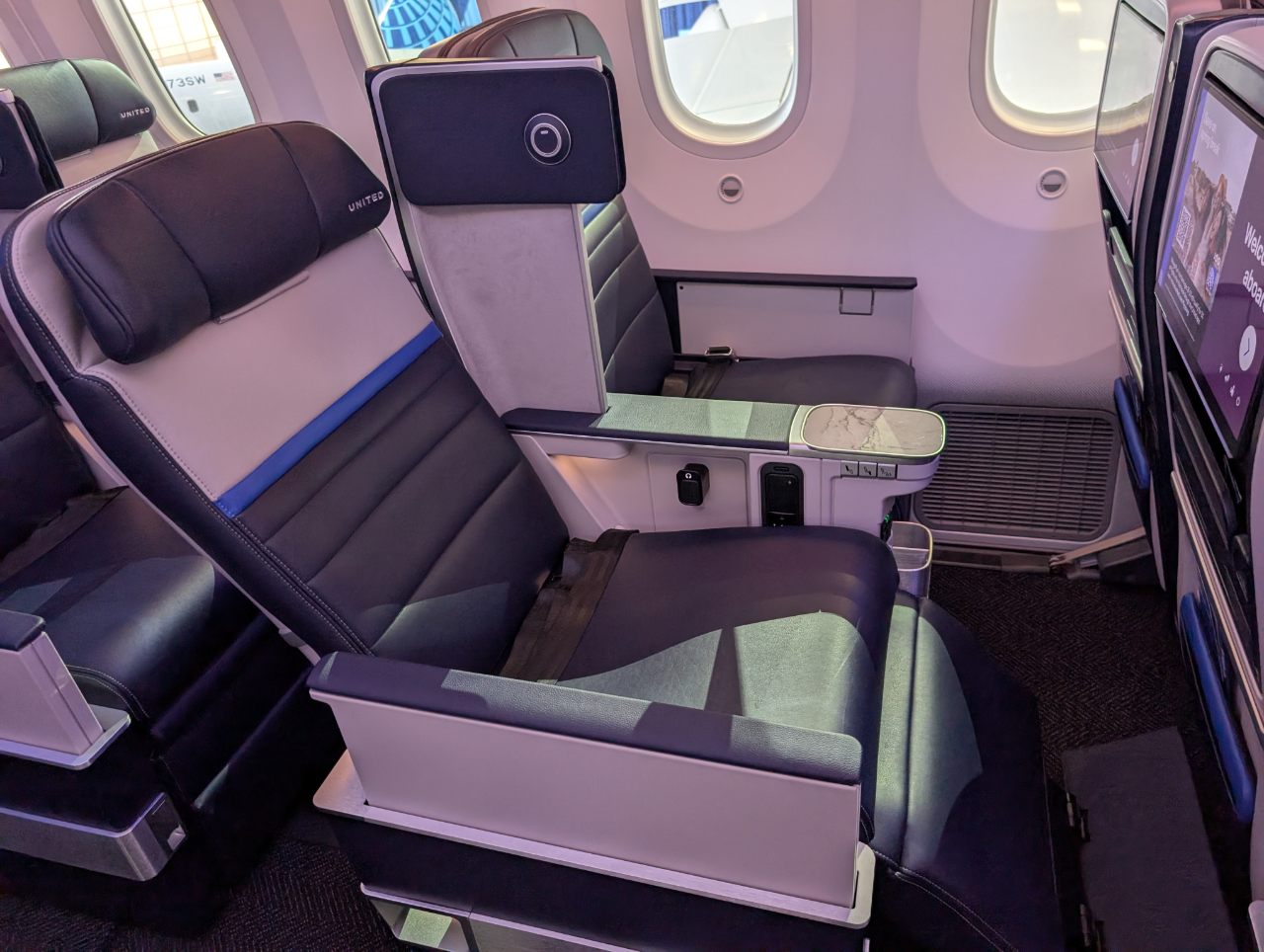
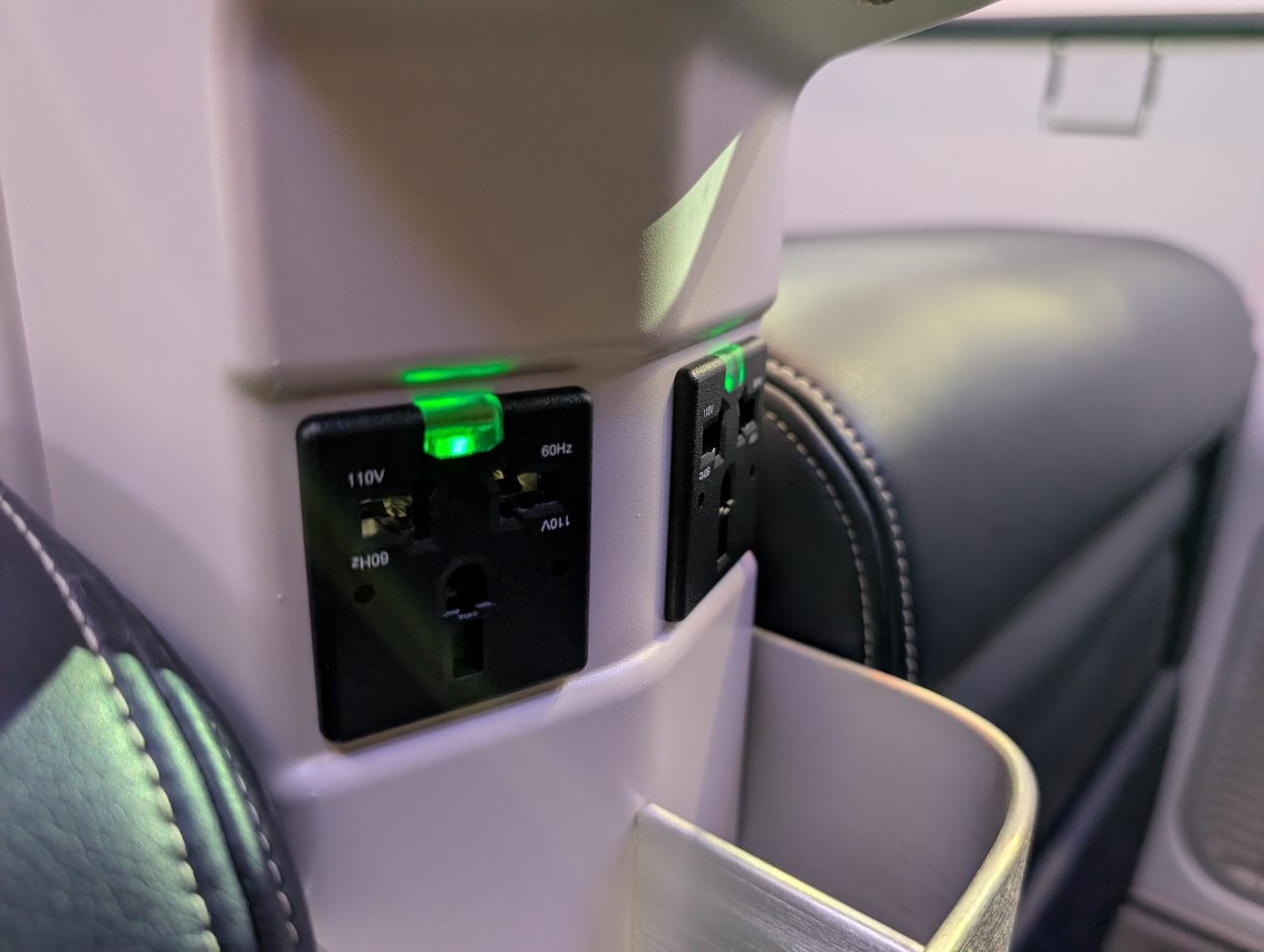
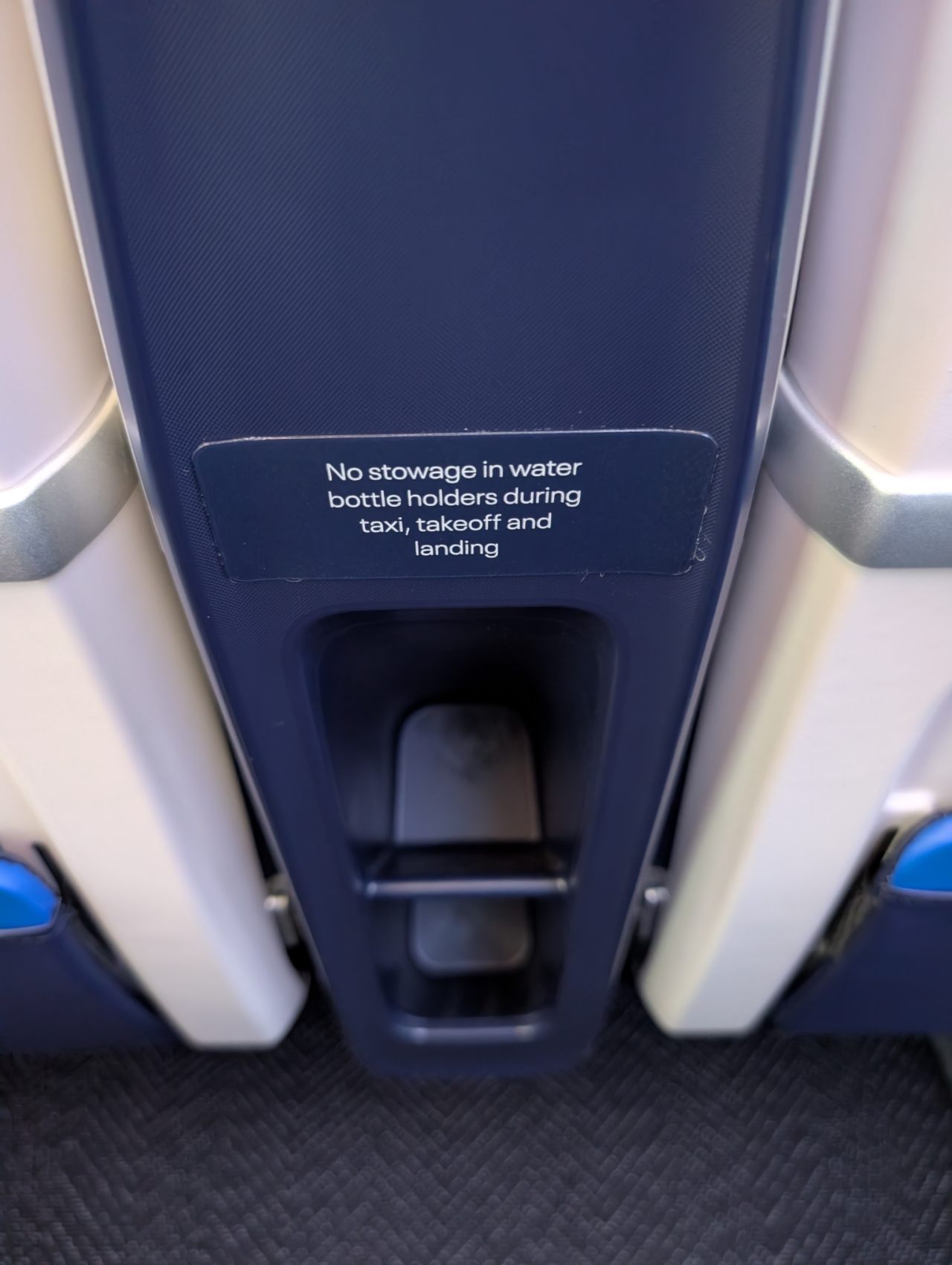
Between each pair of seats are individual power outlets, and some storage space for a water bottle and loose items.
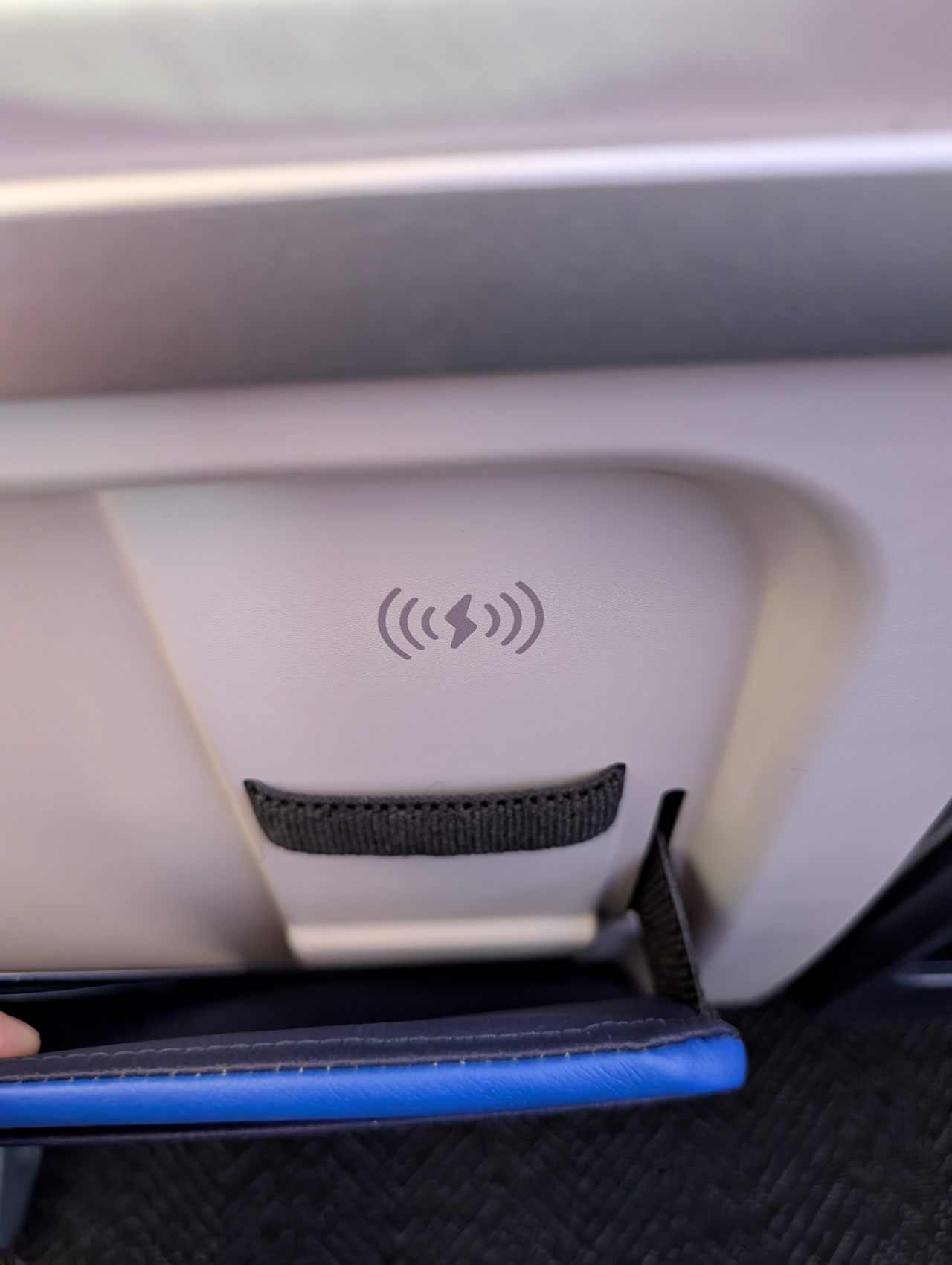
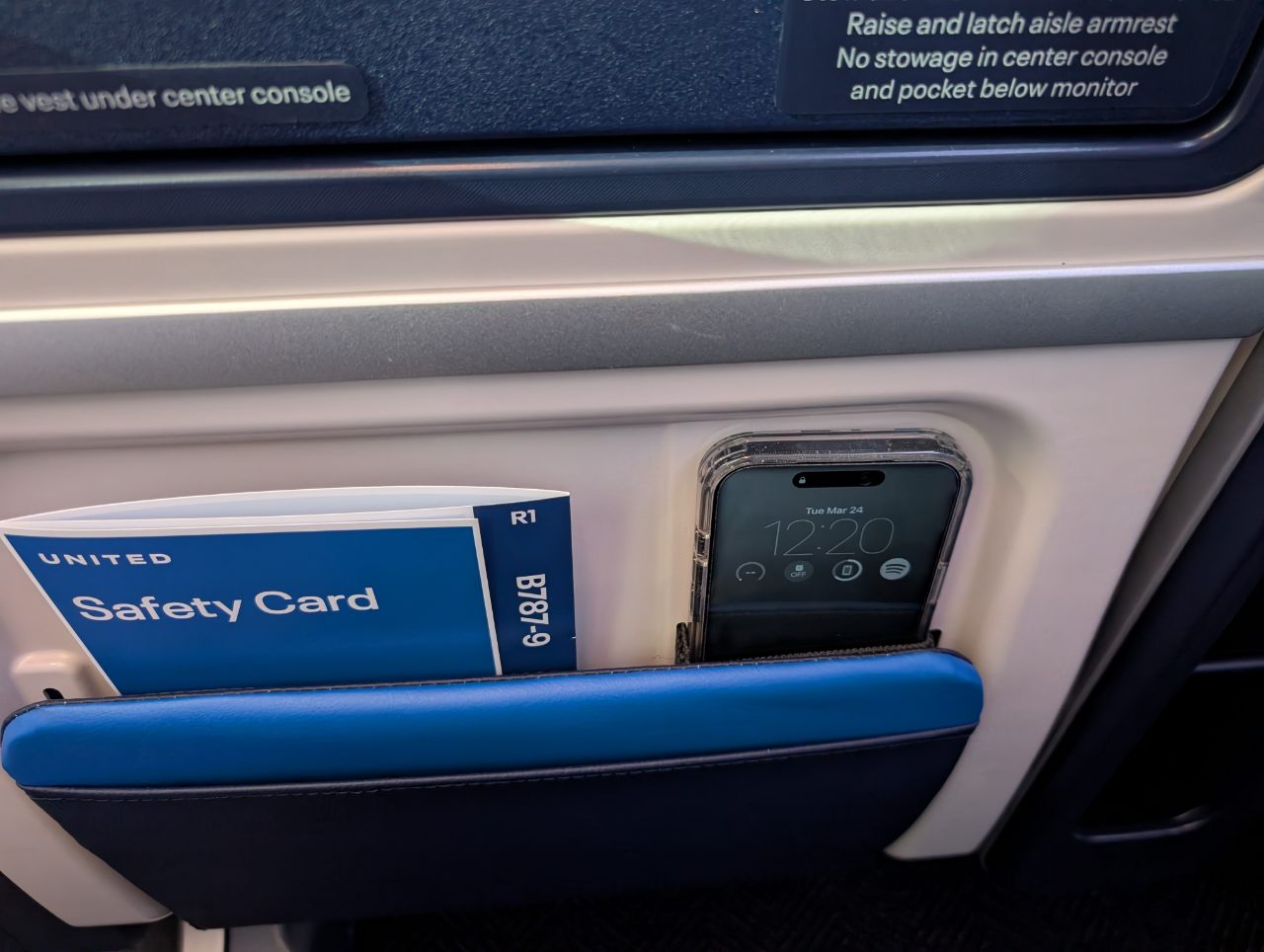
United has managed to install wireless charging pads in these seats too, but the implementation is a little odd, to say the least. The wireless charging pad is found in the seat pocket, with an elastic strap to hold the phone in place. I suppose there’s no space in the centre console, but it does beg the question— if your phone is going to be in the seatback pocket anyway, why not just charge it using a wire?
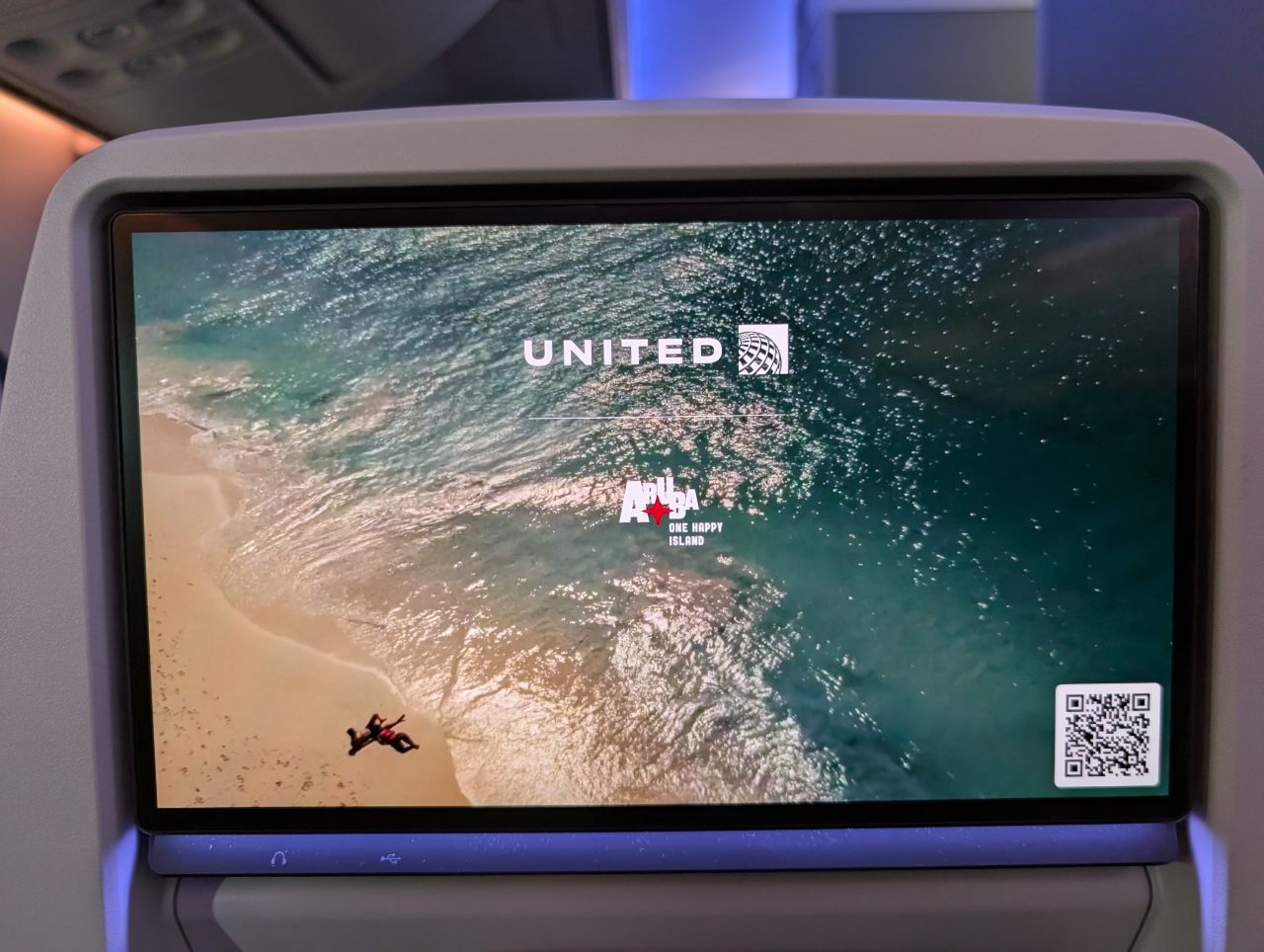
The 4K OLED entertainment screens are 16″ wide, among the largest in the industry (for context, the screens on Singapore Airlines 2018 Regional Business Class seat are 18″). Beneath each screen is a headphone jack and 2x USB-C ports.
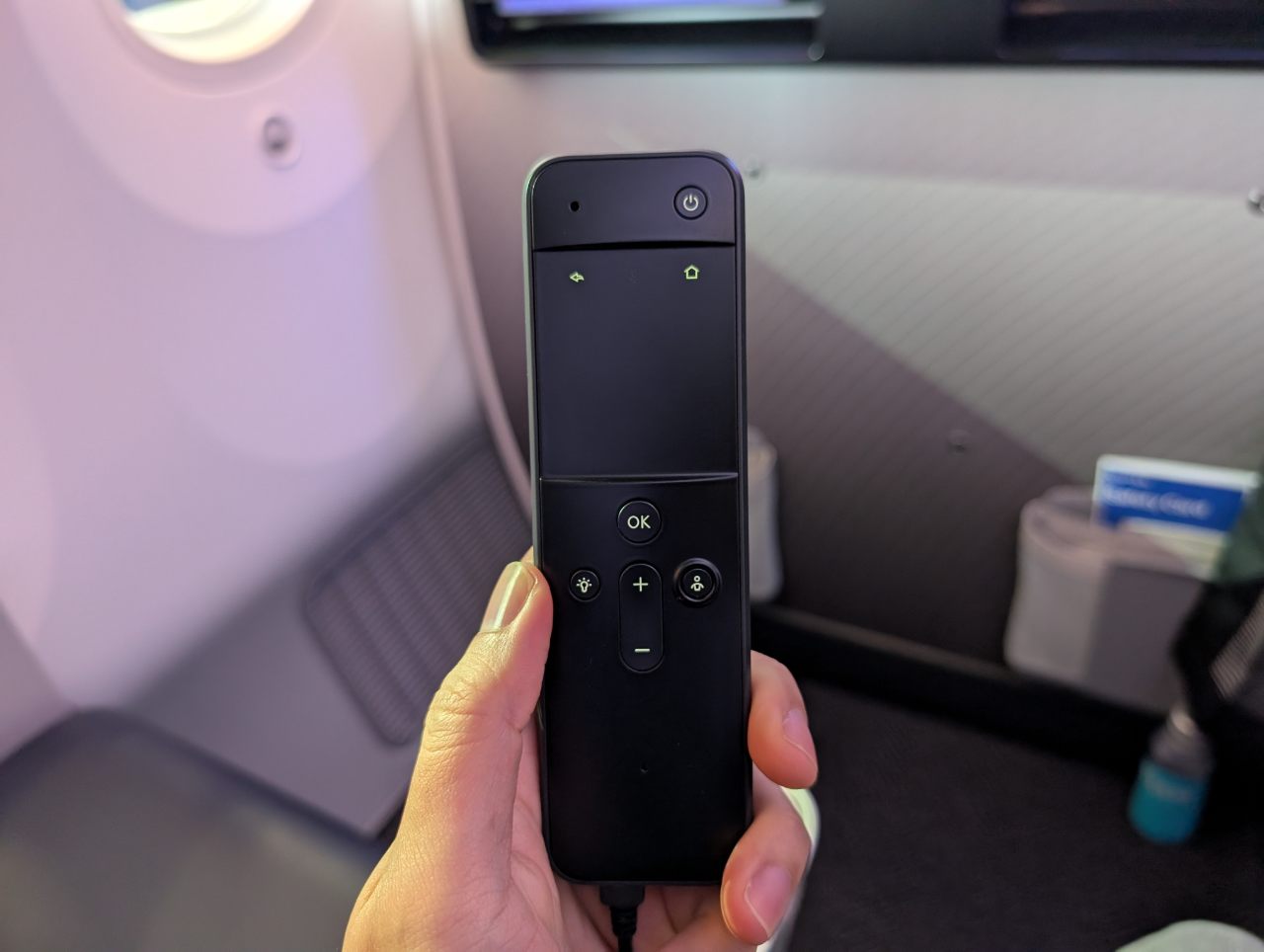
Given the improved seat pitch in Premium Plus (38″), controlling the inflight display by touch alone would be a guaranteed recipe for gorilla arm. To avoid this, passengers have an inflight entertainment remote, with a trackpad for more precise controls.
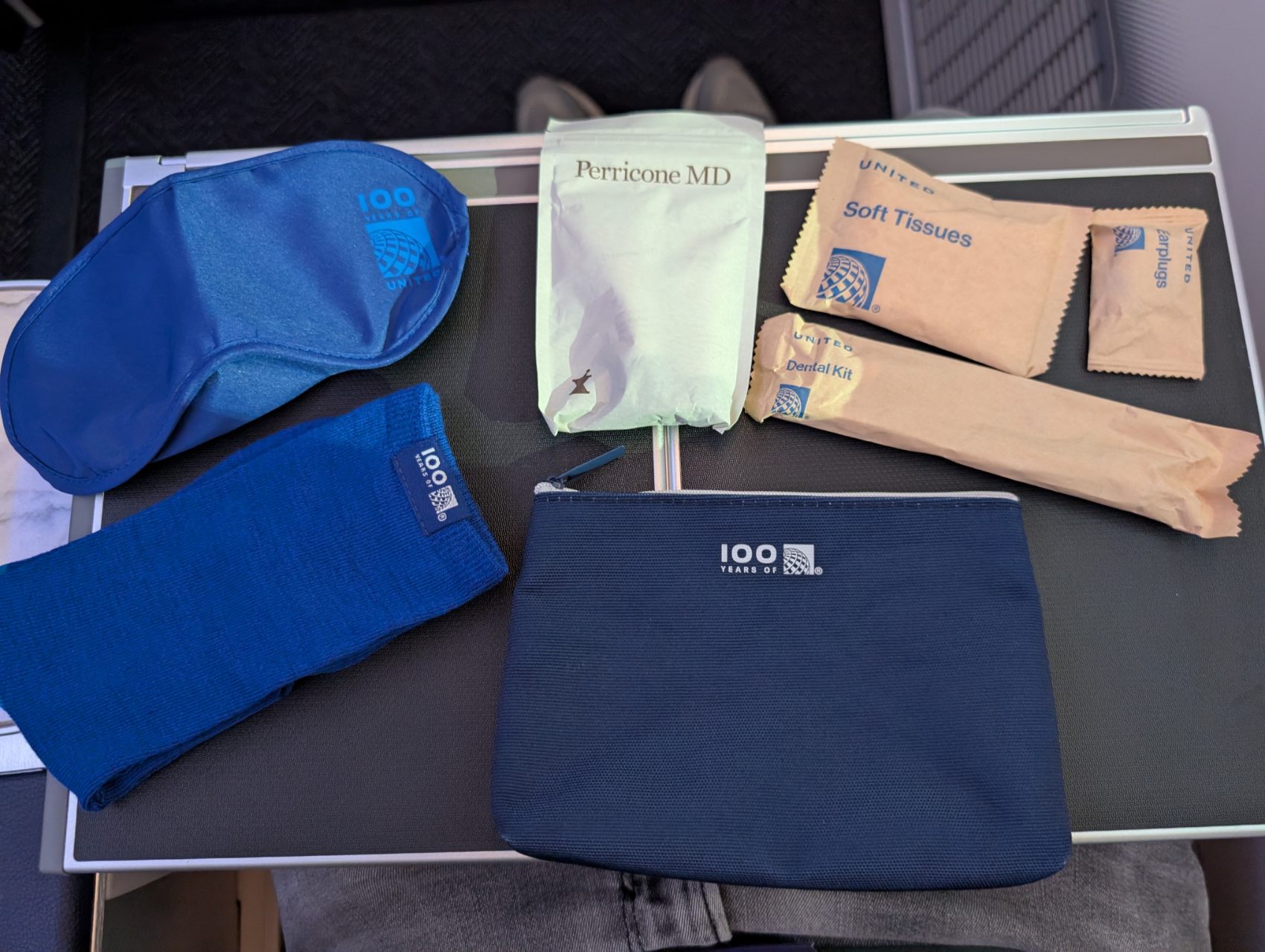
Premium Plus passengers also receive an amenity kit, which includes an eye mask, compression socks, facial tissue, ear plugs, a dental kit and Perricone MD skincare products.
United Economy
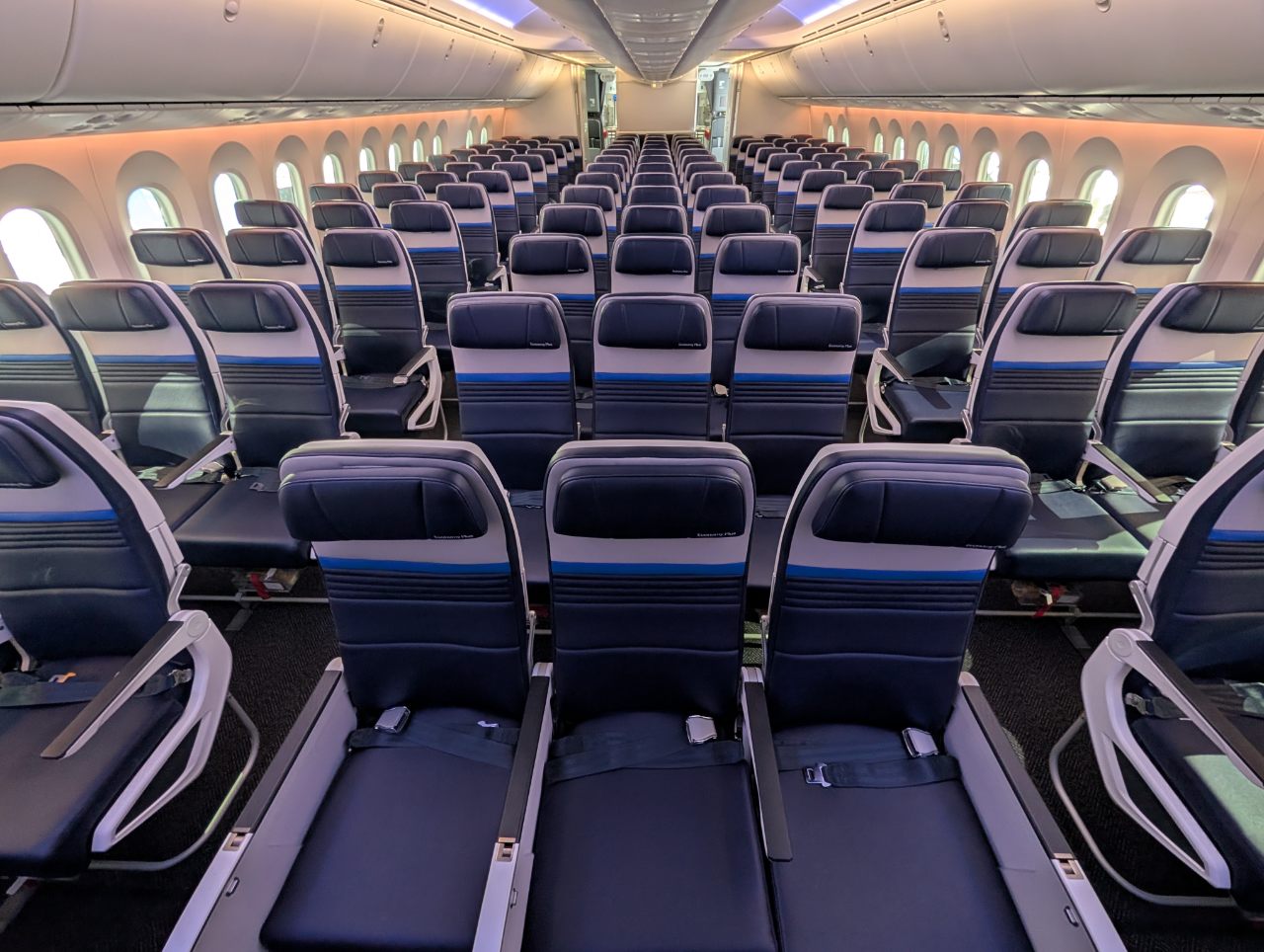
The Economy cabin features a total of 123 seats, split into 90 standard and 33 extra-legroom Economy Plus seats. The cabin is configured in a 3-3-3 layout across 15 rows.
These are slimline seats, though I felt the padding was still acceptable and the support adequate. Of course, sitting on a seat for five minutes is not the same as sitting for a 16-hour transpacific voyage, so we’ll need to wait for the trip reports to come in.
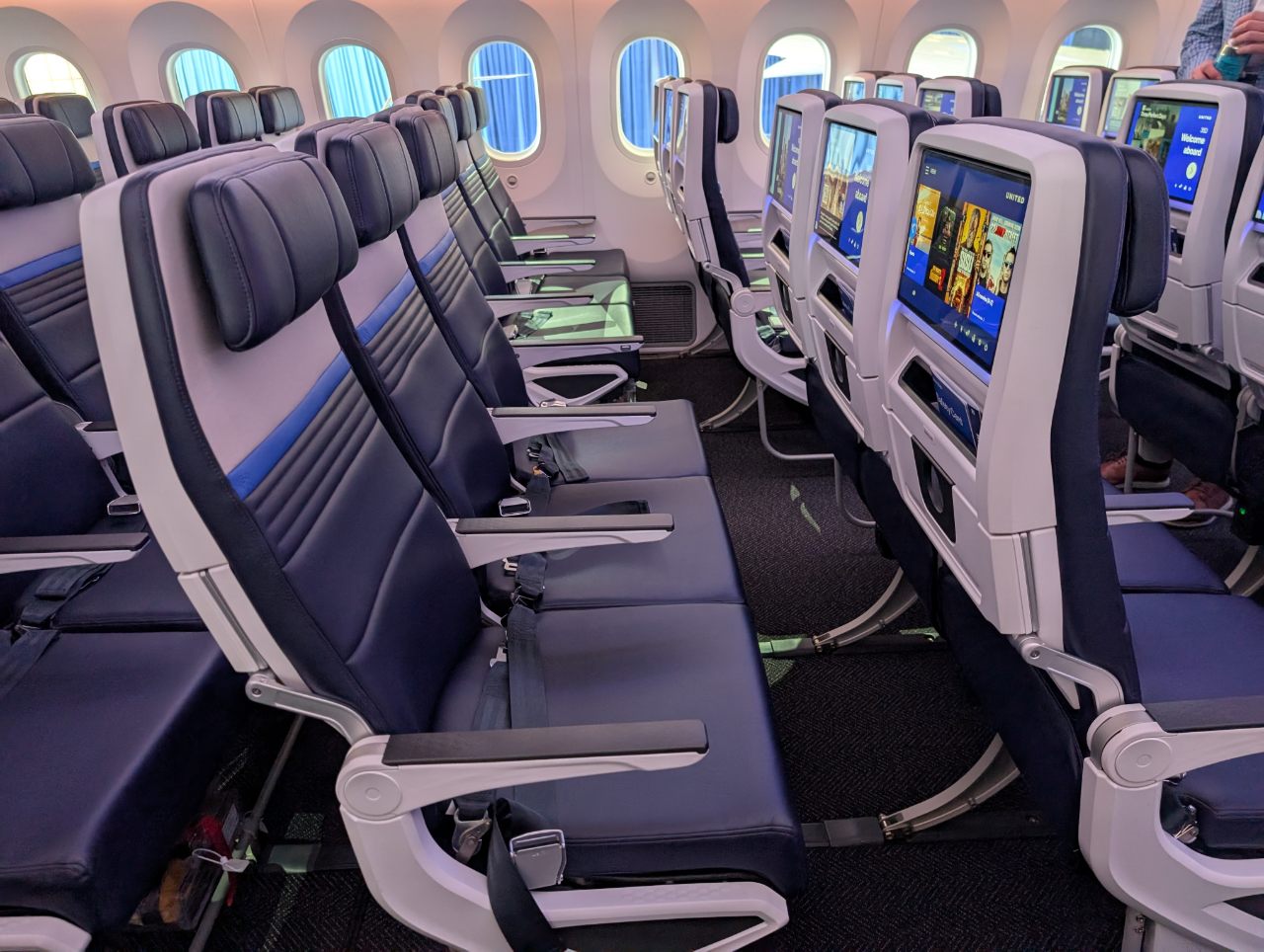
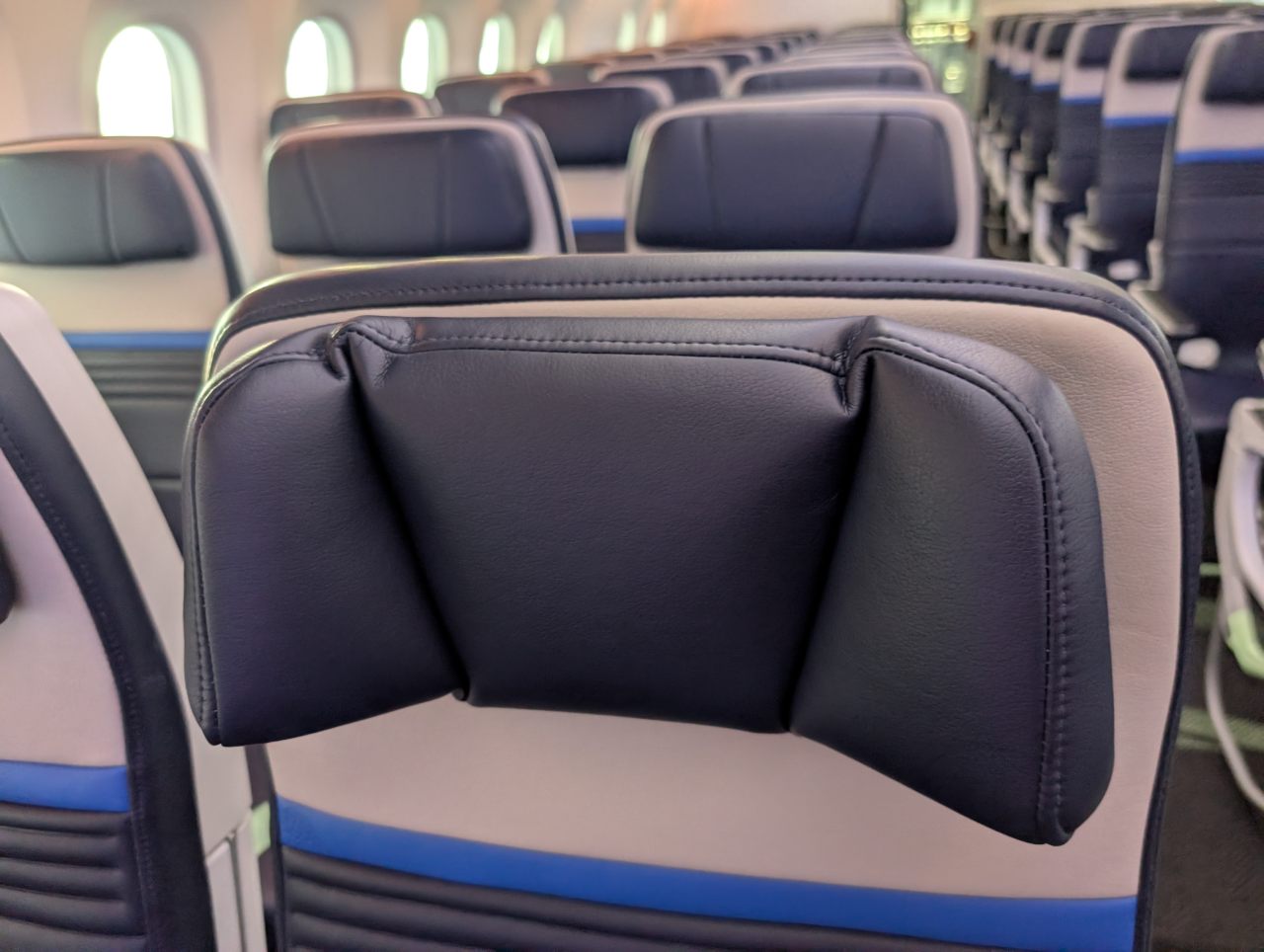
Each seat offers an adjustable headrest and bifold tray table. Seats have 31″ of pitch (34″ for Economy Plus), with 3″ of recline (4″ for Economy Plus).
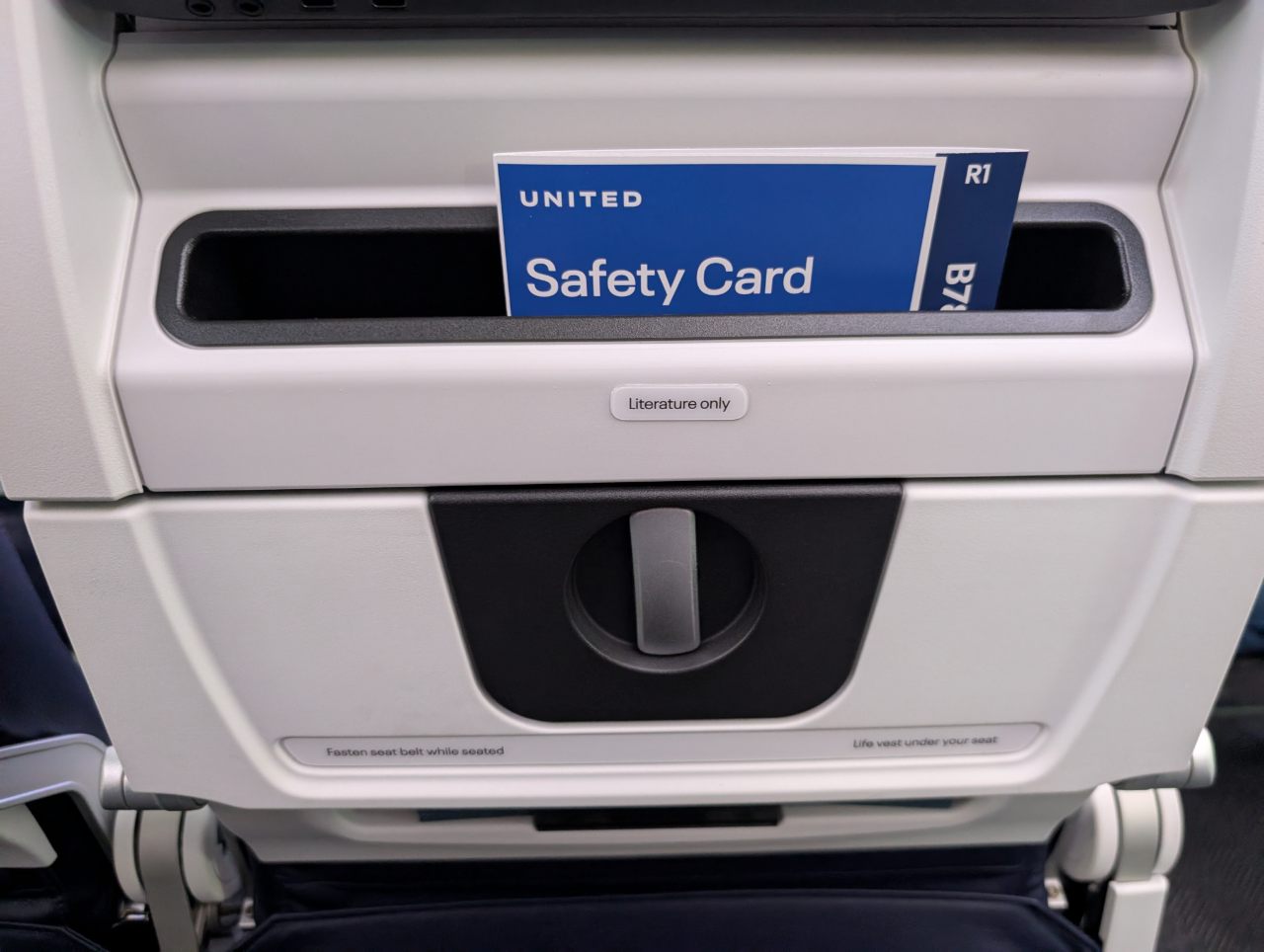
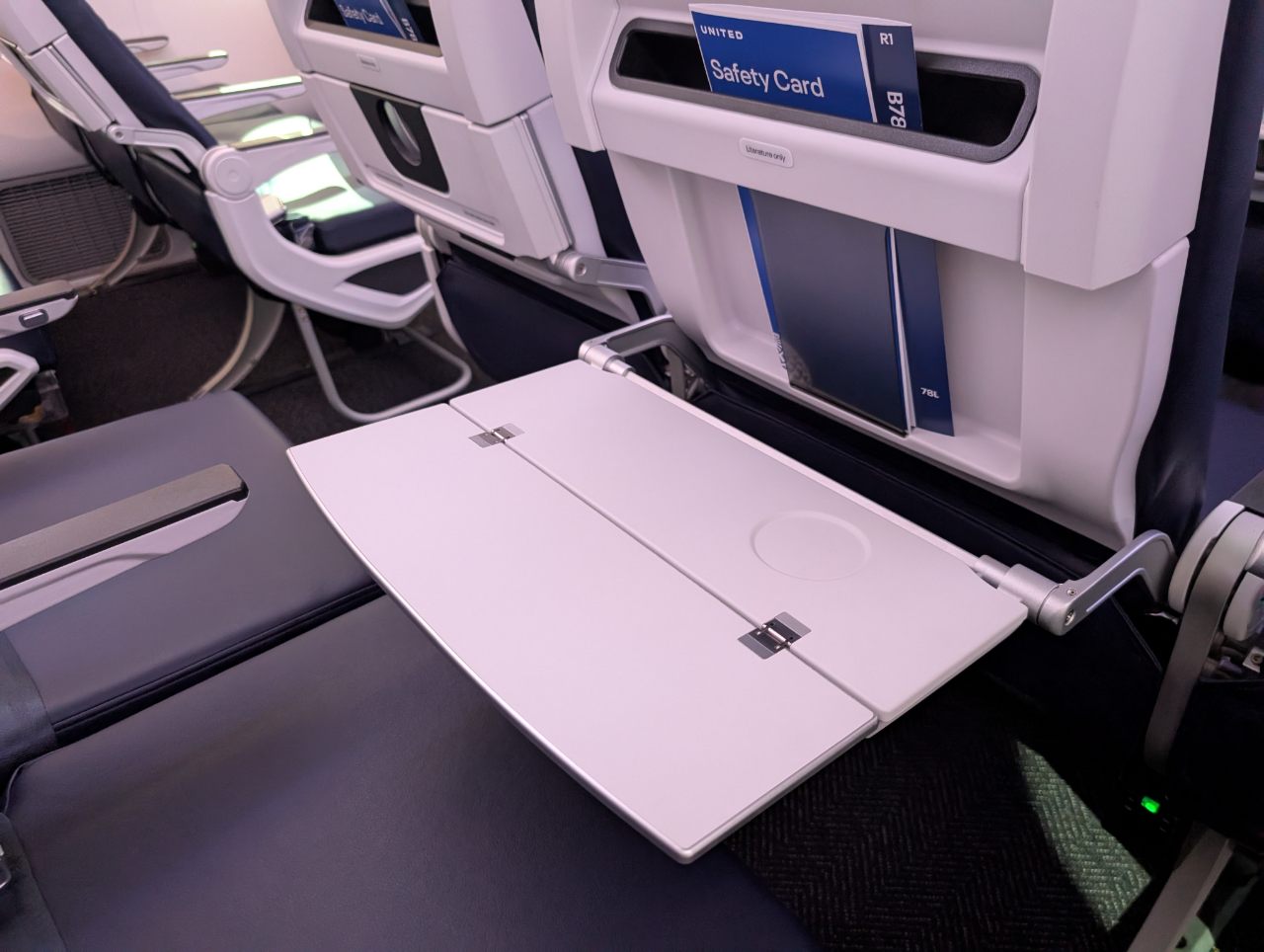
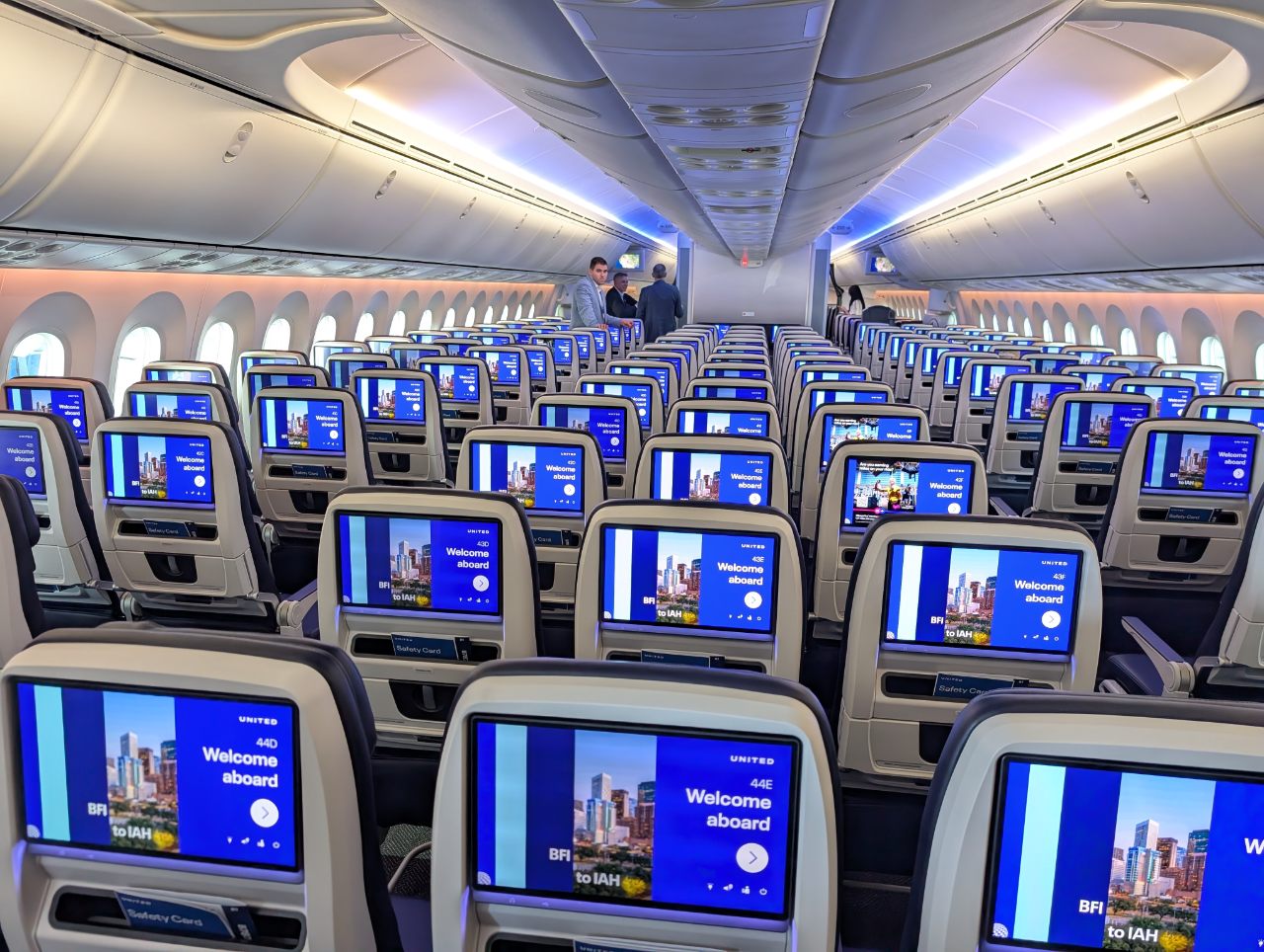
However, the biggest upgrade is no doubt the inflight entertainment, with crisp new 13-inch 4K OLED screens. These boast the title of the largest screens in Economy Class, alongside Air New Zealand’s new B787-9s and STARLUX A350-900s.
There’s also a less visible but meaningful improvement: the inflight entertainment box below the seats has been removed, which means additional legroom and storage space.
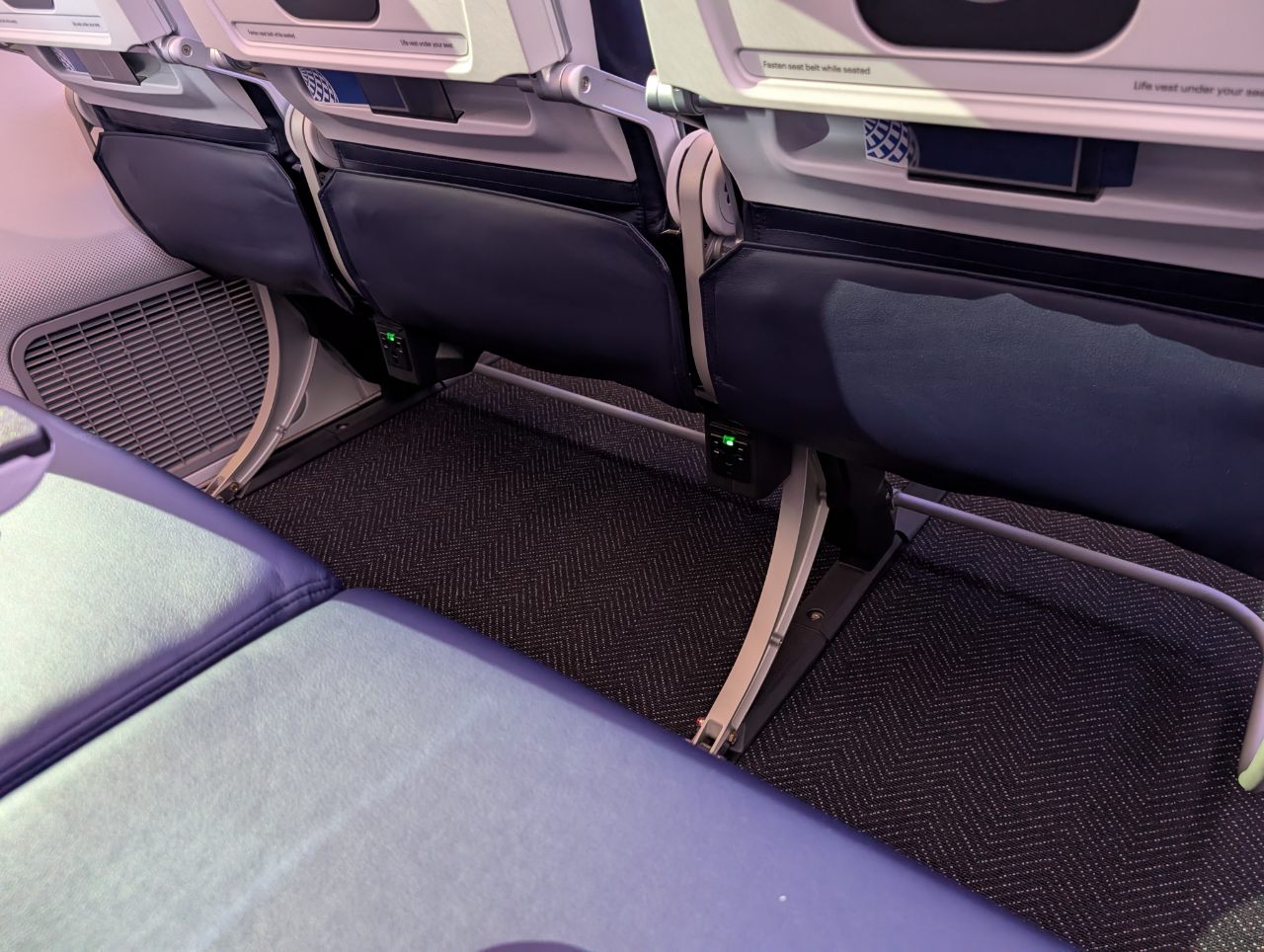
It’s worth noting that Economy passengers will have to share power outlets though, with two outlets for every three passengers.
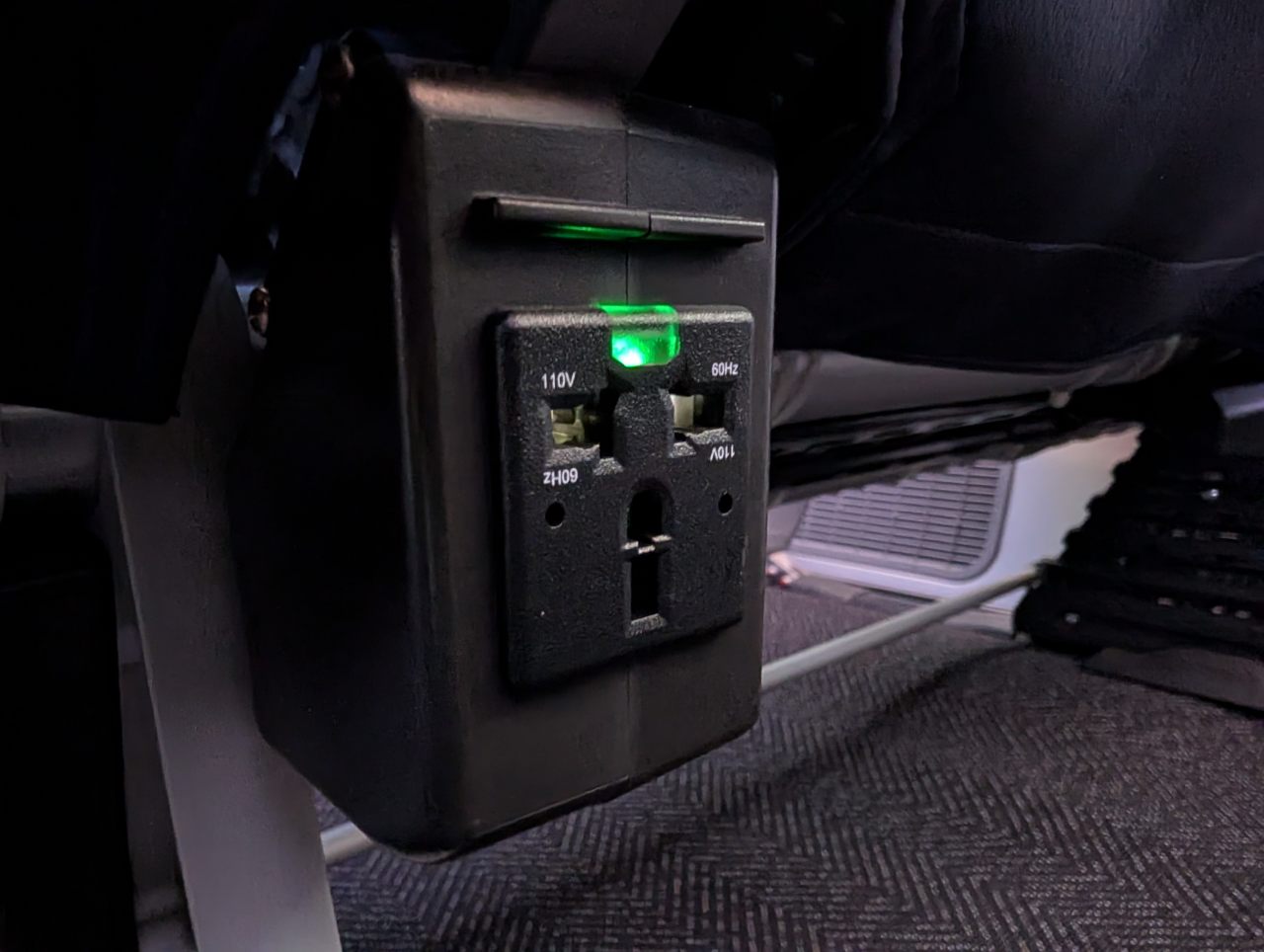
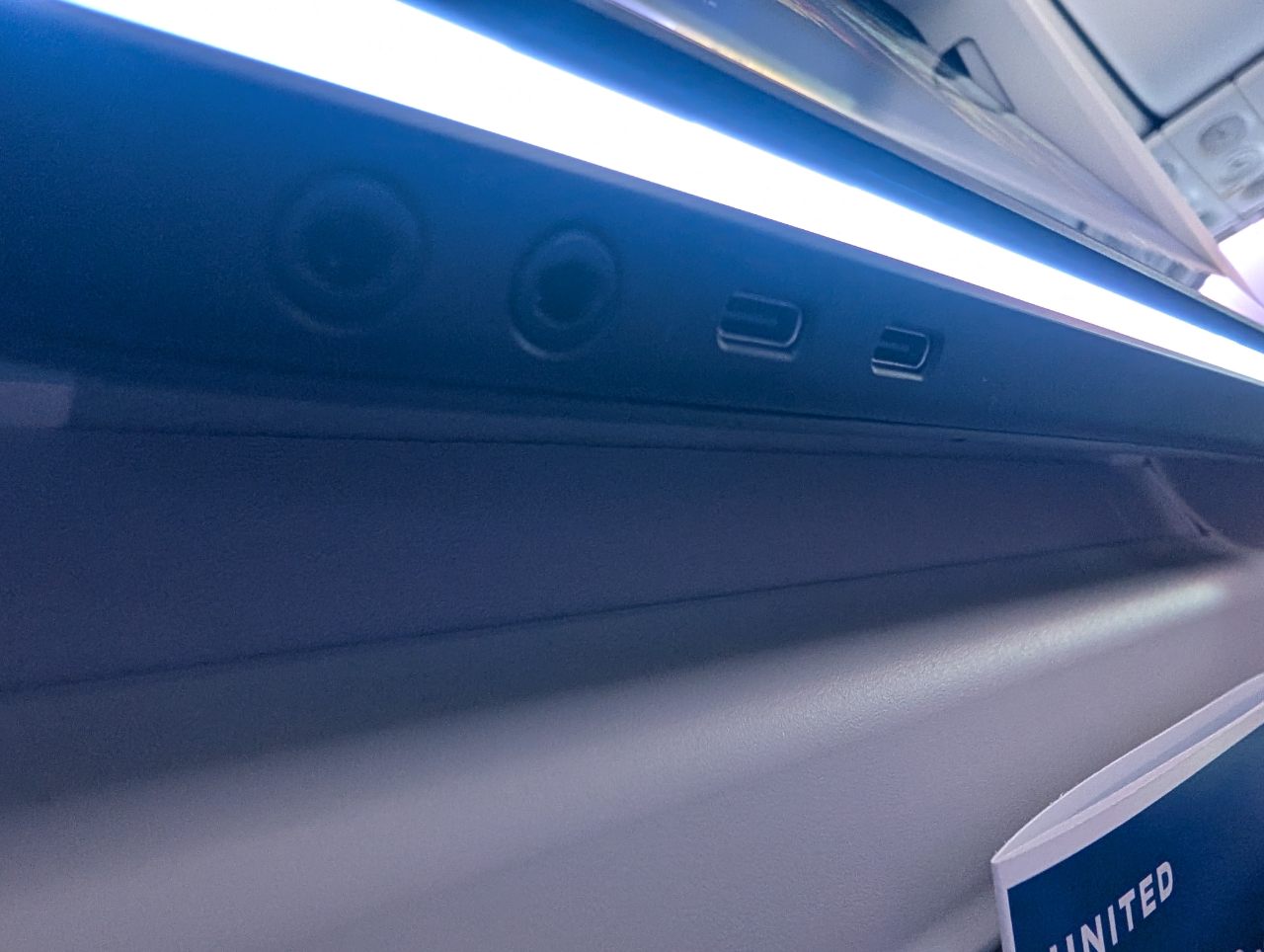
However, each passenger does have two personal USB-C ports, each of which supports 65W charging. So you don’t actually need the power brick— just pack a PD-compatible power cable and all’s well.
At the event, United also took the opportunity to unveil “Relax Row”, a licensed version of the Air New Zealand Skycouch. This allows passengers to purchase an entire row of Economy Class seats, and convert them into a lie-flat bed complete with mattress pad and extra pillows.
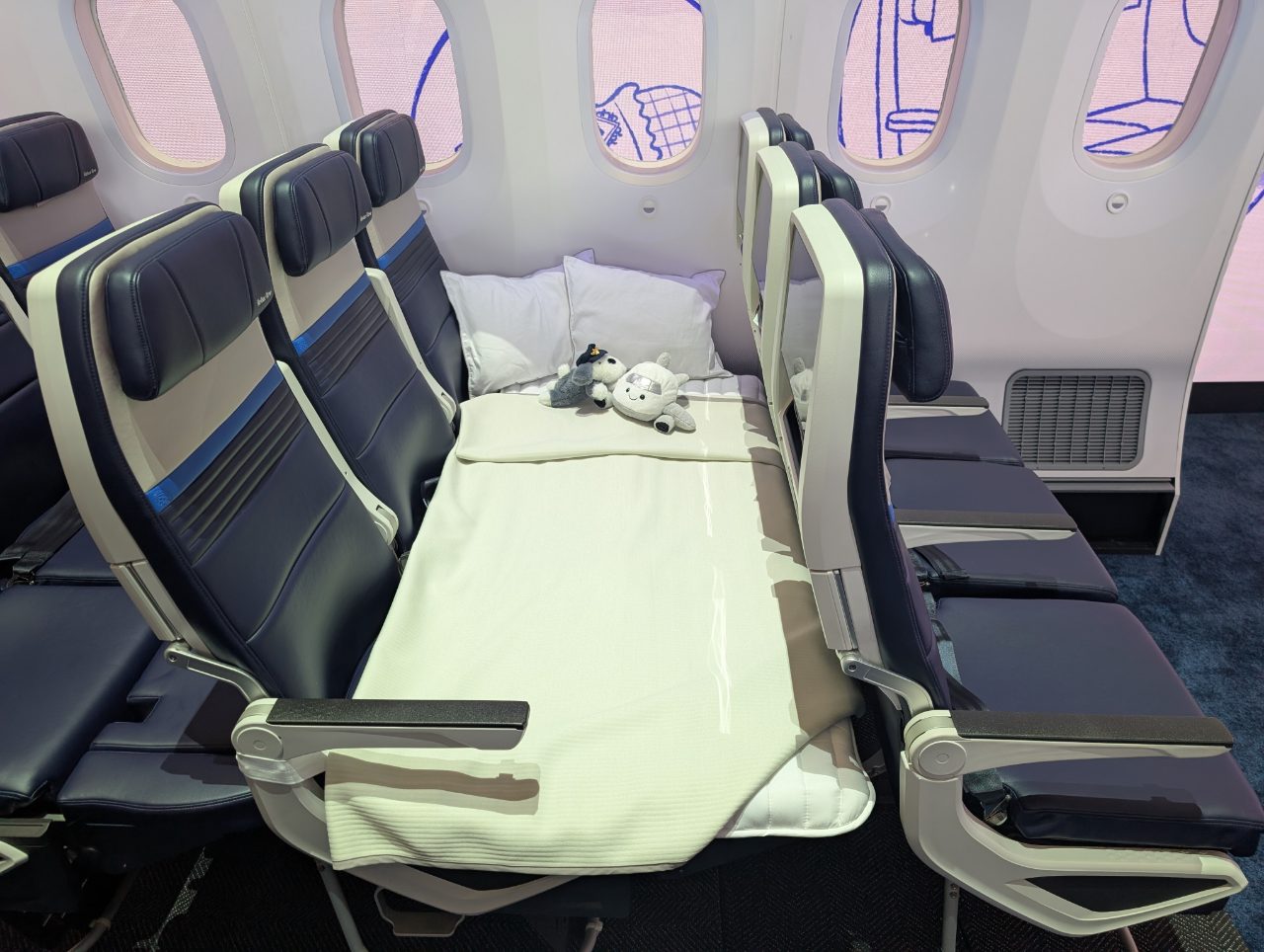
The relatively short length of the “bed” (~130 cm) means it’s more suited for small children than adults, but any additional real estate in Economy is always appreciated.
The Relax Row will debut in 2027 on selected Boeing 777 and 787 aircraft, with United aiming to install it on more than 200 aircraft by 2030. While it’s not the first airline to offer such a product — in addition to Air New Zealand, China Airlines and ANA have also tried something similar — it will be rolled out on a scale unmatched by any of them.
First stop: Singapore
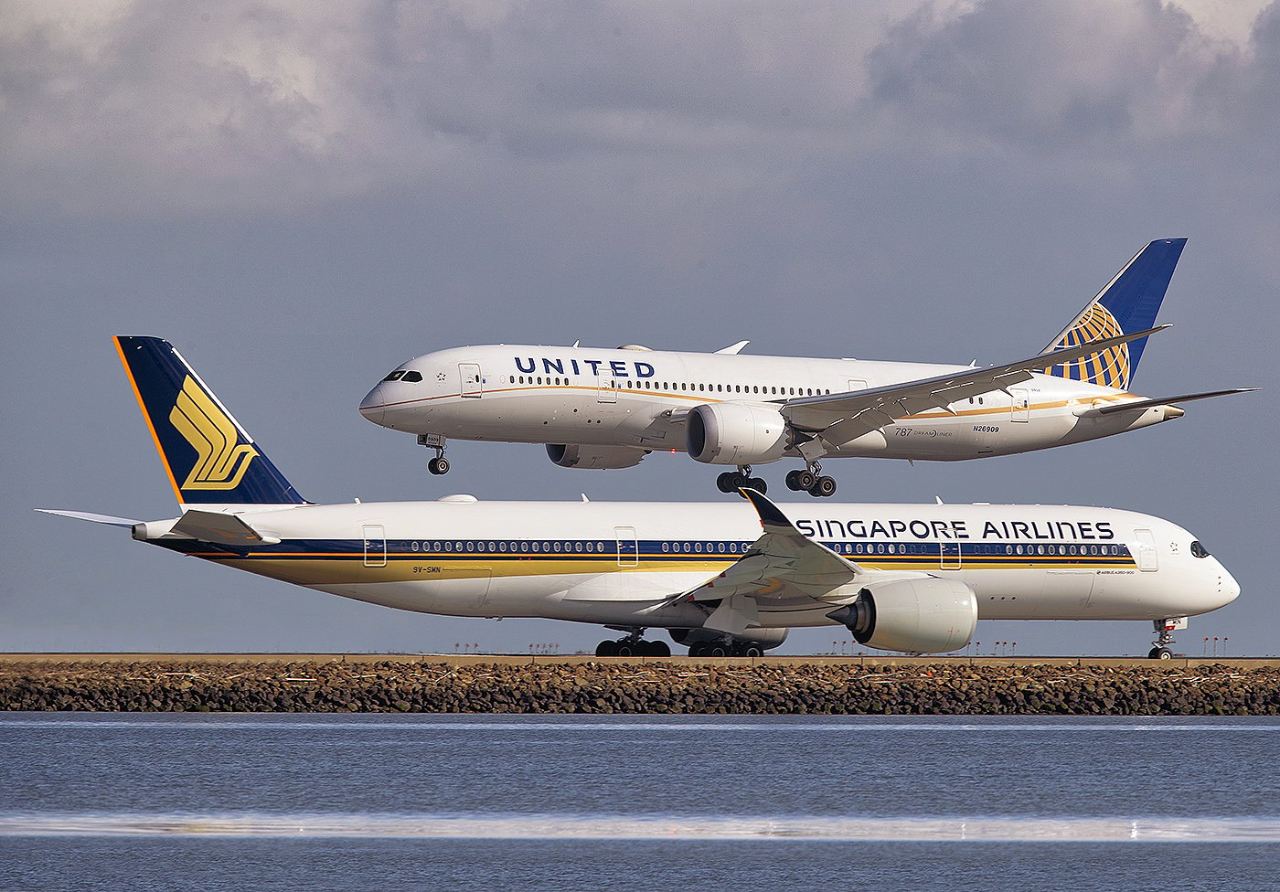
B787-9s with the Elevated interiors will initially operate domestic routes between San Francisco and Houston, in preparation for long-haul deployment.
Following that, Singapore will become the first international destination.
| Flight | Dep. | Arr. | A/C |
| UA1 | SFO 2240 | SIN 0645 (+2) | B787-9 |
| UA2 | SIN 0900 | SFO 0910 | B787-9 |
- UA1 will be the inaugural flight from San Francisco on 22 April 2026
- UA2 will be the inaugural flight from Singapore on 24 April 2026
Seats are now available for sale, and the upgraded aircraft can be identified by the “Polaris Studio available” tag.
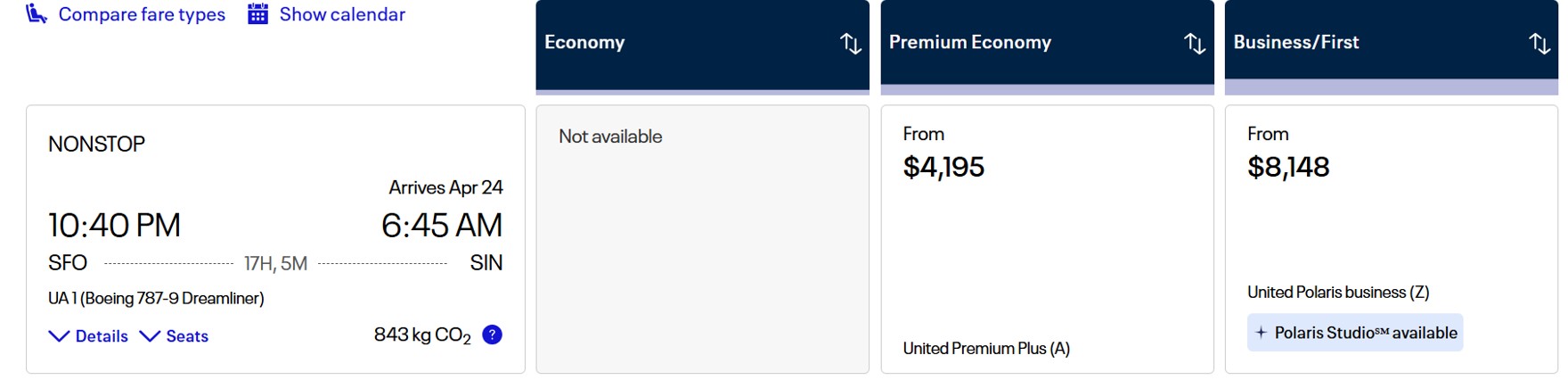
United’s other daily flight to Singapore, UA28/29, will retain the current generation Polaris Business Class seats for now. This seat was introduced in late 2016, and the COVID-disrupted fleet refit was finally completed in 2023.
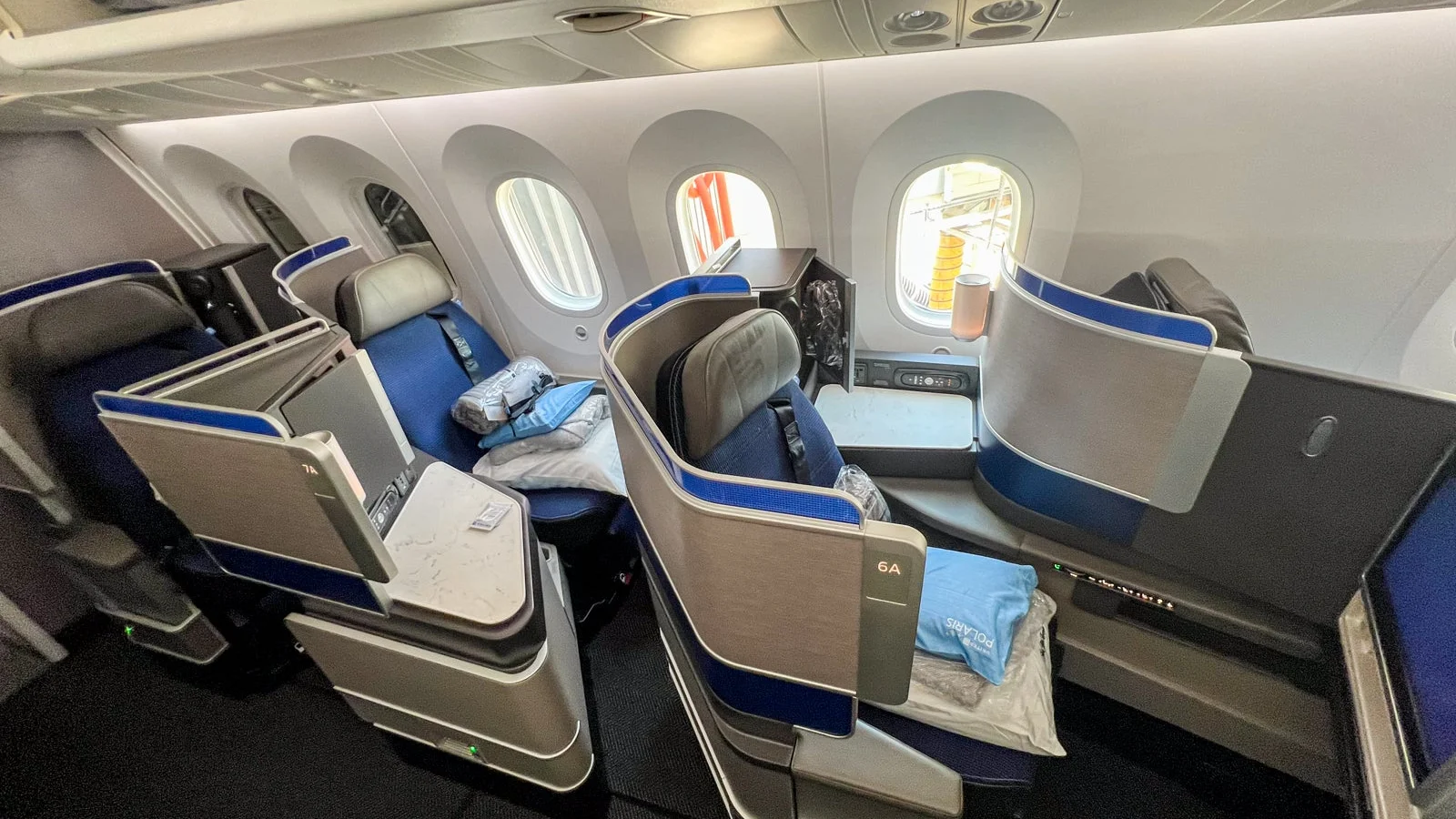
| Flight | Dep. | Arr. | A/C |
| UA29 | SFO 1025 | SIN 1835 (+1) | B787-9 |
| UA28 | SIN 2035 | SFO 2045 | B787-9 |
After Singapore, United will next bring the Elevated interior to London Heathrow on the UA901/900 pairing from 30 April 2026/1 May 2026.
How much do awards cost?
As a Star Alliance partner, KrisFlyer members can redeem miles for United Airlines flights. Awards are priced according to the Star Alliance chart, and I’ve compared them to Singapore Airlines Saver and Advantage awards below.
 One-way Redemption Costs One-way Redemption Costs |
||
| Cabin | United | Singapore Airlines |
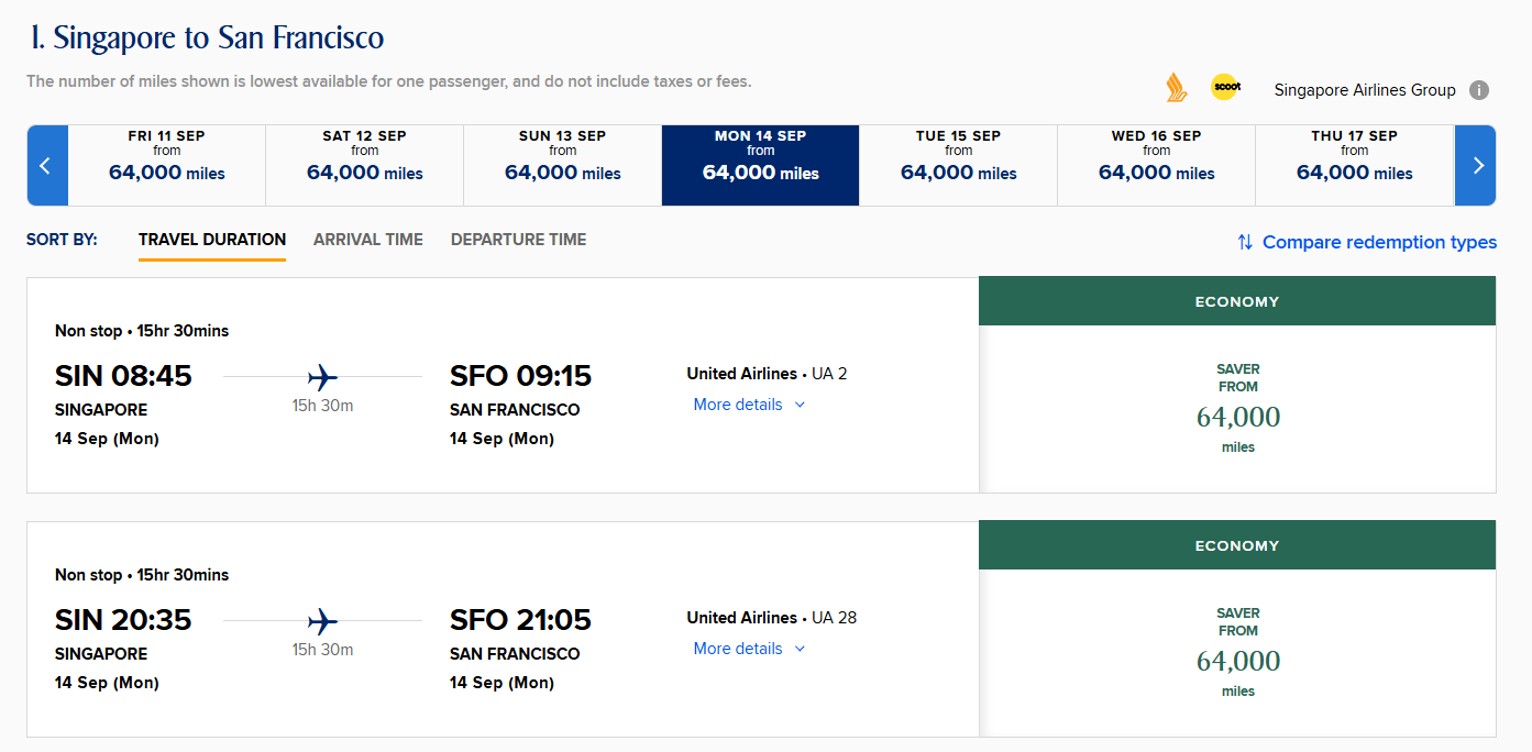
| Economy | 64,000 | 44,000 Saver 79,000 Advantage |
| Business | 131,000 | 112,500 Saver 148,000 Advantage |
| Note: KrisFlyer currently does not offer Premium Economy redemptions on Star Alliance partners. | ||
United awards are more expensive than Savers, but cheaper than Advantage. Therefore, if Saver space is not available, you might want to consider redeeming miles for United before resorting to Advantage pricing.
Here’s the catch though: United releases almost zero Polaris award space to partner programmes. I’m not going to say it doesn’t exist, but I’d be very, very surprised if you managed to book it.
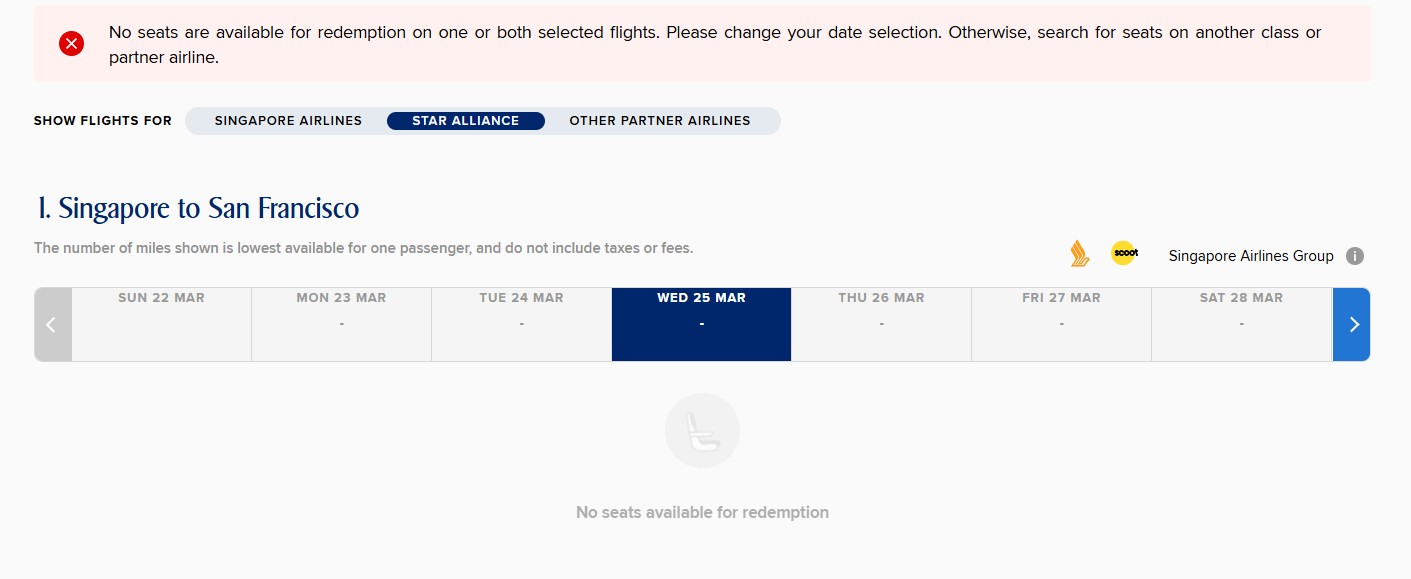
Even within United MileagePlus, you will need to be an elite member or a co-brand cardholder to redeem saver-level United Polaris Business Class award space. Therefore, for someone based in Singapore, redeeming these seats with miles is virtually impossible.
The best you can hope for is Economy Class awards, which are plentiful.
Conclusion
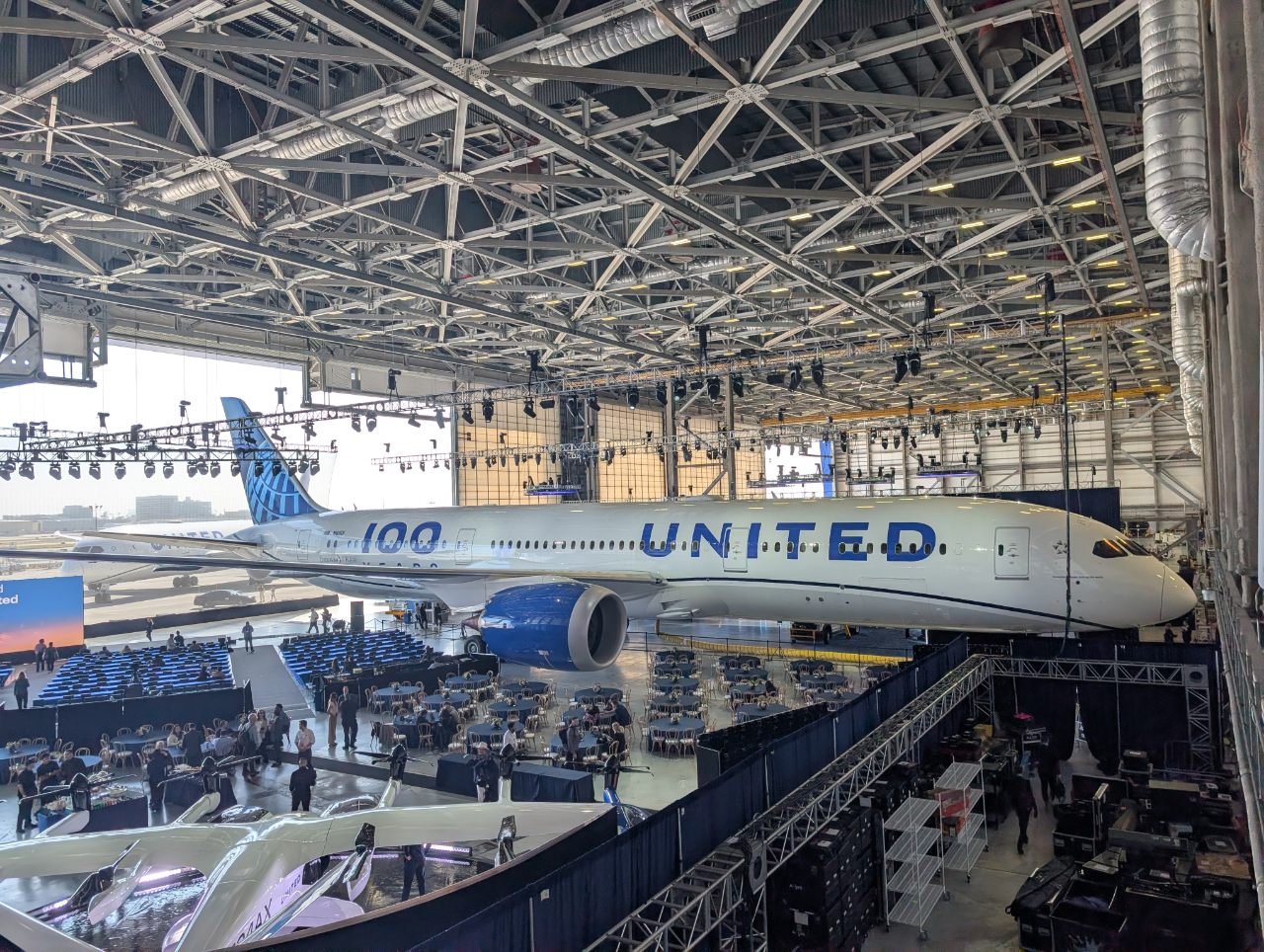
United is betting big on premium with its new Elevated interiors, which will deliver an upgraded onboard experience for all passengers regardless of cabin.
With 16 more of these Dreamliners still to come in 2026, we should soon see these products appearing on more routes (Sydney and Tokyo Narita were namedropped). In the meantime, Singapore can look forward to being the first city to receive these new aircraft, with the debut just a few weeks away.
What do you make of United’s new cabin products?