
Singapore Airlines KrisFlyer and Cathay Pacific Asia Miles may be the two most familiar mileage programmes in Singapore, but cardholders actually have a much broader range of transfer options to choose from.
At last count, credit card points could be converted to 18 airline and five hotel partners, or even more if you include HeyMax’s extensive network. It’s a stark contrast to the landscape when I first started collecting miles more than a decade ago.
That said, not all partners offer good value, and with so many options, it’s easy to feel overwhelmed. In this guide, I’ll walk through the transfer partners offered by each bank, along with the key considerations you should keep in mind.
| 💳 Credit Card FAQs |
| Managing Points |
| Conversions |
| Calculations |
Where can you transfer your credit card points?
The following table summarises the various airline and hotel loyalty programmes available to cardholders in Singapore.
The market leader by far is HSBC, with 16 airlines and four hotels. Historically limited to just KrisFlyer and Asia Miles, it grew its portfolio exponentially with the launch of the TravelOne Card, before rolling it out for all cardholders.
Next is Citibank with 10 airlines and one hotel. While it can’t match HSBC for variety, its key advantage is that all partners share the same transfer ratio (more on that later).
In third place is American Express with eight airlines and two hotels, though a recent Membership Rewards devaluation makes transfers to airline miles less lucrative.
In fourth is OCBC with six airlines and three hotels, though like HSBC, some partners are hamstrung by inferior transfer ratios.
The rest of the banks have rather limited options, mostly featuring Singapore Airlines KrisFlyer and Cathay Pacific Asia Miles. Do note that I’ll be ignoring AirAsia Rewards for the rest of this post, as it’s not really a traditional frequent flyer programme.
What about Max Miles?
 |
|
| Get 200 Max Miles when you sign up for a HeyMax account and complete one transaction | |
| Sign up here |
HeyMax isn’t a card issuer per se, but its Max Miles loyalty currency is still extremely valuable due to its flexibility.
Max Miles can be transferred to more than 30 airline and hotel partners with no conversion fees, mostly at a 1:1 ratio.
| HeyMax Transfer Partners | |
| ✈️ Airlines | |
|
|
| 🏨 Hotels | |
|
|
To recap, HeyMax’s partners fall into two categories: direct transfers, and Cash For Miles.
| Direct | Cash For Miles | |
| Partners | 15 | 19 |
| Min. Transfer | 1,000 Max Miles (1 Max Mile after)# |
10,000 Max Miles (1,000 Max Miles after) |
| Conversion Speed | Instant^ |
5+ business days |
| Conversion Ratio | 1:1* | 1:1* |
| Admin Fees | None | None |
| #Accor currently requires transfers in 1,000 miles blocks, though this will eventually be reduced to 1 mile like the rest ^Except Asia Miles; 5 business days *For all partners except Shangri-La Circle (5 Max Miles = 1 point), and AirAsia Rewards (1 Max Mile= 1.2 points) and IHG One Rewards (1 Max Mile = 1.5 points) |
||
Direct points transfers offer greater convenience, with instant in-app conversions (except Asia Miles) and minimum conversions of 1,000 miles.
Cash For Miles is comparatively more cumbersome:
- Fill out a manual redemption form
- Wait for a virtual Visa debit card to be issued (up to five business days)
- Visit the airline/hotel’s official portal to purchase miles/points
- Wait for the miles/points to be credited (may be instant, but could take a few days)
Important things to note
Not all transfer ratios are the same
For most banks in Singapore, all airline partners share the same transfer ratio. Not only does this simplify things, it also means you can take the headline earn rates at face value.

For example, when the Citi PremierMiles Card advertises 1.2 mpd on local spend, we know that rate applies regardless of which of its 10 airline partners you choose, since they all use the same transfer ratio.
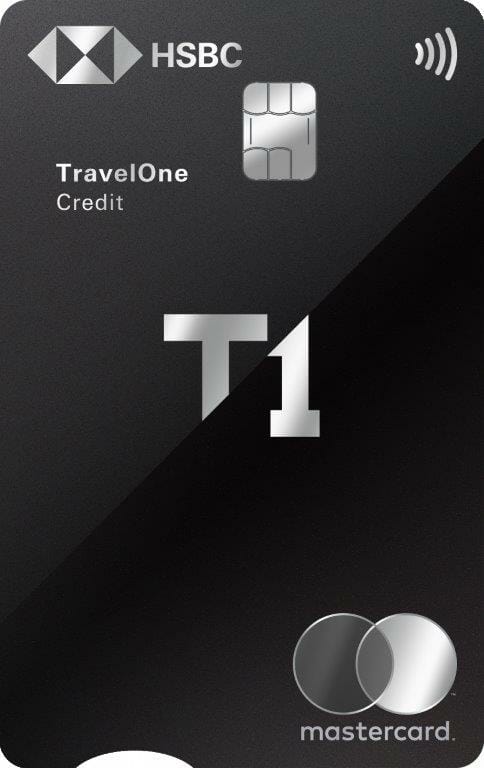
However, when the HSBC TravelOne Card advertises 1.2 mpd on local spend, we need to take a step back and ask “for which airline?” Depending on which mileage programme you transfer to, the actual earn rate could be anywhere from 0.6-1.2 mpd (for KrisFlyer, it’s actually 1 mpd)!
| Transfer Ratio (Points : Miles) |
HSBC T1 (SGD)* |
HSBC T1 (FCY)^ |
| 25,000 : 10,000 | 1.2 mpd | 2.4 mpd |
| 30,000 : 10,000 | 1 mpd | 2 mpd |
| 35,000 : 10,000 | 0.86 mpd | 1.71 mpd |
| 50,000 : 10,000 | 0.6 mpd | 1.2 mpd |
| *3 points per S$1 on SGD spend ^6 points per S$1 on FCY spend |
||
Here’s a summary of the arrangement for each bank.
| Same ratio for all partners | Different ratio for different partners |
|
|
| *Except Emirates Skywards | |
There are two banks where the ratios are not the same across programmes: HSBC and OCBC.
HSBC
| ✈️ HSBC Airline Partners | |
| Mileage Programme | HSBC Points : Partner |
 |
50,000 : 10,000 |
 |
35,000 : 10,000 |
 |
35,000 : 10,000 |
 |
35,000 : 10,000 |
 |
35,000 : 10,000 |
 |
35,000 : 10,000 |
 |
30,000 : 10,000 |
 |
30,000 : 10,000 |
 |
25,000 : 10,000 |
 |
25,000 : 10,000 |
 |
25,000 : 10,000 |
 |
25,000 : 10,000 |
 |
25,000 : 10,000 |
 |
25,000 : 10,000 |
 |
25,000 : 10,000 |
 |
25,000 : 10,000 |
| 🏨 HSBC Hotel Partners | |
| Hotel Programme | HSBC Points : Partner |
 |
30,000 : 10,000 |
 |
25,000 : 5,000 |
 |
25,000 : 10,000 |
 |
25,000 : 10,000 |
OCBC
| ✈️ OCBC Airline Partners | ||
| Mileage Programme | 90°N Miles & VOYAGE Miles : Partner | OCBC$ : Partner |
|
1:1 (VOYAGE) 1,000 : 1,000 (90°N) |
25,000 : 10,000 |
|
1,000 : 1,000 | 10,000 : 4,000 |
 |
1,000 : 900 | 10,000 : 3,600 |
|
1,000 : 900 | 10,000 : 3,600 |
|
1,000 : 750 | 10,000 : 2,900 |
 |
1,000 : 700 | 10,000 : 2,800 |
| 🏨 OCBC Hotel Partners | ||
| Hotel Programme | 90°N Miles & VOYAGE Miles : Partner | OCBC$ : Partner |
|
1,000 : 500 | 10,000 : 2,000 |
 |
1,000 : 1,000 | 10,000 : 4,000 |
|
1,000 : 1,000 | 10,000 : 4,000 |
Minimum transfer amounts may be different
Even if a bank has the same transfer ratio for all partners, the minimum transfer amount may vary depending on partner.
| Same minimum for all airline partners | Different minimum for different airline partners |
|
|
There are two banks where the minimum transfer amounts differ across programmes: Maybank and OCBC.
| Bank | Minimum Transfer Amounts | |
| TREATS Points | ||
| Maybank |
|
|
| 90°N Miles & VOYAGE Miles | OCBC$ | |
| OCBC |
|
|
Look for sweet spots
In the same way that US$1 is not the same as €1 is not the same as S$1, 1 KrisFlyer mile is not the same as 1 Asia Mile. Think of them as different currencies, each with their own rules, redemption partners, and award pricing.
These differences give rise to what we call “sweet spots”, routes where the price with one particular frequent flyer programme is much lower than others.
For example, suppose I want to fly from Singapore to Bangkok in Business Class on Singapore Airlines. I could redeem this flight through:
| Programme | Miles Required (one-way Business Class) |
| Air Canada Aeroplan | 20,000 miles |
| KrisFlyer | 25,000 miles |
| EVA Air | 27,500 miles |
| THAI | 27,500 miles |
| United MileagePlus | 45,000 miles |
| Turkish Miles&Smiles | 50,000 miles |
Note how the cost of the exact same flight ranges from 20,000 to 50,000 miles. To the extent that your credit card points can be converted at the same ratio to all programmes, of course you’d pick the one with the lowest redemption costs!
| ⚠️ Important Note |
|
One assumption we’re making is that the programme does not add fuel surcharges to its award tickets. For example, if programme A absorbs fuel surcharges but programme B does not, then programme A may be the better choice even if it charges more miles than programme B. The exact trade-off depends on your relative valuation of miles for programme A/B. American Airlines AAdvantage, Air Canada Aeroplan, Alaska Mileage Plan, Avianca LifeMiles and United MileagePlus do not pass on fuel surcharges. Unfortunately, these programmes are either unavailable via credit cards in Singapore, or have very poor transfer ratios. |
It’s beyond the scope of this article to highlight all the sweet spots out there, suffice to say that understanding and finding these are key to stretching your miles.
To add further complexity, a sweet spot can be offset by a poor transfer ratio. Going back to our previous example, Air Canada Aeroplan may require fewer miles for the Singapore to Bangkok award, but transfers take place at a rate of 35,000 points = 10,000 miles, versus 30,000 points = 10,000 miles for KrisFlyer. Once you’ve adjusted for that, the sweet spot might not be so attractive anymore!
British Airways Club and Qatar Privilege Club are effectively the same
 |
|
British Airways and Qatar Airways both use Avios as their frequent flyer currency. Members can make free, instant 1:1 conversions between programmes, as well as Aer Lingus, Finnair and Iberia.

Therefore, if a bank offers British Airways Club, it effectively offers Qatar Airways Privilege Club (and vice versa). Take note of this if you have a HSBC card, as it’d be silly to transfer points to Qatar Privilege Club at a 3.5:1 ratio when you could do it via British Airways Club at a 2.5:1 ratio!
Alliances open up further redemption opportunities
The benefit of transferring miles to a frequent flyer programme that’s part of an alliance is the ability to redeem them for flights on any member airline. For example, Asia Miles can be used not just for Cathay Pacific flights, but for flights on oneworld partners like American Airlines and Qatar Airways.
| ❓ Where do I redeem my miles? |
| The correct website to visit depends on which miles currency you’re using to redeem. For example, if I have KrisFlyer miles and want to redeem a flight on ANA, I visit the KrisFlyer website, not the ANA website. |
Here’s a rundown of the three major airline alliances and their members.
 |
|
| Star Alliance | |
|
|
 |
|
| oneworld | |
|
|
 |
|
| SkyTeam | |
|
|
But there’s more than just the three main alliances. Frequent flyer programmes can also have non-alliance partners, where agreements are worked out bilaterally. For example, KrisFlyer members can also redeem miles for Malaysia Airlines, Garuda Indonesia, Virgin Atlantic, and Virgin Australia, despite the fact that none of them are part of Star Alliance.
| FFP | Non-Alliance Partners |
|
|
|
|
 |
|
|
|
|
|
 |
|
|
 |
|
|
 |
|
|
 |
|
|
 |
|
|
Do note that partner awards may only be available on selected routes. For example, Asia Miles allows redemptions on SWISS, but only for flights between Zurich and Berlin, Brussels, Florence, Geneva, Hamburg, Hong Kong, Stuttgart, and Venice.
Moreover, you may not be able to book all partner awards online, so if you don’t see what you want on the website, try calling up customer service.
Check the respective websites for the full details and restrictions.
Fuel surcharges can change the picture
Fuel surcharges are basically junk fees that airlines tack onto award tickets, in an attempt to squeeze some additional cash out of members. It’s an absurd concept if you think about it, kind of like going to a restaurant and having to pay an “ingredient surcharge”.
The good news is that Singapore Airlines no longer imposes fuel surcharges, ever since March 2017. The bad news is that KrisFlyer will continue to pass them on wherever applicable, and these can be substantial on carriers like Lufthansa.
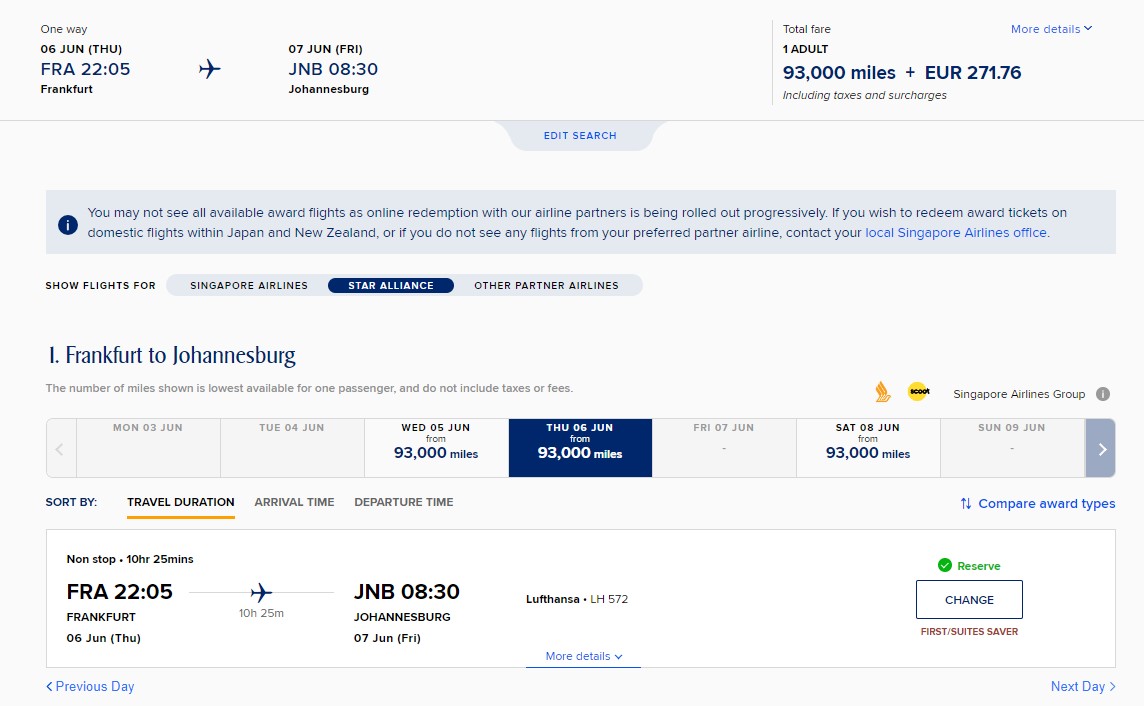
Unfortunately, most mileage programmes will pass on fuel surcharges, with the exception of American Airlines AAdvantage, Air Canada Aeroplan, Alaska Mileage Plan, Avianca LifeMiles and United MileagePlus.
Qatar Privilege Club does not charge fuel surcharges for Qatar Airways flights, but has an “award segment fee” that costs US$180 to US$250 per segment in Business Class- just as bad as a fuel surcharge if you ask me.
All you can do in that case is focus on redemptions on airlines with modest or no fuel surcharges, such as Finnair, Qantas (excluding departures from Europe) or United, or originate from countries that ban or regulate charges such as Australia, Hong Kong, New Zealand and Vietnam.
Flights originating from these countries should have considerably lower fuel surcharges.
What about hotels?

You may have noticed that I haven’t really addressed hotel loyalty programmes so far. There’s a reason for that: it rarely makes sense to convert credit card points to hotel programmes.
For example, suppose you’re a Citi cardholder with 25,000 ThankYou points. You could convert that to 10,000 KrisFlyer miles, or 10,000 IHG points. I personally value a KrisFlyer mile at 1.5 cents, and an IHG point at 0.64 cents (since you can easily buy them at 0.5 cents when they go on sale). Therefore, by choosing the IHG points, you’re taking a haircut of more than 50%!
Fundamentally, the problem can be summarised this way:
- On a 1:1 basis, most hotel points are worth less than airline miles
- Most banks in Singapore offer the same conversion ratios to hotel points as airline miles
There have been some cases when I converted credit card points to hotel programmes, but they were almost always exceptional.
- Back in 2018 American Express offered a transfer bonus of 3 Hilton points per MR point, which was clearly an error, but was still honoured.
- I cashed out my entire StanChart X Card welcome bonus on Accor Live Limitless points, because of an excellent 100% transfer bonus offered at the start of COVID (giving me the equivalent of 3 cents per mile)
- More recently, I transferred a big chunk of Max Miles to Accor Live Limitless, when a 20% transfer bonus presented the opportunity to get 3.56 cents per mile
Outside of these situations, however, you’re usually better off buying hotel points when they go on sale.
| Chain | Typical Price During Sale |
| Hilton | 0.5 US cents (100% bonus) |
| IHG One Rewards | 0.5 US cents (100% bonus) |
| Marriott Bonvoy | 0.89 US cents (40% bonus) |
| World of Hyatt | 1.8 US cents (25% discount) |
Conclusion
KrisFlyer and Asia Miles are useful programmes, but you shouldn’t limit your horizons to just these two. Over the past few years, we’ve seen banks adding more and more “exotic” partners to their rosters, which can open up great redemption opportunities.
So before you decide on yet another KrisFlyer or Asia Miles transfer, think about where you want to go, which programme offers best value for that particular route, transfer bonus opportunities, as well as alliance and non-alliance partners. It’s not always a straightforward exercise, but can be the difference between taking one free trip or several!
Which programmes do you usually transfer your credit card points to?

Hello Aaron, how do you value 1 Asia Miles?
Don’t forget how each programme treats lap infants.
Maybe can come out with an article for sweet spot to destination that are popular and originate from SIN?