
Singapore Airlines has announced that Starlink Low Earth Orbit (LEO) satellite connectivity will be coming to its fleet from early 2027, allowing passengers to enjoy significantly upgraded browsing speeds and gate-to-gate connectivity.

This is a hugely exciting development, if you ask me. I had my first experience with inflight Starlink in March and was blown away — not just by the speeds, but by how it transforms what you can do in the air (you haven’t really lived until you buzz in the deliveryman and give him instructions over the doorbell camera from 35,000 feet).
It’s true that SIA isn’t exactly blazing a trail here — rival carriers have been much quicker to adopt Starlink — but since it’s the airline that I (and many of you, I’m sure) fly the most often, this is a case of better late than never.
That said, after the initial excitement of the announcement died down, some people were left underwhelmed. A common criticism online is that the rollout lacks ambition, both in terms of scope and timeline, and I think that’s worth a discussion…
Recap: Singapore Airlines’ Starlink rollout plan
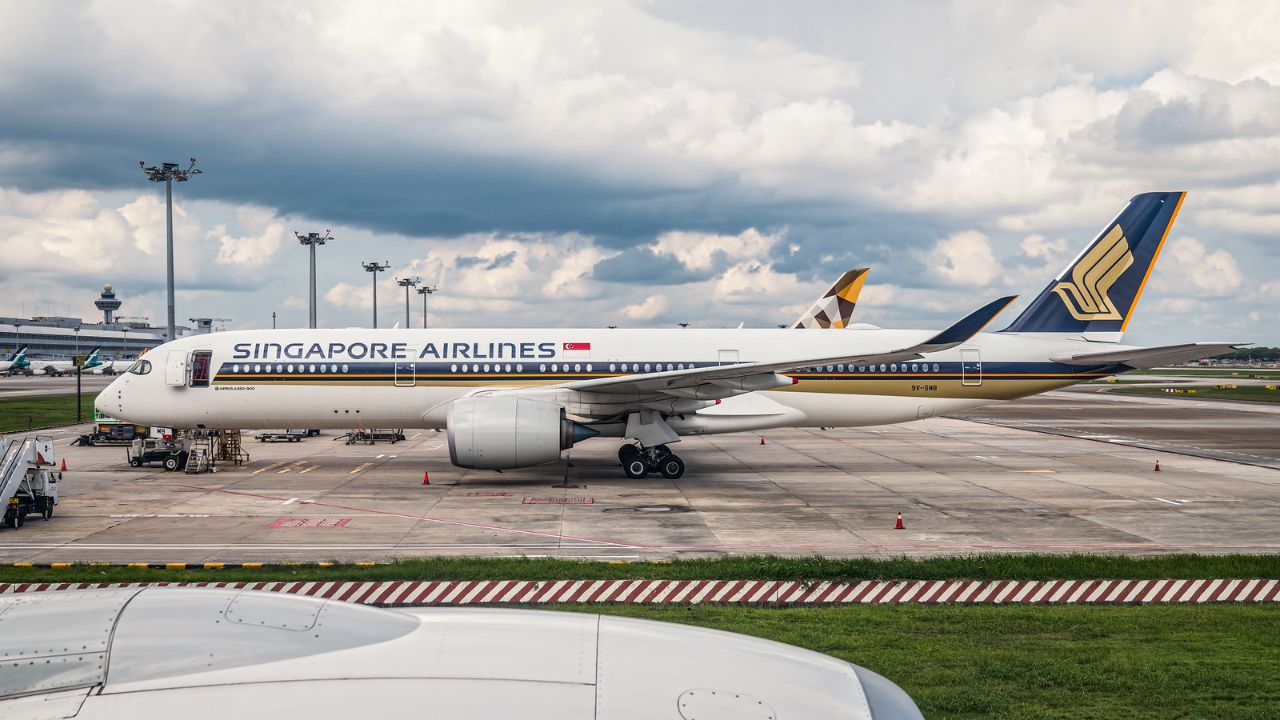
Singapore Airlines plans to install Starlink across the following aircraft types, with the first aircraft refitted in Q1 2027, and the entire project completed by 2029.
- Airbus A350-900LH
- Airbus A350-900ULR
- Airbus A380-800
Starlink internet will be complimentary for:
- Suites, First Class, Business Class passengers and PPS Club members
- KrisFlyer members travelling in Premium Economy and Economy Class.
| 📶 Singapore Airlines Inflight Wi-Fi |
|||
| PPS Club | KrisFlyer | Non KrisFlyer | |
| Suites & First | Unlimited | ||
| Business | Unlimited | ||
| Premium Economy | Unlimited | N/A | |
| Economy | |||
This is identical to the current Wi-Fi policy, and in short, it’s basically free for everyone.
Even if you’re travelling in Premium Economy or Economy Class, you don’t actually have to attach a KrisFlyer membership number to your booking. Instead, you can use your membership to generate a login code once onboard, allowing you to use your preferred frequent flyer programme for status benefits or mileage accrual.
Is this ambitious enough?
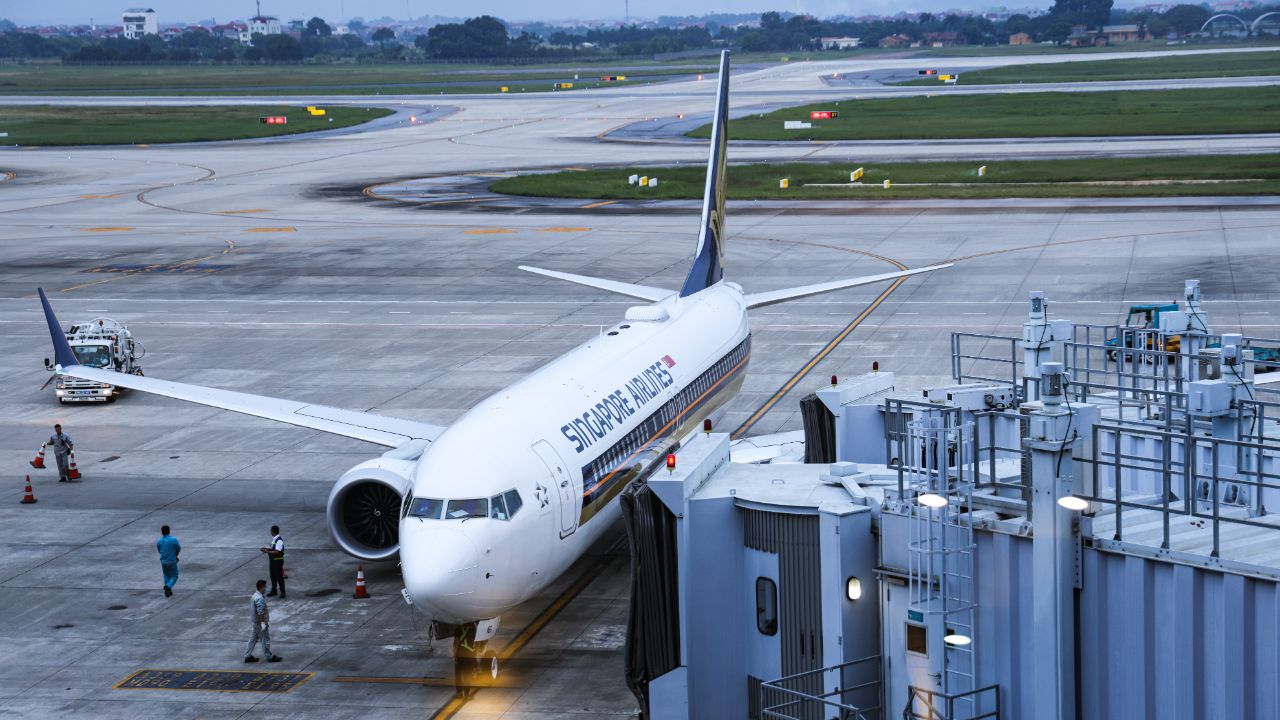
Singapore Airlines currently offers Wi-Fi through Panasonic and Viasat, both of which use Geostationary Orbit (GEO) satellites. This is good enough for basic browsing and emails, but struggles with anything heavier, such as large attachments, video streaming, or cloud backups. Moreover, GEO connectivity is only available at cruising altitude, leading to blackouts during take-off and landing.
Starlink, on the other hand, promises to be a quantum leap, delivering speeds equivalent to a home broadband connection. This makes it possible to play multiplayer games, stream 4K video, or use applications which require low latency, like stock trading and smart home management. Moreover, it will be available throughout the flight, whether you’re waiting to pushback at the gate, or seconds away from touchdown.
I don’t think anyone objects to the introduction of Starlink per se. What they’re taking issue with is the scope and speed of SIA’s planned rollout.
Scope
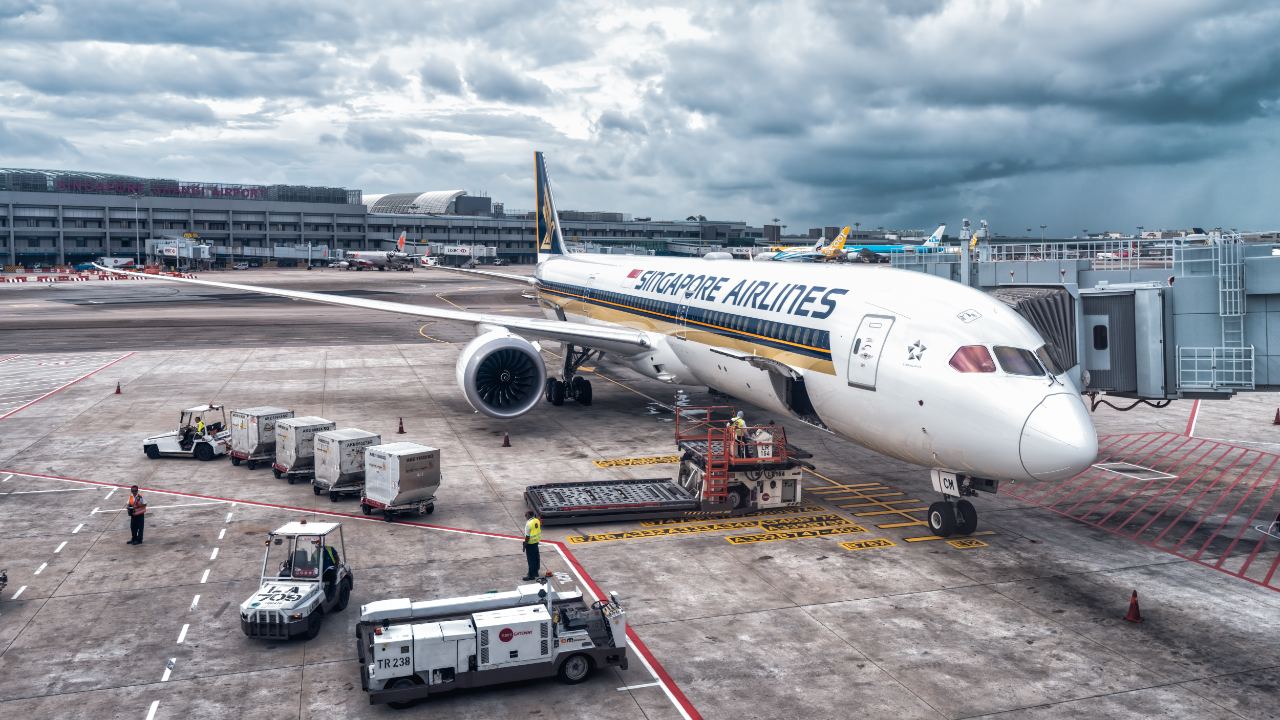
Singapore Airlines plans to install Starlink on a total of 53 aircraft, which, while a significant number, amounts to just over one third of its fleet.
| Aircraft Type | Number in Fleet | Starlink? |
| Airbus A350-900MH | 24 | ❌ |
| Airbus A350-900LH | 34 | ✅ |
| Airbus A350-900ULR | 7 | ✅ |
| Airbus A380-800 | 12 | ✅ |
| Boeing 737-8 MAX | 21 | ❌ |
| Boeing 777-300ER | 22 | ❌ |
| Boeing 787-10 | 28 | ❌ |
That’s led to as much discussion about which aircraft aren’t included as which ones are.
Now, it’s important to remember that this may not be the definitive list. There is always the possibility that SIA announces a second wave of installations, and indeed, an SIA spokesperson shared with me that the airline is still evaluating inflight connectivity options for the other aircraft types in its fleet.
However, the question then becomes why these aircraft were left out of the “first wave”.
Let’s start with the easy one: it’s no surprise to see the Boeing 777-300ER excluded. These aircraft are due to be retired once the Boeing 777-9 arrives, and had everything gone according to plan, would already be exiting the fleet. My assumption is that the Boeing 777-9 will arrive factory-equipped with the Starlink system; I just can’t see any other possibility, given the commercial importance of this aircraft, and the routes it will fly.
As for the exclusion of the Airbus A350-900MH, Boeing 737-8 MAX, and Boeing 787-10, the best explanation I’ve seen for their exclusion relates to coverage. These aircraft operate short and medium-haul routes, which I’ve listed below.
|
|
Now let’s look at Starlink’s coverage map. Countries in light blue have approved Starlink; countries in dark blue are “coming soon”, and countries in grey have either banned the service, or are not in active discussions to approve it.
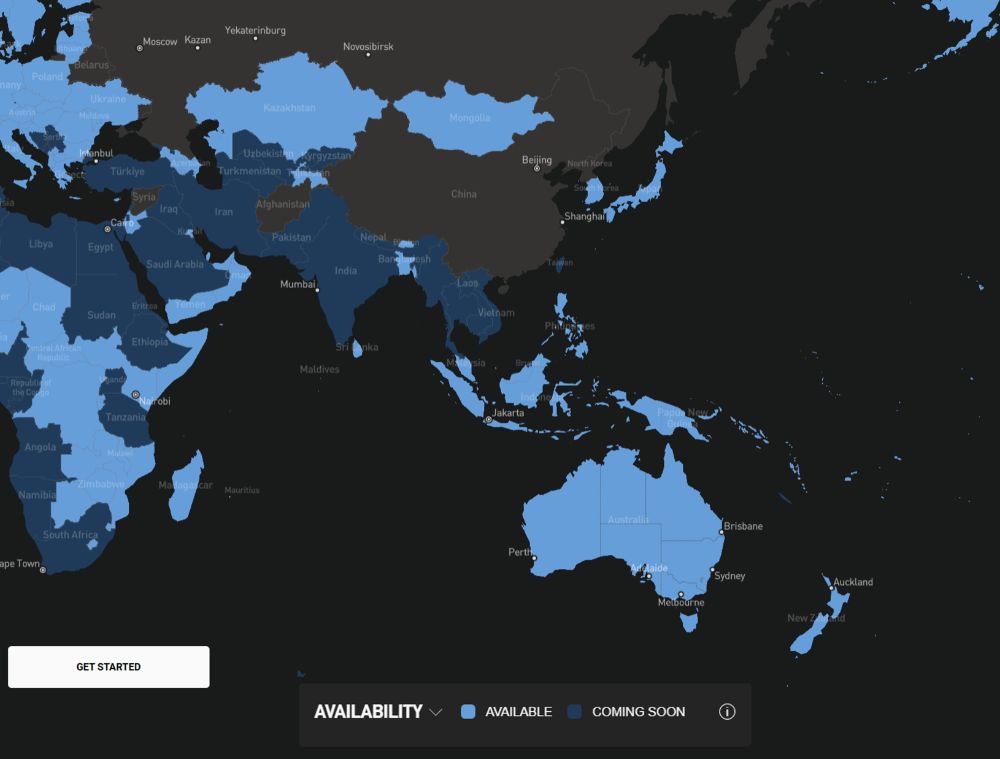
Once we piece the two together, the picture starts to make a bit more sense.
India has not yet approved Starlink, and while progress has been made over the past few years, that’s a big dead zone over an important air corridor. Until this — and the additional coverage gaps over Southeast and South Asia — is resolved, it might be premature to announce the installation on the short and medium-haul fleet (mind you, so long as this remains unresolved, there will also be significant blackouts for flights to Europe).
And even if the regulatory situation in those countries improves over the next few years, the China problem will remain. Beijing views Starlink as a national security threat, and foreign ships are already being penalised for using Starlink within Chinese waters. There’s really no reason to believe that will change anytime soon, so the reasoning may be that it’s better to have slow Wi-Fi throughout the entire flight, rather than a mix of fast Wi-Fi and no connection at all.
That’s where the incumbent systems, Panasonic and Viasat, have the advantage as they enjoy far greater approval.
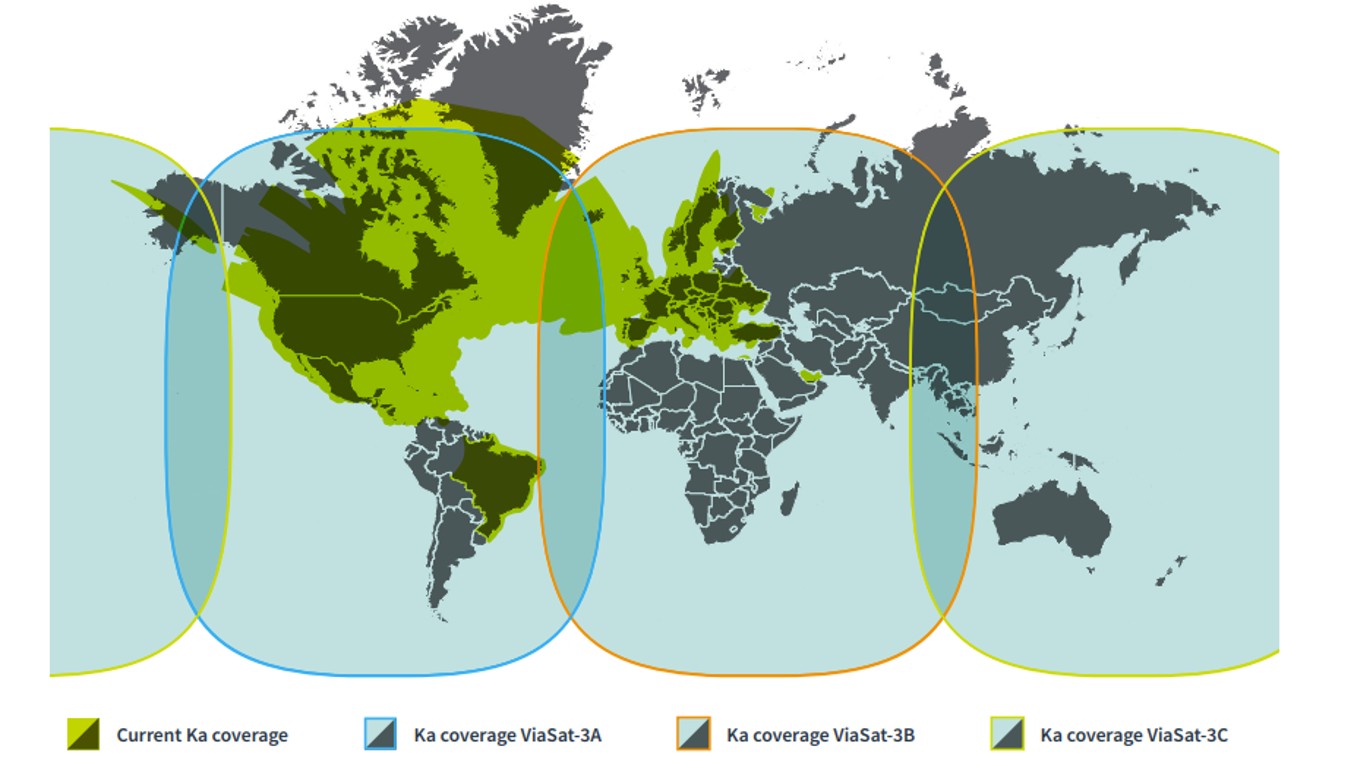
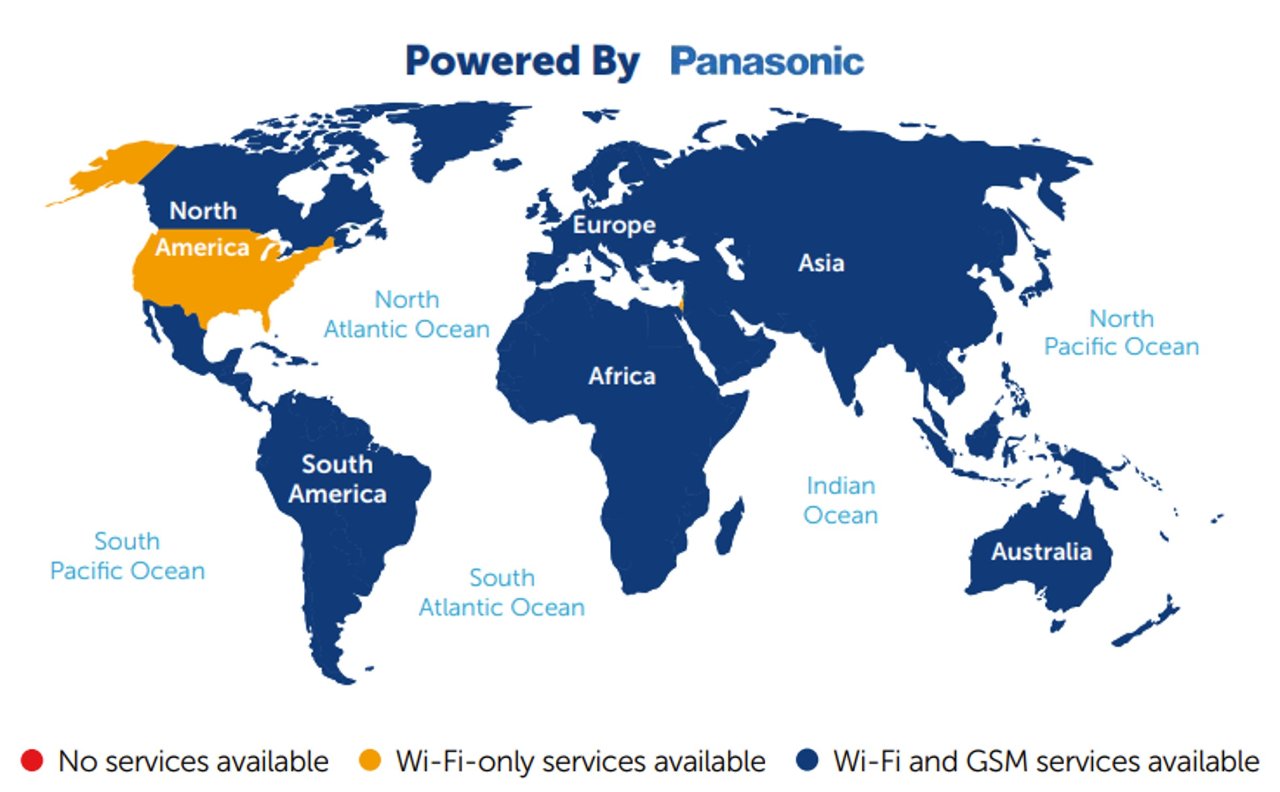
Still, the decision not to equip these aircraft because of coverage concerns will result in “collateral damage” to destinations like Adelaide, Brisbane, Darwin, Perth, Seoul, Tokyo, all of which could be reached without flying over any areas where Starlink is restricted.
I’ve read suggestions that a possible compromise would be to do a partial fitout of the short and medium-haul fleet, with a dedicated “non-Starlink fleet” to serve China and other destinations where Starlink is not approved.
But I doubt this would be viable, as it creates significant complications in terms of network planning and aircraft utilisation. You want the flexibility to take that inbound plane from Adelaide and slot it onto a flight to Shanghai departing in an hour.
Likewise, you shouldn’t expect SIA to keep two systems installed, and switch between them as necessary. After all, one of the benefits of Starlink are the fuel savings by reducing the aircraft drag (as the Starlink system has a lower profile than the current GEO ones). I’m not aware of any airline that uses more than one system on the same aircraft anyway.
Speed
While the decision to commit to only a partial refit of the Singapore Airlines fleet may be logical, what’s harder to understand is the timetable.
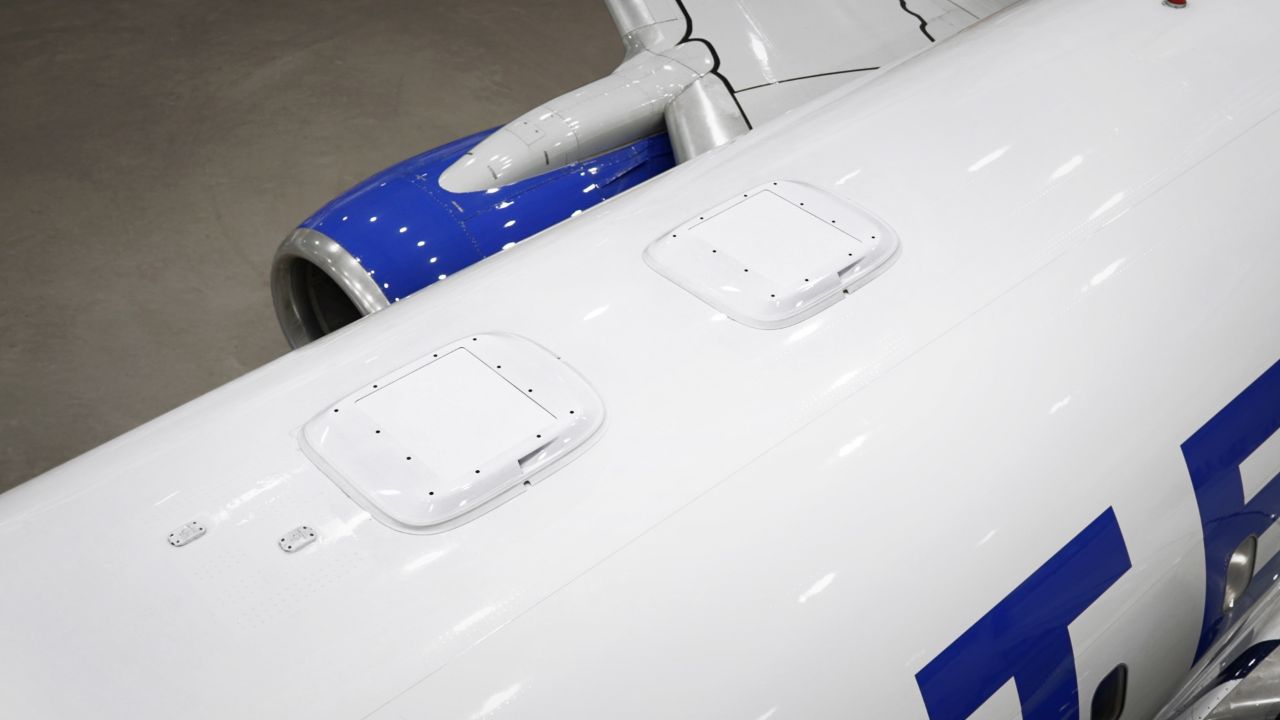
SIA plans to outfit 53 aircraft with Starlink by the end of 2029. Given that Starlink can be installed in just 2-4 days (most of the time is actually spent removing the legacy system), this is a very, very slow rollout.
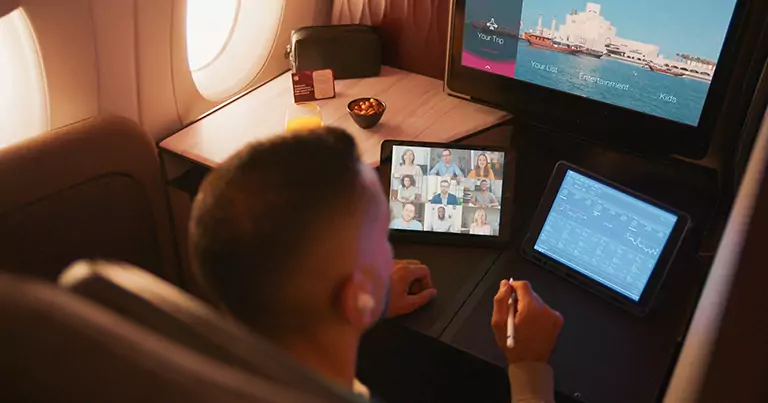
Qatar Airways equipped all its Boeing 777 and Airbus A350 (more than 100 aircraft) in just 14 months. United Airlines managed to equip almost 350 aircraft in just one year, and expects to upgrade its entire fleet of more than 1,000 aircraft by the end of 2027. Emirates completed its first installment in November 2025, and is targeting to fit all 232 of its aircraft by mid-2027.
So it’s definitely feasible, technically speaking, for SIA to complete Starlink installations on 53 aircraft well before 2029. My guess is that the protracted timeline reflects a decision to install Starlink only when the A350-900LH and A350-900ULR aircraft enter the hangar to be retrofitted with the latest cabin products. However, if the plan is to complete Starlink installations by 2029, then at some point the rollout would need to outpace the cabin upgrade programme, since the latter is expected to run into 2030 and possibly beyond.
As to why Starlink can’t be installed earlier, during routine maintenance, well, it’s well outside my area of expertise, but from what I understand the A350-900ULRs completed their C-checks between May 2024 and February 2025, which took on average about 40 days (there were rumours — ultimately incorrect — that SIA would use this time to retrofit them with the new cabin products).
Assuming the more frequent A-checks (10-24 hours) are insufficient for Starlink installation, and SIA is unwilling to take the aircraft out of service for an extra couple of days, the next C-check will be due in 20-24 months, during which I assume the retrofit and Starlink installations will take place.
I’m not sure what the schedule looks like for the A350-900LHs, so if you have a better idea do chime in.
Do I wish Starlink was rolled out a lot faster? Of course. But there could be other considerations at play here. SIA is really starved for aircraft right now, and they also have an opportunity to capture demand arising from the geopolitical misfortunes of the ME3. Perhaps management has decided that the opportunity cost of taking a plane out of service is simply too great, given that the current Wi-Fi is “good enough”.
Conclusion
Starlink marks the next major evolution of inflight connectivity for Singapore Airlines, but customers will need to be patient as the first such aircraft will only arrive in Q1 2027. It won’t be until 2029 that all 53 Airbus A350-900LHs, A350-900ULRs and A380-800s equipped with the system.
Moreover, there are still unanswered questions about whether Starlink will come to SIA’s short and medium-haul fleet, as well as the plans for its upcoming Boeing 777-9 (though like I said, I can’t see any other outcome but these aircraft arriving with Starlink factory-fitted).
For what it’s worth, I’m a firm believer that Starlink has an inbuilt positive feedback mechanism. Once passengers experience it, it’s impossible to go back to regular, slow connectivity, and you can bet they’re going to pressure the airline to accelerate its deployment schedule.
What do you make of SIA’s Starlink rollout plans?

Why rush? No one is going to fly a different airline because of this.
Death by a thousand cuts.
No one is going to fly a different airline because:
it’s more expensive
onboard food quality
lounge
outdated seats
wifi
lack of PJs
no J amenity kit (for <6 hrs)
connecting pax might be on vastly inferior short hauls
very kiasu hot drinks service (or any service?)
sb
Feels like the Starlink rollout is emblematic of SIA – and arguably Singapore more broadly.
Extremely polished, reliable and deliberate, but also very cautious and slow-moving when it comes to innovation and speed of execution.
SIA has historically won through consistency, trust and operational excellence rather than being first. That playbook worked incredibly well in a more stable world.
But competition and customer expectations are evolving much faster now. I wonder how long premium incumbents can rely primarily on loyalty and brand reputation if they’re consistently late to shifts that competitors are embracing aggressively.
This.
Starlink has a huge blackout area when fly to EU. Essentially after malaysia till after leaving turkey airspace, that probably 6-7hr black out.
Current system won’t let us to stream Netflix or do video conference call @ 35k feet but at least allowed me to send a few emails and no issue to text via TEAMS or WhatsApp.
Just an opinion
Really? It was peferectly fine when I fly SIN-DOH last year, really nice expereicne