
Annual fees are an annoying reality with most credit cards, but the good news is that these can usually be waived — at least for entry-level cards.
Requesting a fee waiver is simple, and it costs nothing to try. The worst the bank can say is no, and if it does, you’re perfectly at liberty to cancel the card, get the annual fee refunded, and walk away.
However, you may occasionally run into a customer service officer (CSO) who insists that “the annual fee must be paid, even if you cancel the card”.
That simply isn’t true, and you shouldn’t accept that as an answer.
My recent situation with CIMB
I recently received an SMS from CIMB about an upcoming payment of S$338 that was due in a week’s time — which was odd, because I hadn’t spent on any of my CIMB cards in a very long time.
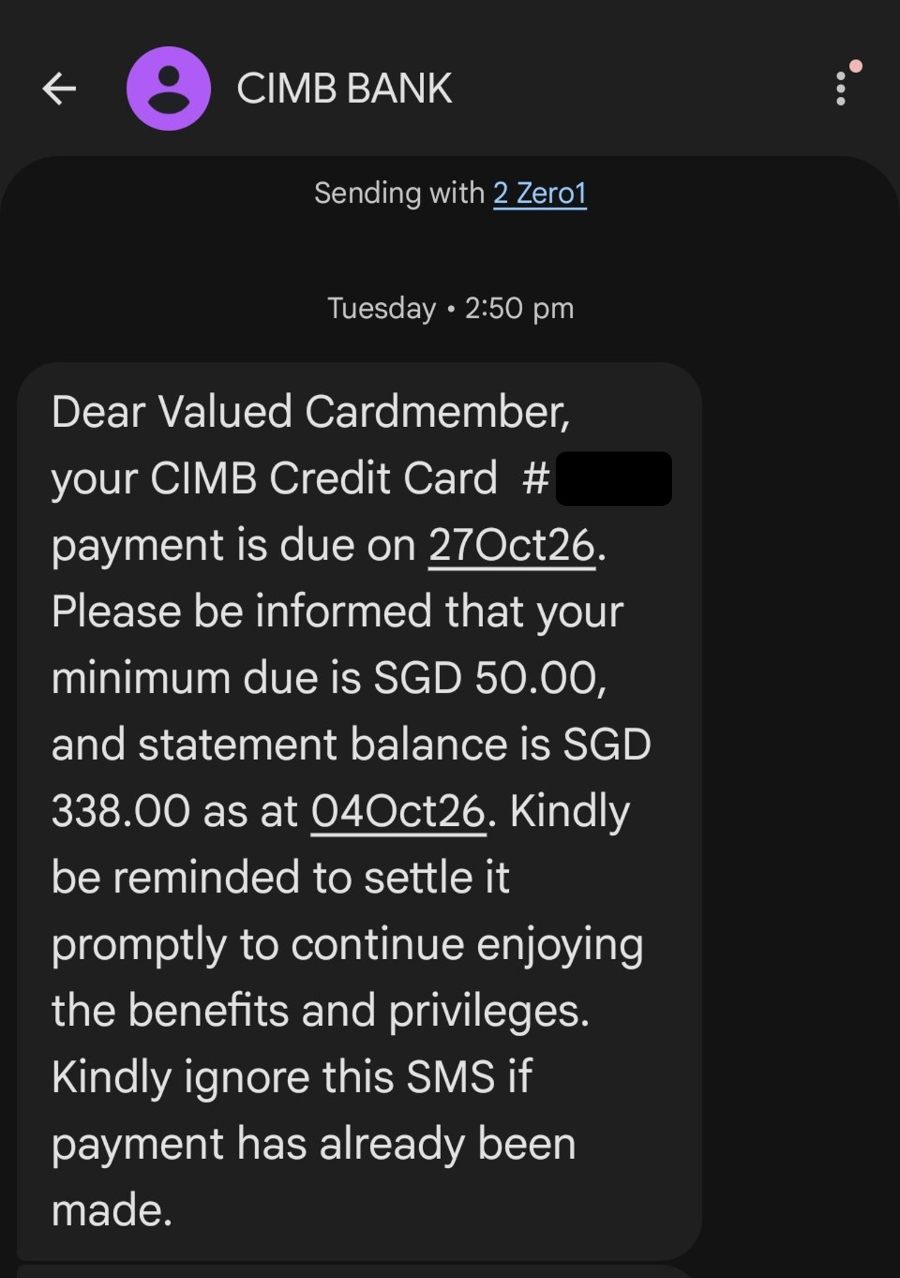
Then I remembered: my CIMB Founders Card was now into its second year, and as much as I appreciate the three free lounge visits, I wasn’t about to pay S$338 for the privilege. So I called up CIMB customer service to cancel the card.
After a brief hold, the CSO told me that he couldn’t cancel the card because there was an outstanding balance on it.
“I know,” I said. “That balance is because of the annual fee, which I’m calling to waive now”.
“Sir, the CIMB Founders Card annual fee is strictly non-waivable”.
“Yes, that’s why I want to cancel the card”
“No sir, we cannot waive the annual fee. You can see on our website that the annual fee is non-waivable. Even if you cancel the card you will need to pay the annual fee first”.
This, of course, is complete and utter nonsense. Annual fees are paid in respect of the upcoming year, not the year that’s just ended. This isn’t like you trying to sneak out of a restaurant without paying the bill. It’s more like you looking at the menu prices, and deciding you want to dine somewhere else.
So I held my ground and kept repeating that there should be no annual fee if you’re cancelling the card. After a while, I suppose I wore him down, because he said he would try to seek approval for an exceptional fee waiver.
There should be nothing “exceptional” about this, really, but about an hour later, he called back to tell me that the waiver had been approved.
Now, in the grand scheme of things, I think I resolved this pretty easily. I’ve read other horror stories from members of the MileLion Community (#1, 2, 3, 4, 5, 6) of CSOs who adamantly refused to do anything. Some of them finally managed to get the issue resolved after filing a complaint with FIDReC or MAS.
If you’re in a similar situation, I’d encourage you to put your foot down too. It’s complete nonsense for a bank to tell you that the annual fee needs to be paid even if you’re cancelling the card.
If all else fails, ask the bank to confirm in writing that the upcoming year’s annual fee can’t be waived, even if you cancel the card. This will help create a paper trail which can support your FIDReC complaint.
It shouldn’t have to be this hard, really, but well…
Exceptions?
If you spot the annual fee late
If you’re cancelling a card at the start of a new membership year, I fully agree that you shouldn’t have to pay the annual fee. But that argument gets weaker with every month that passes. It’d be a little absurd, for example, to call the bank and demand a waiver six months after the fee was charged.
So when is it too late to ask? It depends on the bank, and most don’t publish a policy. UOB is an exception: its website says that waivers can only be requested for annual fees that are still in the current unbilled transactions, or within the past three statement months.
If you ask me, I think requesting an annual fee waiver up to two months later is still reasonable, but anything beyond that is pushing it.
If you’ve used certain card benefits already
Some card benefits are directly tied to the payment of the annual fee, so of course you can’t pull a fast one by quickly utilising them at the start of the year, and then cancelling the card to avoid the fee.
The classic example would be the S$800 statement credits offered by The Platinum Card, where cardholders ran into problems when cancelling the card because they utilised those credits in the same month. This, incidentally, is why American Express now delays certain card benefits (e.g. the Fashion & Dining credit on the AMEX Platinum Credit Card) until eight weeks after the annual fee has been paid.
If we’re talking about other benefits like the complimentary Priority Pass visits on the DBS Altitude, Citi PremierMiles Card or UOB PRVI Miles Card, I wouldn’t be too concerned about that. As far as I know, utilising lounge visits in the same month the annual fee is charged has no impact on the ability to get an annual fee waiver.
Before you cancel
Since we’re talking about cancelling cards, here are a few things you should check before submitting the cancellation request.
Make sure you’re outside the clawback period
If you received a sign-up bonus from a credit card, make sure you check the T&Cs for clawback clauses. This allows the bank to charge you the value of the welcome gift if you cancel within a certain period, usually 6-12 months.
I have yet to see any clawback period beyond 12 months though, which means you can simply submit your cancellation and fee waiver request from the 13th month onwards.
Clear out remaining points
Depending on which card you have, you may or may not need to clear out all the remaining points on the card you intend to cancel.
If your bank does not pool points, any unused points on that card will be forfeited, simple as that.
If your bank pools points, you do not need to take further action, unless it’s your last points-earning card with the bank. The exceptions are DBS, HSBC and Standard Chartered, where points are pooled, but you still need to convert any remaining points associated with a given card before cancelling it.
Be careful about renewal miles!
Some credit cards award bonus miles for paying the annual fee, which will subsequently be clawed back if a waiver is granted.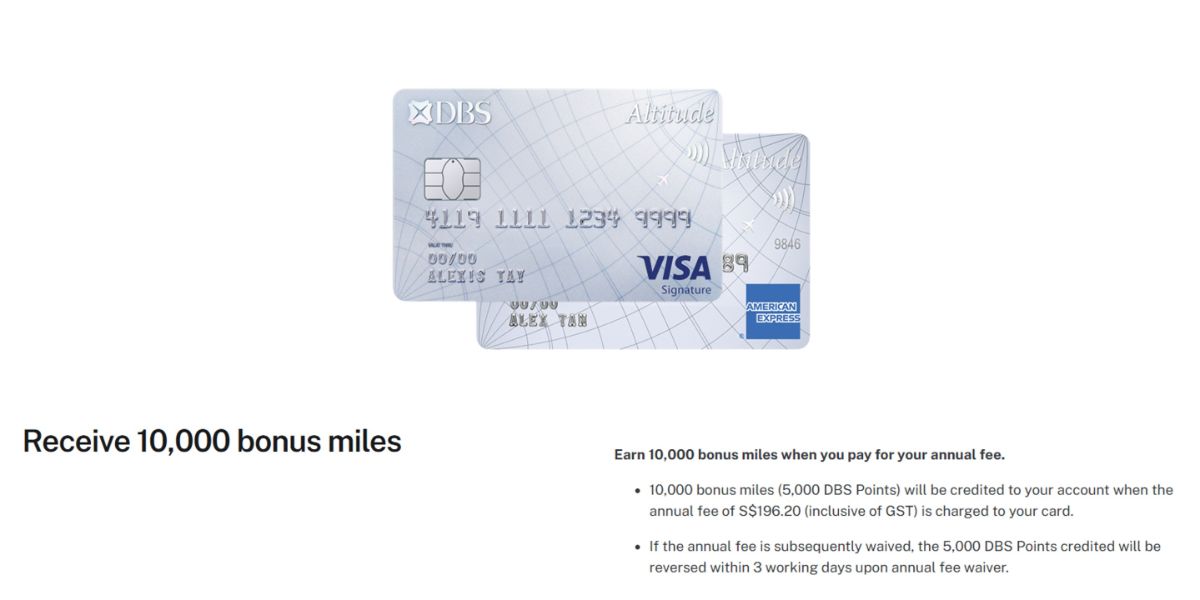
For example, I recently noticed that a S$196.20 annual fee had been billed to my DBS Altitude Card. I managed to get the annual fee waiver, but later realised that earlier that month, I’d converted DBS Points into KrisFlyer miles. This included some of the 5,000 DBS Points (10,000 miles) awarded for paying the annual fee.
Since I didn’t have sufficient DBS Points, I had to repay the deficit at S$0.0388 per DBS Point, which works out to 1.94 cents per mile. Interestingly enough, that’s actually slightly lower than the 1.96 cents per mile (S$196.20/10,000) I’d have paid had I not requested a waiver, so…yay?
Conclusion
Annual fees are paid for the year ahead, not the year gone by. If you cancel a card promptly after the fee is billed, you shouldn’t have to pay it, regardless of what the bank’s website says about fees being “non-waivable”. That only means the bank won’t waive the fee if you keep the card.
Most of the time, a quick call is all it takes. But if you run into a CSO who insists otherwise, hold your ground, ask for escalation, and keep a record of the conversation, in case you need to create a FIDReC case.

That’s right, name and shame these despicable banking practices.
CIMB is a real scummy bank. Will never use any of their services.