
Singapore Airlines announced its long-feared KrisFlyer devaluation on 25 August, which resulted in something of a Manic Monday for me.
Even though I knew it was coming — in a general sense because of the hints they’d been dropping, and more specifically because of a very helpful CSO — my heart still stopped when I got the alert in my inbox.
“It’s happening, it’s happening!” I blurted to The MileLioness, as I dived out of the car and dashed upstairs, with a mere two hours to digest the changes and churn out an article before the embargo lifted at 11 a.m.
It’s all been a crazy blur since then, but now that the dust has finally settled, I wanted to pen an overall piece that sums up my thoughts on the 2025 KrisFlyer devaluation. What’s good (insofar as a devaluation can be called “good”), what’s bad, and what’s yet to be seen?
| 🛬 2025 KrisFlyer Devaluation |
KrisFlyer devaluation: The Good
It wasn’t as bad as we all feared
There’s no such thing as a “good” devaluation, but if we’re being honest, I think everyone heaved a sigh of relief when the actual figures came out.
With the exception of Zone 10 (more on that later), the increase in First and Business Saver awards was just 5%. In fact, Economy Saver awards between Zones 1-9 even fell by an average of 5%, bringing them closer to the levels they were at before the previous devaluation in July 2022.
| ✈️ Saver Award Prices | ||
| First & Business | Economy | |
| Zones 1-9 (Asia & South West Pacific) |
+5% | -5% |
| Zone 10 (Africa, Middle East, Turkey) |
+10-20% | +10% |
| Zone 11-13 (Europe & USA) |
+5% | +5% |
| ✈️ Advantage Award Prices | ||
| First & Business | Economy | |
| Zones 1-9 (Asia & South West Pacific) |
+15% | +10% |
| Zone 10 (Africa, Middle East, Turkey) |
+15-18% | +5% |
| Zone 11-13 (Europe & USA) |
+15% | +13% |
Advantage was hit harder for sure, with increases in the 15% range for First and Business Class, but to put things in perspective, when Cathay Pacific devalued its Asia Miles award charts in October 2023, the increases were in the 30% range. The Turkish Miles&Smiles devaluation in February 2024 doubled the cost of some Business Class awards. Similar devaluation massacres have befallen Alaska Mileage Plan, Etihad Guest, United MileagePlus and many others.
So yes, 5-15% isn’t nothing, but it’s not quite judgment day either. I was half wondering why the US blogosphere was so slow to pick up on the KrisFlyer devaluation, before it dawned on me that for them, price hikes of this magnitude are just a regular Monday!
There was every reason to expect much worse. Leaving aside what competitor programmes have done (and seemingly gotten away with), Singapore Airlines is due to unveil its next-generation Business Class in Q2 2026, and First Class in Q1 2027. Historically speaking, new cabin products have been a Trojan horse for devaluations, kind of like “hey, we’re improving the product, so cough up the miles”.
For example, in October 2006, SIA debuted new First and Business Class seats on the B777-300ER. The following month, it announced that award charts would be devalued from February 2007, and Saver redemptions would not be allowed for aircraft with the new cabin products.
Another KrisFlyer devaluation took place about a year before the launch of the current generation First and Business Class seats in 2013, and further one in March 2017, ahead of the unveiling of the new A380 cabin products later that year.
So look. I’m not going to pretend like this devaluation was a good thing, but I believe it could have been far worse. And judging from what the community was expecting, I think I’m not alone.

Some Economy awards are getting cheaper
Related to the previous point, this isn’t an across-the-board devaluation. Economy Saver awards between Zones 1 to 9 are actually decreasing by 5% on average, and with a further 30% off during Spontaneous Escapes, might even be good deals.
| From Zone 1 | Old | New | % |
| Zone 2 Malaysia, Brunei, Indonesia |
8.5 | 8 | -6% |
| Zone 3 Philippines, Thailand, Vietnam, Cambodia, Myanmar, Laos |
13.5 | 13 | -4% |
| Zone 4 South China, Hong Kong, Taiwan |
16.5 | 15.5 | -6% |
| Zone 5 Beijing and Shanghai |
21.5 | 20.5 | -5% |
| Zone 6 India, Sri Lanka, Maldives, Bangladesh |
20 | 19 | -5% |
| Zone 7 Japan & South Korea |
27 | 25.5 | -6% |
| Zone 8 Perth & Darwin |
21.5 | 20.5 | -5% |
| Zone 9 Rest of Australia & New Zealand |
30.5 | 29 | -5% |
| Zone 10 Africa, Middle East, Turkey |
29 | 32 | 10% |
| Zone 11 Europe |
42 | 44 | 5% |
| Zone 12 USA (West Coast) |
42 | 44 | 5% |
| Zone 13 USA (East Coast) |
44 | 46 | 5% |
Interestingly, Economy Class is the one category of award that seems to defy inflation. If you look at KrisFlyer’s original award chart from 1999, a round-trip Economy Class award to Bangkok costs 25,000 miles, more or less the same as today!
2 months to lock in existing prices
While I think it’s obvious that frequent flyer programmes should be providing advance notice of devaluations, many airlines don’t see things the same way (looking at you, Qatar and Emirates).
Therefore, we can never take a heads-up for granted, and to SIA’s credit, we got two months this time (during the previous devaluation, it was 28 days). This provides members with the opportunity to digest the changes, rather than feeling pressured to stampede for awards.
Safe…for now?
Historically, KrisFlyer devaluations took place every 4–5 years. Since 2019, however, the frequency has increased to once every three years or so. Therefore, a 2025 devaluation shouldn’t have been the biggest surprise, given that the last one took place in 2022.
| ✈️ KrisFlyer Devaluations | |
| Devaluation (One-way Business Saver from SIN) |
Changes |
| February 1999: Launch of KrisFlyer | |
| October 2003 (NRT 27.6K | SYD 36.1K | LHR 51K) Fuel Surcharges |
|
| February 2007 (NRT 29.8K | SYD 38.2K | LHR 51K) Fuel Surcharges |
|
| March 2012 (NRT 34K | SYD 46.8K | LHR 68K) Fuel Surcharges |
|
| March 2017 (NRT 43K | SYD 58K | LHR 85K) No Fuel Surcharges |
|
| January 2019 (NRT 47K | SYD 62K | LHR 92K) No Fuel Surcharges |
|
| July 2022 (NRT 52K | SYD 68.5K | LHR 103.5K) No Fuel Surcharges |
|
| November 2025 (NRT 54.5K | SYD 72K | LHR 108.5K) No Fuel Surcharges |
|
There’s no guarantee that this three-year cycle will continue, but at the very least, I think it’s unlikely we’ll see any major changes to KrisFlyer award prices for the next 18-24 months.
I’ve jinxed it, haven’t I…
KrisFlyer devaluation: The Bad
Zone 10 nerf
You may have noticed that during this devaluation, Zone 10 — comprising of Africa, the Middle East and Turkey — was singled out for special treatment.
| ✈️ Increase in Saver award costs |
|||
| Economy | Business | First | |
| Zone 10 | +10% | +20% | +10% |
| All other zones | -5% to +5% | +5% | +5% |
While Saver awards for other zone increased by a maximum of 5%, Zone 10 saw an increase of up to 20%.
And if you look at the actual figures, it’s easy to understand why. A 13-hour Business Class flight between Singapore and Cape Town currently costs 56,500 miles. That is sensational value (prior to July 2022, it only cost 49,000 miles!), and perhaps too good to last. I’ve cautioned people about rushing out to make speculative bookings, but if you must, then Zone 10 would be the region I’d look at.
No more “free ride” on Star Alliance awards
One lesser-known feature of the Star Alliance award chart is the “free ride” perk, which arises because the mileage required for a Star Alliance and Singapore Airlines award is identical for certain combinations of routes and cabins.
| Singapore to/from | Star Alliance | SIA |
| South East Asia 1 Economy |
8.5 | 8.5 |
| South East Asia 1 Business |
21 | 21 |
| South East Asia 1 First |
30.5 | 30.5 |
| South East Asia 2 Economy |
13.5 | 13.5 |
| South East Asia 2 Business |
24 | 24 |
| South East Asia 2 First |
36 | 36 |
| North Asia 1 Economy |
16.5 | 16.5 |
| North Asia 2 Economy |
27 | 27 |
| Europe Business |
103.5 | 103.5 |
For example, a Business Class award from SIN-FRA on Singapore Airlines would require the same number of miles as SIN-FRA-MAD with Singapore Airlines and Lufthansa (you’d have to pay some additional taxes). Basically, you save the expense of having to book or redeem a separate flight to get to your final destination.
Unfortunately, these instances of parity will be eliminated from 1 November 2025, and across all regions and cabins, the Star Alliance chart will be more expensive than Singapore Airlines.
| Singapore to/from | Star Alliance | SIA | % Diff. |
| South East Asia 1 Economy |
9 | 8 | 13% |
| South East Asia 1 Business |
23.5 | 22 | 7% |
| South East Asia 1 First |
34 | 32 | 6% |
| South East Asia 2 Economy |
14.5 | 13 | 12% |
| South East Asia 2 Business |
26.5 | 25 | 6% |
| South East Asia 2 First |
40 | 38 | 5% |
| North Asia 1 Economy |
17.5 | 15.5 | 13% |
| North Asia 2 Economy |
28.5 | 25.5 | 12% |
| Europe Business |
114 | 108.5 | 5% |
You can read more about this in the article below.
KrisFlyer devalues Star Alliance award chart, nerfs “free ride” perk
Advantage premium back to pre-2022 levels
One interesting quirk of the July 2022 devaluation is that it narrowed the gap between Saver and Advantage awards.
This happened because all Saver awards increased in price, but Advantage awards between Singapore and Zones 1-9 were unaffected. Moreover, while Saver awards to Zones 10-13 increased by an average of 13%, the increase for Advantage was only 5%.
Therefore, psychologically speaking, it became less painful to pay for Advantage over Saver. If I were looking at flights to San Francisco, and saw Business Saver for 107,000 miles (with waitlisting) and Business Advantage for 128,500 miles (with instant confirmation), I might very well spring for the latter, so I can firm up the rest of my plans.
| Business Saver | Business Advantage | |
| Before 2022 devaluation | 95,000 | 125,000 (+32%) |
| After 2022 devaluation | 107,000 | 128,500 (+20%) |
But the November 2025 devaluation will almost completely reverse the trend, because this time round, Saver awards are increasing by 5% while Advantage awards are increasing by 10-15% (Zone 10 aside).
We’re basically reverting to where we were pre-July 2022, and those booking Advantage are going to really feel the pinch.
KrisFlyer devaluation: How the Saver vs Advantage gap will widen
KrisFlyer miles still expire
While PPS Club members enjoy non-expiring miles, all other KrisFlyer members face a three-year expiry cycle.
But I’ve long been making the case for why KrisFlyer should switch to activity-based expiry instead, where miles remain valid so long as you earn or redeem at least one mile within a given period. This would:
- Encourage regular engagement: I’m more likely to use Kris+, KrisShop or Pelago if doing so can extend the life of my entire balance
- Avoid penalising cobrand cardholders: Who have less time to use their miles compared to non-cobrand cardholders because of monthly auto-crediting
- Reduce confusion: It’s somewhat unintuitive that you can have “expired miles” within an otherwise valid ticket, which are non-refundable should that ticket be cancelled
Why KrisFlyer should switch to an activity-based expiry policy
I was hoping that non-expiring miles might be the carrot to the devaluation, but unfortunately, Singapore Airlines is sticking with the status quo.
Regional KrisFlyer members now pay more
This might have flown under the radar for most MileLion readers, since the community is largely based in Singapore. But if you live in Malaysia, Indonesia, Thailand, or elsewhere in Southeast Asia, you might feel aggrieved that the so-called “Zone 1-3 parity” no longer exists.
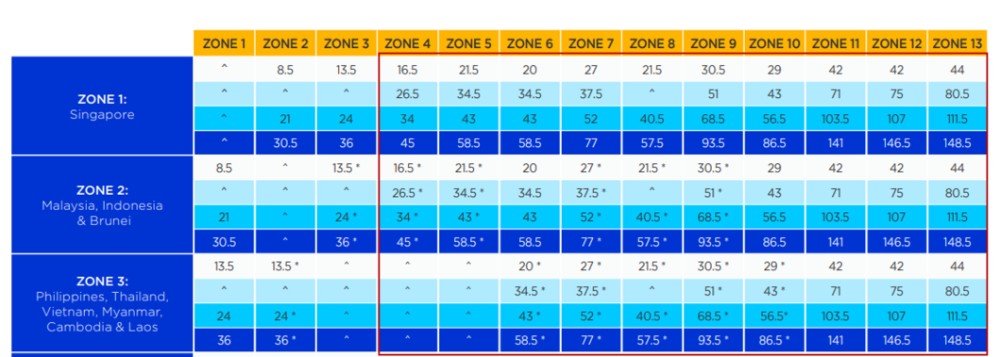
Currently, it costs exactly the same number of miles to fly from Zone 1/2/3 to Zones 4-13. For example, CGK-SIN-LHR costs the same as SIN-LHR, which means the CGK-SIN flight is “free”. In fact, it’s even cheaper in terms of taxes and surcharges, because Singapore charges a lower rate to transit passengers than departing ones!
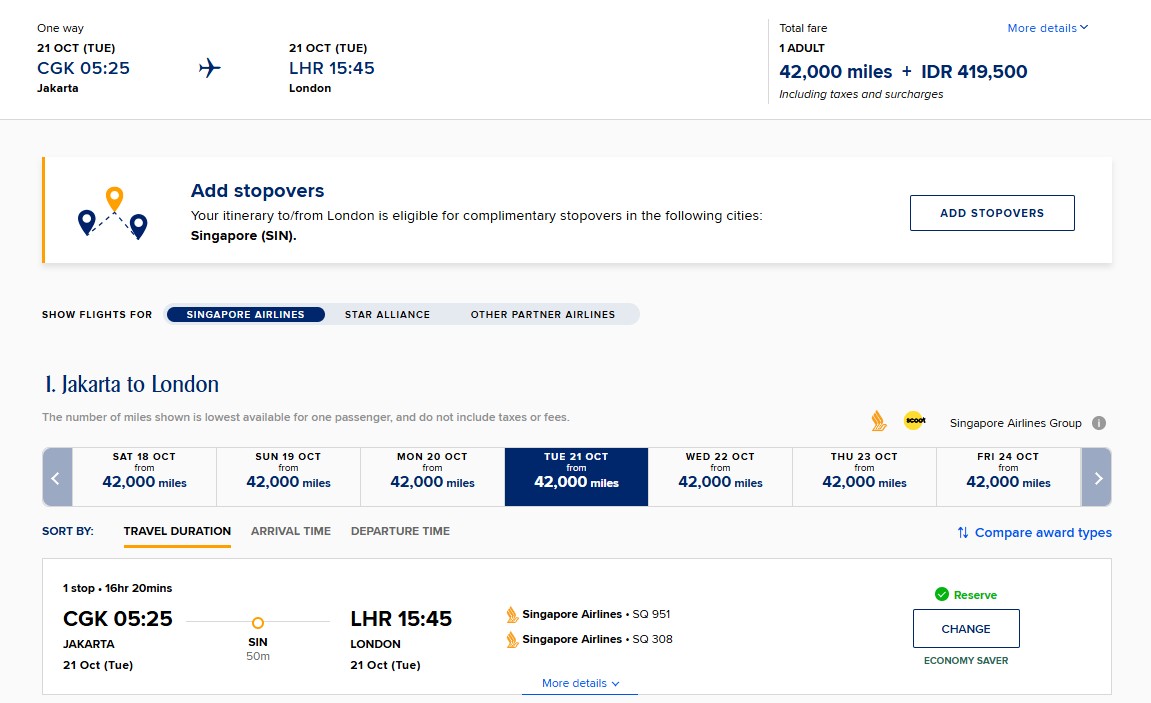
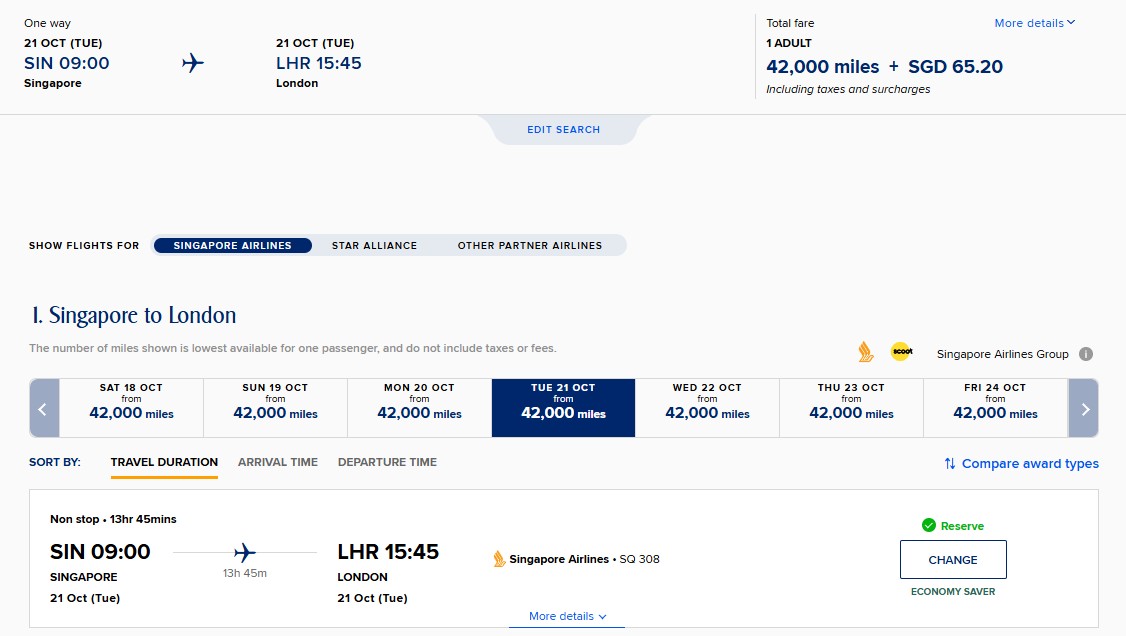
From 1 November 2025, that parity will be removed, and Zone 2/3 residents will have to pay extra miles to cover the cost of their flight to Singapore.
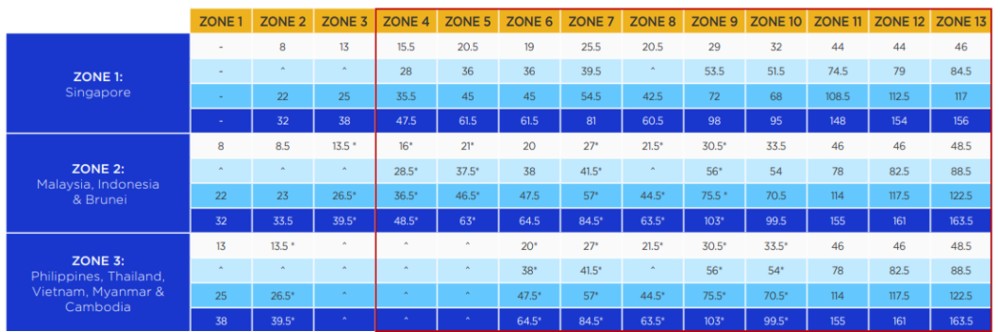
Compared to Zone 1 Singaporeans, Zone 2/3 residents will soon be paying an extra:
- 500 to 2,500 miles, for Economy Class
- 1,000 to 5,500 miles, for Business Class
- 1,000 to 7,500 miles, for First Class
The tables below have the precise figures.
Economy Class
Economy Class
From Zone 2
From Zone 3
To Zone 4
0.5
N/A
To Zone 5
0.5
N/A
To Zone 6
1
1
To Zone 7
1.5
1.5
To Zone 8
1
1
To Zone 9
1.5
1.5
To Zone 10
1.5
1.5
To Zone 11
2
2
To Zone 12
2
2
To Zone 13
2.5
2.5
Business Class
Business Class
From Zone 2
From Zone 3
To Zone 4
1
N/A
To Zone 5
1.5
N/A
To Zone 6
2.5
2.5
To Zone 7
2.5
2.5
To Zone 8
2
2
To Zone 9
3.5
3.5
To Zone 10
2.5
2.5
To Zone 11
5.5
5.5
To Zone 12
5
5
To Zone 13
5.5
5.5
First Class
First Class
From Zone 2
From Zone 3
To Zone 4
1
N/A
To Zone 5
1.5
N/A
To Zone 6
3
3
To Zone 7
3.5
3.5
To Zone 8
3
3
To Zone 9
5
5
To Zone 10
4.5
4.5
To Zone 11
7
7
To Zone 12
7
7
To Zone 13
7.5
7.5
What’s interesting is that the cost of the connecting flight to Singapore increases as your destination beyond Singapore grows further, even though it’s basically the same flight. For example, CGK-SIN-LHR in Business Class costs 5,500 miles more than SIN-LHR, but CGK-SIN-PER in Business Class costs 2,000 miles more than SIN-PER.
In other words, it costs 5,500 miles to tack on CGK-SIN to a London flight, but only 2,000 miles to add that exact same segment to a Perth flight. Weird, right?
KrisFlyer devaluation: The Unknown
Access awards
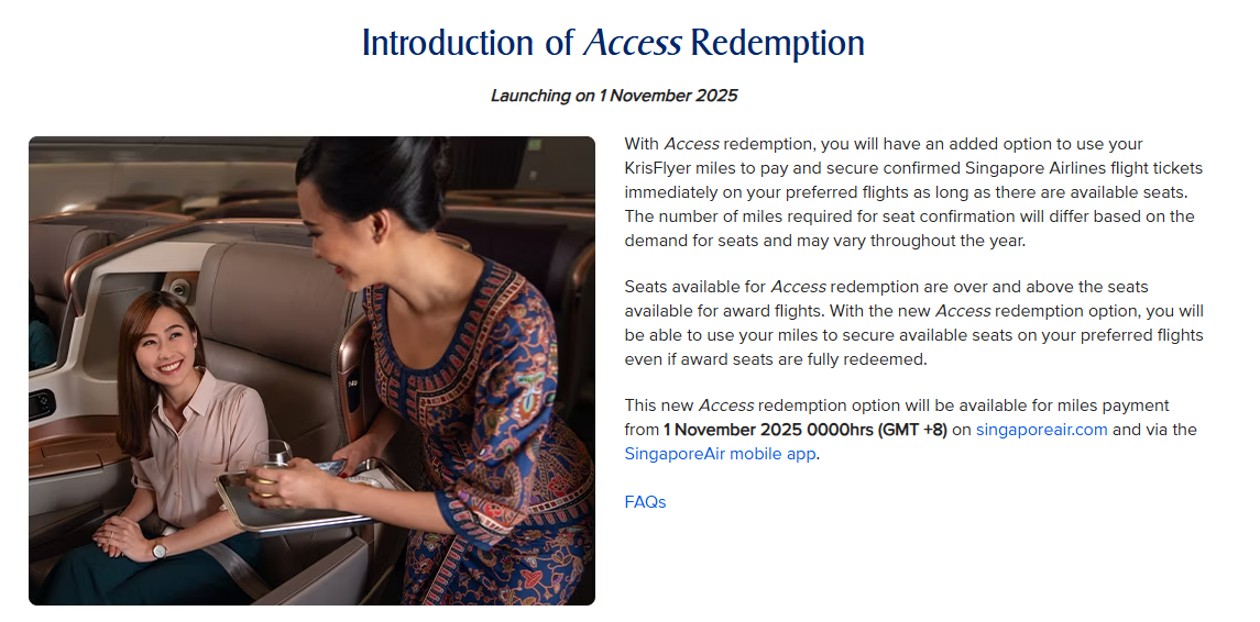
On 1 November 2025, the same day the new redemption charts come into effect, Singapore Airlines will introduce “Access” awards, a new category of award where mileage requirements depend on dynamic factors like seat demand and seasonality.
In other words, this is KrisFlyer’s first brush with dynamic award pricing, and it raises a lot of questions— many of them uncomfortable.
Singapore Airlines is pitching Access awards as a way for KrisFlyer members to secure redemption seats, even when Saver and Advantage awards are unavailable. Moreover, it’s taking pains to emphasise that Access awards will be over and above existing award seats.
But it’s a playbook we’ve seen far too many times. Dynamic pricing is initially introduced on a limited scale, and positioned as a benefit that gives members more choice, at no detriment to regular awards. Then over time, it starts to proliferate throughout the programme, until one fine day, traditional award charts are nowhere to be found.
I’m not saying KrisFlyer will go fully dynamic, but now that the genie is out of the bottle, it’s likely only a matter of time before more dynamic elements appear, such as peak and off-peak pricing. While you could argue that Saver and Advantage awards already serve a similar function, the key difference is that they’re available year-round (in theory, at least). With peak and off-peak pricing, certain periods would always cost more miles.
But hey, we’ll cross that bridge when we get to it. In the meantime, we’ll have to wait till November rolls around to see just how expensive these awards are, though something tells me that if Advantage is already too expensive for you, Access awards will be all but irrelevant.
Watch this space.
Conclusion
The 2025 KrisFlyer devaluation had been telegraphed since June, and should not have come as a surprise. In fact, the real surprise was that Saver awards increased by just 5%, though it remains to be seen whether there will be any meaningful changes to availability (what’s the point of a cheap award you can’t actually book?).
But perhaps the real headline here is that dynamic pricing has finally joined the game, and we need to keep a very close eye on that. History has shown that dynamic pricing is very rarely content to just hover around the edges, and if it starts making inroads into other aspects of KrisFlyer, the entire complexion of the miles game may change.
If nothing else, this devaluation should remind you that miles are the worst asset to hold. They’re not insured, they don’t earn interest, and they can only depreciate over time. Book when you see value, diversify across programmes, and don’t assume today’s pricing will hold tomorrow.
What else did you take away from the 2025 KrisFlyer devaluation?







In sum it’s a war on value. The truly disturbing part is the variable pricing initiative which will start small but eventually consume the program.
In this case, what is the value of the mile? If it is 1.8 cents per mile, a 5 percent devaluation would be 1.70 cents. Nobody considering EY as it is very little value and better to use a cashback card.
i don’t think it’s so clear cut, because now you have Scoot awards which can be good value under certain circumstances too.
In the rare event of having only J Advantage options back to SIN, I made it a habit to add a free DPS/HKT/DAD leg after 30 days of stopover in SIN. In that sense it’s not just the regional members getting hammered.
Previously you could buy a one way saver award with a stop over for up to a year in Singapore. e.g. BKK-SIN-LHR. Then the ability to stopover was removed. The most you can get in Singapore without using more miles is up to 24 hours. And with this latest change the BKK-SIN-LHR miles will be more than the SIN-LHR miles. Things just get harder and harder and more and more expensive. I guess if you are in BKK and your intent is to go to LHR, better to now use another carrier and another program. Why pay extra for the… Read more »
Absolutely. Just thinking about the devaluation again… the *A free flight and tag on nerfs did not only target the Singapore-based members, but also people needing to get to/from the regional stations to fly with SQ