
Singapore Airlines has finally unveiled its next-generation cabin products, which are coming to its retrofitted Airbus A350-900LHs and A350-900ULRs, as well as new Boeing 777-9s.
This S$2 billion investment is SIA’s biggest to date, and features all-new First, Business, Premium Economy and Economy Class seats. These were originally slated to launch on the Boeing 777-9 in 2021, but COVID-19 and the endless dysfunction at Boeing kept pushing the timeline back. In the meantime, rivals such as Cathay Pacific, STARLUX, Qatar Airways and United introduced shiny new cabins that made SIA’s look dated by comparison.
These new seats are a key pillar of SIA’s plan to turn the tide, building on other enhancements such as new and refreshed menus, new amenity kits and sleeper suits, a redesigned KrisWorld inflight entertainment system and Starlink inflight connectivity, all of which were revealed in the weeks leading up to today.
In this post, I’ll walk you through all four new cabins, based on a media briefing held earlier this week, and Q&A sessions with SIA’s management and design teams.
As you read this, I’m busy getting some hands-on time with the new cabin products at the launch event at Marina Bay Sands. That’ll be a far better gauge of how they look and feel beyond the renders, and I’ll be sharing my thoughts on the live blog, with detailed hands-on articles to follow.
My initial impressions in a nutshell? First is amazing, Business is good enough, Premium Economy is disappointing, and Economy is…well, Economy. There’s no denying this investment is decidedly top-heavy, but that’s basic airline economics for you.
Before we get into the cabins, however, I have a bit of bad news…
| ✈️ Details: SIA next-generation cabin products |
Singapore Airlines’ new seats are delayed — again!
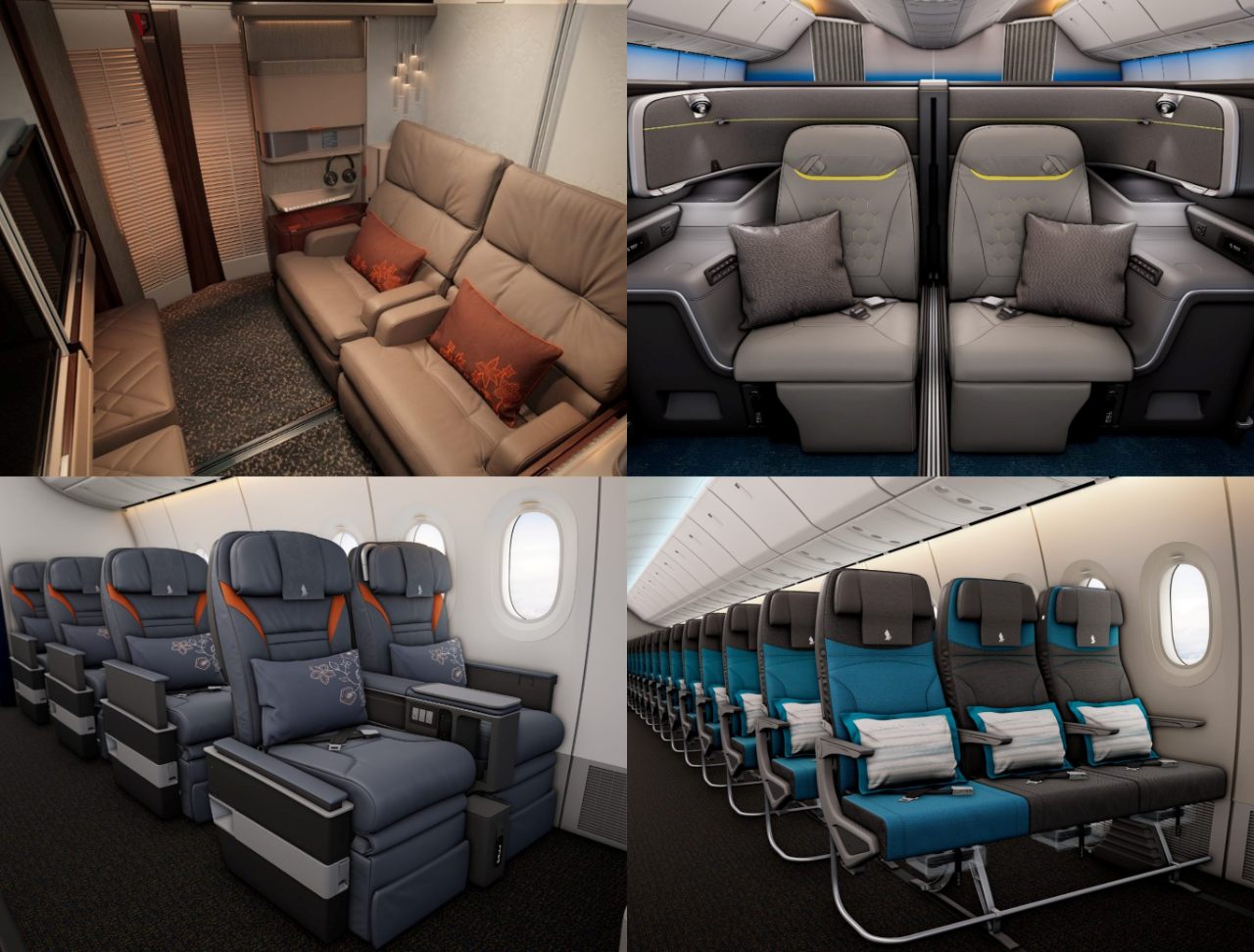
Singapore Airlines has announced a further delay to the introduction of its new cabin products, with the timeline now shifting to H2 2027.
New cabin products scheduled to enter service from the second half of 2027 on SIA’s retrofitted Airbus A350-900 and new Boeing 777-9 aircraft
-Singapore Airlines
Remember: this is a timeline that has already slipped. When Singapore Airlines first announced its Airbus A350 retrofit programme in November 2024, the plan was for the first A350-900LH to enter service in Q2 2026. That was later pushed to Q1 2027 due to supply chain and certification issues.
From what I understand, the issue again is certification. The seats on the B777-9 are certified, but the aircraft is not. The seats on the A350-900LH/ULR are pending certification.
| ✈️ SIA A350 Retrofit Programme |
||
| Aircraft Type | No. of Aircraft | First Refit Entering Service |
| Airbus A350-900LH | 34 | H2 2027 |
| Airbus A350-900ULR | 7 |
TBD |
Unfortunately, this means that the A350 retrofit programme — which was originally slated to wrap in 2030 — is now looking at a completion date in 2032, or possibly even later. Mind you, that’s my estimate. The official line from SIA is that it’s still targeting completion by end 2030.
SIA has not specified which aircraft will enter service first, though I’m fairly certain it has to be the A350-900LH, barring some miracle on the B777-9 front. Assuming the first A350-900ULR retrofit also arrives before the B777-9, then we’ll see the new seats debut in this order:
- New Business Class (A350-900LH)
- New First Class (A350-900ULR)
- New Premium Economy & Economy Class (B777-9)
Here’s a quick overview of where SIA’s next-generation cabin products will be installed.
| A350-900LH | A350-900ULR | B777-9 | |
| First Class | N/A | 4 New |
6 New |
| Business Class | 42 New |
70 New |
54 New |
| Premium Economy Class | 24 Refresh |
58 Refresh |
36 New |
| Economy Class | 192 Refresh |
N/A | 204 New |
| Total Aircraft | 34 | 7 | 31 (on order) |
As I covered earlier, Premium Economy and Economy Class cabins on the A350-900LH and A350-900ULR will only receive a “refresh”, with an upgraded KrisWorld system and new upholstery. New seats — with 4K screens, Bluetooth audio connectivity and USB-C ports — will have to wait until the B777-9 arrives.
New First Class
 |
||
| Seat Manufacturer: Collins Aerospace Designer: PriestmanGoode |
||
| A350-900ULR | B777-9 | |
| No. of Seats | 4 | 6 |
| Configuration | 1-2-1 | 1-2-1 |
| Privacy Doors | ✅ | ✅ |
| Seat Pitch | 89.5″ | 89.5″ |
| Seat Width | 23″ (30″ with armrests lowered) |
23″ (30″ with armrests lowered) |
| Seat Recline | 180° | 180° |
| Bed Length | 80″ | 80″ |
| IFE Screen | 32″ 4K | 32″ 4K |
| Touchscreen | ✅ | ✅ |
| OLED | ✅ | ❌ |
| Spatial Audio | ✅ | ✅ |
| Bluetooth Audio | ✅ | ✅ |
| HDMI | ❌ | ❌ |
| AC Power | ✅ |
✅ |
| USB-A | ❌ | ✅ (1x) |
| USB-C | ✅ (2x Fast Charge) |
✅ (2x) |
| Wireless Charging | ✅ (1x) |
✅ (1x) |
The new First Class suite was built by Collins Aerospace, and designed by London’s PriestmanGoode — marking the studio’s first project for Singapore Airlines.
The cabin features four (A350-900ULR) or six (B777-9) seats, in a 1-2-1 configuration. There were rumours that SIA might have gone 1-1-1 on the B777-9, but that hasn’t played out — which is a good thing, as far as the couple experience is concerned.
The airline describes this as a “private and luxurious sanctuary”, with suites enclosed by curved doors finished in fine horizontal slats. These slats rather remind me of the venetian blinds on the first-generation Suites, which offered privacy — but not complete privacy, for safety reasons. There’s something very alluring about the curvature, which feels more like a hotel corridor than an aircraft cabin.
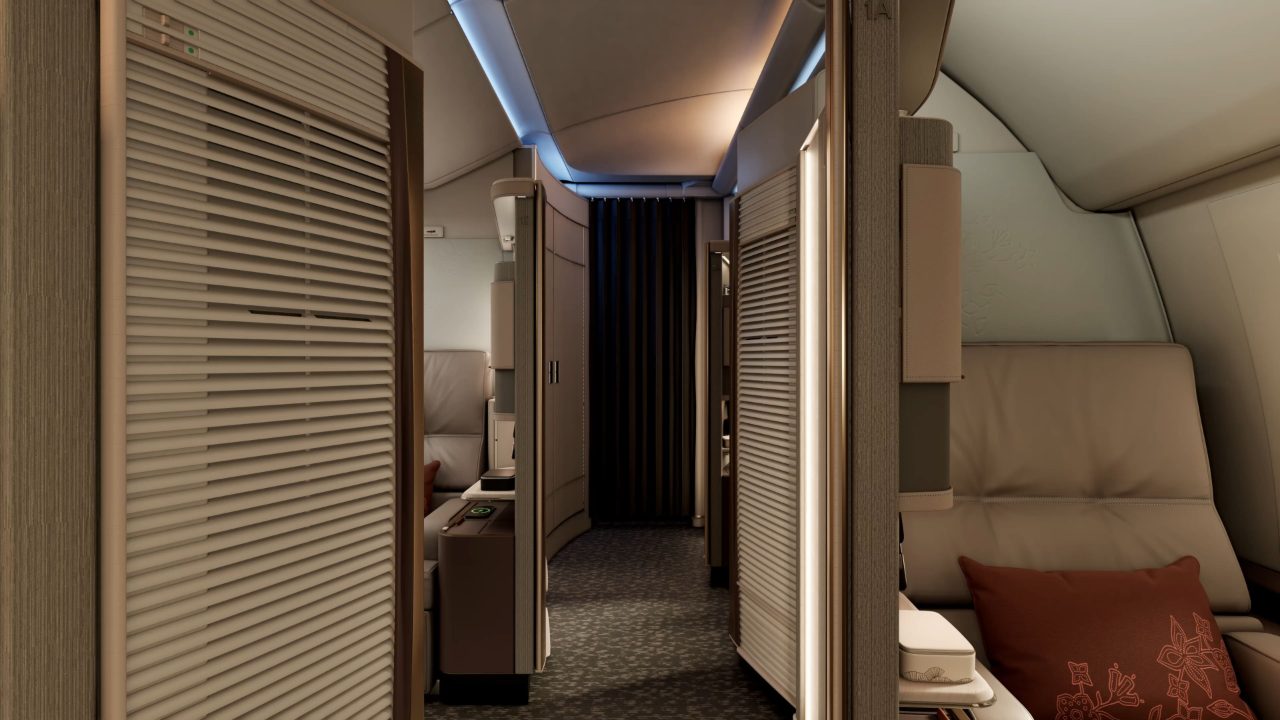
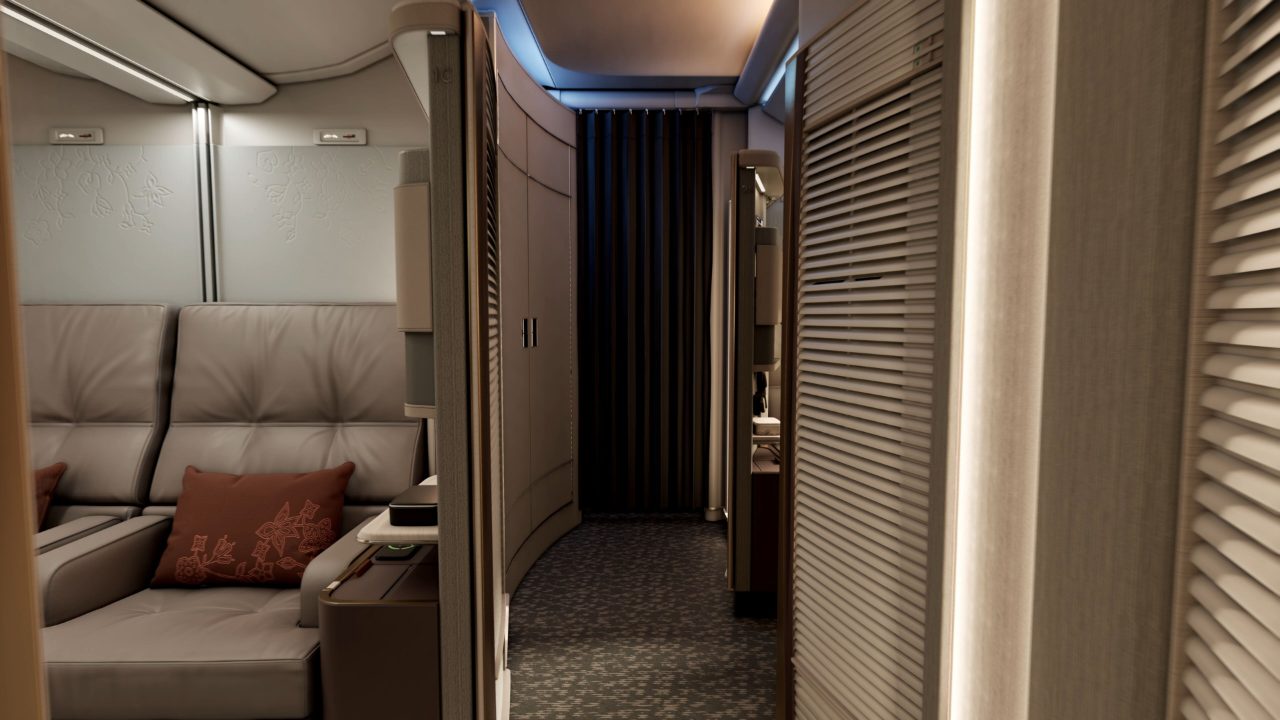
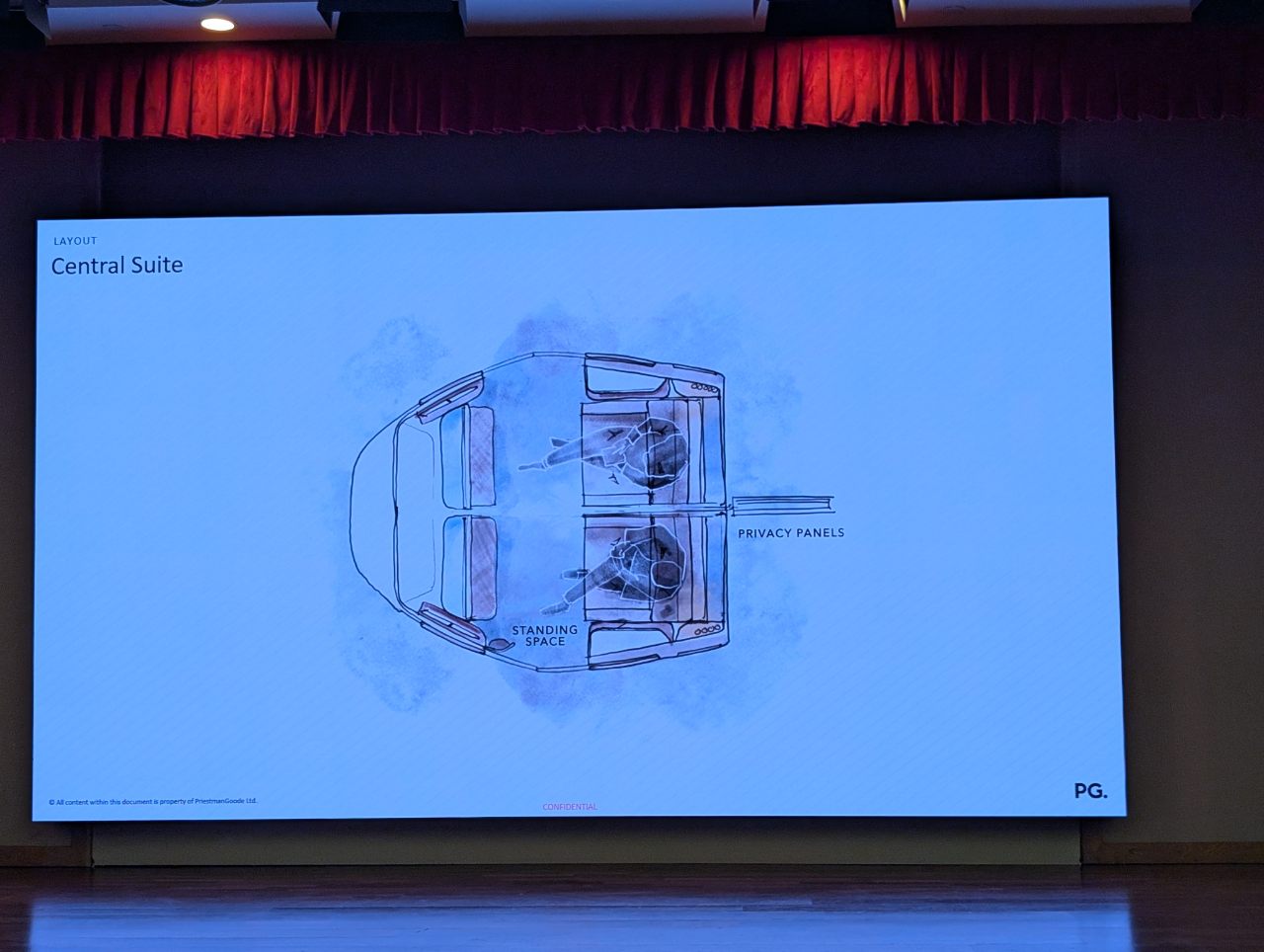
You can see this in the floor plan that was presented at the media briefing (and if you see anything else, you have a filthy, dirty mind and should be ashamed of yourself).
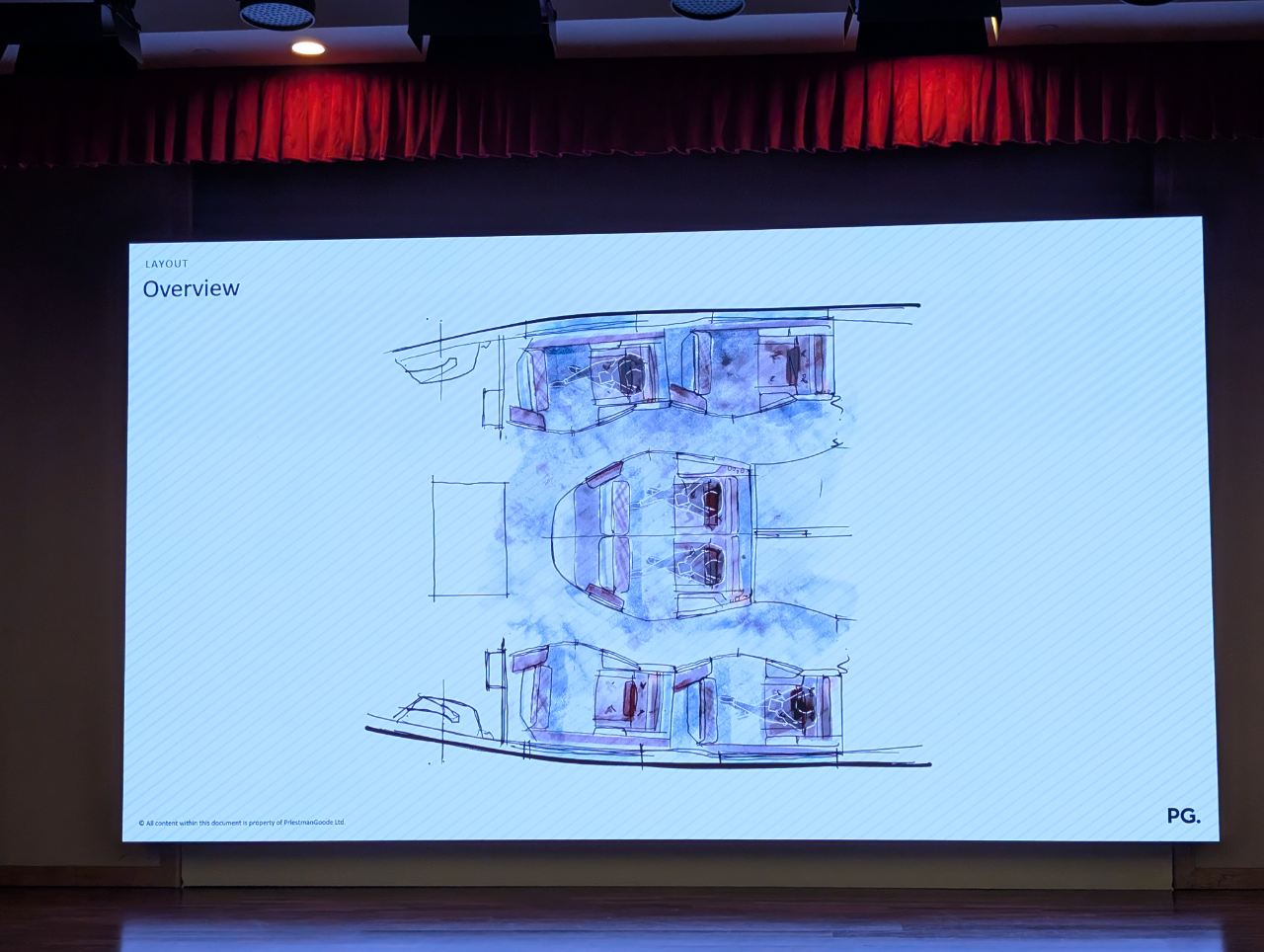
I was wondering whether we might see fully enclosed suites, like what Emirates has done on its “Game Changer” First Class seat. The answer is no, as fully enclosed seats present their own certification challenges (Emirates was only able to do this by making extensive modifications to its suites for fire safety). What we have here are walls 67 inches (170cm) high. Each suite will have its own air vents too, so you don’t need to worry about it getting stuffy.
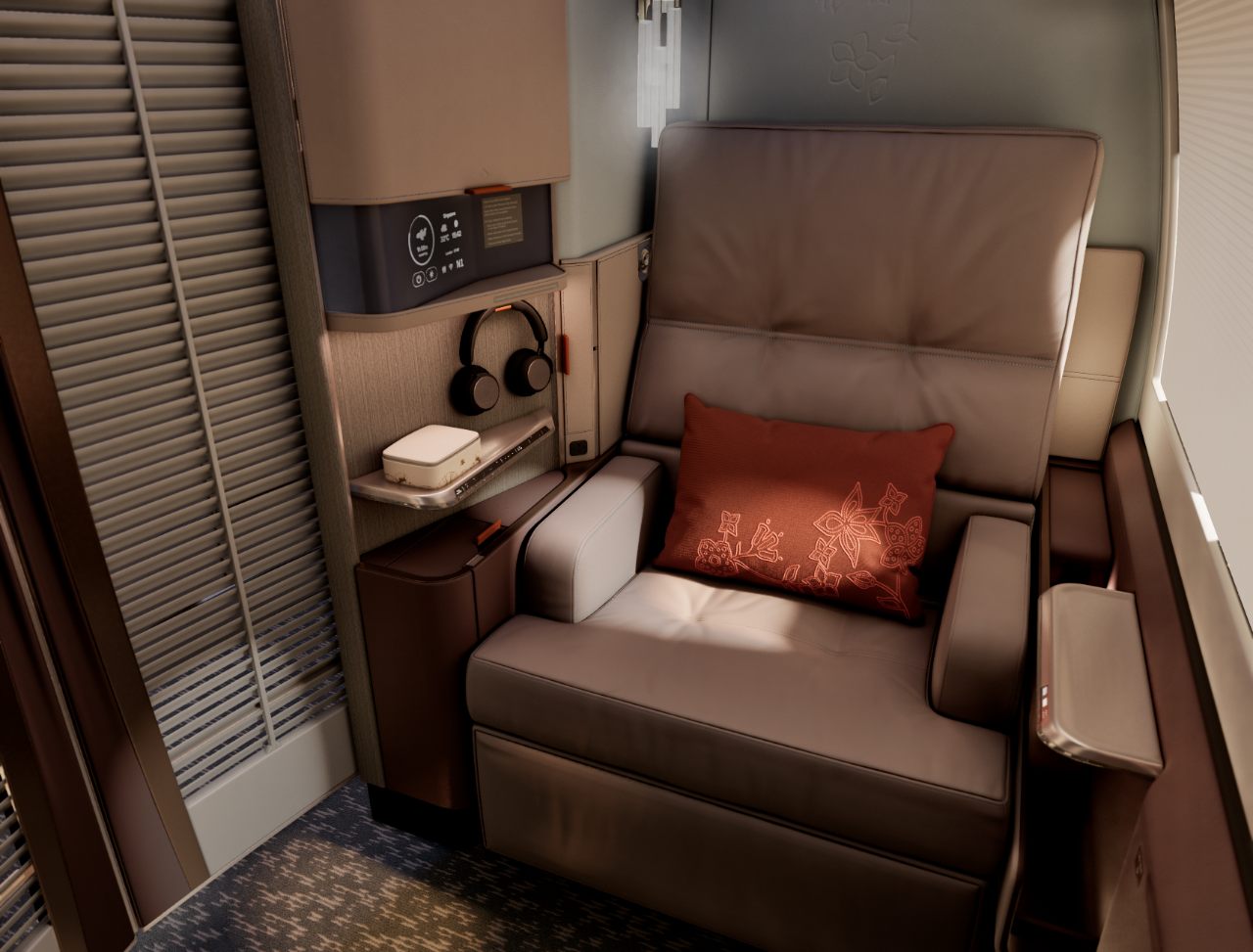
First Class seats are upholstered in Poltrona Frau leather (the same supplier for Suites and Business Class on the Airbus A380), hand-cut and stitched by Sabeti Wain Aerospace with button-tufted cushions. The colour palette features taupe leather and bronze metal trim, set against a speckled grey carpet. It’s all very warm and residential, compared to the cool greys of the new Business Class cabin.
The seat has electrically adjustable side wings, upper and lower lumbar support, and a leg rest. SIA claims to be offering the world’s first “smart cabin controls” that allow you to save your preferred seat position and lighting to your KrisFlyer account via myKrisWorld, and recall them on your next flight. To be frank though, I find this a bit gimmicky, and can’t really see myself using it.
Single seats enjoy three windows, with electrically-controlled blinds. Each is a self-contained room with its own wardrobe, vanity and an armchair. Unlike the A380 Suites, there is no separate bed — the seat itself reclines into a flat bed.
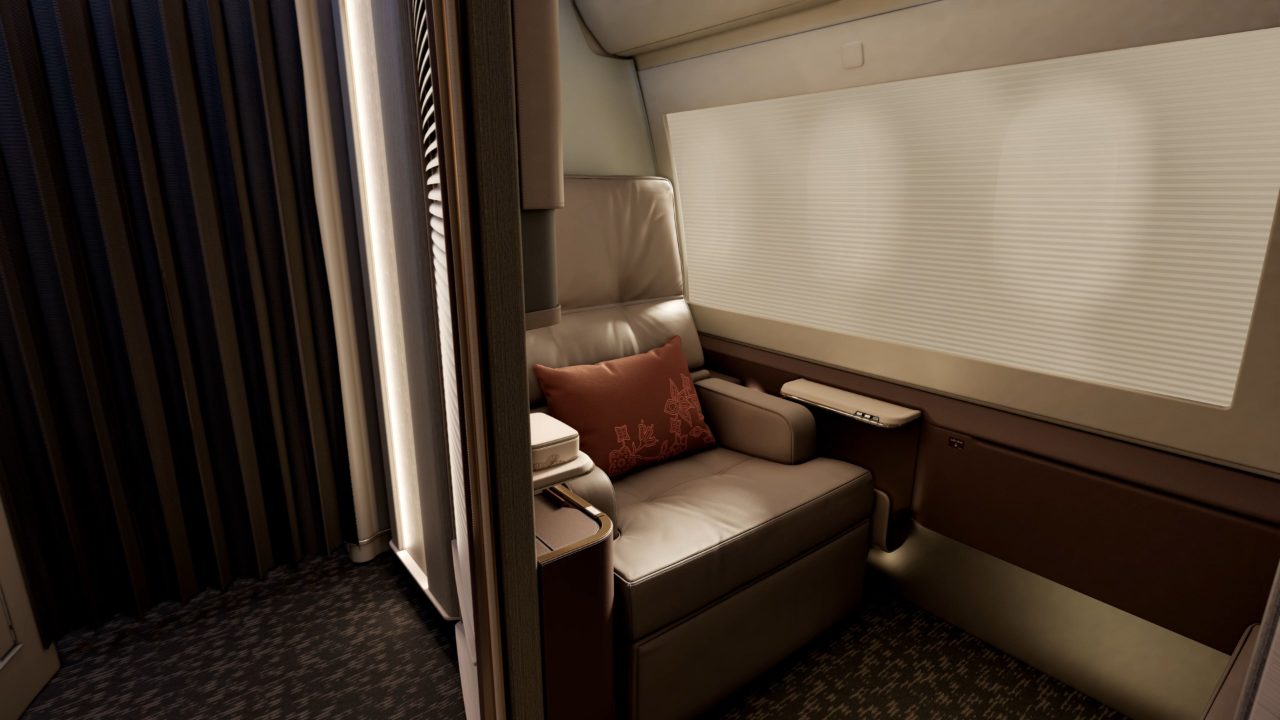
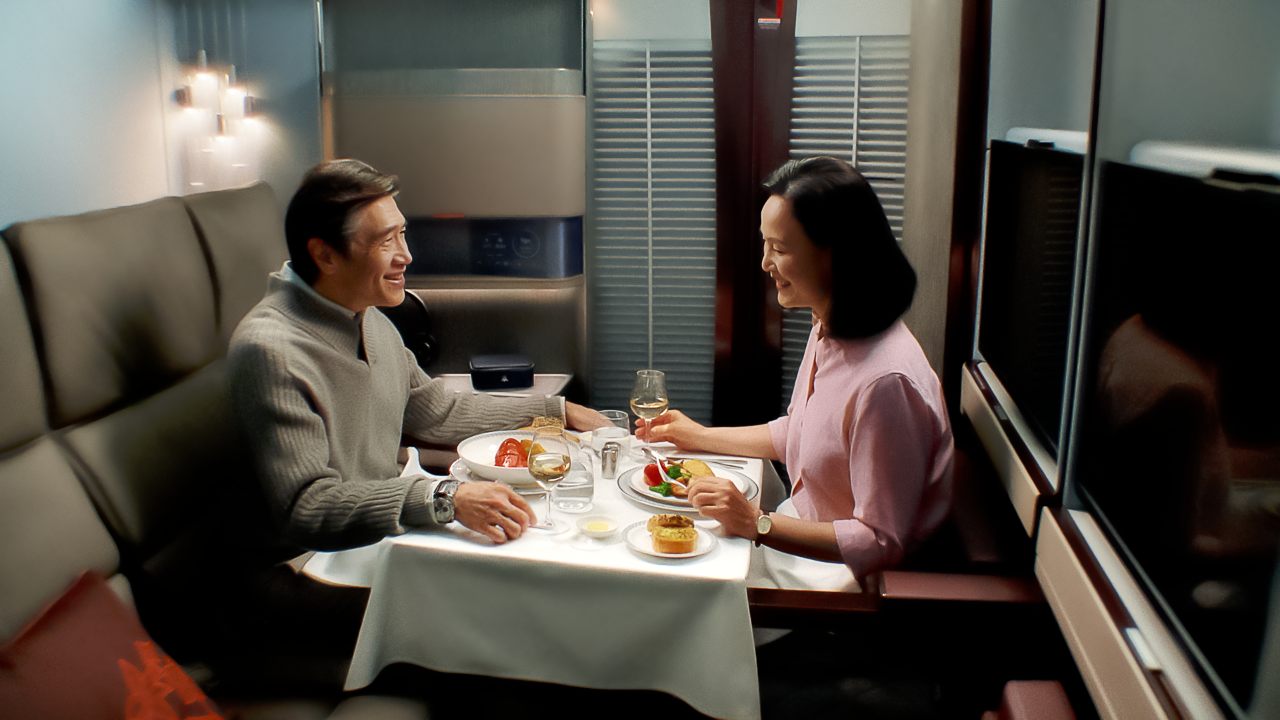
But it’s the two centre seats that will grab all the headlines. Passengers travelling together can ask for the privacy divider to be opened, creating a shared space for dining and relaxing. The best thing about this divider? It retracts horizontally, not vertically. It slides into a pocket, completely removing any barrier between the two centre seats. You can cross between the aisles with no awkward cowboy stepping.
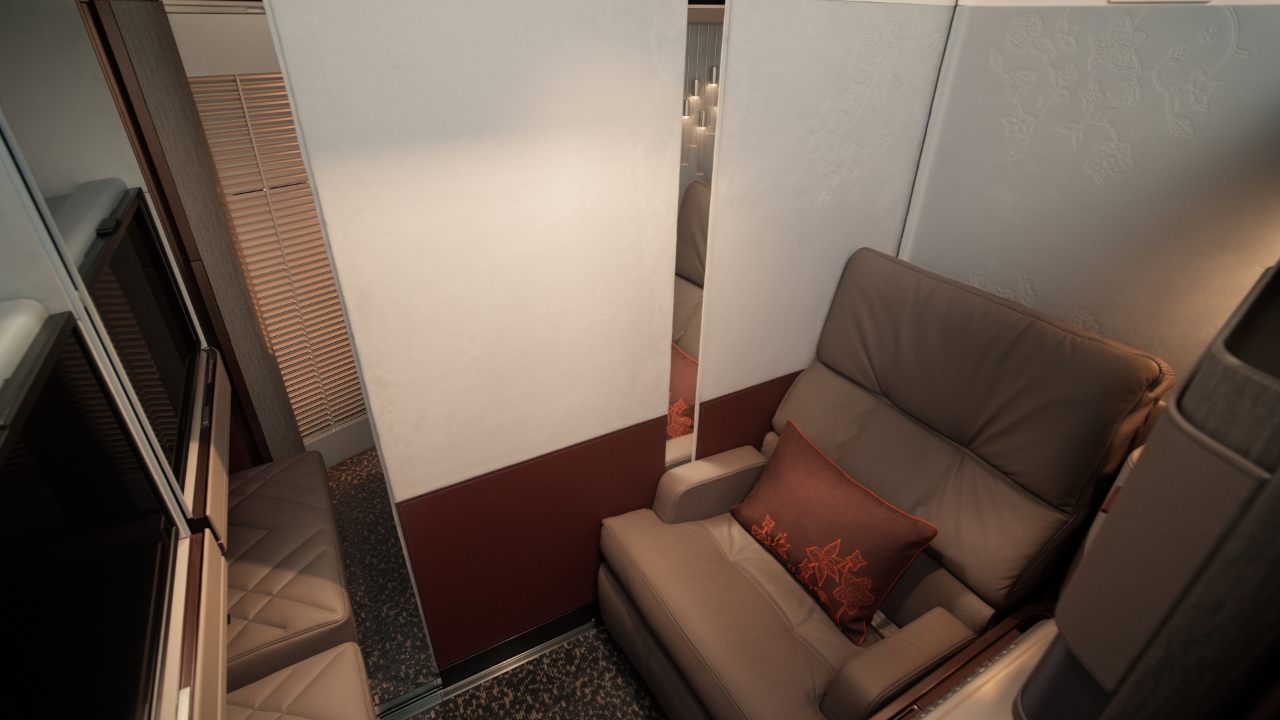
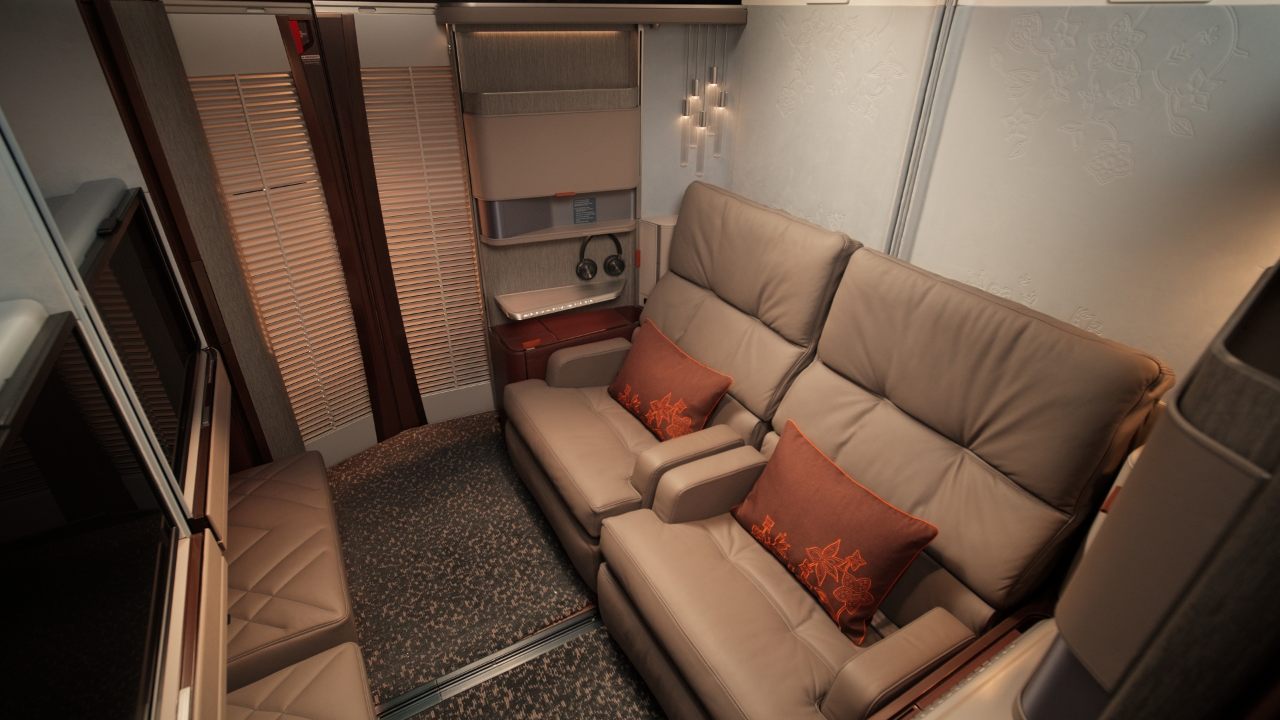
With the privacy divider stowed, the armrests can be lowered and the seats paired to move in tandem, creating a two-seater sofa.
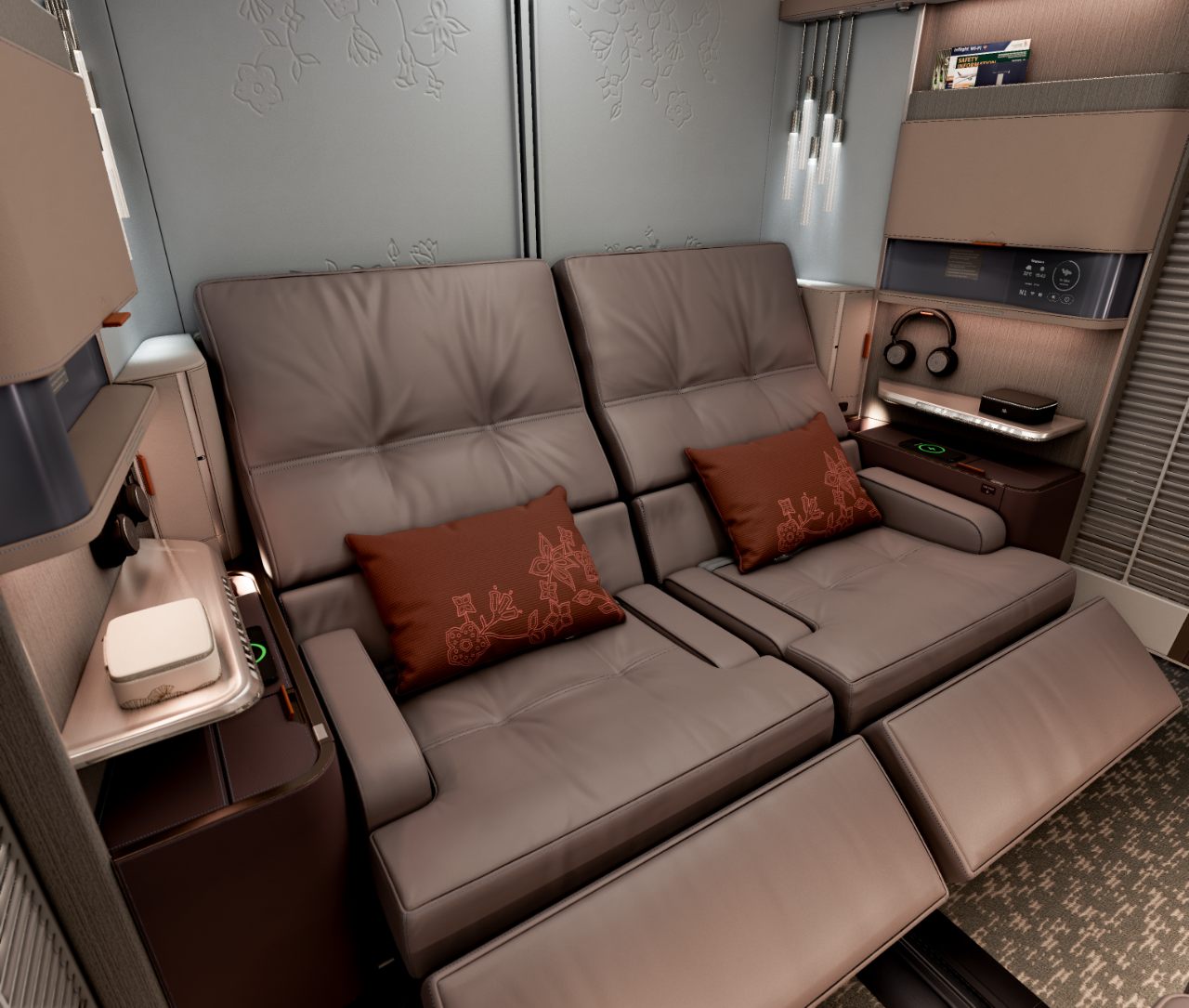
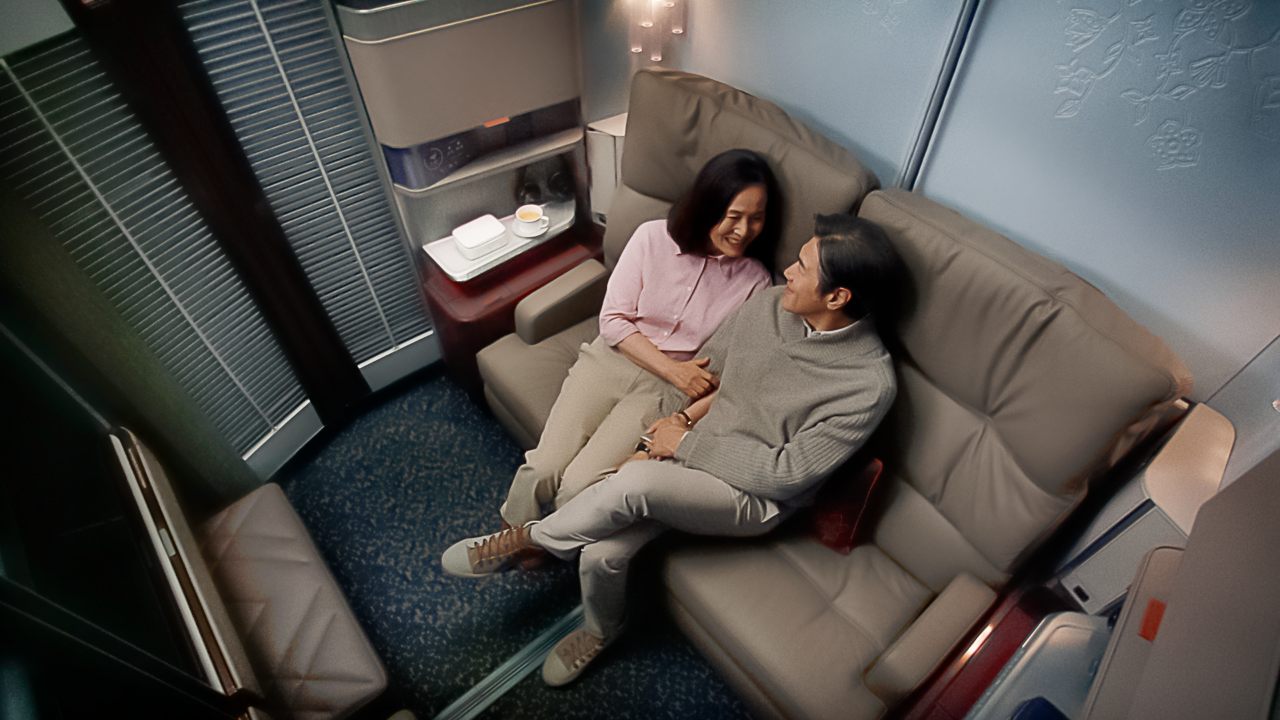
It’s a great little party trick, but it gets even better. The fully retractable divider also means that customers will enjoy the largest double bed in commercial aviation. At 80 inches long and 60 inches wide, it’s basically queen-size, and even larger than the bed in Etihad Airways’ The Residence (82 inches long and 47.5 inches wide).
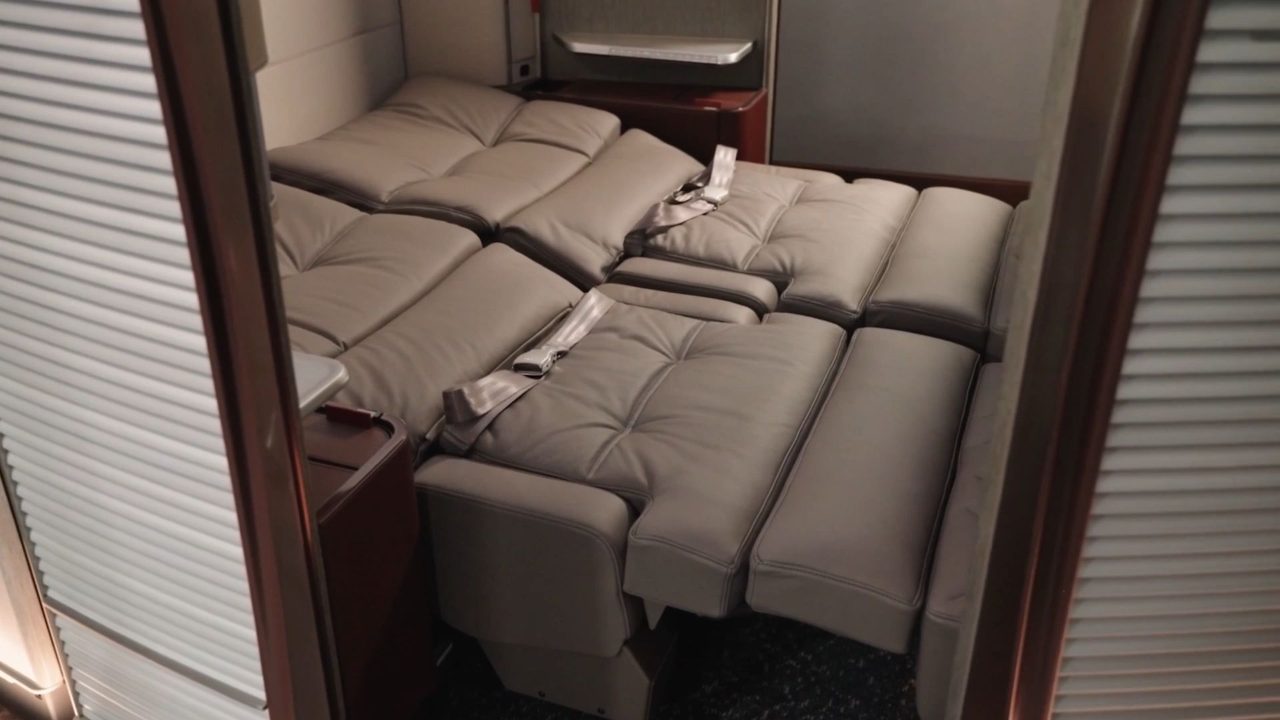
Crew dress the bed with a mattress topper from Paradies, a German luxury bedding specialist. This features breathable spacer fabric, enhanced cushioning and better thermal regulation. 100% cotton bed linens, a duvet and a choice of pillows complete the experience.
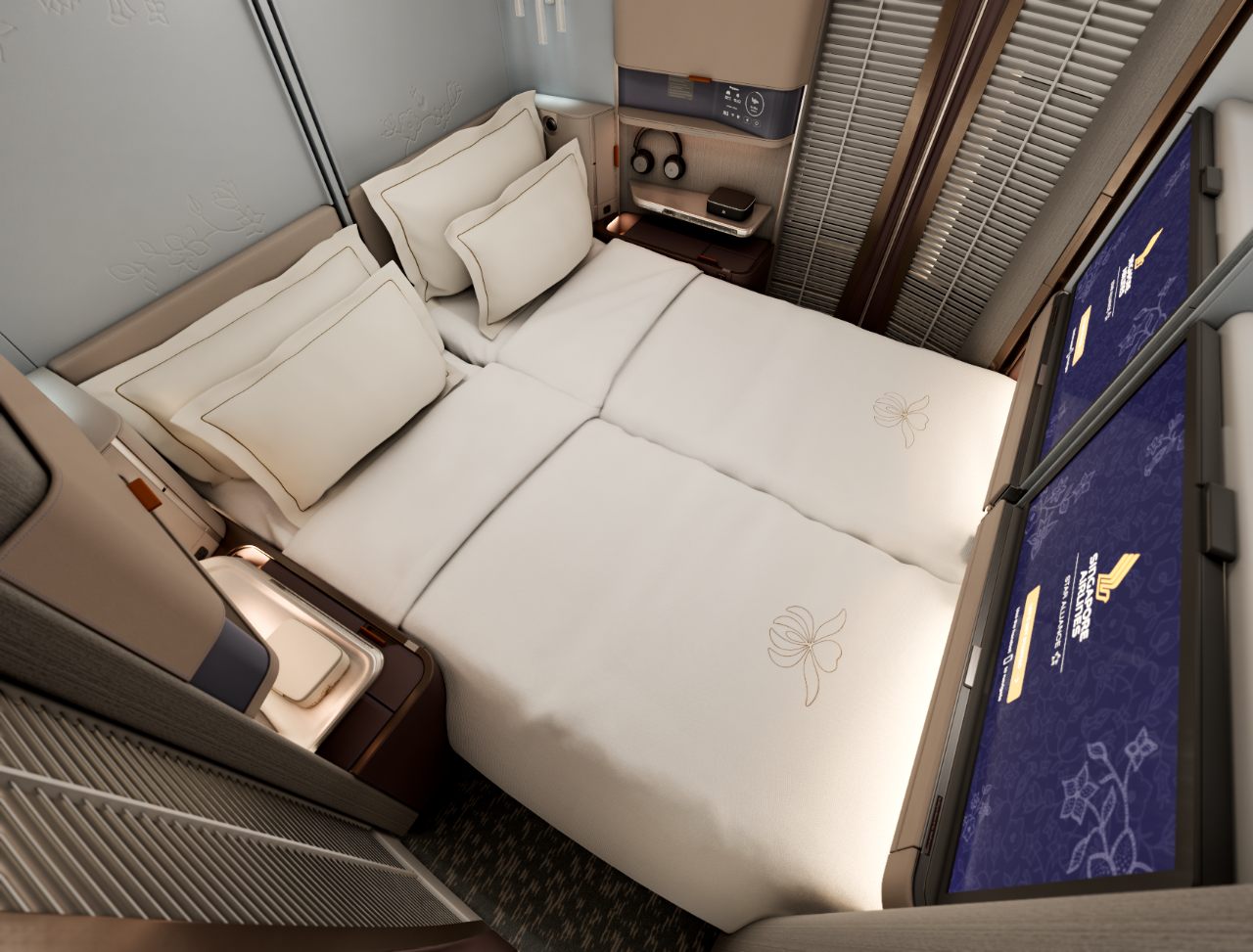
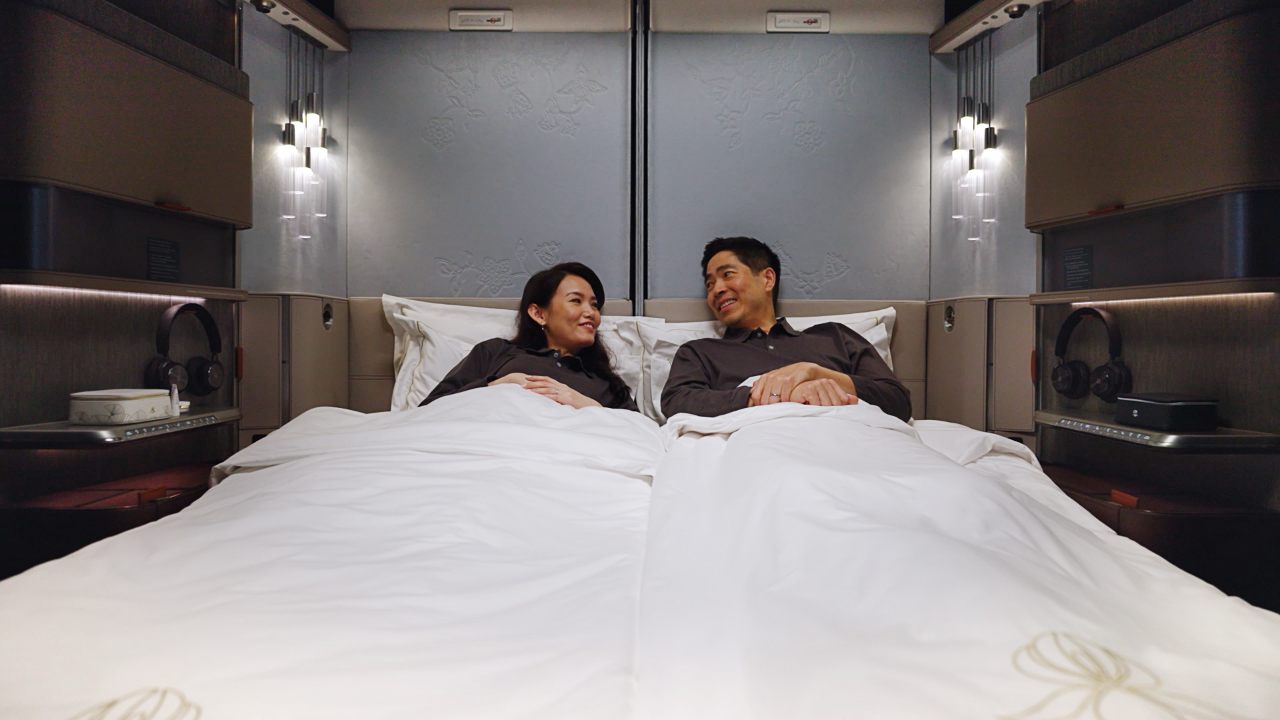
I’d consider this to be the first true double bed that SIA has offered. Yes, there’s still a bit of a seam in the middle, but it’s completely different from the first and second generation Suites, which were basically two single beds separated by a rock-hard divider (the crew would cover it with blankets, but you’d definitely feel it still).


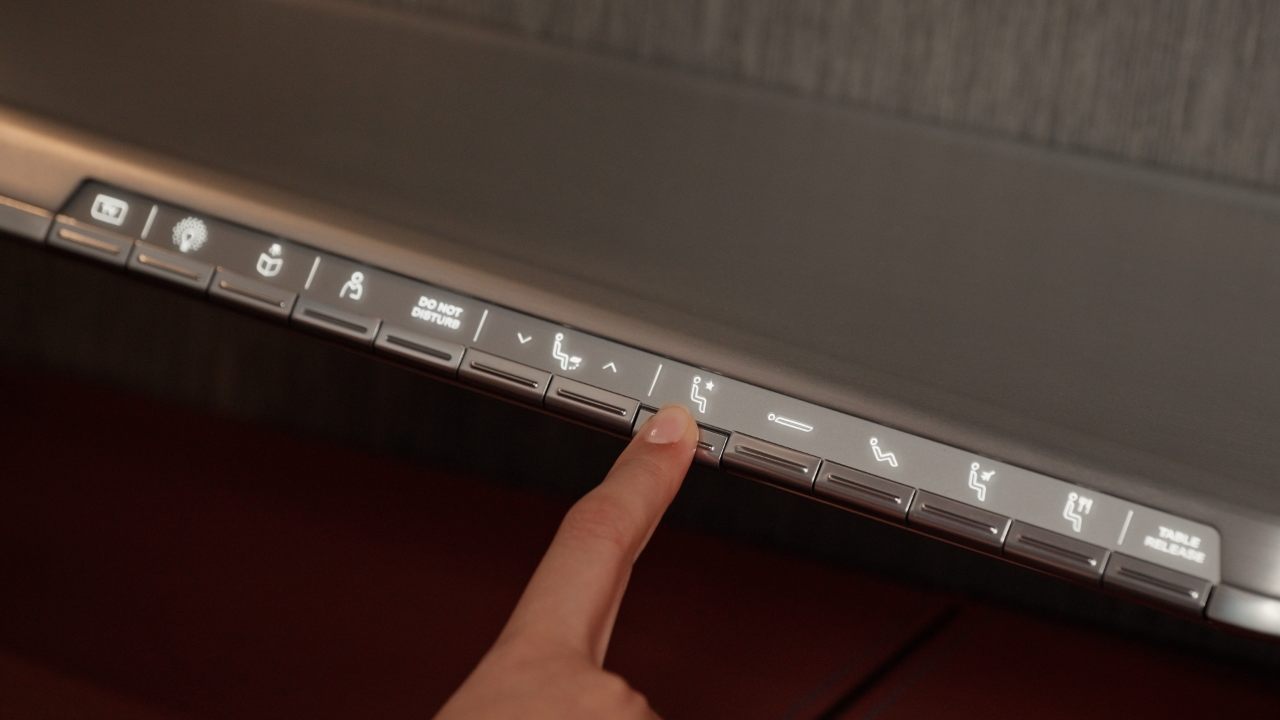
Seat controls run along a slim strip of backlit keys. While the trend in many luxury vehicles is to do away with physical buttons in favour of touchscreens, I’m so glad that hasn’t happened here. Physical buttons offer tactile feedback, and it’s one less thing to blind you with blue light when you wake up in the middle of the night and just want to make a minor adjustment.
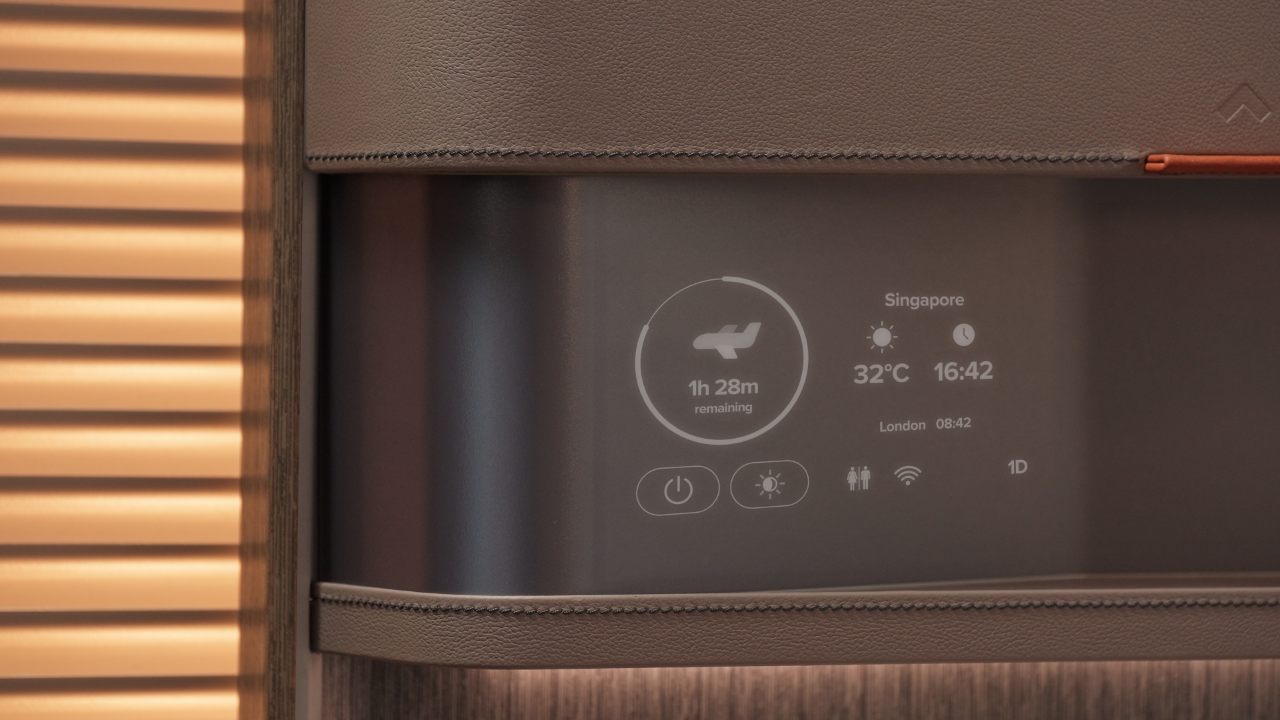
Tucked into a leather-trimmed alcove beside the seat is a small touch panel that blends into the surrounding trim until it lights up. When it does, the soft white graphics look almost printed onto the surface, rather than shown on a screen — definitely the right call, because a gamepad-style touchscreen remote would have looked completely out of place here (to be clear, the suite still has one, it’s just hidden discreetly). The panel provides a way of checking the flight progress, local time and weather at the destination, Wi-Fi status and lavatory occupancy, without having to turn on the main screen.
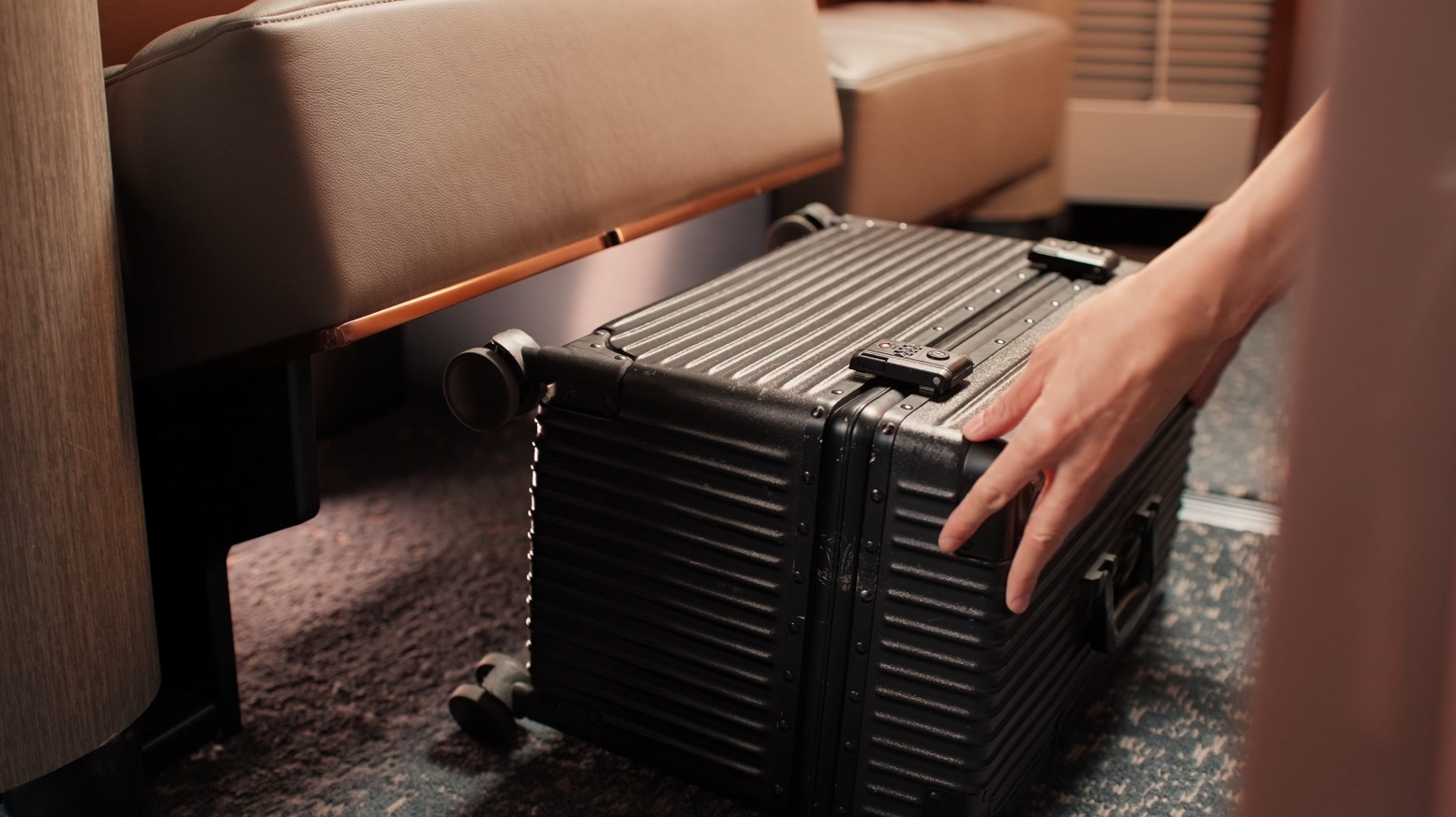
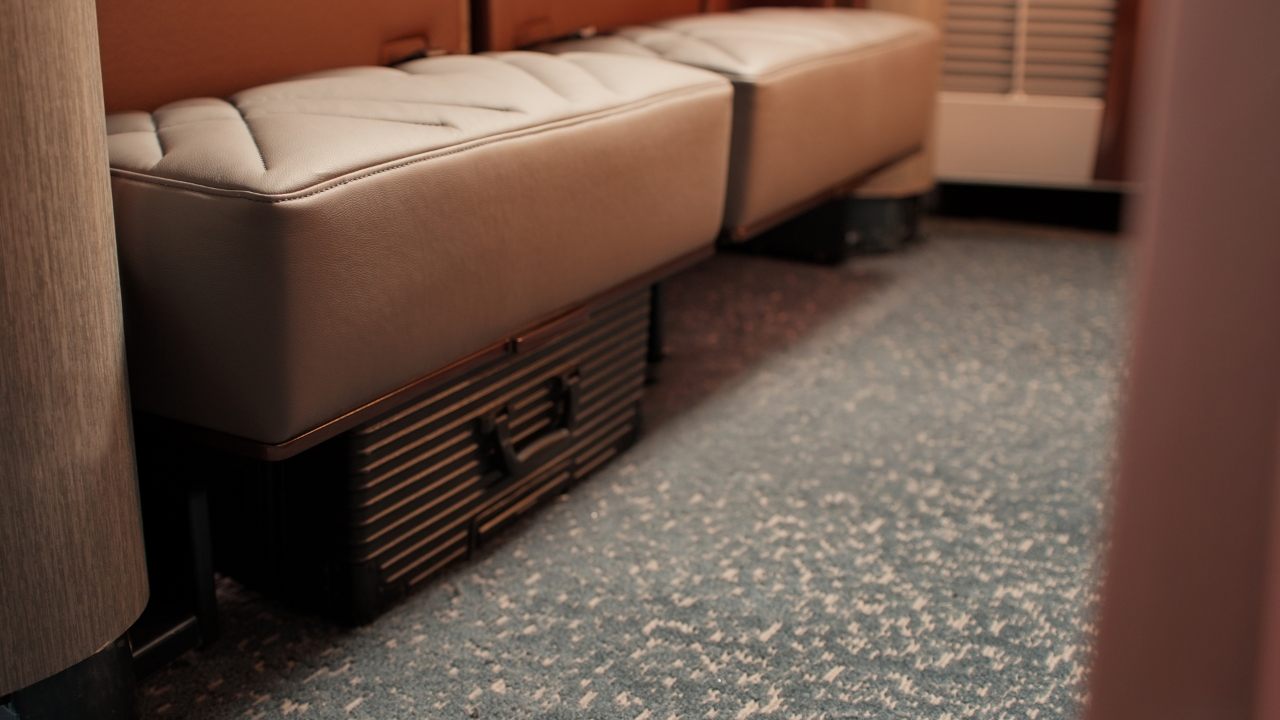
There are no overhead storage bins in First Class, to help maximise the feeling of space. Carry-on luggage can be stowed in the open bay beneath the ottoman, which flips up for easy access. This keeps luggage within reach throughout the flight.
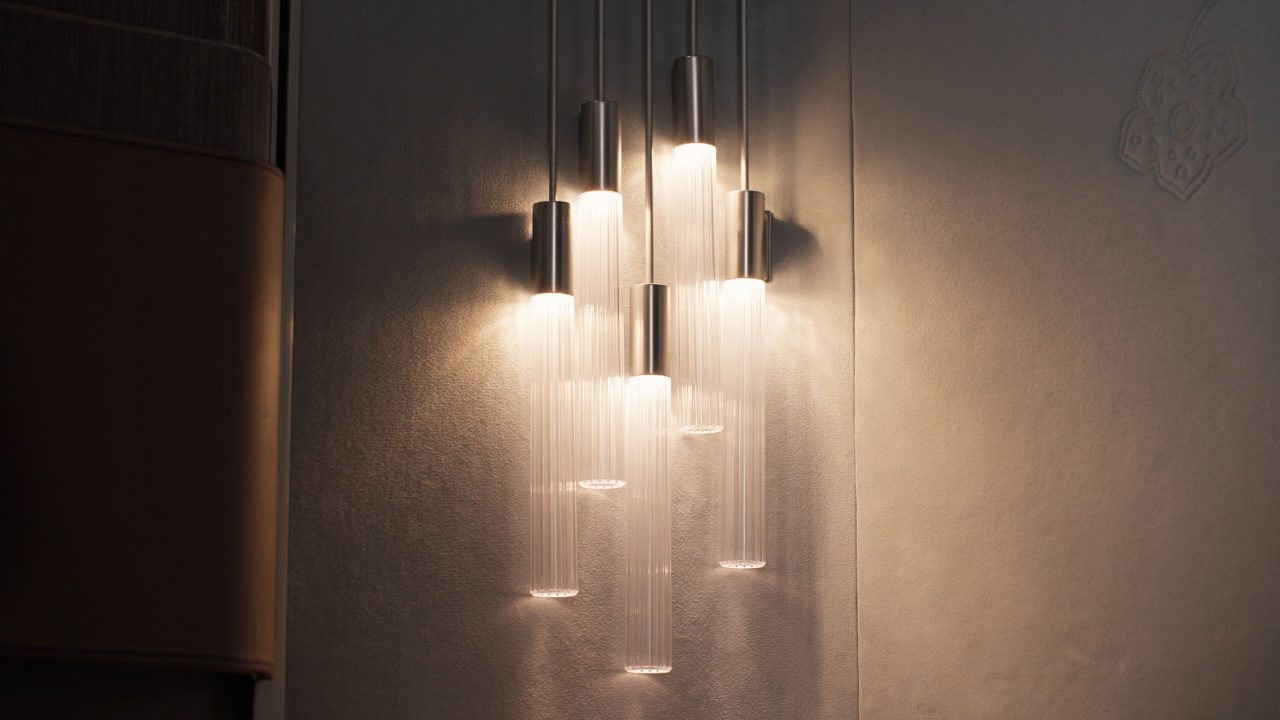
First Class suites have elegant ambient lighting, as shown in this shot of five pendant fluted lights against a padded wall with SIA’s batik motif subtly embossed into the surface.
In the centre suites, the two 32-inch 4K screens sit edge to edge, so when the divider is down, you effectively have one wide video wall (one detail I’m trying to confirm is whether the IFE system allows couples to watch the same film in sync, which would be a lovely feature to have). Entertainment can be enjoyed with B&O wireless headphones, the first time a wireless option has been offered on Singapore Airlines.
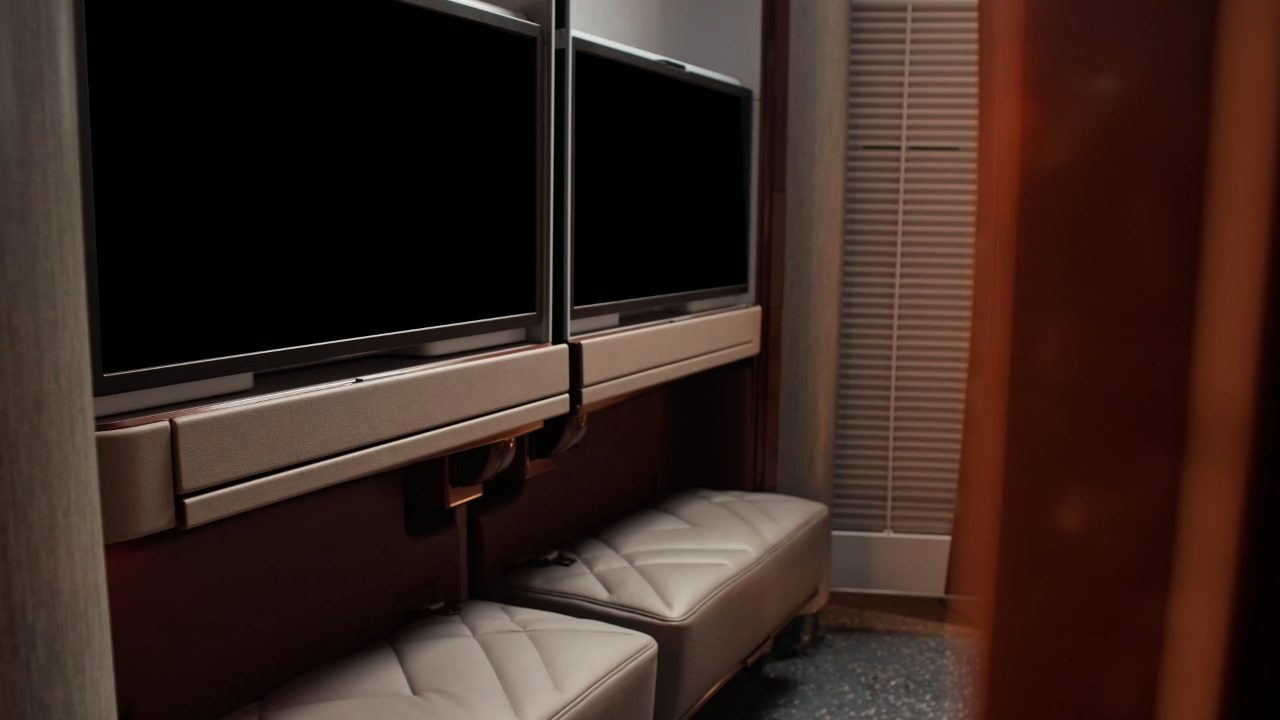
Beneath the screen is a generous wood-grain tray table (at 27 inches by 22.5 inches, it’s nearly double the one in Business Class).
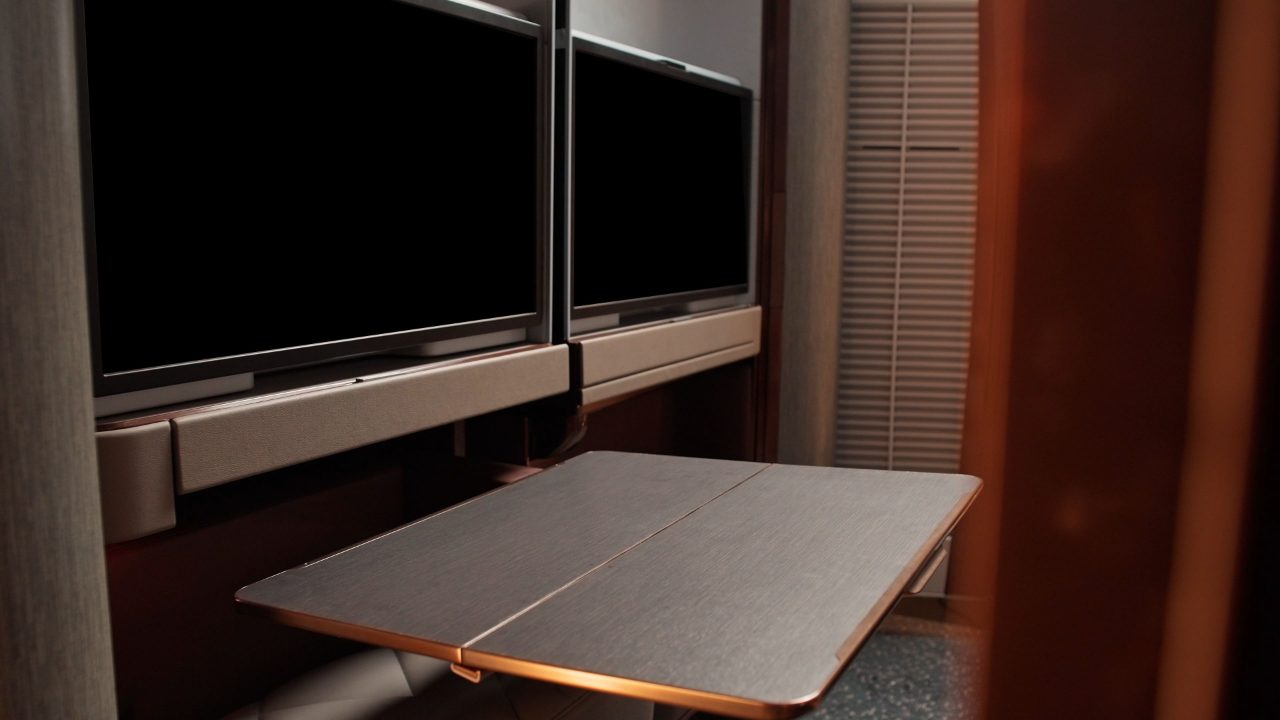
SIA previously revealed that the new First Class seat would offer companion dining, marking the return of a concept which has been missing ever since the retirement of the first-generation Suites during the pandemic. Companions sit on the ottoman, which has its own seatbelt.
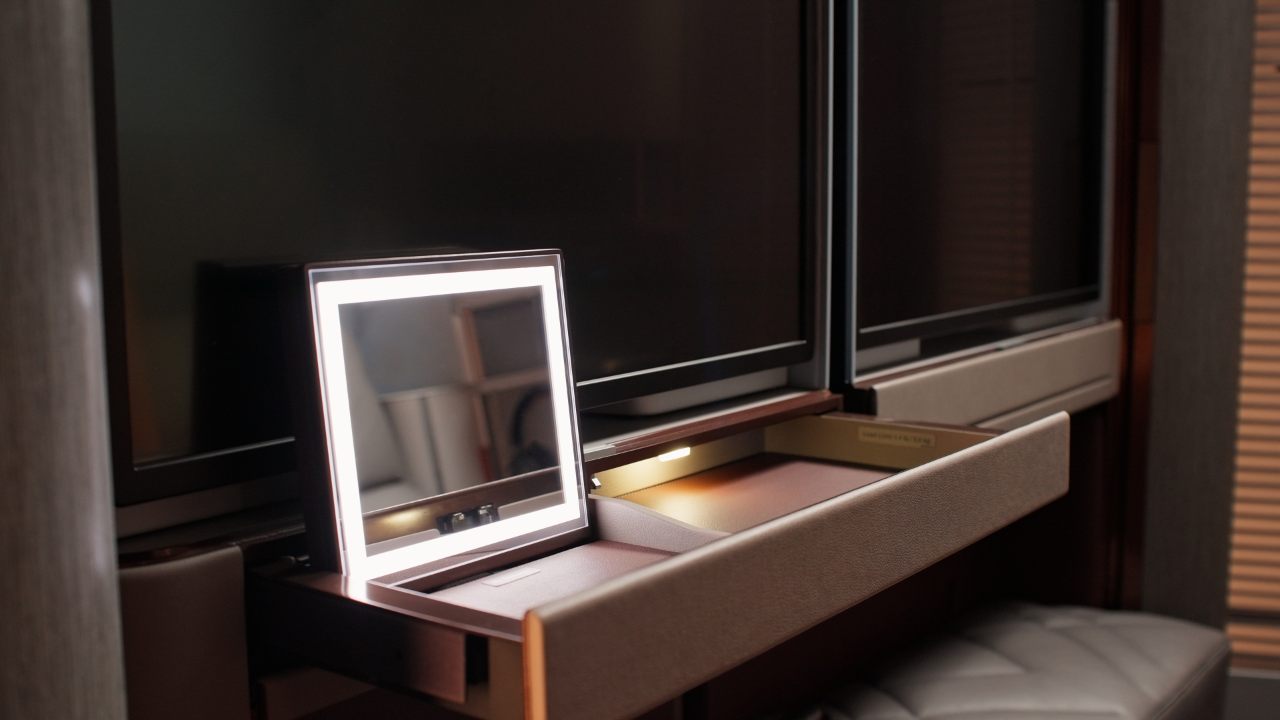
Also beneath the screen is a leather-lined vanity drawer with an illuminated mirror, ringed in light like a dressing room.
Wireless charging is also available, and of course, it’s a classy affair. The charging pad is set into an oxblood leather console, marked with a faint debossed icon. I was afraid it might be some plasticky surface that sticks out like a sore thumb, but thankfully the designers thought of that too.
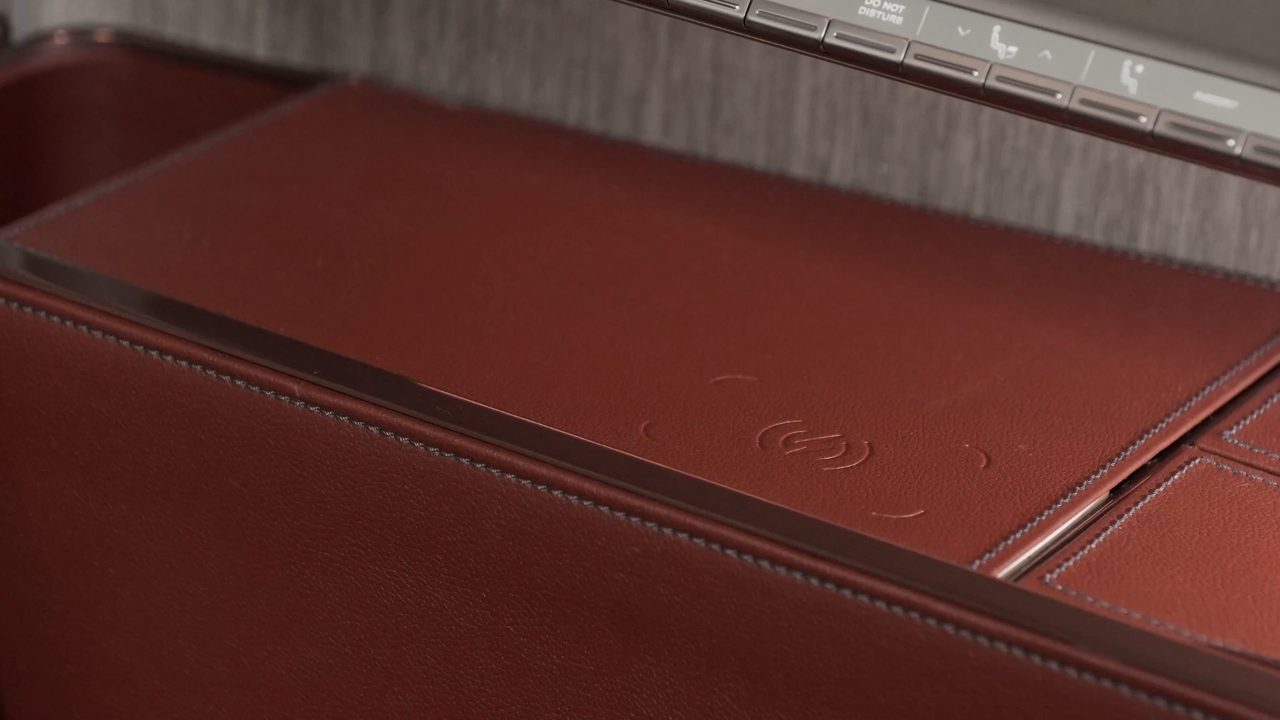
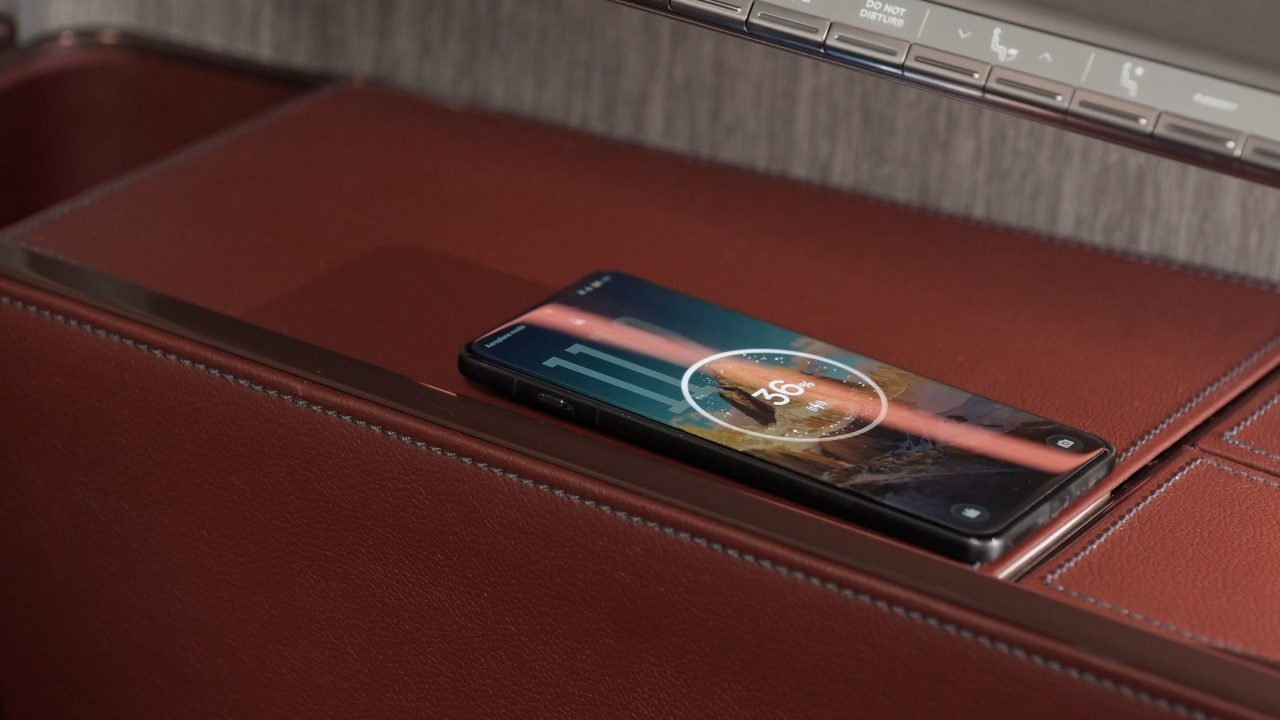
It’s a small touch, but it sums up the new First Class well. Nothing shouts for attention, and when you don’t need something, it fades into the background.
Put it all together, and this new First Class feels like a private luxury apartment. On paper, this sets a very high bar indeed.
New Business Class
 |
|||
| Seat Manufacturer: Recaro Designer: Designworks |
|||
| A350-900LH | A350-900ULR | B777-9 | |
| No. of Seats | 42 | 70 | 54 |
| Configuration | 1-2-1 | 1-2-1 | 1-2-1 |
| Privacy Doors | ✅ | ✅ | ✅ |
| Seat Pitch | 50″ | 50″ | 50″ |
| Seat Width | 22″ | 22″ | 24″ |
| Seat Recline | 180° | 180° | 180° |
| Bed Length | 79″ | 79″ | 79″ |
| IFE Screen | 22″ 4K | 22″ 4K | 20″ 4K |
| Touchscreen | ✅ | ✅ | ✅ |
| OLED | ✅ | ✅ | ❌ |
| Spatial Audio | ✅ | ✅ | ✅ |
| Bluetooth Audio | ✅ | ✅ | ✅ |
| AC Power | ✅ |
✅ |
✅ |
| USB-A | ❌ | ❌ | ✅ (1x) |
| USB-C | ✅ (2x Fast Charge) |
✅ (2x Fast Charge) |
✅ (2x) |
| Wireless Charging | ✅ (1x) |
✅ (1x) |
✅ (1x) |
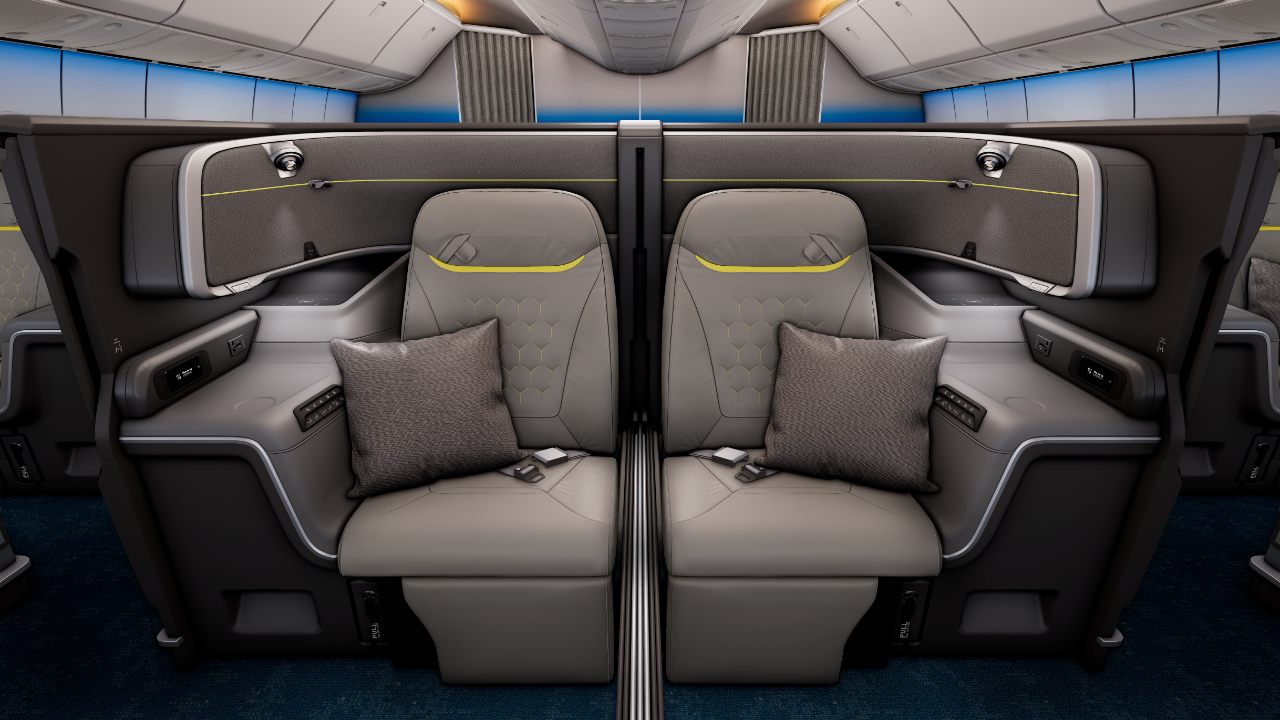
Singapore Airlines has selected Recaro to manufacture its new Business Class seat, which it says is not the R7, as was rumoured, but rather a completely bespoke product.
I actually had the opportunity for some hands-on time with a mock-up of this seat (for the B777-9) earlier this week, so I’ll be able to comment a bit more definitively.
Let’s start by talking about the colour scheme, because it marks a notable departure from SIA’s traditional Business Class palette.
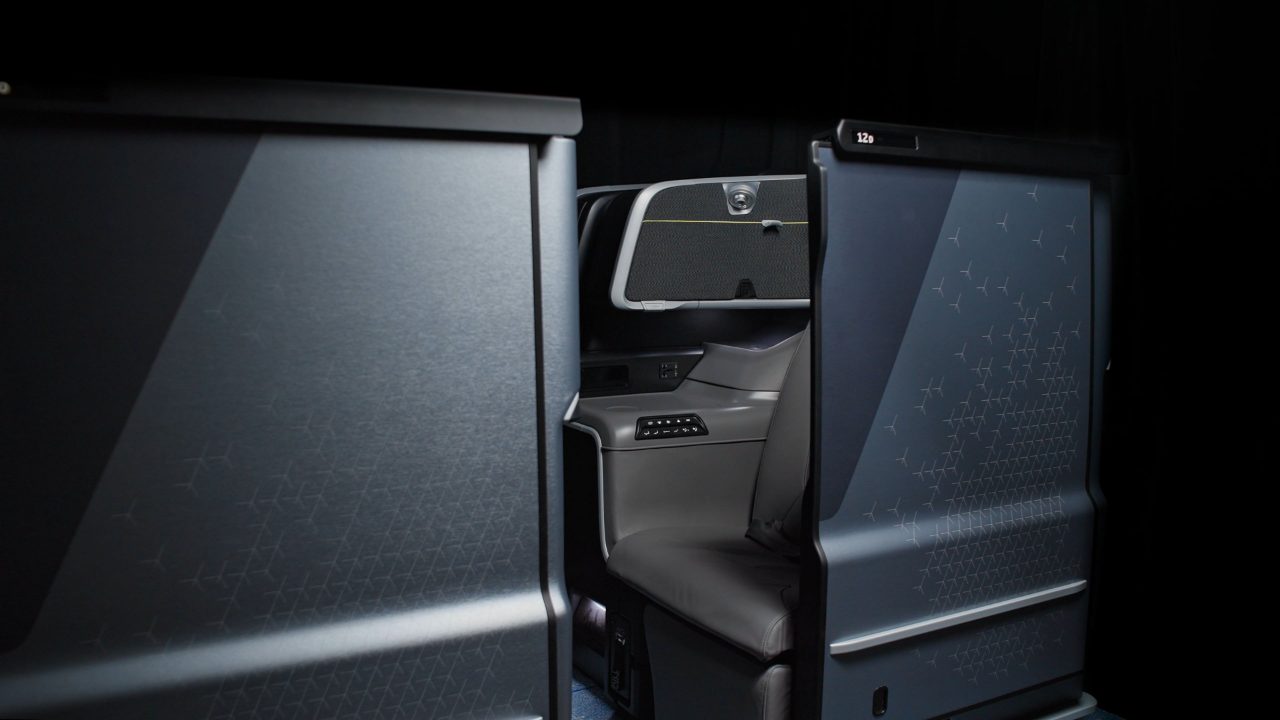
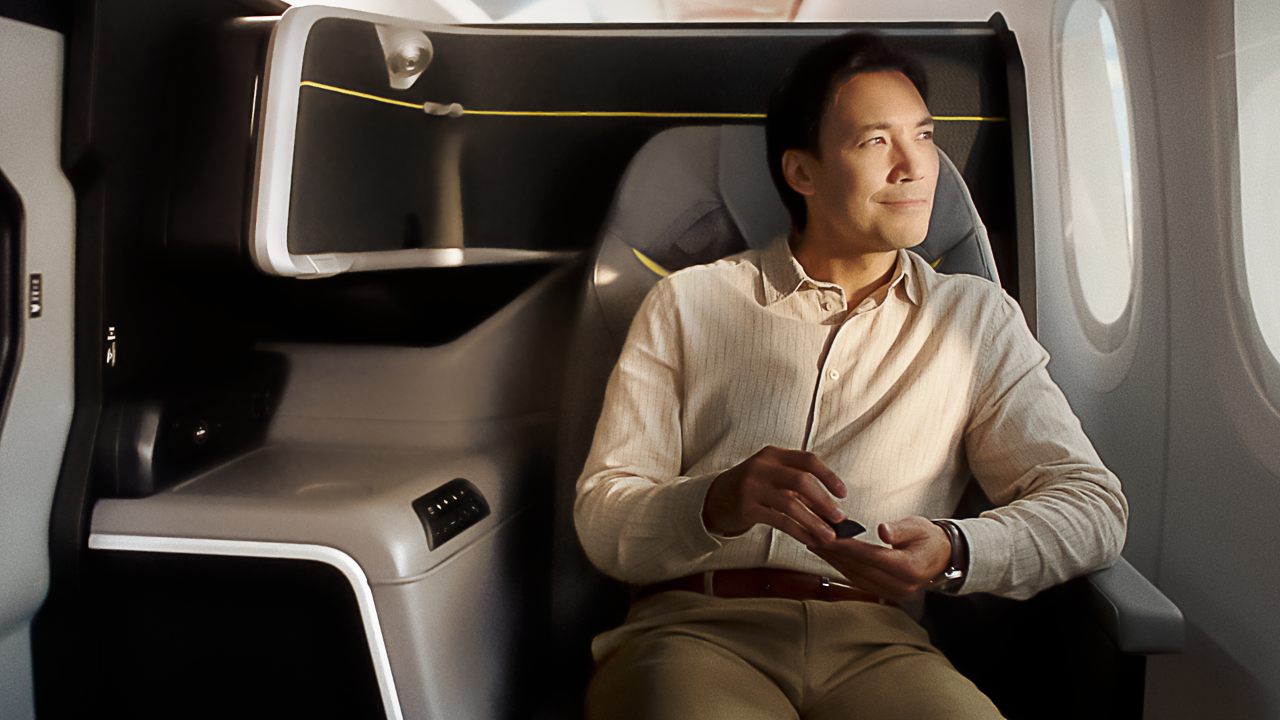
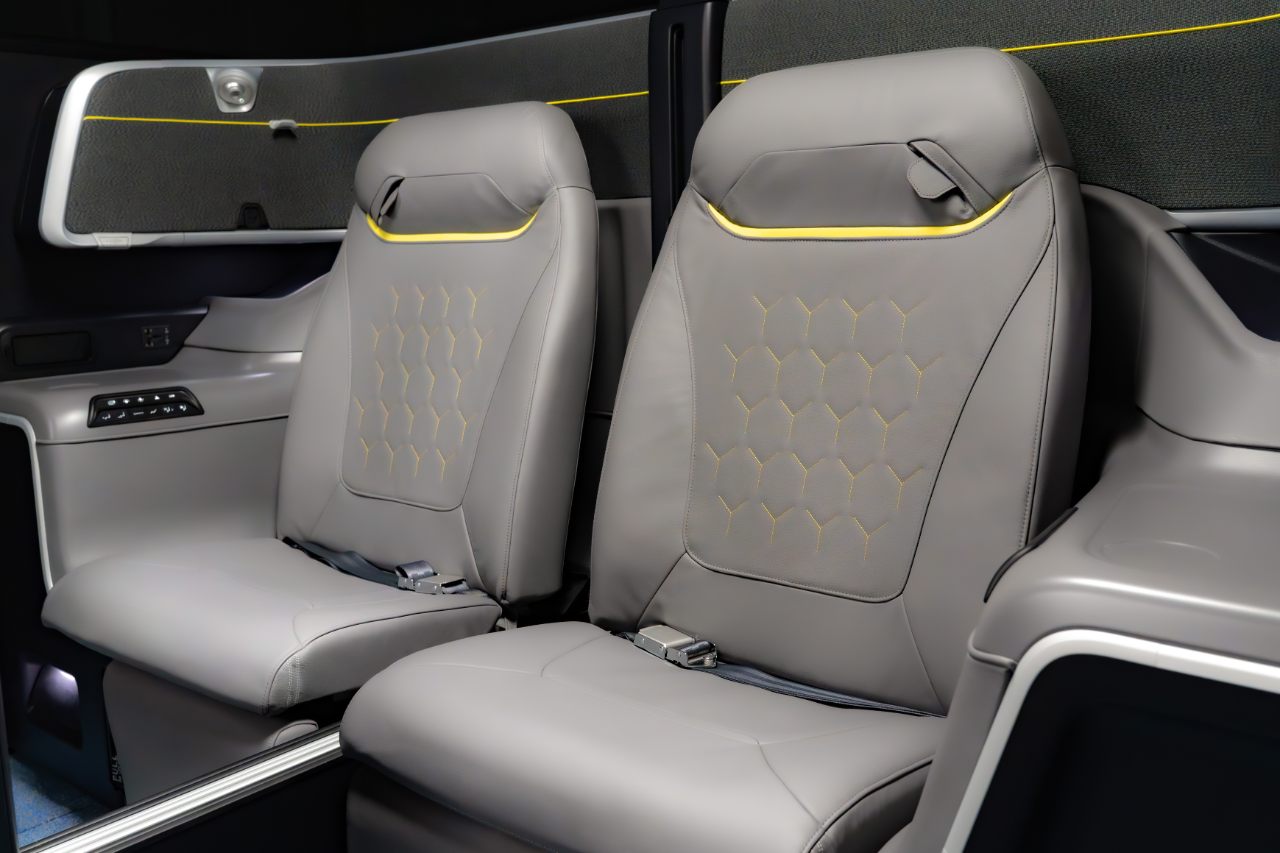
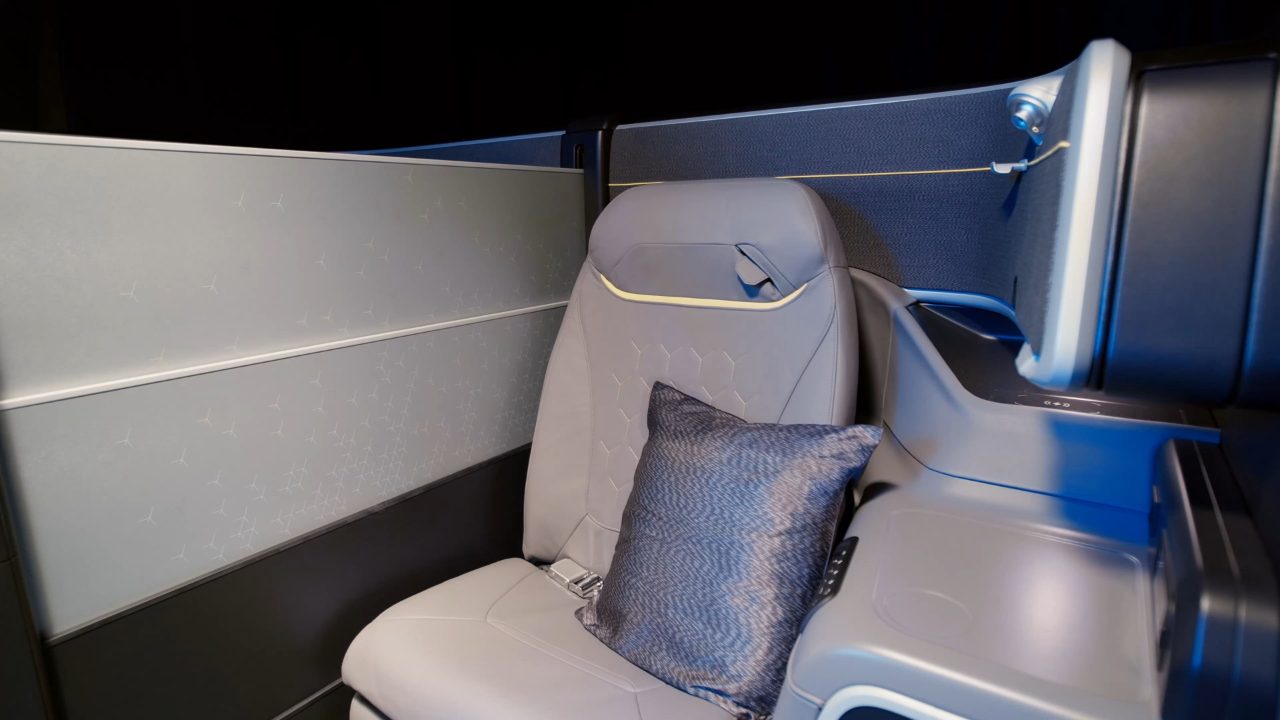
Seat designer Designworks has said that its goal was to bring an automotive-inspired seat into the cabin (well, it does have a three-point seatbelt!).
Mineral greys set the base for it, they have a balanced and stable feel. Then we have this cool, very energetic yellow that is contributing in the accents. We have the blue in the carpet, which brings freshness and calm into the cabin. The silver accents and the deep black-blue are adding elegance to it, and the soft touch surfaces and textiles make it feel really inviting to the touch.
Singapore Airlines’ warmer style had served the airline for a long time, and many cabins in the market are going more and more traditional.
We wanted this Business Class to stand on its own. With its own attitude. Modern, progressive, and refreshing.
-Designworks
Incidentally, that splash of yellow is what confused me so much initially when I spotted it in one of SIA’s teaser videos — I mistook it for green, which the airline has never used in its Business Class cabins.
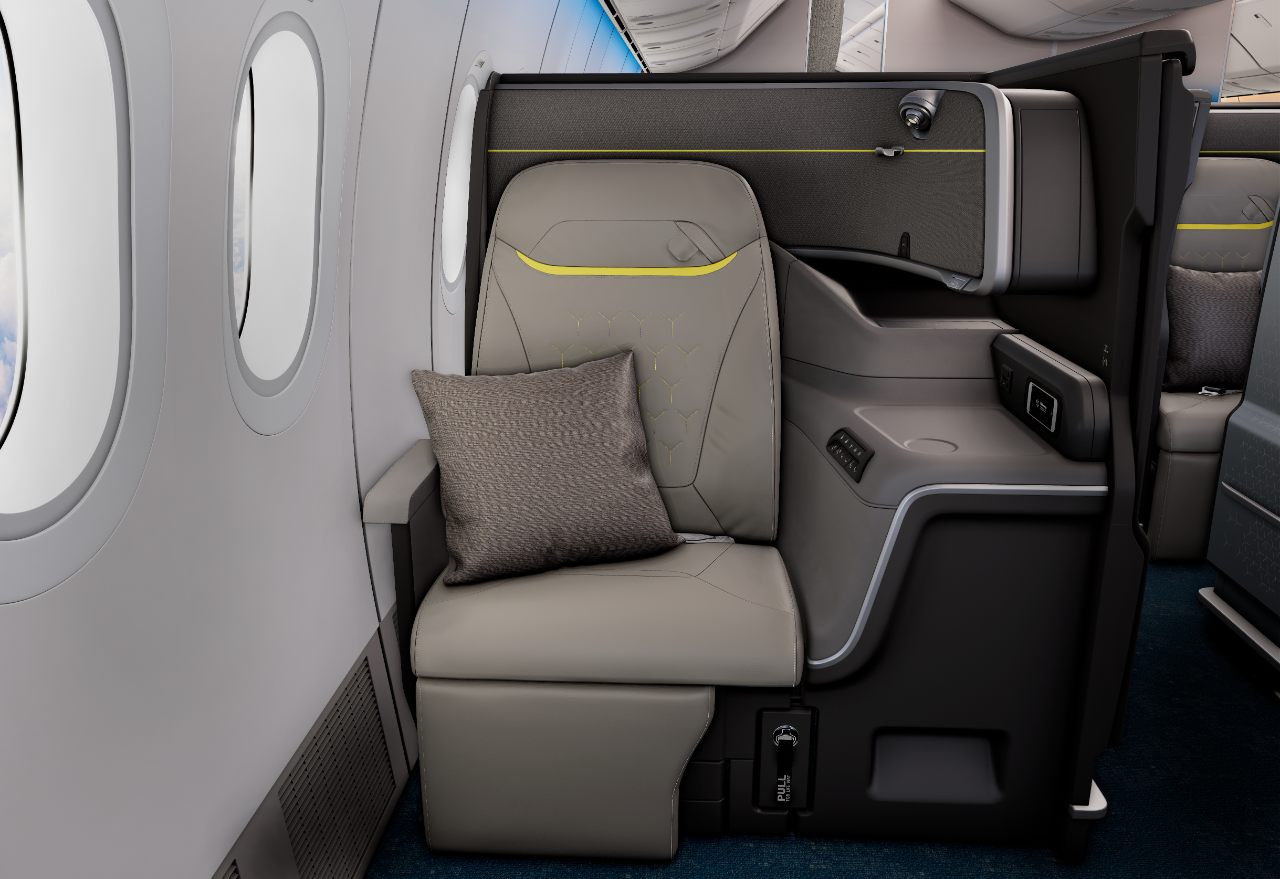
As for the design…I’m conflicted. The mock-up I saw was finished in the actual seat fabrics, so I can vouch that the renders are a faithful representation of the colours. And to my eye, it plays things very cold: grey on grey, set against a blue carpet. It’s a stark contrast to First Class. Step out of First’s luxury hotel-like corridors into Business, and you might think you’ve wandered into an EV dealership.
I’m also not sold on the light grey upholstery. Part of that is practical, since I wonder how it will hold up against the red wine and coffee spills that are a fact of life on board. But I also suspect a deeper shade would have looked more sophisticated and premium. There is little textural contrast within the suite, and wood has been passed over entirely in favour of moulded plastic, which doesn’t feel very premium. I understand the splashes of yellow are intended to inject some personality, but to me, they feel slightly out of place.
| ❓What’s that motif? |
|
Fun fact: that satellite-like motif you’ve probably spotted on the doors, interiors and seat stitching is a nod to NASA’s Juno mission. I didn’t quite catch the link between a 2011 space mission and a modern-day Business Class seat though. Wouldn’t the batik motif have been more obvious? |
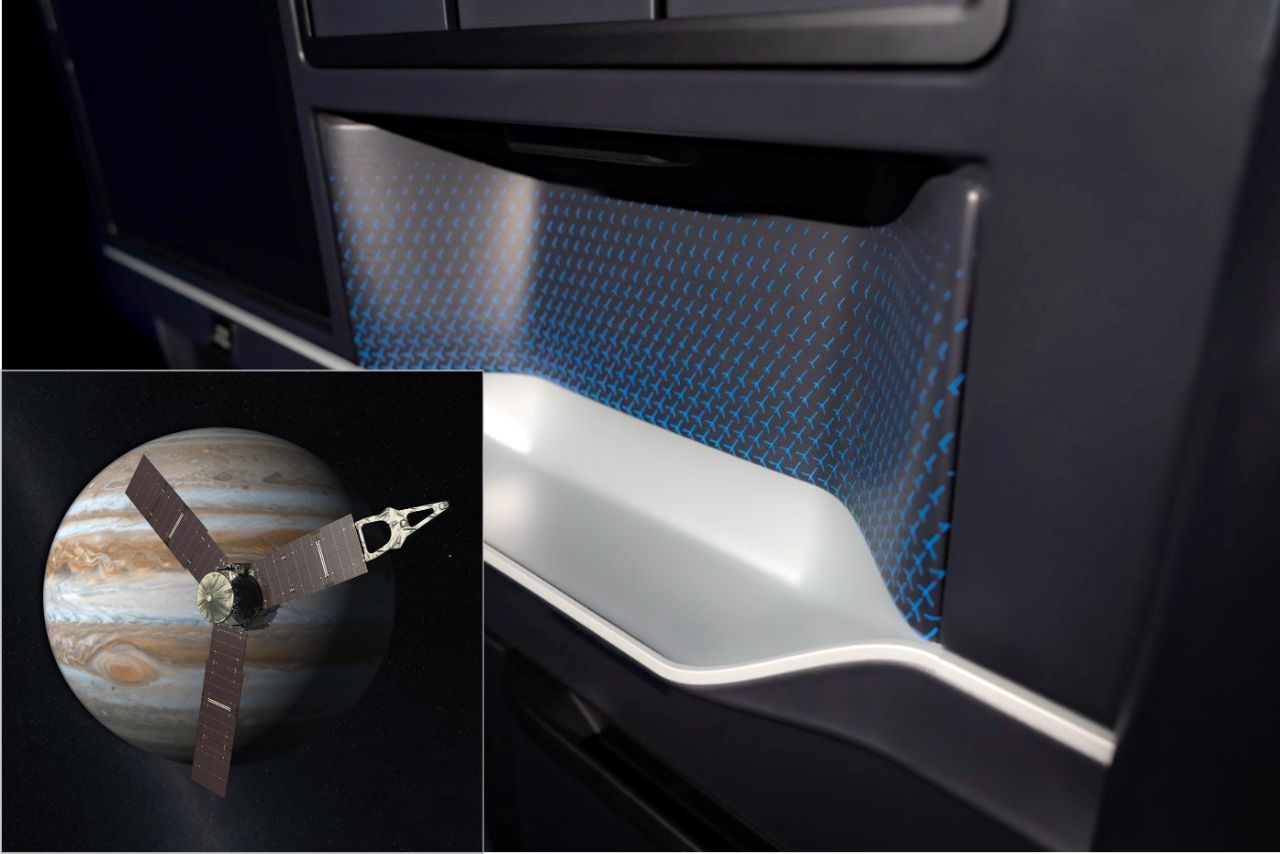
Aesthetics aside, each seat has a sliding privacy door with a brushed metal handle, and is enclosed by walls 52 inches (132cm) high. According to Designworks, regulations would actually have allowed taller walls, but it chose to stop at 52 inches so passengers get privacy without feeling boxed in.
Doors can be centrally locked open during taxi, take-off and landing. I tried the mechanism, and it feels robust. When the door is closed, there is hardly a gap between the door and the wall.
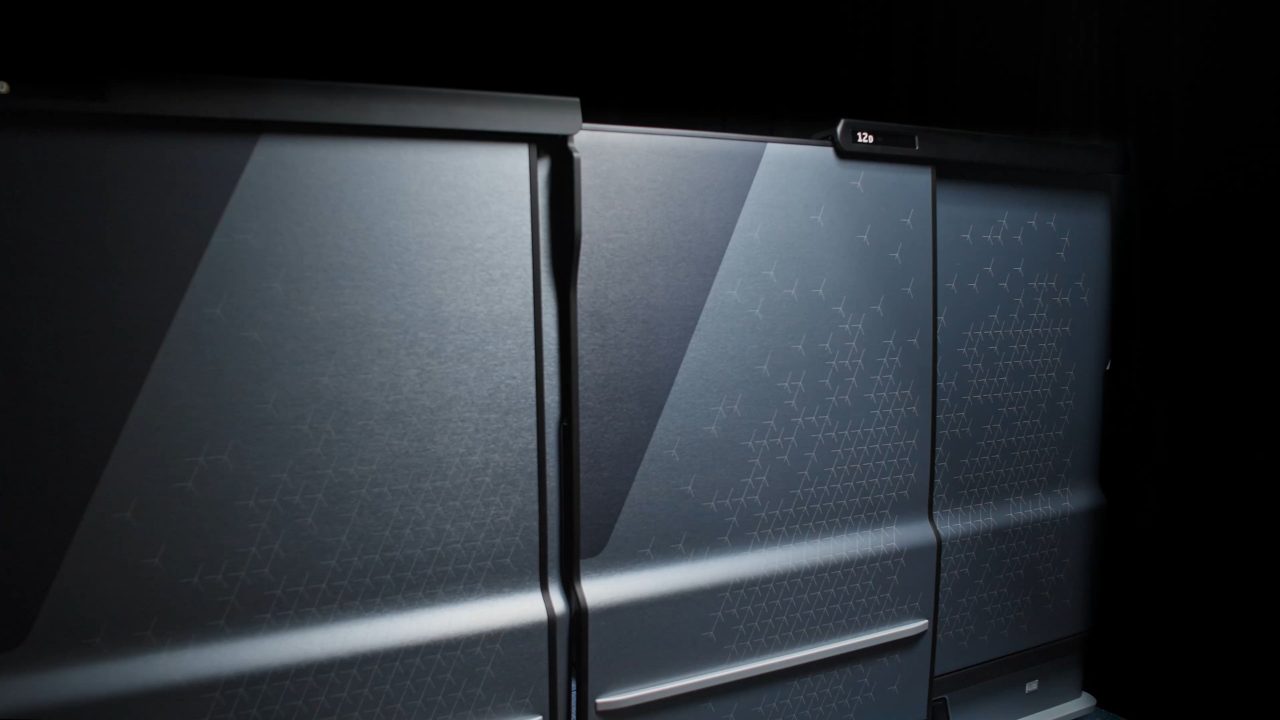
Business Class seats offer 50 inches of pitch, and 22 inches (A350-900LH/ULR) or 24 inches (B777-9) of width. This is significantly narrower than the 28 inches offered by the 2013J, but I didn’t really feel it because it’s generous around the shoulders.
A 1-2-1 configuration offers direct aisle access, as expected, and comes in a staggered arrangement:
- Single seats alternate between window alignment and aisle alignment
- Centre seats alternate between “honeymoon” (pushed together) and “divorce” (separated by side console)
Unlike the 2013J seat, which required passengers to stand up and flip it over into a bed, you can remain seated while this new seat reclines into a flat bed, in roughly 30 seconds. This means you no longer have to wait for the seatbelt sign to turn off before you can convert your seat, which was a bugbear for many. And yes, all passengers sleep parallel to the aisle — the days of diagonal sleeping are gone!
In bed mode, the seat is quoted at 79 inches long (though based on my measurements, the usable space is closer to 75 inches because of a gap between the top of the headrest and the shell).
At the “honeymoon” seats, the electrically-operated privacy divider can be lowered all the way down at the touch of a button — which you only need to press once, instead of press and hold — allowing the two seats to be converted into a double bed.
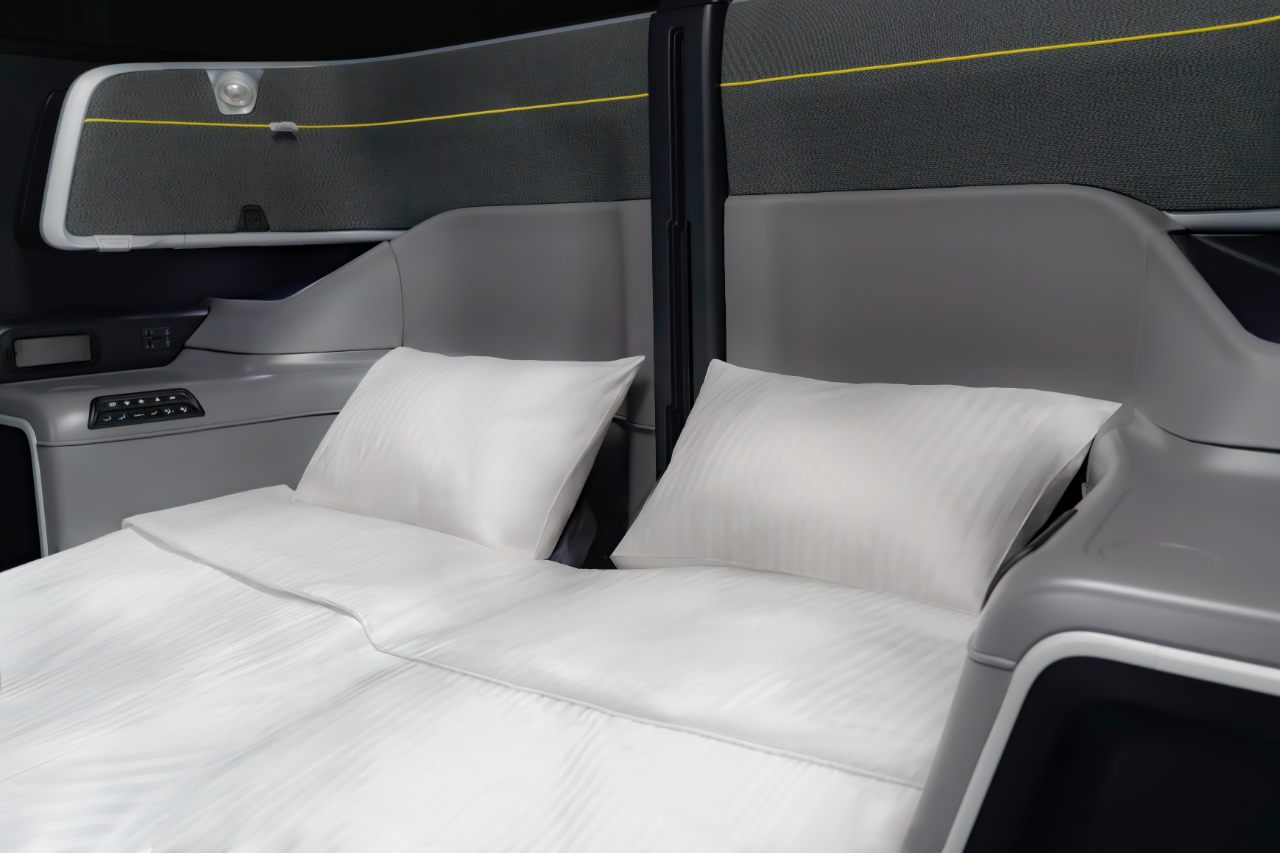
There is a seam of ~15cm between the seats, and I’m told that a mattress pad will cover it. Even so, it’s probably better to think of this as two single beds pushed together, because your feet will still be separated by the foot cubbies.
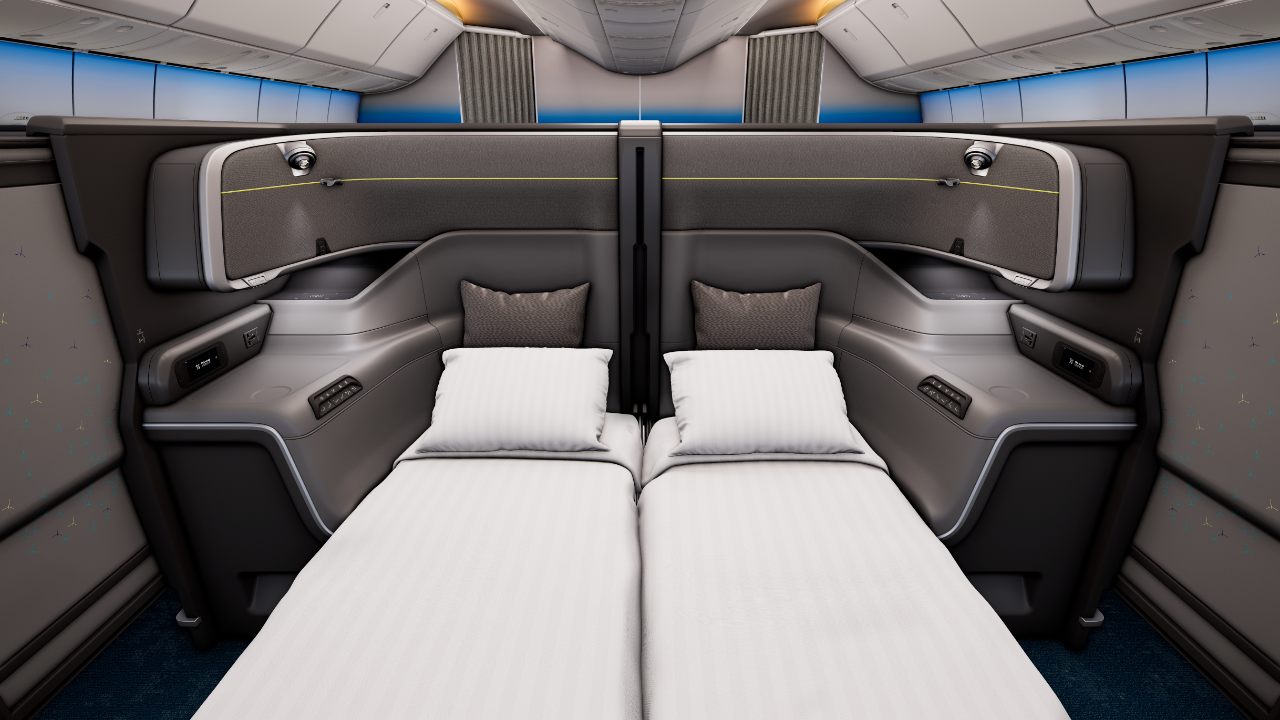
One design feature I appreciate is that even when the seat is in bed mode, there’s still a space to put your backpack or shoes. This is unlike the current 2013J seat, where your carry-on items are “trapped” beneath the sleeping surface when the seat is flipped over.
On a side note, I realise those foot cubbies look small, but don’t worry — it’s nowhere near as bad as the 2013J seat on the A350. The new cubby measured 15 inches at its narrowest, and I found it perfectly comfortable for side and back sleeping.
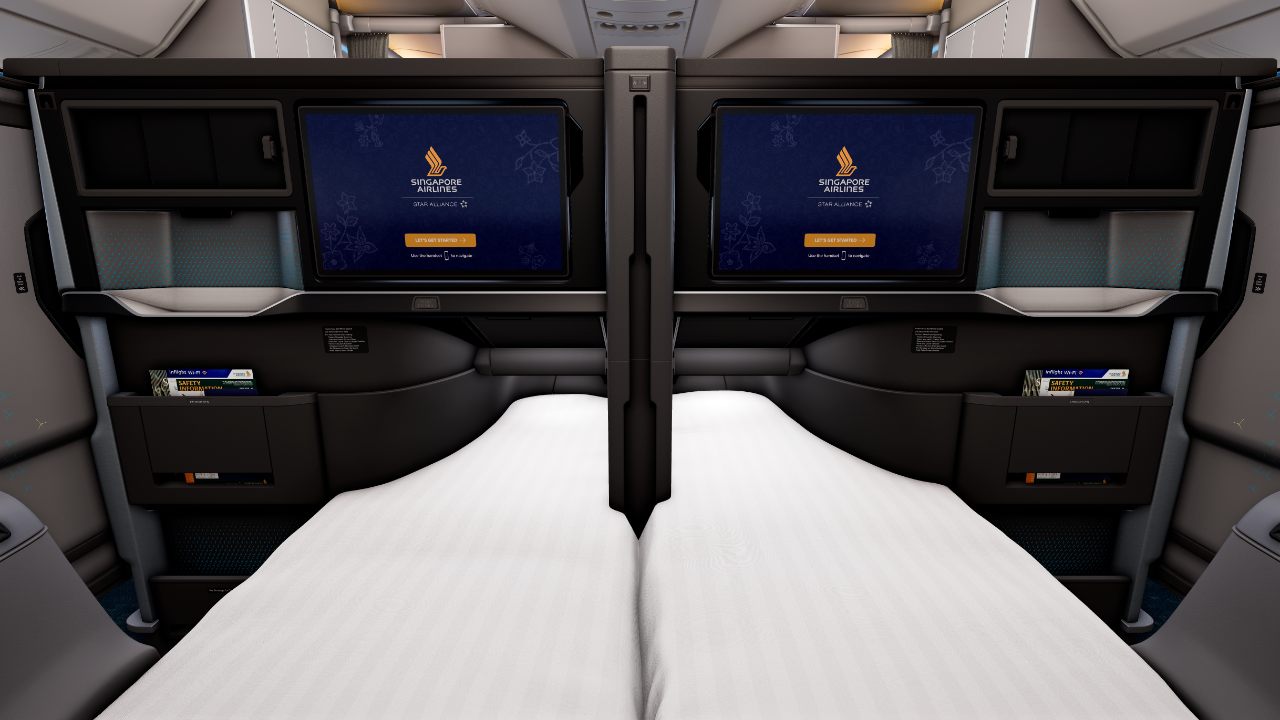
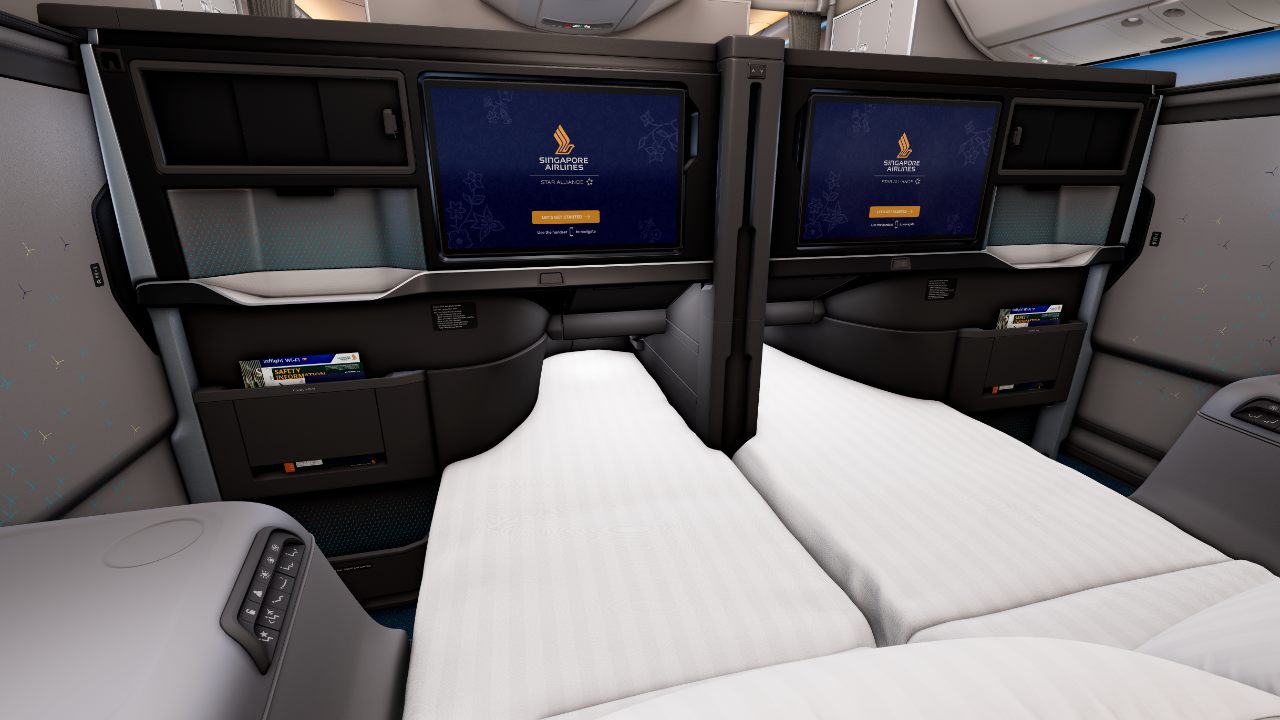
In any case, the new Business Class cabin will offer a significantly better experience for couples. On the A380, only 6 out of 78 Business Class seats could be converted into double beds. On the A350-900LH/ULR and B777-9, that figure should be closer to 25-30%, depending on the actual cabin layout.
But given SIA’s recent move to limit advance seat selection for passengers on Business Lite fares, as well as Business Advantage, Saver and Promo awards, I also wonder how many of these seats will actually be selectable at the time of booking.
If you’re travelling solo and end up in one of these honeymoon seats — not to worry. When the privacy divider is raised, you won’t even see your seat mate.
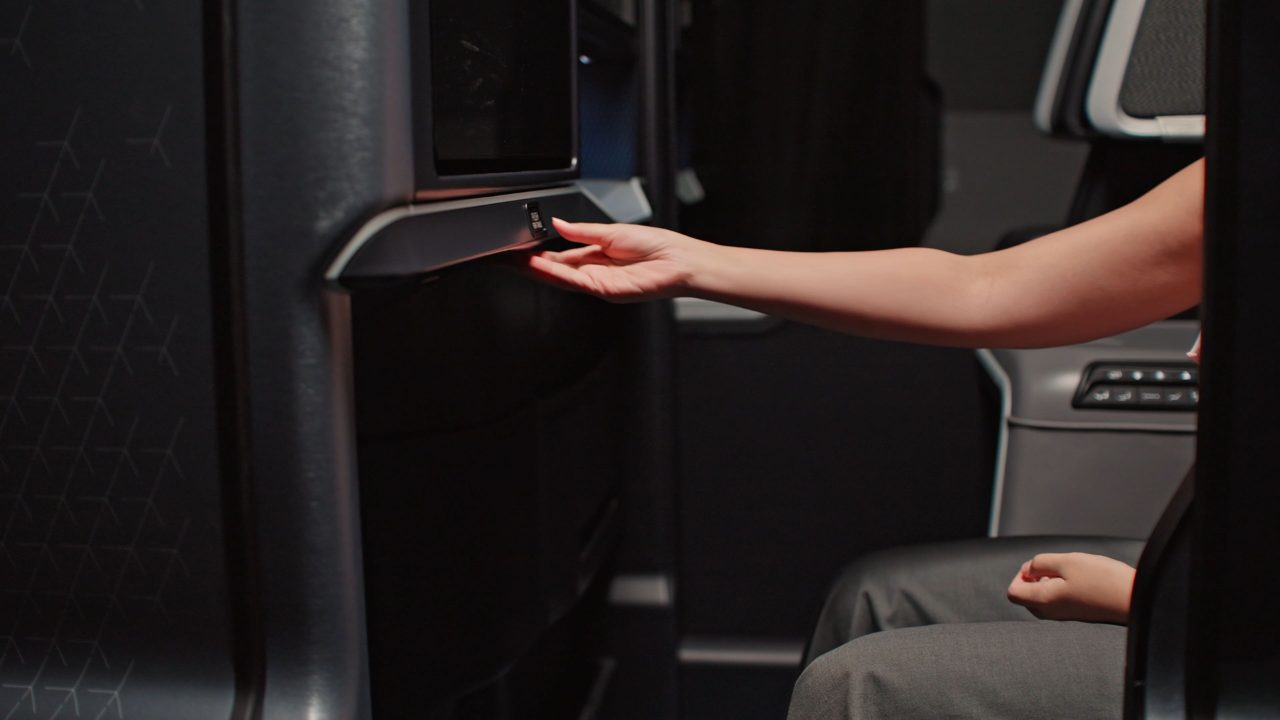
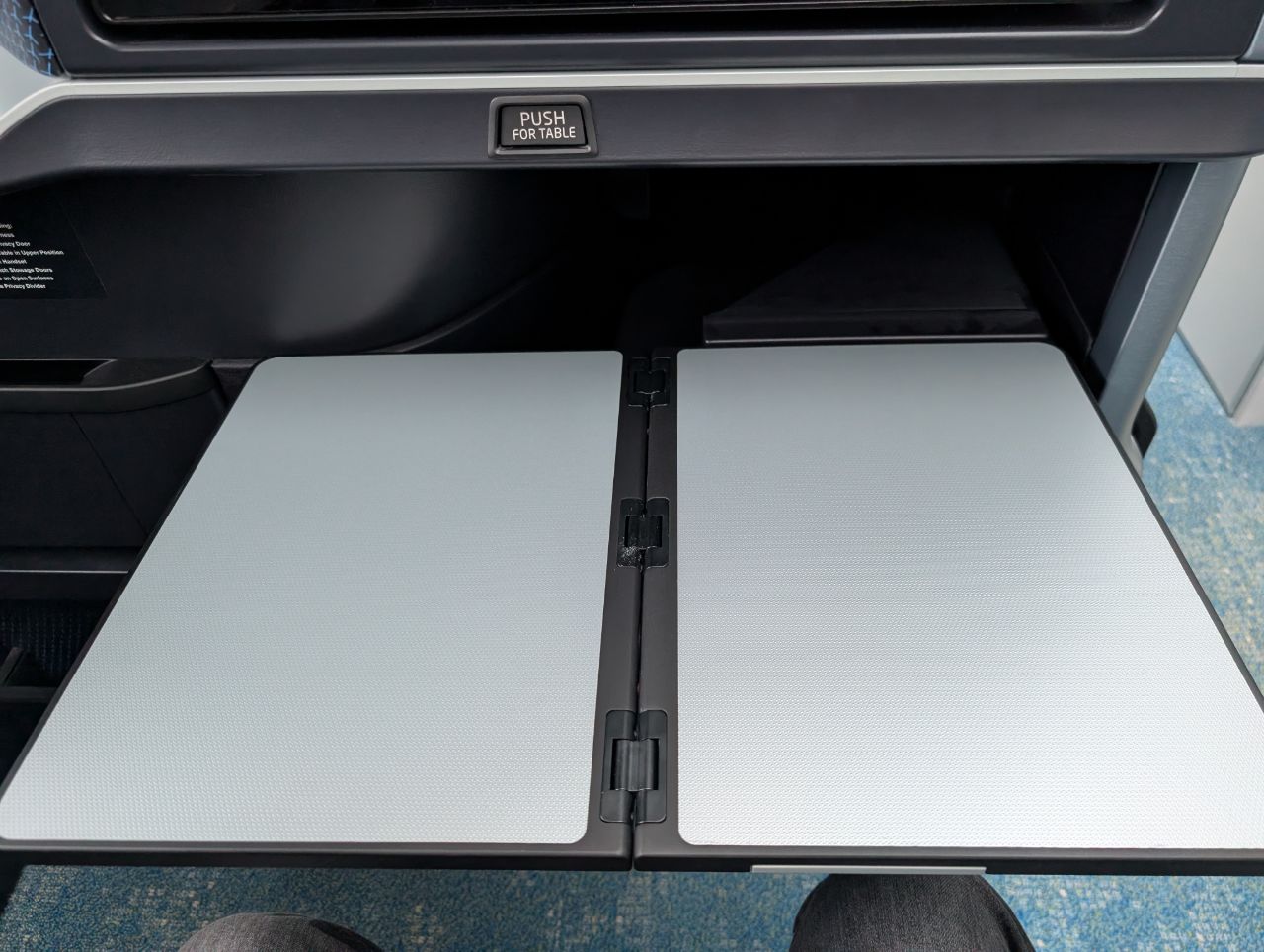
The tray table (22 inches by 14.7 inches) has been designed in a way that it stows at an angle beneath the IFE screen. To use it, you fold it down, then pull it towards you. It’s a clever touch, and one I’ve also seen on STARLUX’s A330 Business Class. Because the table tucks up under the screen when stowed, it stays clear of the footwell, leaving more room for your feet.
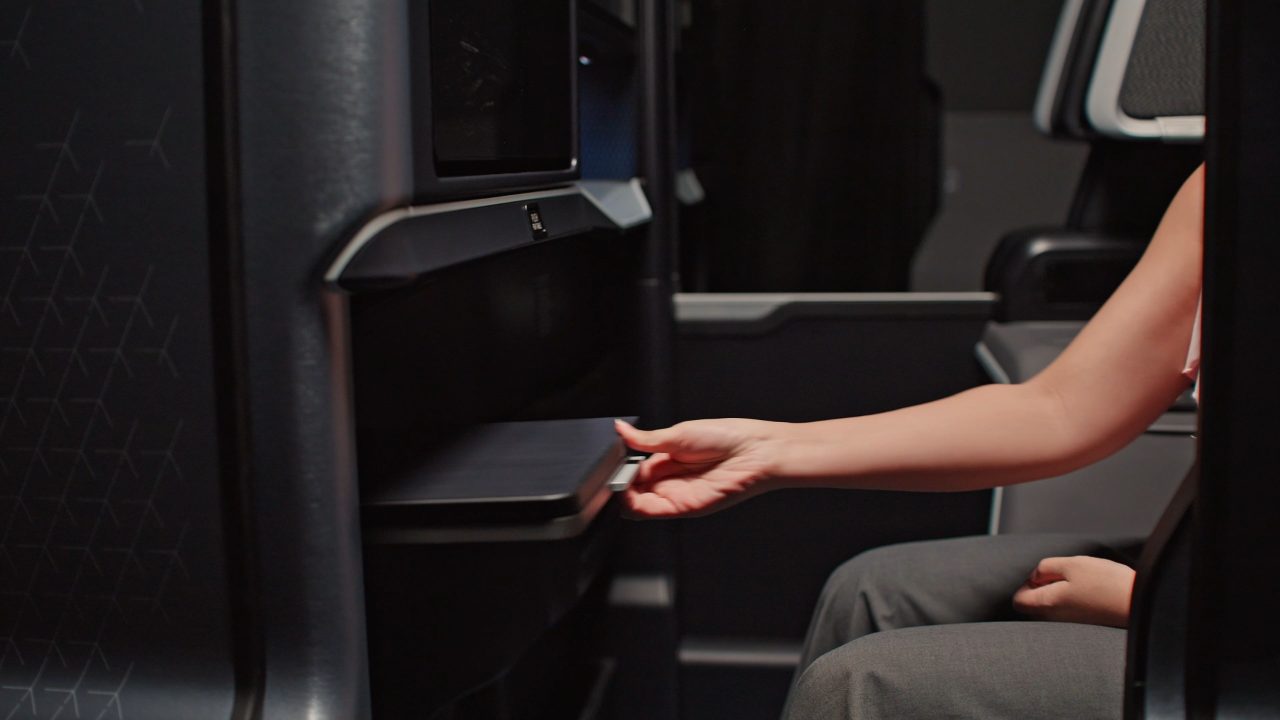
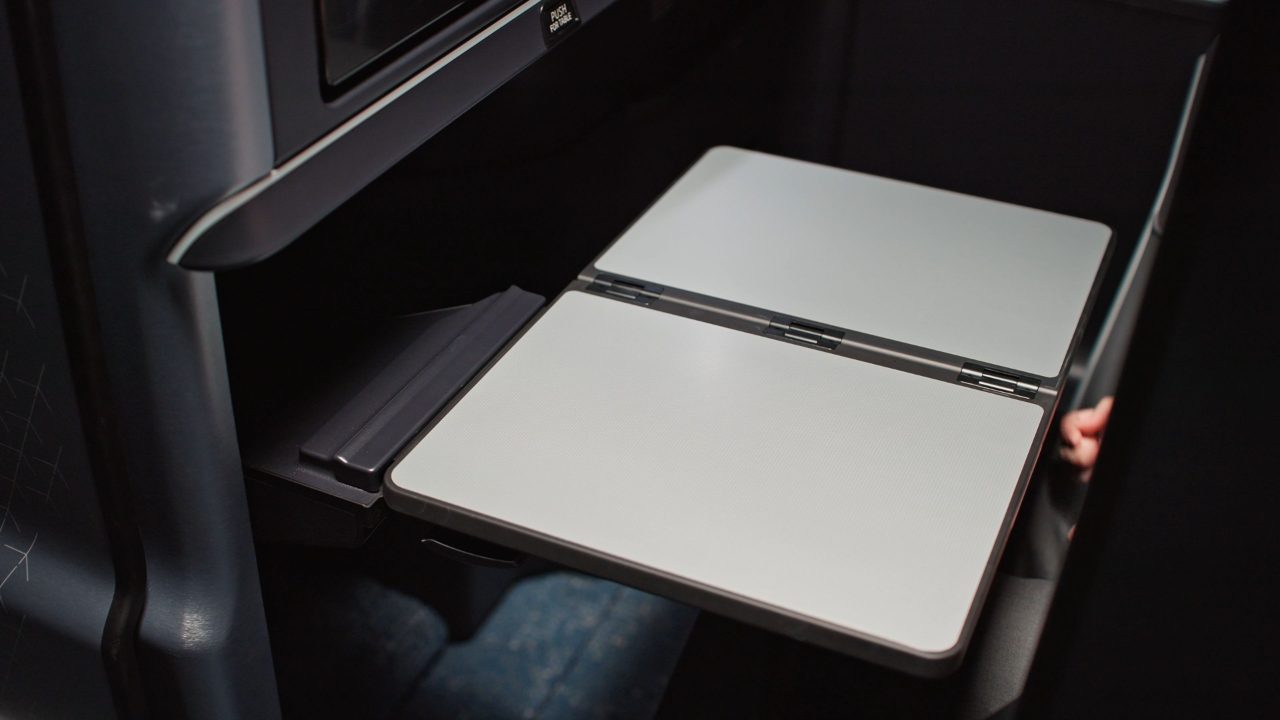
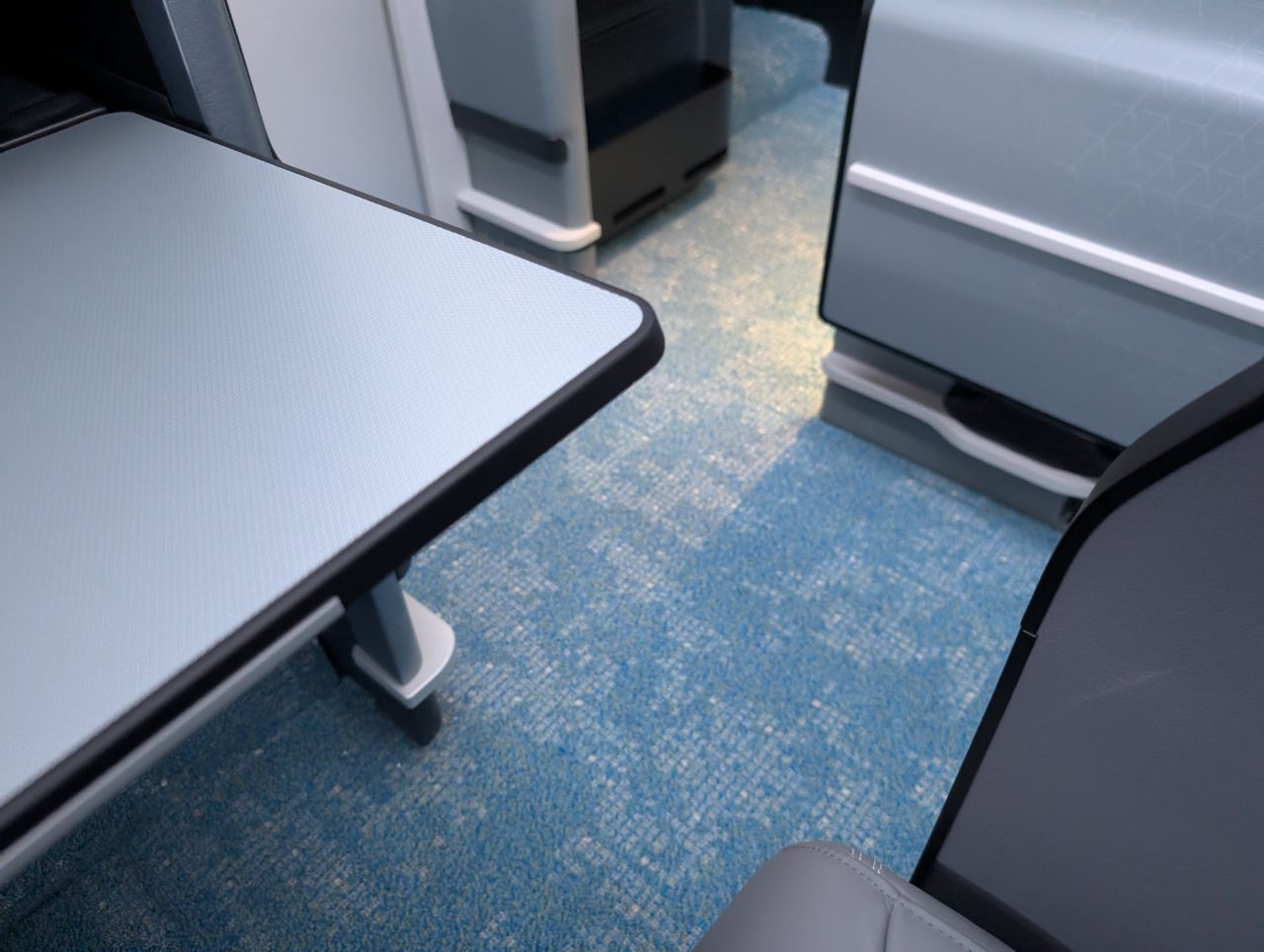
However, I did notice that the tray table, when fully deployed, traps you in your seat. Because of the shell of the seat, it cannot slide forward sufficiently to create a big enough gap to exit the seat (it’s less than 13cm) — a pet peeve of mine.
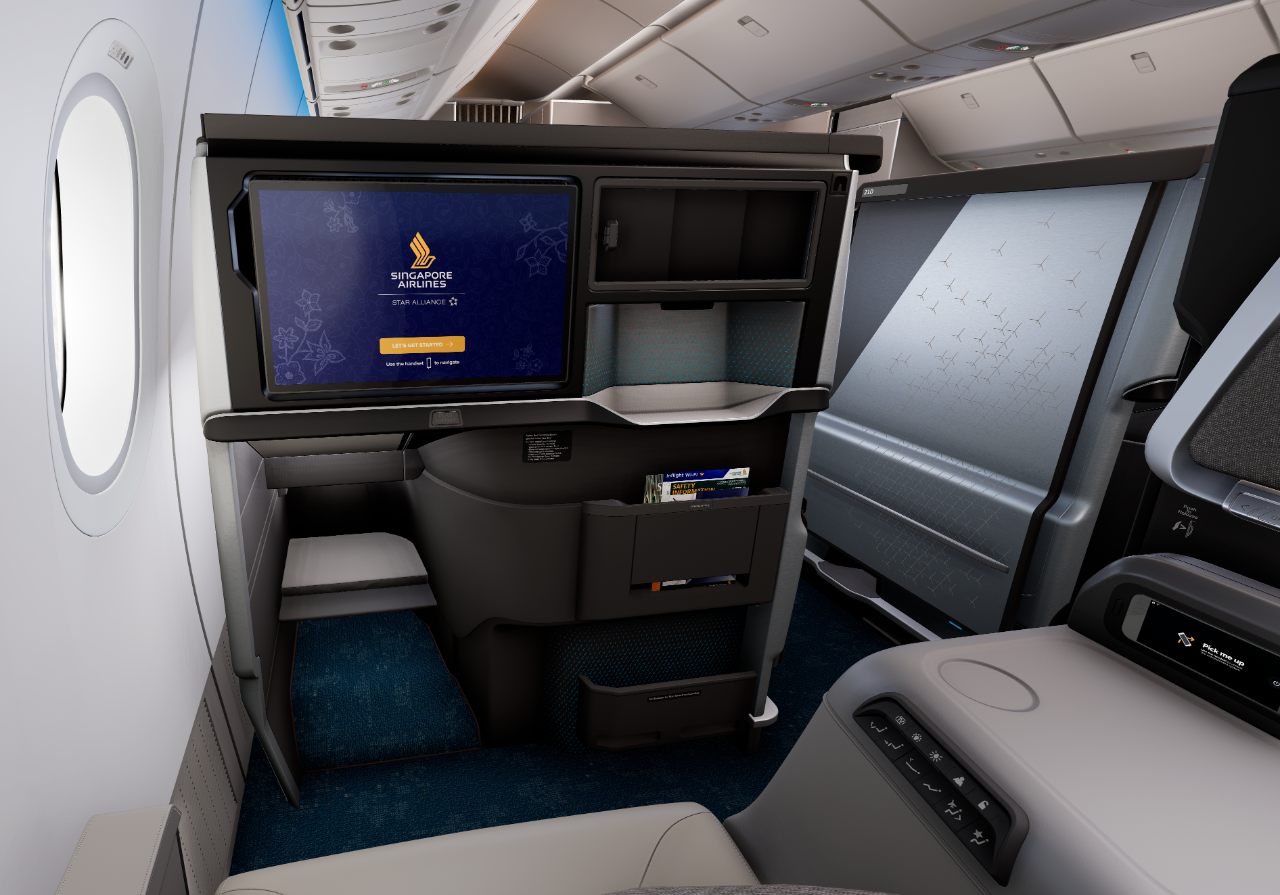
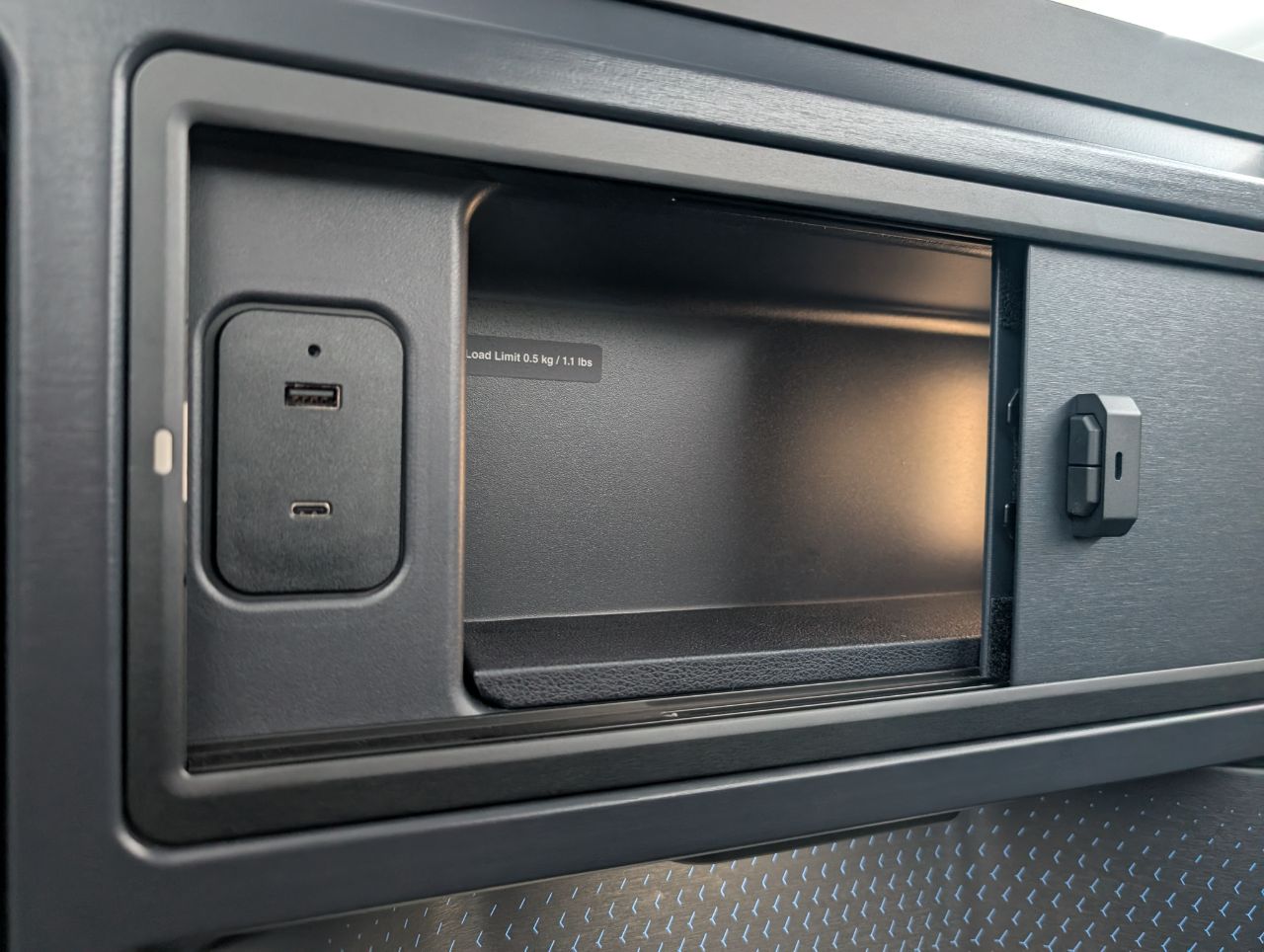
In addition to the side console, storage options include a recessed cubby next to the screen, which slides back to reveal a USB-A (B777-9 only) and USB-C port. There’s also a literature pocket, and a low bin near the floor big enough for a laptop.
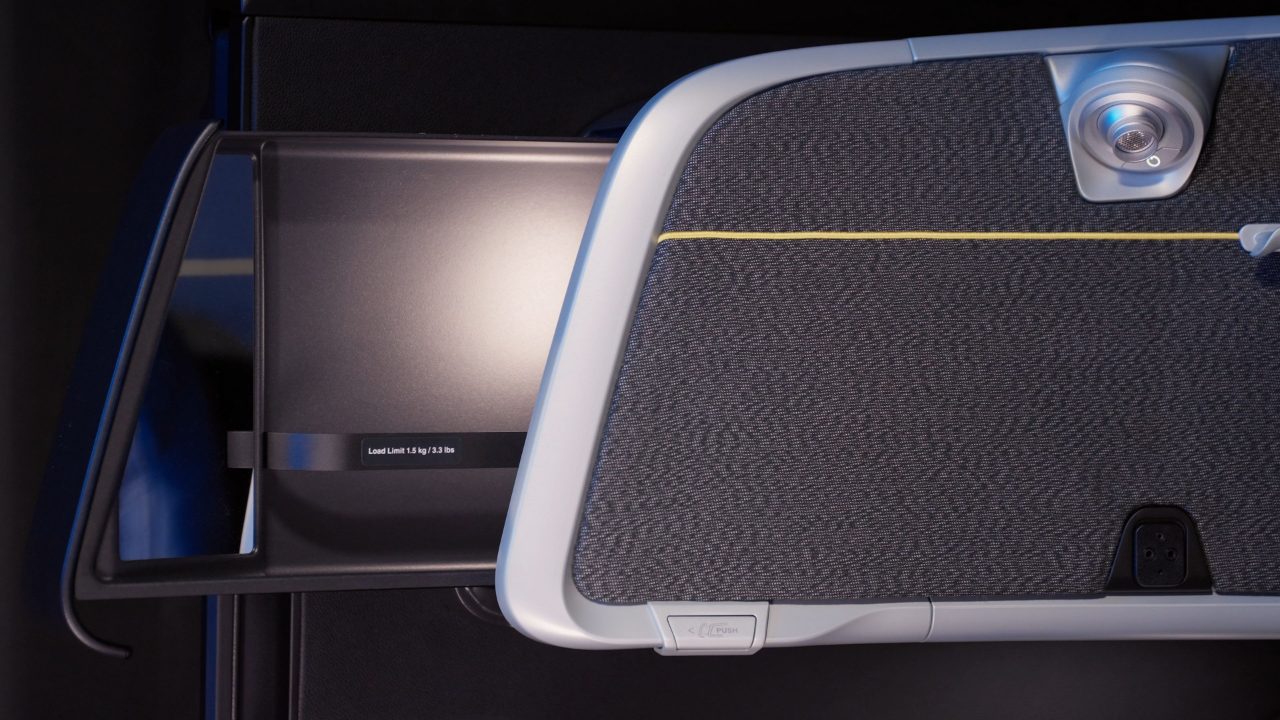
Another easy-to-miss storage feature is cleverly tucked away in the wing panel beside your head, which slides out to reveal a storage tray for water bottles or headphones. A vanity mirror can be found here too.
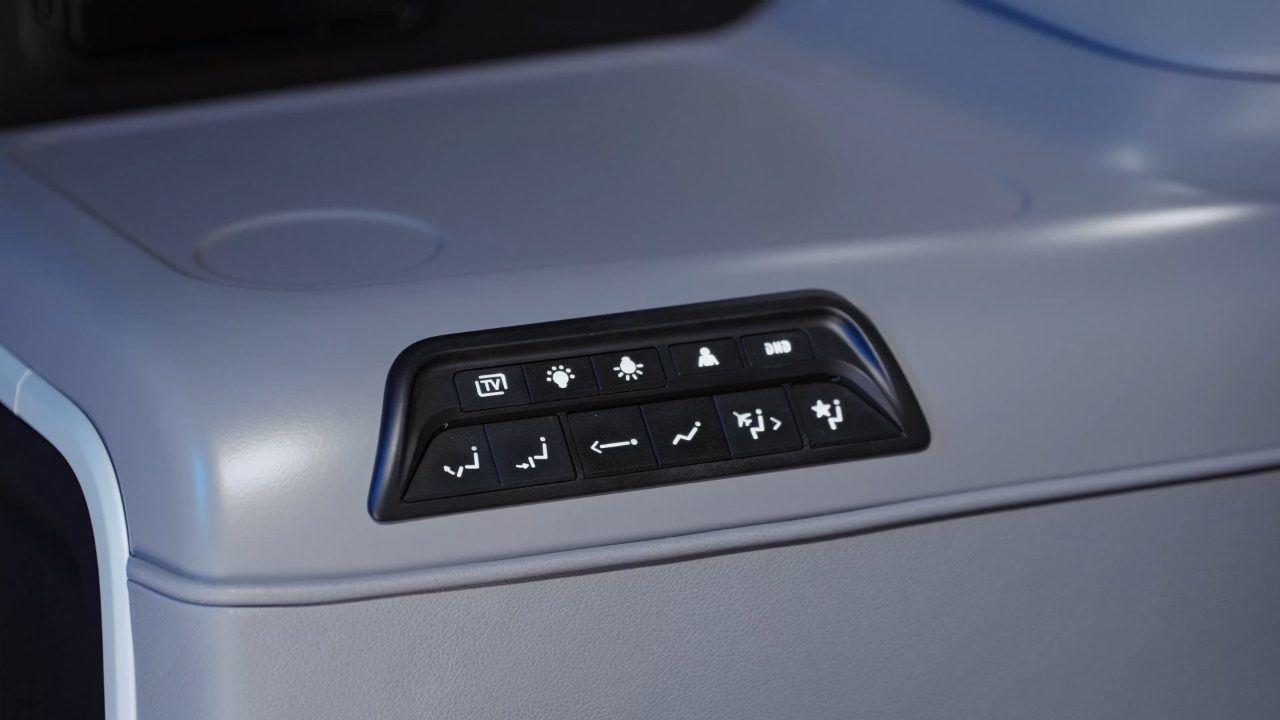
Seat controls are found in the side console, with presets for full upright, lounging and bed modes, along with individual footrest controls. Just like First Class, the Business Class seat also has a “memory” button that recalls the customer’s preferred position, saved from a previous flight. There are dedicated buttons for the IFE screen, lighting controls, and a Do Not Disturb mode.
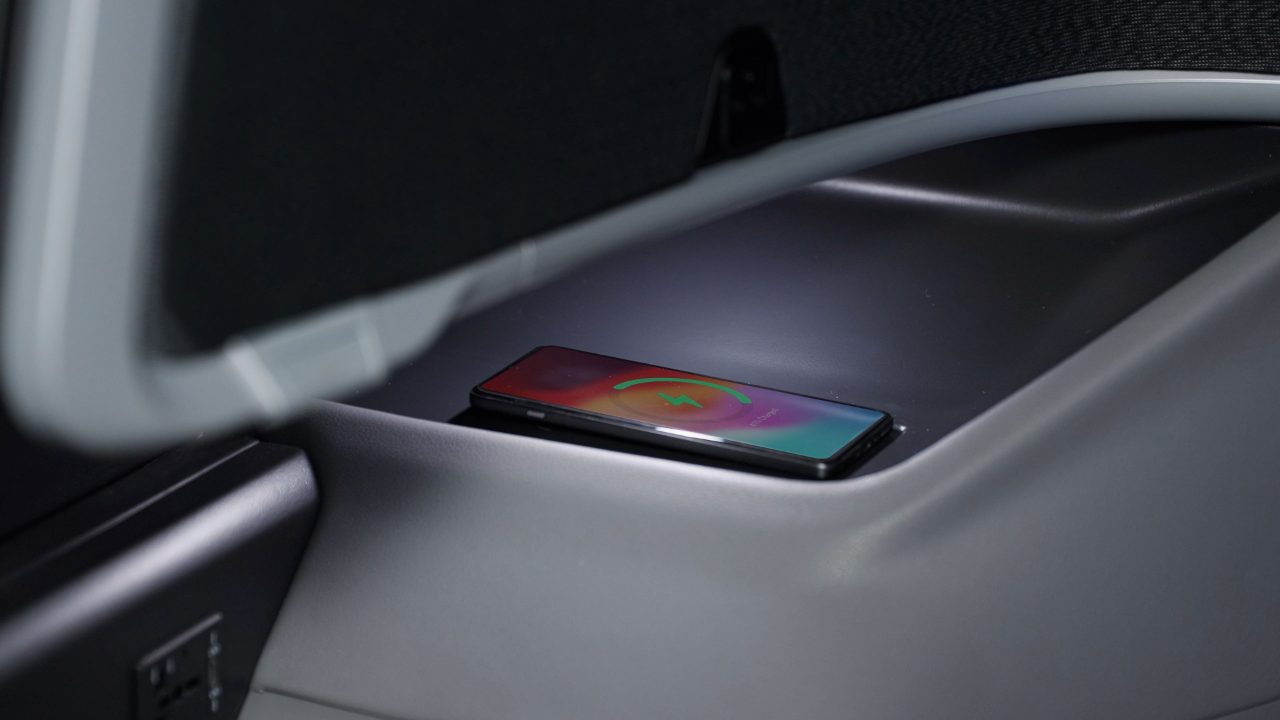
Charging options include a universal AC outlet, two USB-C ports, and a wireless charging pad. USB-A charging is only available on the B777-9.
The 4K IFE screens measure 22 inches on the A350-900LH/ULR, and 20 inches on the B777-9 (surprisingly, while the B777-9 seat is wider, the A350 screen is bigger). A discreet finger grip sculpted into the edge of the bezel lets you tilt the screen down towards you when you’re reclined.
The new Business Class seat looks like it fixes most of the complaints that passengers had about its 2013J predecessor, though its aesthetics won’t be for everyone.
New Premium Economy Class
 |
|
| Seat Manufacturer: Collins Aerospace Designer: Factorydesign |
|
| B777-9 | |
| No. of Seats | 36 |
| Configuration | 2-4-2 |
| Seat Pitch | 40″ |
| Seat Width | 19″ |
| Seat Recline | Up to 9″ |
| IFE Screen | Up to 16″ 4K |
| Touchscreen | ✅ |
| OLED | ✅ (19 of 31 aircraft) |
| Spatial Audio | ✅ |
| Bluetooth Audio | ✅ |
| AC Power | ✅ |
| USB-A | ✅ (1x, 12 of 31 aircraft) |
| USB-C | ✅ (1x) |
| Wireless Charging | ❌ |
| Other Features |
|
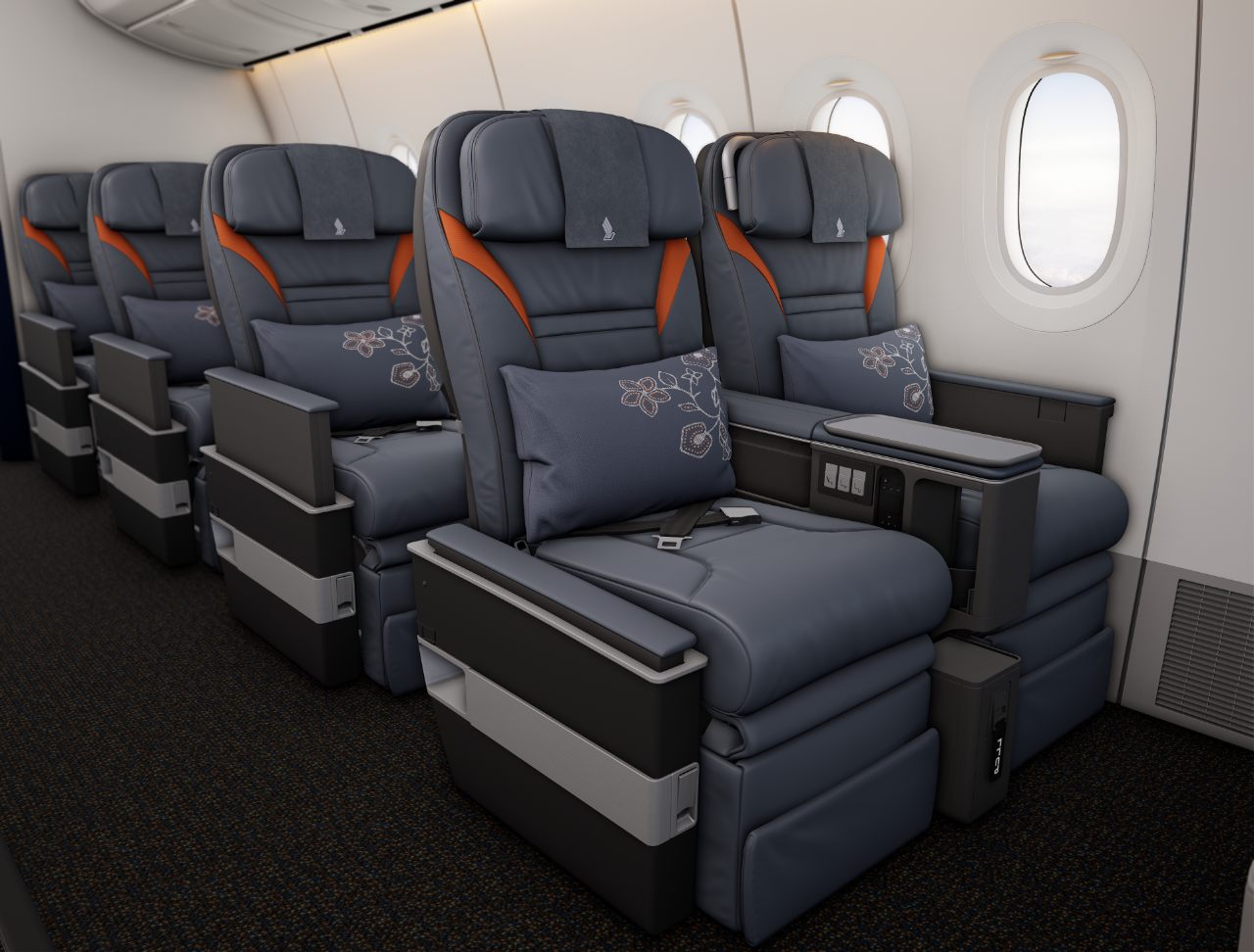
Singapore Airlines’ new Premium Economy Class seat will be exclusive to the Boeing 777-9, with 36 seats in a 2-4-2 configuration.
Seats are clad in full-grain premium leather in a slate blue-grey tone, with bright orange accents on the inner edges of the headrest wings. Again, this is a very different direction from First and Business Class — three different design studios were involved in this project, and it definitely shows.
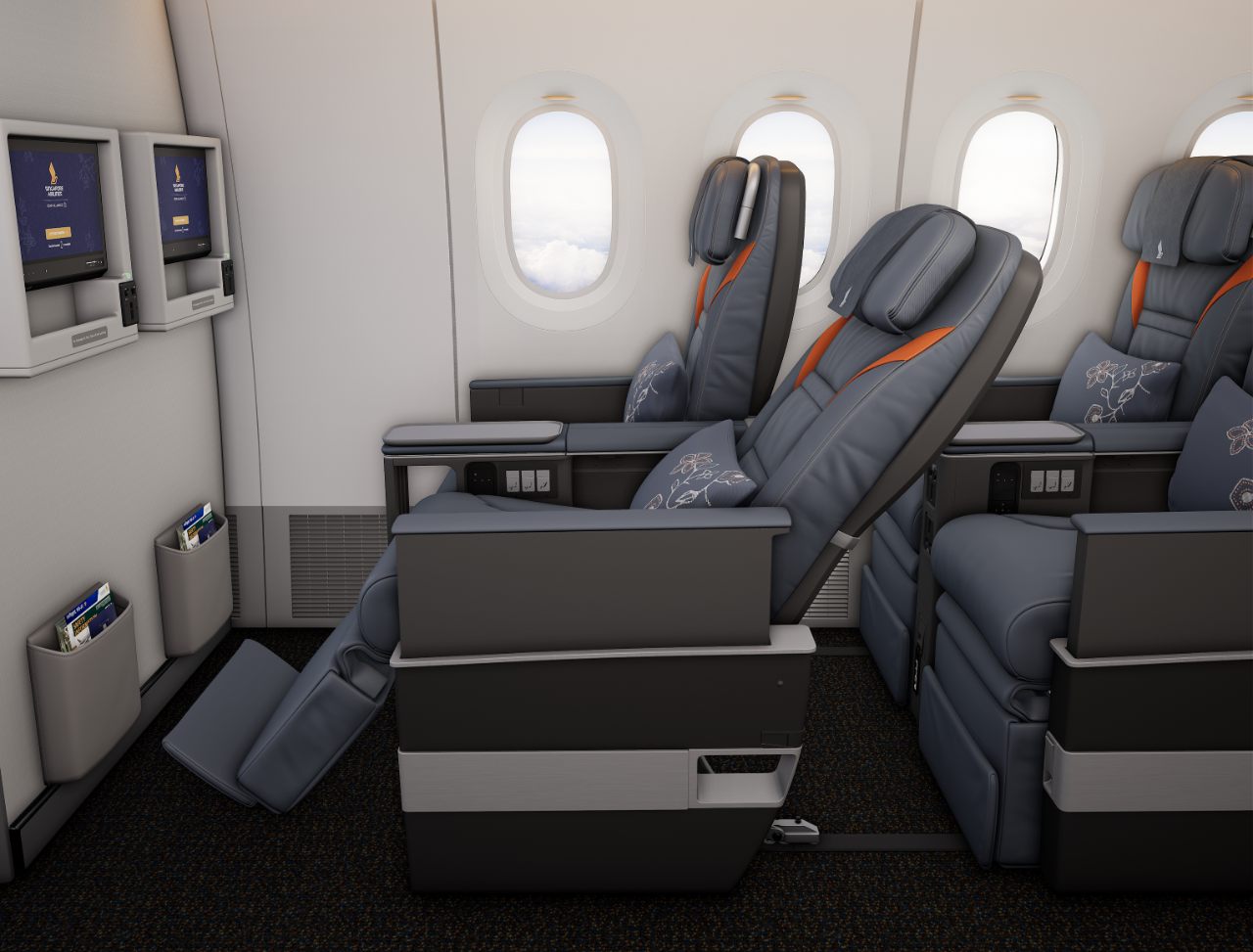
Seats measure 19 inches wide, with 40 inches of pitch and up to nine inches of recline. Each seat has a four-way adjustable headrest and leg rest with adjustable footrest. Seat controls (manual, not electric) are embedded in the shared armrest, adjacent to a small storage compartment and inflight entertainment remote.
Passengers have an adjustable reading light, a bi-fold tray table equipped with a personal electronic device holder, and a separate cocktail tray to enjoy drinks and snacks without deploying the full table.
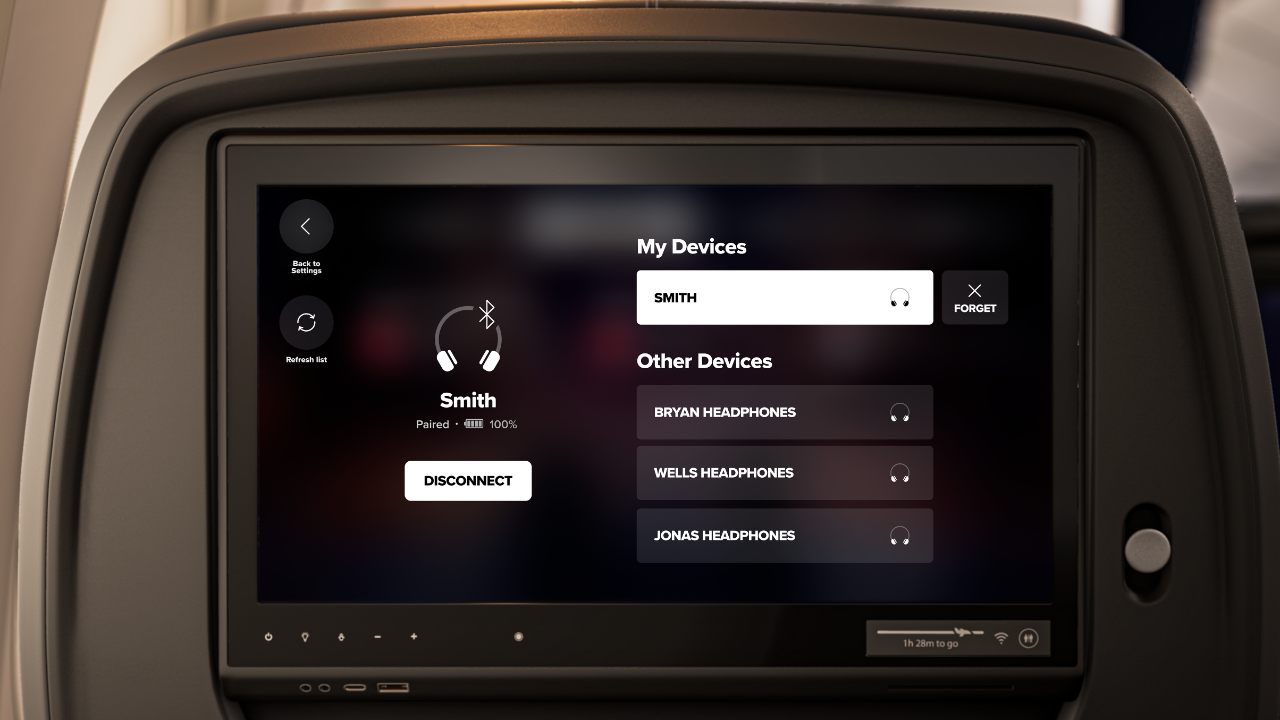
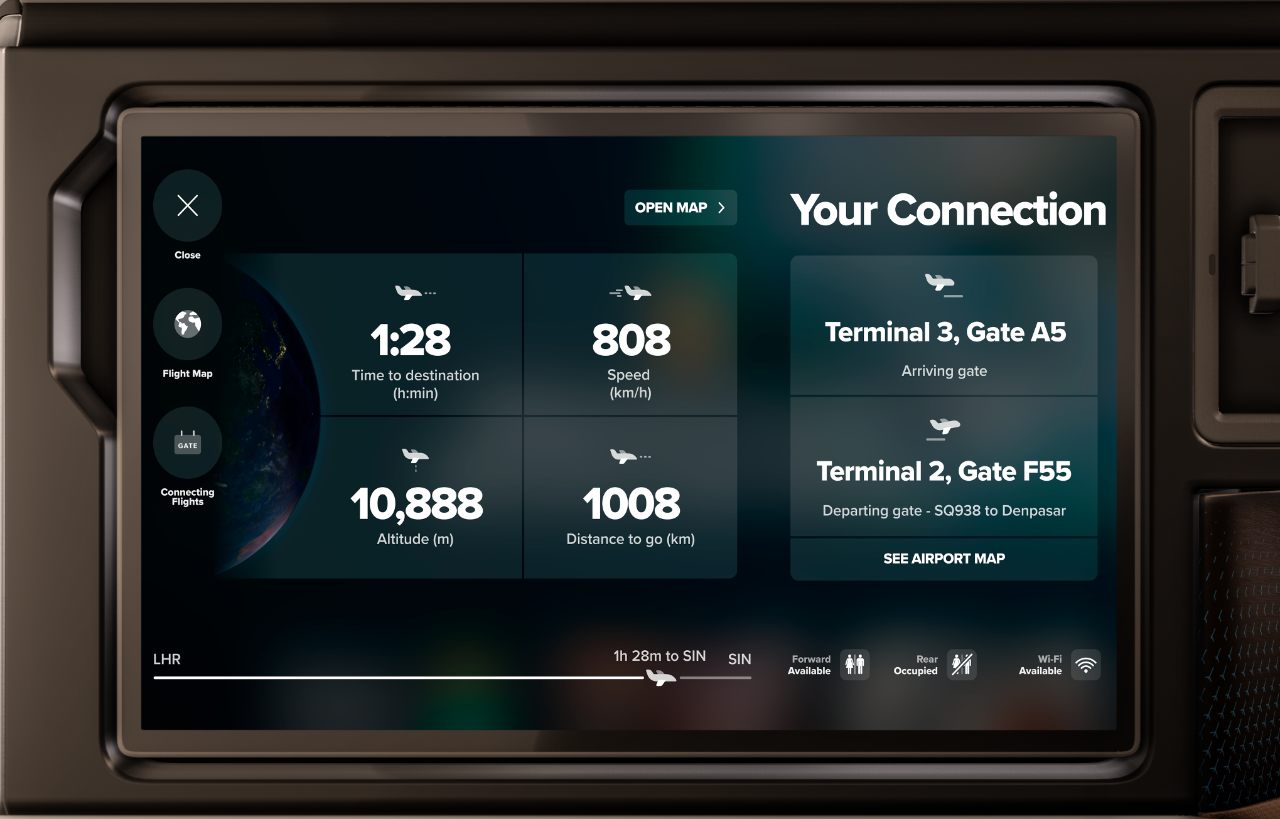
The next-generation KrisWorld entertainment system supports spatial audio and Bluetooth connectivity, and can be navigated through a dedicated handset. All passengers get 4K touchscreens of up to 16 inches, USB-C charging ports and universal AC power. Wireless charging is not available, though I wouldn’t really have expected to see it here anyway.
Depending on which version of the B777-9 you’re on, you’ll get either a USB-A port or an OLED screen (more on the two versions in the Economy section below).
It looks like a perfectly comfortable seat, with all the modern tech you’d expect. But it’s hard to feel like this isn’t a missed opportunity, given what rivals are doing in this cabin. Besides, it lacks any sort of privacy, and it’s disappointing to know that this is what we’re stuck with for the next decade.
New Economy Class
 |
|
| Seat Manufacturer: Collins Aerospace Designer: Factorydesign |
|
| B777-9 | |
| No. of Seats | 204 |
| Configuration | 3-4-3 |
| Seat Pitch | 31-32″ |
| Seat Width | 17.6″ |
| Seat Recline | Up to 6″ |
| IFE Screen | Up to 13″ 4K |
| Touchscreen | ✅ |
| OLED | ✅ (19 of 31 aircraft) |
| Spatial Audio | ✅ |
| Bluetooth Audio | ✅ |
| AC Power | ✅ (12 of 31 aircraft) |
| USB-A | ✅ (1x, 12 of 31 aircraft) |
| USB-C | ✅ (1x) |
| Wireless Charging | ❌ |
| Other Features |
|
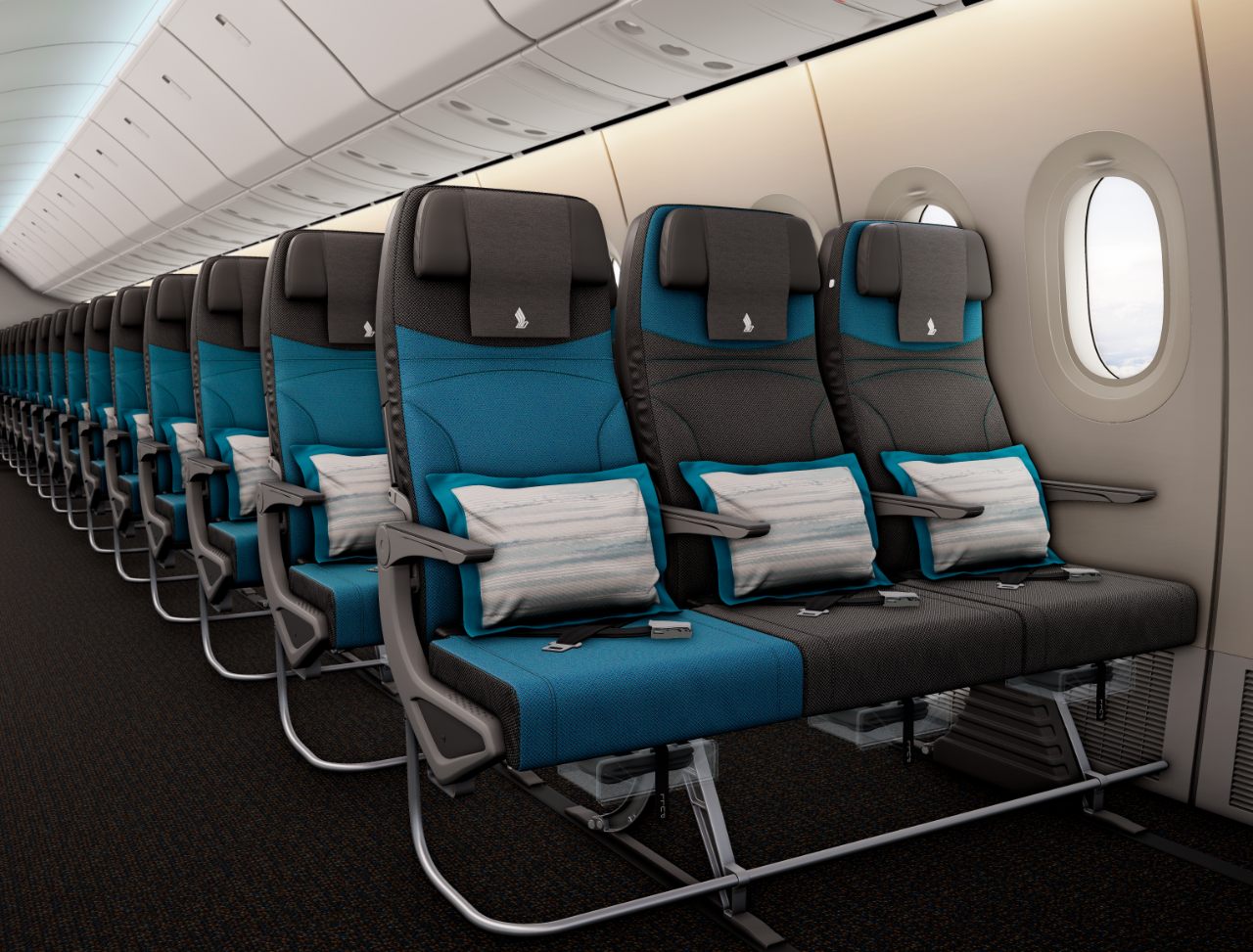
Singapore Airlines’ new Economy Class seat will also be exclusive to the Boeing 777-9, with 204 seats in a 3-4-3 configuration. Seats are 17.6 inches wide, with 31-32 inches of pitch and up to six inches of recline.
Perhaps the most striking thing about this cabin is the colour asymmetry. The aisle seat is in teal, and the middle and window seats are charcoal with teal trim (apparently, it’s a visual trick to break up a dense cabin — Lufthansa does something similar on its A350s by shading its Economy seats from dark blue at the windows to lighter blue in the middle).
Seats feature wool-blend upholstery, ergonomic cushioning, a four-way adjustable headrest, and a redesigned seat reclining mechanism with greater knee and shin clearance. I’d be very interested to see what kind of a difference this makes in practice, because everyone knows the annoyance of having their knees bumped by a reclining seat in front.
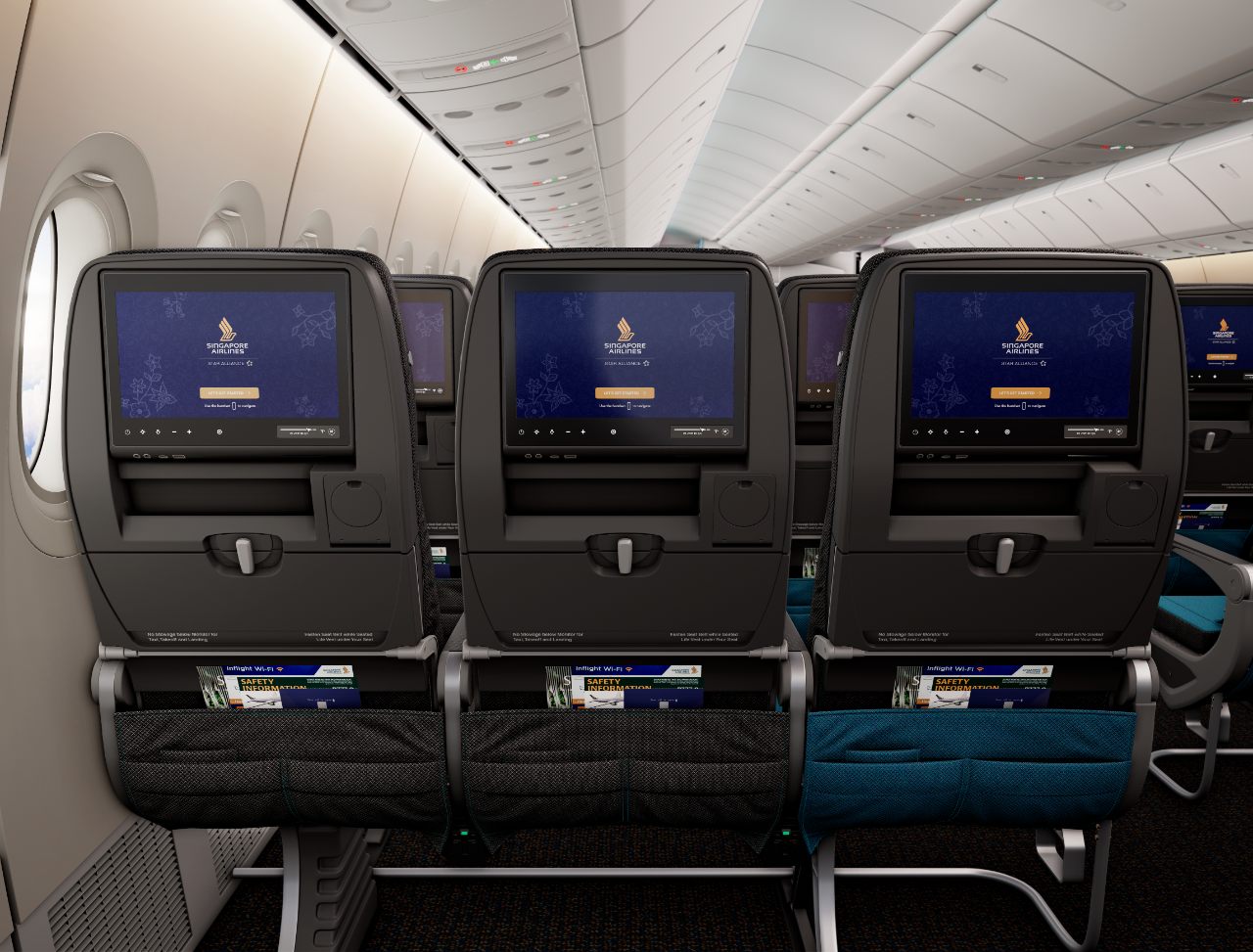
Passengers have a bi-fold tray table, cupholder, and coat hook, with under-monitor storage space for personal items.
The next-generation KrisWorld entertainment system supports spatial audio and Bluetooth audio connectivity, with up to 13-inch 4K touchscreens. A secondary display at the bottom of the screen tracks flight progress, Wi-Fi status and lavatory occupancy.
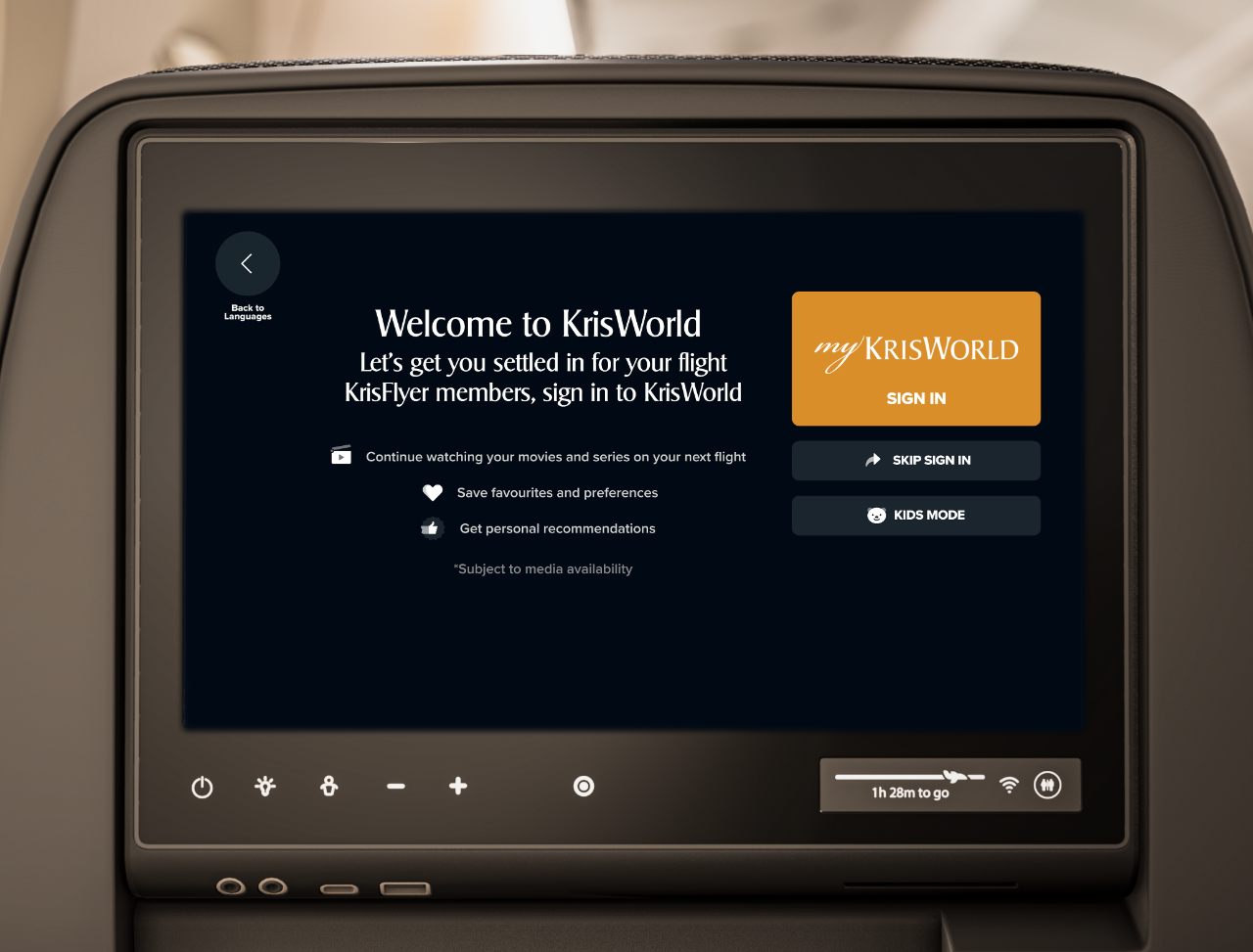
USB-C ports are available on all aircraft, but whether you get USB-A and AC power depends on which B777-9 you’re on.
While First and Business Class are identical across all B777-9s, there will be two different versions for Premium Economy and Economy.
| B777-9 v1 | B777-9 v2 | |
| No. of Aircraft | 12 | 19 |
| Premium Economy |
|
|
| Economy |
|
|
For Premium Economy passengers, the difference is minor. The v1 aircraft have a USB-A port, while the v2 aircraft lose the USB-A port but gain an OLED display. Either way, you’ll have USB-C and AC power.
For Economy passengers, the trade-off is bigger. The v1 aircraft have USB-A ports and AC power. The v2 aircraft upgrade you to an OLED display, but at the expense of both. USB-C becomes your only way to charge.
Granted, a high-powered USB-C port can handle most of what passengers carry today, like phones, tablets, earbuds and laptops. But it seems like a bold decision to do away with AC power completely, especially on an aircraft that’s meant to fly long-haul routes (SIA doesn’t offer AC power in Economy on its B737-8 MAX fleet, but it flies short-haul).
On the bright side, you could be an Economy passenger on a B777-9 enjoying an OLED screen, while those plebs in First and Business go without!
My initial thoughts
I want to caveat this by saying that at the time of writing, I had yet to have any hands-on experience with the seats (Business Class mock-up aside, which had limited functionality), so all this is based on what I’m seeing from the renders and reading from the press releases.
That said, if I were to group these seats into three categories: behind the curve, on par, and market-leading, then my impressions are as follows.
| Preliminary Verdict | Seats |
| Market-Leading |
First Class |
| On Par |
Business ClassEconomy Class |
| Behind the Curve |
Premium Economy Class |
First Class: Market-leading
|
 |
|
| 2027F | 2013F | |
| Manufacturer | Collins | JAMCO |
| Configuration | 1-2-1 | 1-2-1 |
| Privacy Doors | ✅ | ❌ |
| Seat Pitch | 89.5″ | 71″ |
| Seat Width | 23″ (30″ with armrests lowered) |
35″ |
| Seat Recline | 180° | 180° |
| Bed Length | 80″ | 82″ |
| IFE Screen | 32″ 4K | 24″ HD |
| Touchscreen | ✅ | ❌ |
| OLED | ✅ A350ULR |
❌ |
| Spatial Audio | ✅ | ❌ |
| Bluetooth Audio | ✅ | ❌ |
| HDMI | ❌ | ✅ |
| AC Power | ✅ |
✅ |
| USB-C | ✅ (2x) |
❌ |
| USB-A | ✅ (1x) B777-9 |
✅ (2x) |
| Wireless Charging | ✅ (1x) |
❌ |
The new First Class is undoubtedly the pick of the lot by far.
It’s beautifully and thoughtfully designed, and I haven’t been this excited about a new Singapore Airlines product for a long time — not even the 2017 Suites, which I thought was slightly underwhelming, almost as if the designers ran out of ideas of what to do with all that space.
This time, every square inch feels considered: the curved, slatted corridors, the soft batik motif walls, the elegant pendant lights, the bronze trim. If the A380 Suites were a luxury room in the sky, the new First Class is a luxury hotel.
The seat also has the tech chops to back it up, and what I appreciate the most is that it’s not an orgy of screens. Sure, there’s the mandatory 32-inch 4K monitor, but that aside, the seat remote is hidden, there’s no (arguably superfluous) control tablet like in Suites, and the touch panel almost disappears into the trim, making itself as unintrusive as possible.
But best of all, it gets the couple experience spot on. The centre suites are going to be a showstopping feature, allowing couples to do everything together (well, maybe not literally everything, wink wink). This is the A380 Suites double room concept done right: not two single rooms divided by a bed, but one unified space with absolutely no partition between them.
I can’t think of any other product on the market that rivals this.
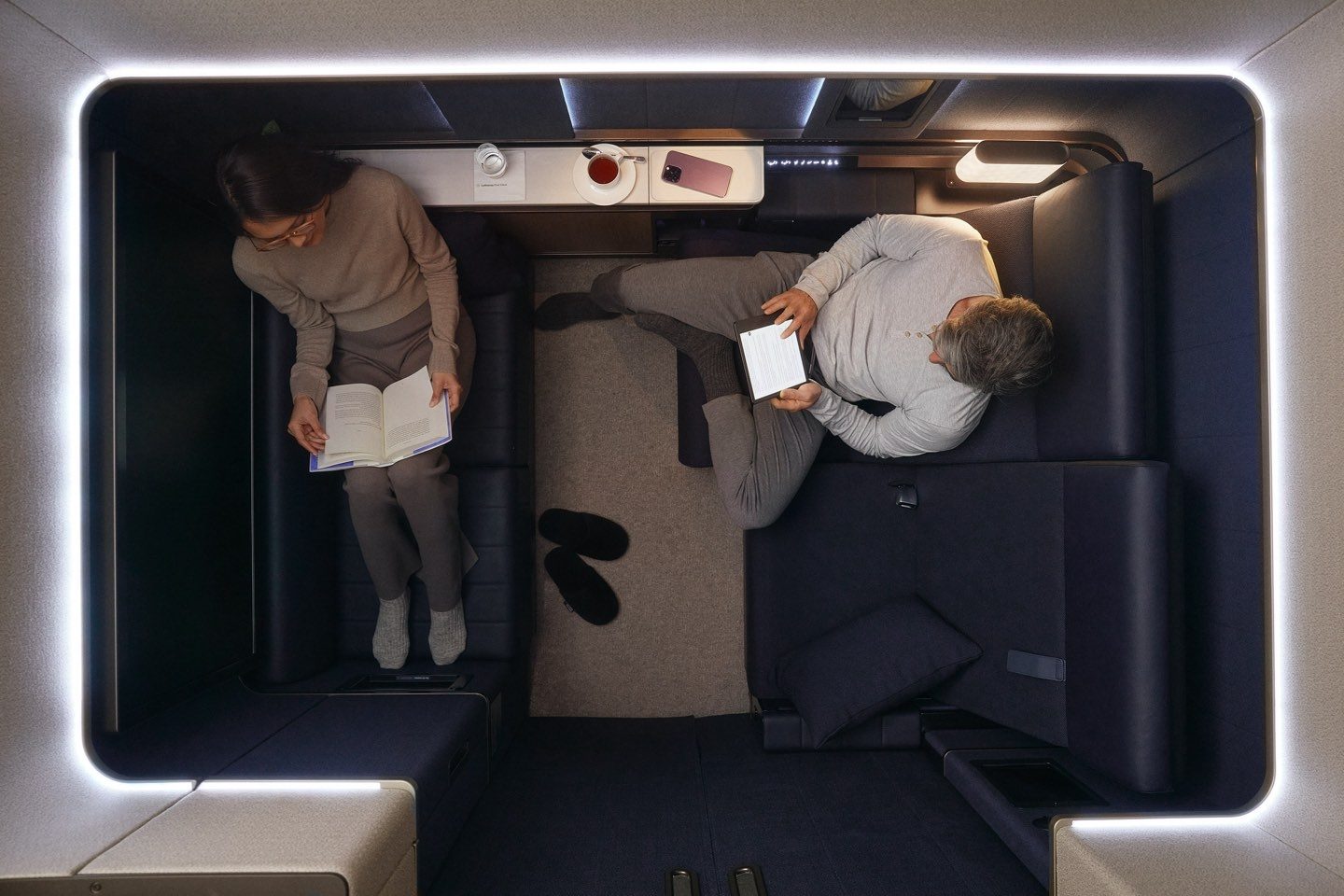
Lufthansa’s Allegris Suite Plus is probably the most direct comparison, since it was also built by Collins Aerospace and designed by PriestmanGoode. But that’s smaller than the sum of two individual seats, and only has a single tray table and monitor. That concept simply doesn’t work if you want to watch different things, or if one person wants to sleep and the other stay awake. And because it only has a door on one side, when in bed mode, the passenger further from the aisle has to awkwardly climb over the other to exit the suite.
The upcoming Qantas Sunrise First offers a separate bed and seat, but it’s largely a solo experience. JAL’s A350-1000 First has nifty tech features, but again it’s nowhere as strong when it comes to couples.
For all the disappointments over the past few years, this First Class represents Singapore Airlines at its best: understated luxury, backed by innovation that’s ahead of the pack.
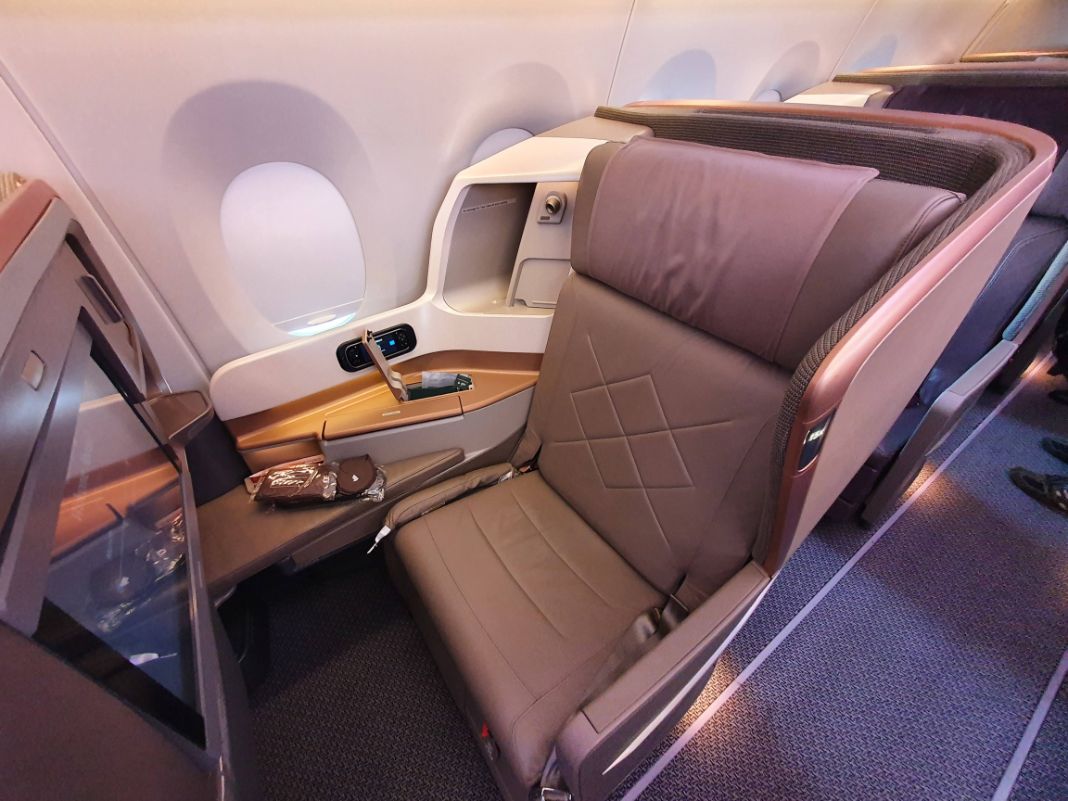
Business Class: On par
|
 |
|
| 2027J | 2013J | |
| Manufacturer | Recaro | JAMCO |
| Configuration | 1-2-1 | 1-2-1 |
| Privacy Doors | ✅ | ❌ |
| Seat Pitch | 50″ | 55″ |
| Seat Width | 22″ A350LH/ULR 24″ B777-9 |
28″ |
| Seat Recline | 180° (Reclined) | 132° (Reclined) 180° (Flip) |
| Bed Length | 79″ | 78″ |
| IFE Screen | 22″ 4K A350LH/ULR 20″ 4K B777-9 |
18″ HD |
| Touchscreen | ✅ | ❌ |
| OLED | ✅ A350LH/ULR |
❌ |
| Spatial Audio | ✅ | ❌ |
| Bluetooth Audio | ✅ | ❌ |
| HDMI | ❌ | ✅ |
| AC Power | ✅ |
✅ |
| USB-A | ✅ (1x) B777-9 |
✅ (2x) |
| USB-C | ✅ (2x) |
❌ |
| Wireless Charging | ✅ (1x) |
❌ |
The aesthetics of the new Business Class are going to divide opinion, and I’m sure there will be plenty of animated discussions about this.
But if we leave that aside, I have no issues with its functionality. The new seat won’t redefine the market like Qatar’s Qsuites did, but at the very least, it finally brings SIA on par with its peers. Privacy doors, 4K screens, Bluetooth audio, USB-C, and wireless charging are all table stakes these days, and with the upcoming addition of Starlink Wi-Fi and sleeper suits, SIA will have a much more competitive Business Class offering.
It even has an edge over next-generation products like Aria Suites, BA Club Suites or STARLUX’s A350 Business Class, whose reverse herringbone configuration means they are primarily intended as solo experiences. Those in the centre seats have no double bed option, and can’t even see their companion unless they awkwardly lean forward.

Even JAL’s staggered Business Class on the A350-1000 has an all-divorce configuration, so even with the privacy divider lowered, couples are still separated by a side console.

More importantly, the new Business Class has addressed most of the pain points that customers had about the 2013J seat. There’s no longer a need to flip the seat over, you can sleep parallel to the aisle, there’s a free choice of recline angles, and the foot cubby is significantly more generous than the A350’s notorious “foot dungeon”, regardless of which row you’re seated in.
So it doesn’t necessarily leapfrog anyone, but at this point, I’d settle for catch-up.
Premium Economy Class: Behind the curve
|
 |
|
| 2027W | 2015W | |
| Manufacturer | Collins Aerospace | ZIM^ |
| Configuration | 2-4-2 | 2-4-2 |
| Seat Width | 19″ | 18.5″ |
| Seat Pitch | 40″ | 38″ |
| Seat Recline | 9″ | 8″ |
| IFE Screen | Up to 16″ 4K | 13.3″ HD |
| Touchscreen | ✅ | ✅ |
| OLED | ✅ (19 of 31 aircraft) |
❌ |
| Spatial Audio | ✅ | ❌ |
| Bluetooth Audio | ✅ | ❌ |
| HDMI | ❌ | ❌ |
| AC Power | ✅ |
✅ |
| USB-A | ✅ (1x, 12 of 31 aircraft) |
✅ (2x) |
| USB-C | ✅ (1x) |
❌ |
| Wireless Charging | ❌ | ❌ |
| Reading Light | ✅ | ✅ |
| Calf Rest | ✅ | ✅ |
| ^ZIM for A380-800 and B777-300ER, Safran for A350-900LH and A350-900ULR. I’m comparing this with the B777-300ER seat, since that’s the aircraft the B777-9 is meant to replace |
||
Premium Economy is by far the most disappointing seat of the four.
I don’t care about the lack of wireless charging. It’s far from a standard feature in Premium Economy, and I don’t really see the point when this cabin has so little surface space to begin with. On some airlines (e.g. United), the wireless charging pad is tucked into the seat pocket, which begs the question — why not just use a wire?
I don’t care about the lack of electric seat controls. This would have been nice to have, and would have made the product feel more premium and closer to regional Business Class, but such mechanisms add weight and maintenance complexity, and I know it’s a lot to ask (JAL and Emirates have done it though).
But the current trend in Premium Economy is towards greater privacy, so I was expecting to see larger privacy dividers like the ones Emirates and JAL have introduced, or at the very least, privacy wings around the headrest, like Cathay Pacific.
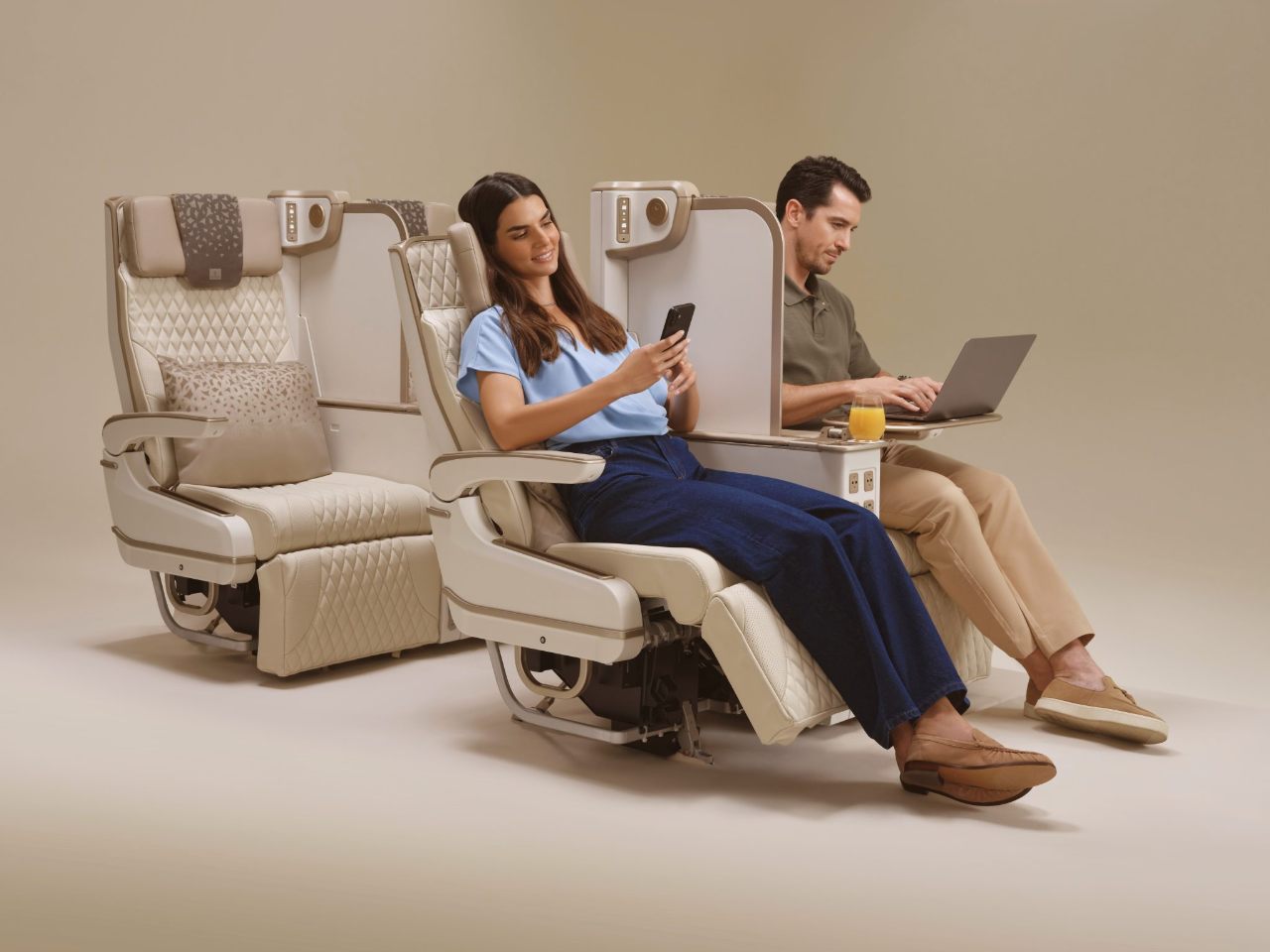
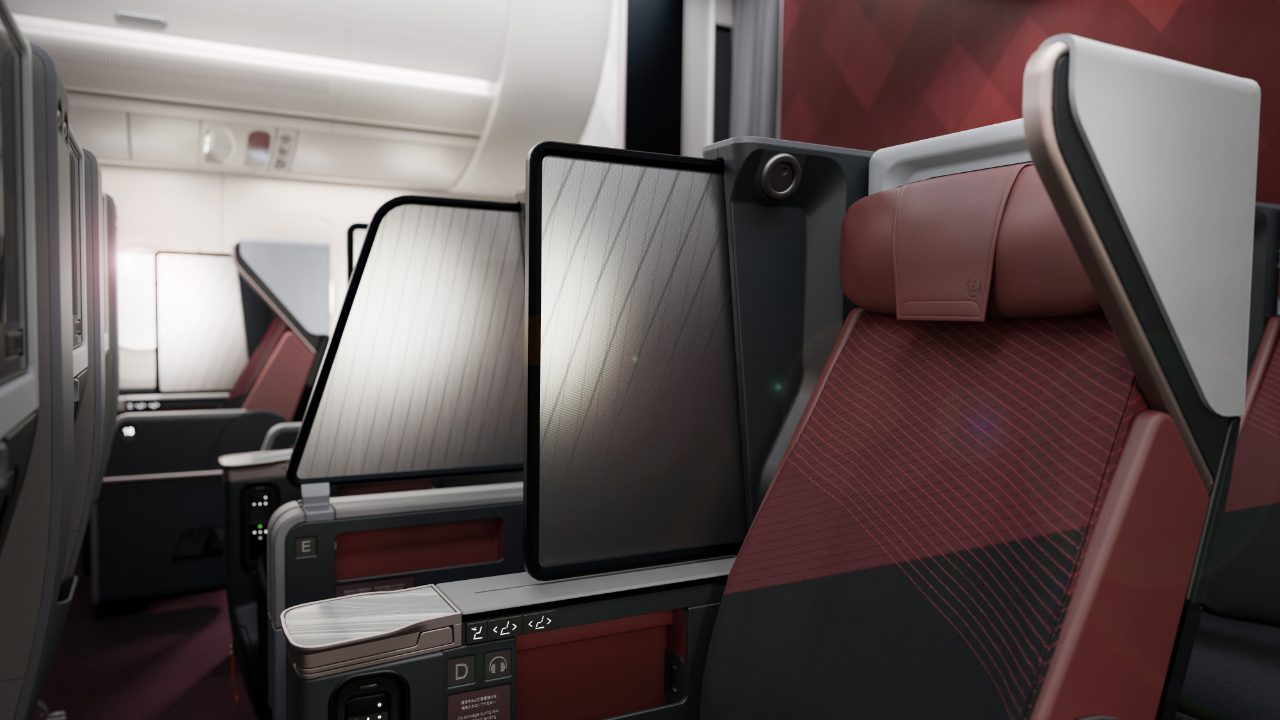
Instead, we got a modest evolution of the current Premium Economy seat. Show the old and new side by side to the average person, and I reckon they’d struggle to tell you which is which!
Sure, the seat pitch is slightly better and the seat reclines a little more, but I’d trade that for a shell, partition or some side wing that provides better visual isolation from your seatmate. The tech-related upgrades are nice, but again they’re table stakes, the sort of thing that passengers would expect from any new seat in 2027.
What makes this even more frustrating is how long SIA had to get it right. The current seat dates back to 2015, and with that kind of vintage, you really should be moving to the next generation, not making incremental upgrades.
As it is, we’ll have a very mediocre Premium Economy seat flying into the late 2030s and beyond, and only on the B777-9s. Besides, the A350s are keeping their existing Premium Economy seats, so most Premium Economy travellers won’t even see this modest upgrade for years.
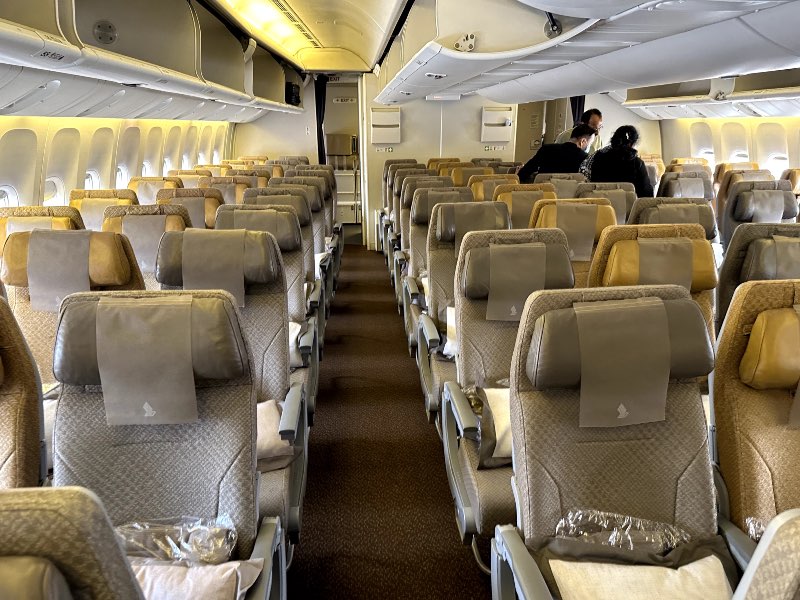
Economy Class: On par
|
 |
|
| 2027Y | 2013Y | |
| Manufacturer | Collins Aerospace | Safran Z300 |
| Configuration | 3-4-3 | 3-3-3 |
| Seat Pitch | 31 to 32″ | 32″ |
| Seat Width | 17.6″ | 18″ |
| Seat Recline | Up to 6″ | Up to 6″ |
| IFE Screen | Up to 13″ 4K | 11.1″ |
| Touchscreen | ✅ | ✅ |
| OLED | ✅ (19 of 31 aircraft) |
❌ |
| Spatial Audio | ✅ | ❌ |
| Bluetooth Audio | ✅ | ❌ |
| HDMI | ❌ | ❌ |
| AC Power | ✅ (12 of 31 aircraft) |
✅ (3 pax: 2 outlets) |
| USB-A | ✅ (1x, 12 of 31 aircraft) |
✅ (2x) |
| USB-C | ✅ (1x) |
❌ |
| Wireless Charging | ❌ | ❌ |
| ⚠️ We’re talking about the B777-9 |
| It’s worth a reminder that Economy Class on the A350-900LH is very much behind the curve, now that SIA has decided against installing new seats for the A350 retrofit. |
Economy Class is going to feel noticeably more squeezed on the B777-9 that replaces the B777-300ER, with the seating configuration going from 3-3-3 to 3-4-3. The new configuration also means that 4 in 10 seats will be middles, up from 3 in 9, and the share of aisle and window seats will likewise fall.
But really, that’s simply where the industry has been for a long time. In fact, SIA deserves credit for sticking to 9-across Economy on its B777-300ERs when most of its competitors were cramming in an extra seat. At one point, it was even used as a marketing tool!

At the end of the day, however, the average Economy Class passenger doesn’t know about 9- or 10-across when making a booking; he/she is more likely to look at fares and schedule. If 10-across enables lower fares, that’s what’s going to win the day.
If it’s any consolation, the seat width isn’t nearly as badly affected as you might think. It’s “only” going from 18″ to 17.6″, because the B777-9’s fuselage is slightly wider than the B777-300ER’s.
SIA has added the 4K screens, Bluetooth audio connectivity and USB-C ports that passengers demand, and that’s probably the best that one could have hoped for. There’s only so much room for innovation in Economy — quite literally.
If you ask me, the bigger concern here is the decision not to have AC power in Economy on 19 out of 31 aircraft, more than 60% of the fleet. Sure, it saves weight, and a USB-C port can do a lot of heavy lifting, but what if you want to power multiple devices? What if there are situations where you still need AC power, e.g. older CPAP machines? What’s more, it’s not something you can really plan around, since I doubt there’ll be an indication when booking whether the aircraft operating your route has those features (and even so, a last-minute swap could change that).
So I’d certainly feel a little bit anxious about flying long-haul without AC power. But SIA is hardly the pioneer here: Air France and China Southern don’t offer Economy AC power on their A350-900s, nor does Air New Zealand on its B787-9s.
Unsurprisingly, this was also the seat on which the least time was spent during the media briefing, so I’ll need to get some hands-on time with it at the event to see how it handles.
Unanswered questions
How fast will these seats be rolled out?
There is no doubt that all four seats are major upgrades over their predecessors (well, maybe not Premium Economy!). But the real question is whether these will be flying in any meaningful numbers over the next few years.
With the first retrofitted A350-900LH only due to enter service in the second half of 2027, an uncertain timeline for the A350-900ULR retrofits, and the Boeing 777-9 spawning endless jokes about vaporware, the cold hard reality is that SIA’s increasingly uncompetitive 2013 Business Class seat — and to a lesser extent, the 2013 First Class seat — will be flying for many years to come.
Hindsight is always 20/20. We can say that SIA should have given up waiting for Boeing to get its act together and started the A350 retrofits earlier. We can say that SIA should have ordered the A350-1000 instead. It is what it is.
These new seats are going to get a ton of publicity in the weeks to come, but your chances of actually flying on them in the near future are going to be slim.
Where are they heading?
Singapore Airlines has yet to announce what route the new seats will launch on, despite several questions during the media briefing.
London and Sydney are the obvious candidates, but it’s clear the airline would rather play things close to its chest until it’s cleared the certification hurdle and has a more definite entry-into-service date.
What about the regional fleet?
SIA’s regional Business Class product on the B787-10 and A350-900MH dates back to 2018, and while it’s not long in the tooth by any means, we’re getting to the point where the designers will have to start cracking their heads about what will replace it.
I’m hoping we see a modified version of the long-haul product, similar to what Cathay Pacific has done with the Aria Suite and Aria Studio, though based on my discussions, nothing is in the works yet.
What about award redemptions?
For many of us, redeeming miles is the only way we’re ever going to see the insides of SIA’s new First and Business Class cabins.
But blocking Saver redemptions for new cabin products is something that SIA has done in the past. When it launched the 2006 First and Business Class seats on the B777-300ER, only Unrestricted redemptions (the forerunner of today’s Advantage awards) were permitted. It wasn’t until March 2012 that members could make Saver redemptions for these cabin products.
Likewise, Suites Saver awards were not available until 2012, five years after the product debuted. Until 2009, it wasn’t even possible to redeem Suites with miles, period!
However, it seems like SIA has stopped this practice. There were no restrictions when the 2013 First and Business Class seats launched, nor the 2017 Suites and Business Class on the A380. Fingers crossed this continues.
Conclusion
After years of delays and increasingly awkward comparisons with the competition, it’s a relief to finally see what Singapore Airlines has been working on — and for the most part, I’m happy with what I see.
The new First Class is a genuine showstopper, the kind of product that reminds you how SIA built its reputation in the first place. Business Class won’t redefine any paradigms, but it closes the gap with rivals and fixes nearly every gripe about the 2013J seat (its colour scheme will divide opinion, I’m sure). Economy is about as good as you can hope for in a 10-across cabin. The less said about Premium Economy the better. It’s a missed opportunity we’ll be living with for a long time.
But there’s no point in having a great seat that you can’t actually fly in, and realistically speaking, delays to the A350 retrofits and the B777-9 doing its best impression of Schrodinger’s aircraft mean that most SIA passengers will be sitting in old seats for years to come.
We’ve seen the future; we just don’t know when it’ll get here.
What do you make of Singapore Airlines’ new cabin products?

What hot garbage this is 🤣
Great trend follower. Luckily SQ didn’t tease and tease, and alas! Playing catching up.
Big disappointment again, time to fly other airlines. Waiting for StarLink on part of the fleet till 2032, but paying highest prices in the industry.
So disappointed in the design, especially the new colour for business class. Can’t we just have warm tone to make it feel more luxurious? And the PE? No comments, can the management take a look at what their competitors are pushing?