
If your goal is to collect KrisFlyer miles, one of the first decisions you’ll face is whether to use a Singapore Airlines cobrand card or a non-cobrand card.
Cobrand cards are jointly issued by a financial institution and a retail partner—in this case, Singapore Airlines. In Singapore, American Express and UOB have the rights to issue these cards.

Thanks to their visibility, cobrand cards often seem like the obvious choice. You’ll see them promoted in lounges, inflight magazines, and marketing eDMs, and many people assume that because of the direct relationship with Singapore Airlines, they must offer the best earn rates. Not true. In fact, non-cobrand cards usually earn miles much faster!
Still, cobrand cards are not without their advantages, and in this post, we’ll compare and contrast the two.
What cobrand cards does Singapore Airlines offer?
On paper, Singapore Airlines offers seven different cobrand cards in Singapore, issued by American Express (5) and UOB (2).
| Card | Min. Income | Annual Fee |
 AMEX HighFlyer Card AMEX HighFlyer CardApply Review |
S$30,000 | S$400 |
 AMEX KrisFlyer Credit Card AMEX KrisFlyer Credit CardApply Review |
S$30,000 | S$179.85 (FYF) |
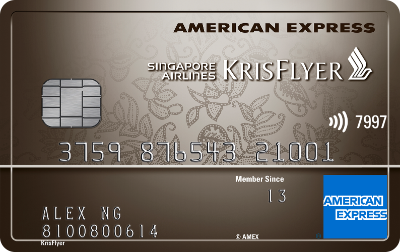 AMEX KrisFlyer Ascend AMEX KrisFlyer AscendApply Review |
S$30,000 | S$397.85 |
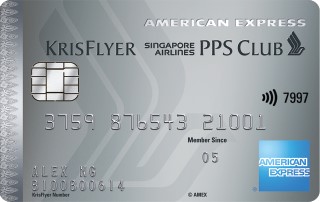 AMEX PPS Card AMEX PPS CardApply Review |
S$30,000 | S$561.35 (FYF) |
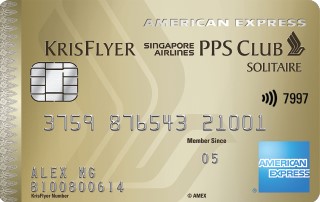 AMEX Solitaire PPS Card AMEX Solitaire PPS CardApply Review |
S$30,000 | S$561.35 (FYF) |
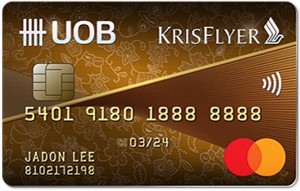 KrisFlyer UOB Credit Card KrisFlyer UOB Credit CardApply Review |
S$30,000 | S$196.20 (FYF) |
 KrisFlyer UOB Debit Card KrisFlyer UOB Debit CardApply Review |
None | S$54.50 (FYF) |
In practice, however, it’s more like four, because the AMEX Solitaire PPS Card and AMEX PPS Card are only available to Solitaire PPS and PPS Club members respectively (don’t worry, you’re not missing out on anything great!) and the AMEX HighFlyer Card is intended for SMEs with an ACRA registration number.
Do note that you’re limited to holding only one AMEX Singapore Airlines cobrand card at a time. For example, if you have the AMEX KrisFlyer Credit Card and apply for an AMEX KrisFlyer Ascend, the former will be automatically cancelled upon approval of the latter (this rule does not apply to the AMEX HighFlyer Card, since it is a business card).
However, you can hold both the KrisFlyer UOB Credit Card and Debit Card if you wish. Mind you, the latter requires the opening of a KrisFlyer UOB Account, which offers miles instead of interest. Take it from me: this is a crappy deal, and if you’re willing to swap interest for miles, use the UOB Lady’s Savings Account instead.
What’s the difference between a cobrand and non-cobrand card?
The table below summarises the key differences between cobrand and non-cobrand cards.
| Cobrand | Non-cobrand | |
| Earn Rates | Up to 3 mpd | Up to 4 mpd |
| Transfer Fees | Free | Free to S$25 |
| Transfer Speed | Automatic transfers once a month | From instant to a few days |
| Expiry | 3 years from SIA | >1 year from bank + 3 years from SIA |
| Choice of Frequent Flyer Programme | Single | Multiple |
| SIA Privileges | Yes | No |
Earn rates
As I mentioned earlier, a common misconception is that cobrand cards offer the best earn rates because of their direct relationship with Singapore Airlines.
Unfortunately, that’s just not true.
| Card | General Spend | Bonus Spend |
| AMEX HighFlyer Card |
1.2 mpd | 2 mpd on SIA, Scoot, KrisShop |
| AMEX KrisFlyer Credit Card |
1.1 mpd | 2 mpd on SIA, Scoot, KrisShop |
| AMEX KrisFlyer Ascend |
1.2 mpd | 2 mpd on SIA, Scoot, KrisShop |
| AMEX PPS Card |
1.3 mpd | 2 mpd on SIA, Scoot, KrisShop |
| AMEX Solitaire PPS Card |
1.3 mpd | 2 mpd on SIA, Scoot, KrisShop |
| KrisFlyer UOB Credit Card |
1.2 mpd |
|
The AMEX Singapore Airlines Cards offer embarrassingly poor earn rates. Outside of their welcome bonuses and occasional AMEX Offers, there is little reason to use them for day-to-day spending.
The KrisFlyer UOB Credit Card does better, with an uncapped 3 mpd on Singapore Airlines, Scoot, KrisShop, Kris+ and Pelago, and an uncapped 2.4 mpd on dining, food delivery, online shopping and travel, and transport (reduced from 3 mpd in June 2025). But even then, it would only be used as a backup option, after the caps on higher-earning cards are exhausted.
Non-cobrand cards are simply superior when it comes to earning miles. The following four cards alone would earn 4 mpd on the vast majority of day-to-day spend, without the need to memorise specific categories.
| Card | Earn Rate | Remarks |
 UOB Preferred Platinum Visa UOB Preferred Platinum VisaApply |
4 mpd | On mobile payments, max S$600 per c. month Review |
 UOB Visa Signature UOB Visa Signature Apply |
4 mpd | On contactless payments, min. S$1K, max S$1.2K per s. month Review |
 Citi Rewards Card Citi Rewards CardApply |
4 mpd | On online spend except travel, max S$1K per s. month Review |
 DBS Woman’s World Card DBS Woman’s World CardApply |
4 mpd | On online spend, max S$1K per c. month Review |
That’s not to mention other 4 mpd cards like the HSBC Revolution, Maybank XL Rewards Card, OCBC Rewards Card and UOB Lady’s Card, all of which should be prioritised for spending ahead of any cobrand card.
Transfer fees and speed
When you spend with a cobrand card, the miles earned are automatically batched and credited to your KrisFlyer account once a month, with no transfer fees. This means that your miles are always standing by, ready to be deployed at a moment’s notice.

When you spend with a non-cobrand card, you don’t earn miles per se. Instead, you earn bank points (e.g. Citi Miles, UNI$), which can be converted into miles on demand. This usually — but not always — involves a fee.
| Issuer | Conversion Fee | Conversion Speed |
 |
Free | Instant |
 |
S$30 | 1-2 weeks |
 |
S$27.251 | 1-2 working days |
 |
S$27.252 | 1-2 working days |
 |
Free | Instant |
 |
S$27.25 | 1-2 working days |
 |
S$25 | Next day |
 |
S$27.25 | 1-3 working days |
 |
S$253 | 1-2 working days |
| 1. Waived for Citi ULTIMA Cardholders 2. Waived for DBS Insignia Cardholders 3. Waived for UOB Reserve, UOB Visa Infinite Metal, UOB Visa Infinite and UOB Privilege Banking Cardholders |
||
Also, with the exception of American Express and HSBC, conversions are not instant. If the award seats you’re looking for suddenly pop up, you may face a nerve-wracking wait for the miles to come through.
Expiry
While cobrand cards make things convenient with automatic transfers, the trade-off is that the three-year expiry countdown for KrisFlyer miles starts immediately. Depending on how fast you accumulate miles and how often you redeem them, this may or may not be a problem.
On the other hand, if you’re using a non-cobrand card, you effectively get “two layers” of validity: one from the bank and another from KrisFlyer. Since bank points are typically valid for at least a year, you’ll enjoy a minimum of four years in total. In fact, some bank points don’t expire at all!
| 💸 Points Expiry Policy |
||
| Bank | Currency | Expiry |
|
Membership Rewards | No expiry |
|
Rewards Points | 12-24 months |
 |
Citi Miles | No expiry |
| ThankYou Points | Up to 5 years1 | |
|
DBS Points | 1 year2 |
|
Rewards Points | 37 months |
|
TREATS | 12-15 months |
|
OCBC$ | 2 years |
| 90°N Miles | No expiry | |
| VOYAGE Miles | No expiry | |
|
360° Rewards Points | Up to 3 years4 |
|
UNI$ | 2 years |
| 1. ThankYou Points earned on the Citi Prestige Card and Citi ULTIMA Card do not expire 2. DBS Points earned on the DBS Altitude Card, DBS Insignia Card and DBS Treasures AMEX do not expire; DBS Points earned on the DBS Vantage Card are valid for three years 3. TREATS Points earned by Rewards Infinite members do not expire 4. 360° Rewards Points earned by StanChart Beyond Card, StanChart Journey Card, StanChart Visa Infinite and StanChart Priority Visa Infinite do not expire |
||
But just because your points don’t expire shouldn’t be a reason to hold on to them indefinitely. Devaluations can and do happen, and the longer you wait to use your points, the greater the risk.
Mileage programme choices
At the risk of stating the obvious, Singapore Airlines cobrand cards limit you to earning miles with — you guessed it — Singapore Airlines.
Non-cobrand cards open up many more possibilities, especially if you’re earning points with American Express, Citi and HSBC. Why is this important? Because of sweet spots.
For example, suppose I want to fly from Singapore to Bangkok in Business Class on Singapore Airlines. I could redeem this flight through:
| Programme | Miles Required (one-way Business Class) |
| Air Canada Aeroplan | 20,000 miles |
| THAI | 20,000 miles |
| KrisFlyer | 24,000 miles |
| EVA Air | 27,500 miles |
| United MileagePlus | 45,000 miles |
| Turkish Miles&Smiles | 50,000 miles |
Note how the cost ranges from 20,000 to 50,000 miles, though you get exactly the same flight either way. To the extent that your credit card points can be converted at the same ratio to all programmes, of course you’d pick the one with the lowest redemption costs!
Singapore Airlines privileges
One unique feature that cobrand cards can offer are Singapore Airlines benefits, such as fast-tracks to KrisFlyer Elite Gold or Silver (no PPS fast-track, sorry!)
| Card | Singapore Airlines Benefits |
| AMEX HighFlyer Card |
|
| AMEX KrisFlyer Credit Card |
|
| AMEX KrisFlyer Ascend |
|
| AMEX PPS Card |
|
| AMEX Solitaire PPS Card |
|
| KrisFlyer UOB Credit Card |
|
| KrisFlyer UOB Debit Card |
Unfortunately, very few of these are “passive benefits”. The majority are unlocked through spending, and given the relatively weaker earn rates, the foregone miles are likely to outweigh the value of the benefits earned.
For example, AMEX Solitaire PPS or PPS Cardholders who spend at least S$75,000 on any retail transactions from 1 July to 30 June each year of membership will receive a 50% off KrisFlyer miles redemption voucher. This reduces the cost of an award booking by 50%, capped at 50,000 miles.
However, spending S$75,000 on a 1.3 mpd card entails a lot of opportunity cost. Assuming this could have been put on 4 mpd cards instead (and at S$6,250 per month, it’s not beyond the realm of possibility), you’re forgoing more than 200,000 miles!
So I’m lukewarm at best about this, and come to think of it, the Scoot benefits might be better than the Singapore Airlines ones!
Conclusion
If you’re serious about earning KrisFlyer miles quickly, non-cobrand cards will almost always give you a faster earn rate, greater flexibility, and longer validity for your miles. Cobrand cards, on the other hand, offer simplicity, automatic transfers, and a few airline-specific perks — but these seldom outweigh the miles you’d be giving up.
The ideal strategy might be to use non-cobrand cards for the bulk of your everyday spending, and keep a cobrand card handy just in case you value its unique benefits (or, in the case of the KrisFlyer UOB Credit Card, need something with an uncapped earn rate).

UOB KF Debit earns miles on spend too. Transferred free to Krisflyer at month end. When used with FX conversion this is a low cost way to earn miles on foreign spend.
and there’s also a relatively low amount of interest in savings every month