
While I’m sure business cards have their uses, earning rewards is not one of them. Most business cards (also known as commercial or corporate cards) are absolutely rubbish when it comes to rewards, which really boils down to demand and supply.
Companies rarely choose business cards on the basis of rewards. Their priorities are internal controls, real-time expense visibility, integration with accounting systems, and streamlined administration. Put it another way— they’re far more concerned that employees aren’t charging gentleman’s clubs to the corporate coffers, rather than how many miles they’re racking up!
Banks also know that business expenses tend to be non-discretionary, and several magnitudes higher than personal spending. Therefore, they’re not as inclined to reward them as generously as they would a personal card.
All this means that business credit cards are extremely lacklustre from a rewards point of view. If you thought that 1.2/2 mpd on local/FCY spend for a general spending card was mediocre, well, that’s the kind of thing business card users can only dream of!
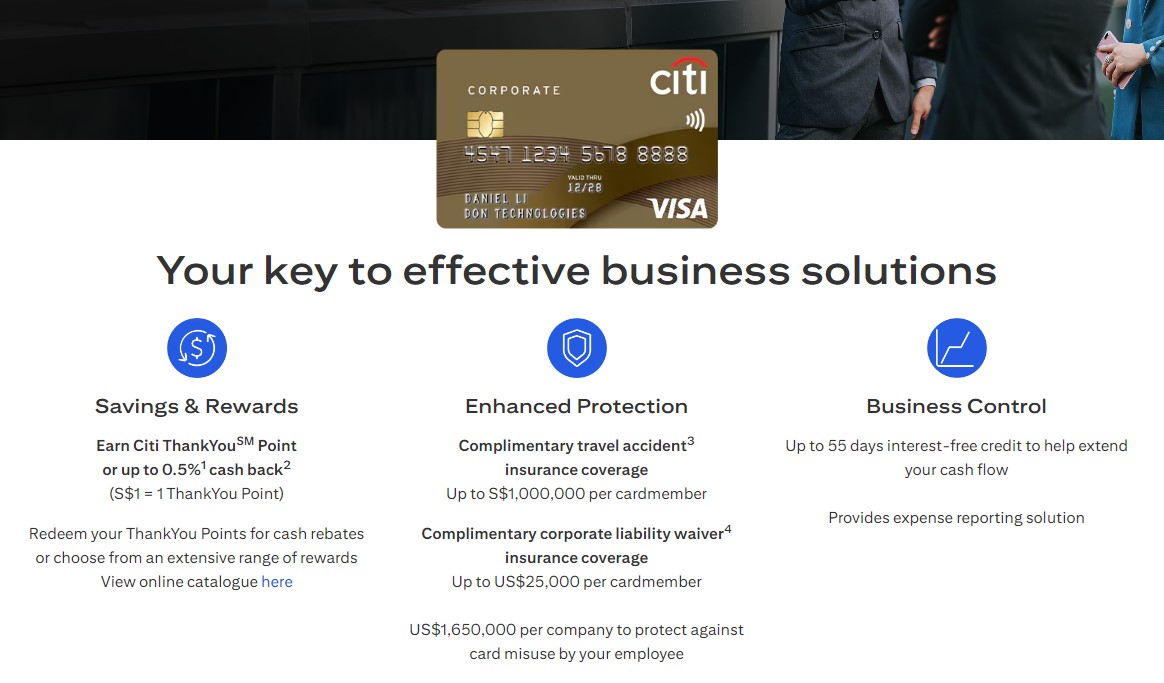
So if you’re running your own business, or fortunate enough to work for a company that isn’t fussy about how you charge expenses, you might be tempted to spend on personal cards instead and take advantage of their superior sign-up bonuses and earn rates. Is that something you can do?
Yes and no.
You technically can’t use personal cards for business expenses…
Strictly speaking, personal cards aren’t supposed to be used for business expenses. There is meant to be a church and state separation between individual and business expenses, because a company is a separate legal entity.
This implies that there’s also a risk involved in charging business expenses to a personal card. If you’ve incorporated a company and charge expenses to a business credit card issued in its name, those debts are the debts of the company. Should the worst happen, the creditors can only lay claim to the assets of the company, and not you as an individual (assuming everything has been conducted above board).
However, the moment you charge those expenses to a personal card, the liability shifts to you instead of the company. This means that creditors can come after your personal assets should you fail to make payment.
| ❓ What if you’re a sole proprietorship? |
|
If you’re running a sole proprietorship, there is by definition no distinction between your expenses and those of your business. However, the bank may still expect you to register for a business credit card nonetheless (sole proprietorships can be registered with ACRA, so you’d have the UEN needed to open one), since the argument is that your expenditure is still non-personal in nature. |
That said, banks are well aware that the line often gets blurred in practice — and the lure of generous rewards with personal cards can be hard to resist — which is why some explicitly exclude business-related transactions from earning rewards in their terms and conditions.
For example:
HSBC
 |
|
|
6. Where any charge posted to a Card account is reversed or is found to be (in HSBC’s opinion) in respect of or related to a corporate or business transaction (whether in whole or in part), the Points awarded in respect of such transaction will be cancelled (“Cancelled Points”). In the event that the Cancelled Points have been redeemed, HSBC reserves the right to charge the equivalent cash value of the redemption to the Card account. The cash value of each Point shall be equivalent to the dollar amount required to redeem such Point under the Pay with Points |
Maybank
 |
|
|
2.2 Transactions charged to a Card which will not be eligible for the awarding of TREATS Points |
UOB
 |
|
|
12. Should UOB deem a Cardmember’s spending to be for commercial, non-personal purposes, purposes prohibited by law, or purposes excluded by UOB from time to time, or if it deems that such UNI$ was not earned from qualifying spend of a Cardmember, UOB reserves the right to refuse to award any UNI$ for such transactions, and to cancel and void any UNI$ awarded at any time. Cardmembers shall not be entitled to any compensation or payment whatsoever for UNI$ not awarded or subsequently cancelled/voided. |
Even where banks do not address the matter explicitly, you’ll notice that they tend to use the term “retail spend” when talking about awarding points. If push comes to shove, they can use that term to justify their decision to exclude certain transactions, because “retail” doesn’t encompass B2B spending.
…but enforcement is tricky

While banks would prefer that you not use your personal card for business expenses, in practice it can be hard to distinguish.
If your card shows a restaurant charge, is that a business lunch, or are you on a date? If your card shows a supermarket charge, are you restocking the office pantry, or are those your personal groceries? If your card shows an air ticket purchase, are you going on a business trip, or a holiday?
It’s not always possible to tell, and banks simply don’t have the time or resources to investigate every case. But there are some obvious red flags.
B2B MCCs
There are MCCs specifically related to B2B spending, which ordinary consumers are unlikely to encounter in the regular course of life.
- MCC 1731: Electrical Contractors
- MCC 1750: Carpentry Contractors
- MCC 5039: Construction Materials Not Elsewhere Classified
- MCC 5046: Commercial Equipment Not Elsewhere Classified
- MCC 5051: Metal Service Centre and Offices
- MCC 5065: Electrical Parts and Equipment
- MCC 5074: Plumbing and Heating Equipment
- MCC 5085: Industrial Supplies Not Elsewhere Classified
- MCC 7311: Advertising Services
- MCC 7339: Stenographic and Secretarial Support Services
Other examples include services like Mailchimp, Shopify, Squarespace and Facebook ads.
The list above isn’t exhaustive, and of course there could be perfectly innocuous reasons why a bona fide consumer has such charges on their card, but that’s generally the first line of monitoring for banks.
If you ask me, I’d say that “dual-use” situations are quite safe— any kind of expenditure that could plausibly have a consumer purpose, like mobile phone subscriptions, office supplies or computer equipment (though perhaps not a five-digit server refit).
Recurring transactions
Another indicator that banks would look at in determining whether a transaction is commercial in nature is whether it recurs with any regularity.
If there’s a fixed charge to a B2B MCC like AWS or Facebook ads that happens each month, you can bet that will send up some flares.
Quantum
And of course, there’s quantum. If your spending is modest, it’s highly unlikely the bank will give it a second look. If you’re spending very large amounts, however, then it’s a different situation.
It’s impossible to say precisely what threshold will trigger attention, but common sense will tell you that some things are playing with fire. I have a friend who runs a talent agency, and regularly used her UOB PRVI Miles Card to pay overseas influencers via PayPal. These payments would run into the six digits each month, and after a few months, UOB shut down her account. I’ve also read online accounts of people charging five-digit AWS or Google Adwords expenses to their cards, and landing in similar trouble.
Are there any decent business cards out there?
If circumstances force you to use a business card, then it’s a simple matter of choosing the “least worst” option.
If we’re talking about miles, then these are the two highest-earning options I’ve found.
AMEX HighFlyer Card
 AMEX HighFlyer Card AMEX HighFlyer CardApply |
|
| Min. Income | S$30,000 p.a. |
| Annual Fee | S$400 |
| Earn Rates |
|
| Other Benefits |
|
Once upon a time, the AMEX HighFlyer Card was a ridiculously good deal. The first year’s annual fee was waived, you got a free Accor Plus Explorer membership (with 50% off dining and one free hotel night), and it earned points on almost everything— even GrabPay top-ups! There was a period where AXS accepted GrabPay, so this was basically an opportunity to earn free miles on anything that could be paid through AXS (who needs CardUp?).
Sadly, that couldn’t last forever, and nowadays the HighFlyer Card is a lot more mediocre. Cardholders earn 2 mpd on Singapore Airlines, Scoot and KrisShop, and 1.2 mpd everywhere else. They also receive a complimentary ALL Accor+ Explorer membership, but I don’t think there’s enough here to justify the S$400 annual fee— except perhaps in the first year, where the welcome bonus provides further value.
DBS World Business Card
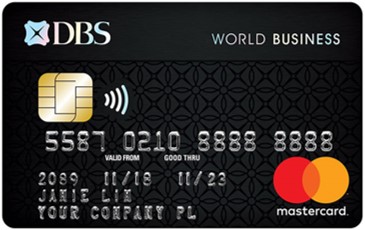 DBS World Business Card DBS World Business CardApply |
|
| Min. Income | S$80,000 p.a. |
| Annual Fee | S$414.20 (FYF) |
| Earn Rates |
|
| Other Benefits |
|
The DBS World Business Card may not be an option for everyone, since it has a minimum income of S$80,000 p.a. (though whether DBS strictly enforces it is another matter altogether).
Assuming you’re approved, however, you’ll enjoy a waiver of its S$414.20 annual fee for the first year, together with 10x Priority Pass visits and a 1GB FlexiRoam data plan. Those are actually pretty solid benefits, even compared with consumer cards.
As for earn rates, you’ll earn 2 mpd on FCY spending, 1 mpd on local dining, entertainment and travel, and 0.3 mpd everywhere else.
Other options
If you’re running a business, you could very well have more pressing concerns than earning miles.
In that case, you might want to explore the business cards below, which offer upfront savings through cashback or, in the case of the CIMB Founders Card, an extended interest-free credit line.
| Card Annual Fee |
Key Features |
 S$338 |
|
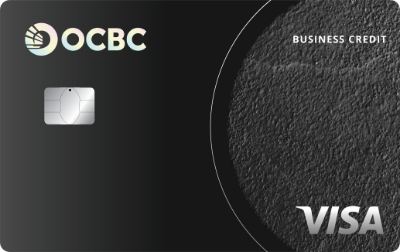 OCBC Business Credit Card OCBC Business Credit CardS$196.20 |
|
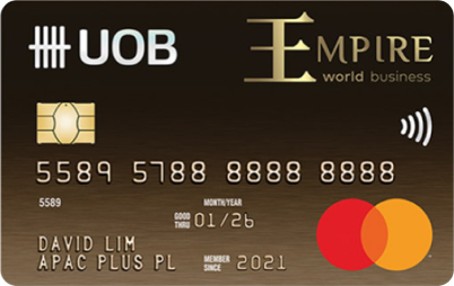 UOB Empire World Business Mastercard UOB Empire World Business MastercardS$387.10 (FYF) |
|
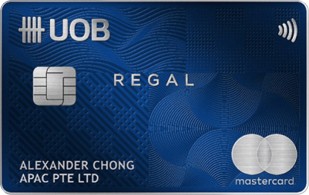 UOB Regal Business Metal Card UOB Regal Business Metal CardS$692.71 |
|
Alternatively, if you don’t mind forgoing the interest-free credit line that credit cards offer, you might consider a multi-currency debit card like Airwallex or YouBiz, which offer lower fees on FCY spending.
Conclusion
There’s no law that says you can’t use your personal card for business expenses, but it comes with a few risks.
First, you assume personal liability for any unpaid expenses, unlike with a business credit card where those debts are owed by the company. Second, your rewards might be clawed back if the bank decides to investigate your spending, and deems it business-related rather than personal.
That said, I’m sure there are plenty of SME owners who put large amounts of business spending on their personal card, and earn plenty of miles in the process. This is more plausible if you’re spending on things that aren’t explicitly business-related, and if your spending volumes aren’t excessive (though again, what counts as excessive is very open to interpretation!) .
It’s a fine line really, but given how terrible business cards rewards tend to be, I can’t really blame them for wanting to.




Never trust uob and your example is correct
what’s TPS report?
Quote from movie
i am very sad how many people don’t know office space.
It’s not just the absolute amount but your history as well.
Eg. If you are a high roller, spending 5-6 digits on say petrol or flights may not trigger any scrutiny if that’s just a certain percentage of your income. These supercars might burn $100 monthly just warming up and running the AC.