
Here’s The MileLion’s review of the Chocolate Visa Card, which upended the miles game when it teamed up with HeyMax to offer 2 Max Miles per S$1 on virtually everything — even charitable donations, education, hospitals, insurance premiums, utilities, and AXS payments.
Naturally, that didn’t last very long, as people started doing…shall we say, creative things with their cards. Chocolate quickly yanked support for AXS — not exactly their finest moment — and eventually nerfed the earn rates, while adding caps on certain categories that amounted to de facto exclusions.
But it’s now undergone a mini-renaissance of sorts. From September 2026, cardholders can earn 1 Max Mile per S$1 on the first S$2,000 per month (up from S$1,000), and earn up to 300 Max Miles per month on bill payments (up from 100 Max Miles).
It won’t be your daily driver, that’s for sure, but the Chocolate Visa Card could be useful for charitable donations, education and overseas spend — though that last use case is potentially undermined by the recent introduction of the Trust Freedom Card.
 |
|
| Chocolate Visa Card |
|
| 🦁 MileLion Verdict | |
| ☐ Take It ☑ Take It Or Leave It ☐ Leave It |
|
| What do these ratings mean? | |
| The Chocolate Visa Card’s improved caps and lack of FCY fees make it a useful option — but the Trust Freedom Card poses a serious threat. | |
| 👍 The Good | 👎 The Bad |
|
|
Overview: Chocolate Visa Card
|
|||
| Apply | |||
| Open a Chocolate Finance account via SingSaver and get up to S$120 cash or S$130 Grab vouchers. T&Cs apply. |
|||
| Income Req. | N/A | Points Validity | No expiry |
| Annual Fee | None | Min. Transfer |
1,000 miles |
| Miles with Annual Fee |
None | Transfer Partners |
1 (Max Miles, which in turn has 20+ partners) |
| FCY Fee | None | Transfer Fee | None |
| Local Earn | 1 mpd on first S$2K, 0.4 mpd after | Points Pool? | N/A |
| FCY Earn | Lounge Access? | N/A | |
| Special Earn | N/A | Airport Limo? | N/A |
| Cardholder Terms and Conditions | |||
The Chocolate Visa Card is the companion card of the Chocolate Account, so you will need to open an account before you can get a card.
At the time of writing, balances in Chocolate earn up to 2% p.a. for SGD and 4.1% p.a. for USD.
| Chocolate Finance Returns 🇸🇬 SGD |
||
| Amount | Return | Remarks |
| First S$20K | 2% p.a. | Guaranteed |
| Next S$80K | 1.8% p.a. | Guaranteed |
| Above S$100K | Up to 1.8% p.a. | Non-guaranteed |
| Chocolate Finance Returns 🇺🇸 USD |
||
| Amount | Return | Remarks |
| First US$20K | 4.1% p.a. | Guaranteed |
| Next US$80K | 3.8% p.a. | Guaranteed |
| Above US$100K | Up to 3.8% p.a. | Non-guaranteed |
You’ll have to decide for yourself whether these rates are attractive enough, especially since it’s no longer possible to use the Chocolate Visa Card as a passthrough, i.e. only topping up funds before spending and otherwise keeping nothing inside.
That’s because of a new requirement that customers must maintain an ADB of at least S$5,000 in their Chocolate Finance account in the previous month before they can earn any Max Miles (more on this below).
The other important thing to know about the Chocolate Visa Card is that it’s a debit card, not a credit card.
You should therefore take additional precautions, because any fraudulent transactions will be immediately debited from your account balance (compared to a credit card where the bill is only due later, giving you time to spot and report the transaction).
There is a proper fraud reporting process to get such transactions reversed from your account, but you’ll be out of pocket during the investigation period. Mind you, these concerns aren’t unique to the Chocolate Visa; it’s the same for any debit card.
So even though the experts advise against freezing Chocolate, you’re going to want to do exactly that whenever it’s not in use. This can be done easily via the app with a few taps.
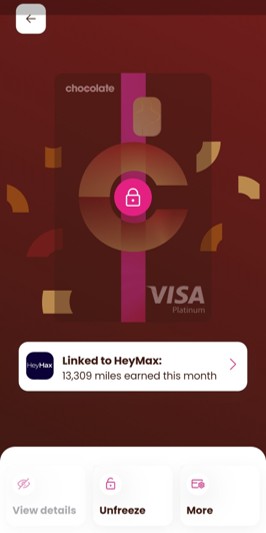
Also, you should not use the Chocolate Visa Card for security deposits at hotels or when renting a car. Debit cards do not support authorisation holds, so any amounts are immediately deducted from your balance. These amounts will be refunded after check-out or dropping off the car, but you may suffer losses due to FX movements, and you won’t earn interest on those funds in the meantime.
How much must I earn to qualify for a Chocolate Visa Card?
The Chocolate Visa Card has no minimum income requirement.
How much is the Chocolate Visa Card’s annual fee?
The Chocolate Visa Card has no annual fee.
Link your card before spending!
 |
| Get 200 Max Miles when you open an account and complete your first transaction |
| Get a HeyMax Account |
Before you spend a single dollar on your Chocolate Visa Card, you’ll need to create a HeyMax account and pair the Chocolate Visa Card via the HeyMax website (Profile > My Cards) or app (Card icon on home page > + button).
A test transaction of S$0.01 will be charged and refunded. Each Chocolate Visa Card can only be linked to a single HeyMax account, and vice versa.

You will not earn any Max Miles for spending done before linking your card, so don’t forget to do this!
Minimum balance requirement
From 1 October 2026, customers must maintain a minimum ADB of S$5,000 in SGD (ADB in USD doesn’t count) to earn any Max Miles.
Eligibility is determined by the previous month’s ADB. For example, your September ADB determines whether you can earn Max Miles in October.
There is a transitional arrangement in place, such that all customers will be able to earn Max Miles in September 2026 regardless of their ADB in August 2026.
How many miles do I earn?
| 🇸🇬 SGD Spend | 🌎 FCY Spend | ⭐ Bonus Spend |
| 1 mpd on first S$2K, 0.4 mpd after | N/A | |
The Chocolate Visa Card earns:
- First S$2,000 per calendar month: 1 Max Mile per S$1
- Above S$2,000 per calendar month: 0.4 Max Miles per S$1
There is no cap on the miles that can be earned, though obviously the earn rate is a lot less lucrative after the first S$2,000.
However, do note that there is a spending limit of S$1,000 per transaction and S$20,000 per day on the Chocolate Visa Card.
While I understand the need for backstops in case of fraud, I find it a little odd that users don’t have the option of adjusting the limits themselves. I mean, this is the first case I can think of where a debit card restricts how much of your own money you can spend.
Cap on miles for bill payments
Cardholders are capped at earning a maximum of 300 Max Miles per calendar month from so-called “bill payments”.
Bill payments are defined as transactions with the following MCCs (for the avoidance of doubt, the 300 Max Miles cap is shared among all categories).
| MCC | Category |
| MCC 4900–4999 |
Utilities |
| MCC 6300–6399 |
Insurance |
| MCC 6513, 6531 |
Real Estate and Property Management |
| MCC 7311–7399 |
Business Services |
| MCC 8011–8099 |
Medical Services, Health Practitioners, Hospitals, Dentists |
| MCC 9311–9399 |
Government Services |
This basically works like a de facto exclusions list, and one annoying thing is that MCC 7399 is included. While this is used by CardUp, it’s also used by a lot of merchants which aren’t remotely connected to bill payments.
For example, Points.com transactions code as MCC 7399, which means that you’re capped at 300 Max Miles when buying miles or points from Aeroplan, Alaska, Flying Blue, GHA, Hilton, IHG, Marriott, Qatar Airways, United and any other airline or hotel which uses the platform.
MCC 7399 can also pop up in unexpected places, like when you’re making cash + points bookings with IHG, or even Shopee.
Because of this, if there’s even a shadow of a doubt about the MCC, you should make a point of looking it up before swiping the Chocolate Visa Card.
| Method | Ease of Use | Reliability |
| ❓HeyMax | ●●● | ● |
| 📱Instarem app | ●● | ●● |
| 🤖DBS digibot | ● |
●●● |
| “Ease of use” and “reliability” are all relative. HeyMax already provides a solid baseline for reliability, and the DBS digibot is still simple enough to use, despite requiring more steps than the other two methods. | ||
Charitable donations and education are not defined as bill payments, and therefore are not subject to the 300 Max Miles cap.
| ❤️ Local donations only! |
| The Chocolate Visa Card can only be used for local charitable giving. Donations to overseas charitable entities are blocked. |
What is the FCY fee?
One big advantage of the Chocolate Visa Card is that it has no FCY transaction fees.
| 💳 FCY Fees by Issuer and Card Network |
||
| Issuer | ↓ MC & Visa | AMEX |
| Standard Chartered | 3.5% | N/A |
| American Express | N/A | 3.25% |
| Citibank | 3.25% | N/A |
| DBS | 3.25% 0% for Chromo |
3.25% |
| HSBC | 3.25% | N/A |
| Maybank | 3.25% | N/A |
| OCBC | 3.25% | N/A |
| UOB | 3.25% 0% for EVOL/Singtel-UOB |
3.25% |
| BOC | 3% | N/A |
| CIMB | 3% | N/A |
| ICBC | 2.5% | N/A |
| Chocolate | 0% | N/A |
| GXS Bank | 0% | N/A |
| MariBank | 0% | N/A |
| Trust | 0% | N/A |
FCY transactions will be converted into SGD at the prevailing Visa rate, with no further markup. You can use the official Visa calculator here to check how much you’ll pay (set the bank fee at 0%).
This means that one of the best uses for the Chocolate Visa Card is for overseas spending.
|
 |
|
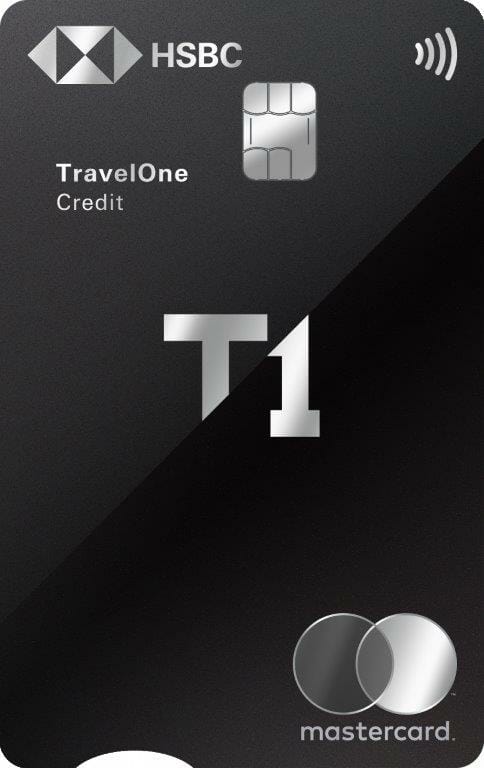
| Chocolate Visa Card | HSBC TravelOne Card | |
| FCY Earn Rate | 1 mpd | 2.4 mpd |
| FCY Transaction Fee | 0% | 3.25% |
For example, if your alternative option is a general spending card like the HSBC TravelOne Card, then spending on the Chocolate Visa Card makes more sense — at least for the first S$2,000 per month — because paying a 3.25% fee to earn an extra 1.4 mpd means buying miles at 2.32 cents each, way above what you should be paying.
However, if your alternative option is a specialised spending card like the UOB Visa Signature, then paying a 3.25% fee to earn an extra 3 mpd means 1.08 cents per mile. This is a lot more reasonable, making the Chocolate Visa Card the inferior option.
|
 |
|
| Chocolate Visa Card | UOB Visa Signature | |
| FCY Earn Rate | 1 mpd | 4 mpd |
| FCY Transaction Fee | 0% | 3.25% |
Moreover, the new Trust Freedom Card poses a serious challenge — which I’ll address later.
Transaction date or posting date?
The Chocolate Visa Card tracks spending based on the transaction date, not posting date.
For example, if you make a S$100 transaction on 31 July and it posts on 1 August, the S$100 spend will count against July’s spending cap.
When are Max Miles credited?
Max Miles are awarded once the transaction posts, which usually takes 1-3 days.
How are Max Miles calculated?
Here’s how you can work out the Max Miles earned on your Chocolate Visa Card.
| Local/FCY Spend | Multiply transaction by 1, then round up to 1 decimal place |
You must spend at least S$0.50 on a transaction to earn Max Miles, and Max Miles are awarded in minimum increments of 0.1. For example, a transaction of S$10.13 would earn 10.2 Max Miles.
If you’re an Excel geek, here are the formulas you need to calculate points:
| Local/FCY Spend | =ROUNDUP(X*1,1) |
| Where X= Amount Spent |
|
For the full list of formulas that banks use to calculate credit card points, do refer to these articles:
What transactions aren’t eligible for Max Miles?
Transactions with the following MCCs will be ineligible to earn Max Miles. These are mostly related to money transfers and prepaid account top-ups, like GrabPay and YouTrip.
| ❌ Excluded Transactions | |
| MCC | Merchant Category Name |
| 4829 | Money Transfer |
| 6010 | Financial Institutions – Manual Cash Disbursements |
| 6011 | Financial Institutions – Automated Cash Disbursements |
| 6012 | Financial Institutions – Merchandise, Services and Debt Repayment |
| 6050 | Quasi Cash – Financial Institutions, Merchandise, Services |
| 6051 | Non-Financial Institutions – Foreign Currency, Money Orders (Not Wire Transfer), Stored Value Card/Load, Travelers Cheques, and Debt Repayment |
| 6529 | Quasi Cash – Remote Stored Value Load – Financial |
| 6530 | Quasi Cash – Remote Stored Value Load – Merchant |
| 6540 | Non-Financial Institutions – Stored Value Card |
| – | Wallet top-ups such as EZ-Link & SimplyGo wallet |
| – | Payments at AXS |
However, do remember that the monthly cap of 300 Max Miles on bill payments such as government services, hospitals, insurance premiums and utilities makes these effectively exclusions, once you’ve spent more than S$300.
What do I need to know about Max Miles?
| ❌ Expiry | ↔️ Pooling | ✈️ Transfer Fee |
| None | N/A | None |
| ⬆️ Min. Transfer | ✈️ No. of Partners | ⏱️ Transfer Time |
| 1,000 Max Miles | 23 | Mostly instant |
Expiry
Max Miles do not expire.
Pooling
All Max Miles earned on the Chocolate Visa Card will be credited directly to your HeyMax account, where they will pool with miles earned from all other sources.
Transfer Partners & Fees
Max Miles can be converted to more than 20 airline and hotel programmes. Most transfers are at a 1:1 ratio.
| ✅ HeyMax Transfer Partners All 1:1 unless otherwise stated |
|
| ✈️ Airlines | |
|
|
| 🏨 Hotels | |
|
|
You might see older articles on this website mentioning partners such as Air Canada Aeroplan, Emirates Skywards and World of Hyatt. These were available under the Cash For Miles programme, where HeyMax would issue a prepaid debit card for customers to purchase the miles/points directly from the programme itself. Unfortunately, Cash For Miles was retired on 1 June 2026.
Transfer Fee
All conversions are free of charge.
Transfer Blocks
A minimum transfer of 1,000 Max Miles is required. Subsequent conversions can be in blocks of 1 or 100 Max Miles, depending on programme.
Transfer Times
While HeyMax quotes one business day for transfers, you can usually expect them to be completed instantly.
The following programmes are exceptions:
- Air India Maharaja Club: 3 business days
- Cathay Pacific Asia Miles: 3 business days
- Philippine Airlines Mabuhay Miles: 5 business days
Other things to know
Here are a few more important things to know about the Chocolate Visa Card:
- You cannot withdraw money from ATMs using your Chocolate Visa Card
- The card can be digitised and added to Apple Pay, Google Pay or Samsung Pay
- The Chocolate Visa belongs to the Visa Platinum tier
Miles for Returns
 |
|||
| Apply | |||
| Open a Chocolate Finance account via SingSaver and get up to S$120 cash or S$130 Grab vouchers. T&Cs. |
This has nothing to do with the Chocolate Visa Card, strictly speaking, but it’s still worth mentioning that Chocolate Finance offers a feature called Miles for Returns.
This allows accountholders to convert their returns into Max Miles.
| Period | Rate | Cost Per Max Mile |
| 1 Sep to 30 Nov 2026 | 80 Max Miles per S$1 | 1.25¢ |
| 1 Dec 2026 onwards | 62.5 Max Miles per S$1 | 1.6¢ |
For example, if your returns for August 2026 are S$100, you can convert up to S$100 into 8,000 Max Miles in September 2026.
In my opinion, it’s a no-brainer to convert your returns, thanks to the HeyMax FlyAnywhere feature. This allows you to redeem Max Miles against the cost of a commercial or award flight booking at 1.8 cents each, as a direct deposit to your bank account.
The basic idea here is that you “buy” Max Miles at 1.25 cents each and redeem them at 1.8 cents each, earning the spread. For example:
- If you have a S$20,000 balance in Chocolate, your monthly returns are S$33.33 (2% of S$20,000 / 12 months)
- You can convert those returns into 2,666 Max Miles (S$33.33 x 80), which can be cashed out for S$48 via FlyAnywhere
- Earning S$48 monthly on S$20,000 is equivalent to a 2.88% return.
The table below compares the returns from cashing out Chocolate Finance returns in cash, versus Max Miles (based on an 80 Max Miles = S$1 ratio, available till 30 November 2026).
| One-Month Returns, Cash vs Max Miles |
||
| Amount | Returns (Cash) |
Returns (Max Miles) |
| First S$20,000 | S$33.33 2% |
S$48 2.88% |
| Next S$80,000 | S$120 1.8% |
S$172.80 2.59% |
I’ve written a detailed guide to FlyAnywhere, which can be found below.
HeyMax FlyAnywhere guide: Redeem Max Miles for any seat, any airline, anywhere
The problem of the Trust Freedom Card
It’s unfortunate to have to end this review on a downer note, but we have to address the elephant in the room: the Trust Freedom Card.
In September 2026, the Trust Freedom Card added Miles mode, which allows cardholders to earn 1.3 KrisFlyer miles or Max Miles per S$1 on local and overseas spending, with no minimum spend, cap, or FCY transaction fees.
|
 |
|
| Chocolate Visa Card | Trust Freedom Card | |
| Card Type | Debit | Credit |
| Min. Deposit to Earn Miles | S$5K ADB | None |
| Local & Overseas Spend | 1 mpd Cap S$2K p.m 0.4 mpd After |
1.3 mpd |
| Min. Spend to Earn Miles | S$0.50 | S$5 |
| Points Calculation | Multiply by 1/0.4 and round up to 1 d.p | Round down to S$5 before awarding miles |
| FCY Fee | None | None |
| Miles on Bill Payments | 300 miles per month | N/A |
| Miles for Education & Donations | Yes | N/A |
| Transfer Partners | Max Miles | Max Miles, KrisFlyer |
| Transfer Fee | None | S$27.25 |
As you can see, the Trust Freedom Card offers several advantages over the Chocolate Visa Card:
- You don’t need to park any funds with Trust to earn miles
- Earn rates are better, and uncapped
- You can earn KrisFlyer miles, in addition to Max Miles
- It’s a credit card, so you don’t need to “pre-fund” it before spending
However, the Chocolate Visa Card:
- Earns up to 300 Max Miles on bill payments each month
- Earns miles on charitable donations and education
- Does not have transfer fees to Max Miles
- Has a more favourable rounding policy
I wouldn’t put a lot of weight on the absence of transfer fees, since the higher earn rate of the Trust Freedom Card will eventually compensate for the S$27.25 transfer fee.
However, the rounding policy is the potential saviour. If you’re spending on smaller transactions that aren’t multiples of S$5, then you could potentially earn more miles with the Chocolate Visa Card than the Trust Freedom Card.
| Chocolate Visa 1 mpd |
Trust Freedom 1.3 mpd |
|
| S$4.99 | 5 miles ✅1 mpd |
0 miles N/A |
| S$5 | 5 miles 1 mpd |
6.5 miles ✅1.30 mpd |
| S$9.99 | 10 miles ✅1 mpd |
6.5 miles 0.65 mpd |
| S$10 | 10 miles 1 mpd |
13 miles ✅1.30 mpd |
| S$14.99 | 15 miles ✅1 mpd |
13 miles 0.87 mpd |
| S$15 | 15 miles 1 mpd |
19.5 miles ✅1.30 mpd |
| S$19.99 | 20 miles ✅1 mpd |
19.5 miles 0.98 mpd |
| S$20 | 20 miles 1 mpd |
26 miles ✅1.30 mpd |
| S$25 | 25 miles 1 mpd |
32.5 miles ✅1.30 mpd |
| Headline Earn Rate Actual Earn Rate | ||
tl;dr: it’s generally better to use the Chocolate Visa Card for transactions less than S$10. And for any spending S$20 or more, the Trust Freedom Card always wins.
Conclusion
|
|||
| Apply |
The Chocolate Visa Card has improved its earning caps and continues to offer zero FCY fees, but its recent rejuvenation threatens to be overshadowed by the launch of the Trust Freedom Card.
I wouldn’t go so far as to say that the Trust Freedom Card makes the Chocolate Visa Card obsolete. As we saw earlier, it has the upper hand for bill payments, education and donations. Also, the rounding policy makes it the better choice for spending below S$10.
What the Trust Freedom Card does, however, is to push Chocolate into a smaller and smaller box, relegating it to niche roles. You’ll have to decide for yourself if that justifies the minimum ADB required to earn miles with Chocolate.
Does Chocolate have anything else up its sleeve? We’ll have to see.

Hi Aaron! I can add chocolate card to my Apple Pay though
Oh- maybe they fixed that. One of their FAQs say it’s currently not possible.
I just tried. It is still not possible to add it to Apple Pay. I checked with the team recently and they said they are still in discussions with Apple Pay to have it added. Could it be that the person above has had the Choco card added to Apple Pay BEFORE the functionality was taken off? Currently I still cannot ADD the card to Apple Pay.
It works.
The freezing chocolate link was funny man. Well played